Attention Is All You Need
Ashish Vaswani
Google Brain
avaswani@google.com
Noam Shazeer
Google Brain
noam@google.com
Niki Parmar
Google Research
nikip@google.com
Jakob Uszkoreit
Google Research
usz@google.com
Llion Jones
Google Research
llion@google.com
Aidan N. Gomez
University of Toronto
aidan@cs.toronto.edu
Łukasz Kaiser
Google Brain
lukaszkaiser@google.com
Illia Polosukhin
illia.polosukhin@gmail.com
Abstract
The dominant sequence transduction models are based on complex recurrent or convolutional neural networks that include an encoder and a decoder. The best performing models also connect the encoder and decoder through an attention mechanism. We propose a new simple network architecture, the Transformer, based solely on attention mechanisms, dispensing with recurrence and convolutions entirely. Experiments on two machine translation tasks show these models to be superior in quality while being more parallelizable and requiring significantly less time to train. Our model achieves 28.4 BLEU on the WMT 2014 English-to-German translation task, improving over the existing best results, including ensembles, by over 2 BLEU. On the WMT 2014 English-to-French translation task, our model establishes a new single-model state-of-the-art BLEU score of 41.8 after training for 3.5 days on eight GPUs, a small fraction of the training costs of the best models from the literature. We show that the Transformer generalizes well to other tasks by applying it successfully to English constituency parsing both with large and limited training data.
1 Introduction
Recurrent neural networks, long short-term memory
Recurrent models typically factor computation along the symbol positions of the input and output sequences. Aligning the positions to steps in computation time, they generate a sequence of hidden states
Attention mechanisms have become an integral part of compelling sequence modeling and transduction models in various tasks, allowing modeling of dependencies without regard to their distance in the input or output sequences
In this work we propose the Transformer, a model architecture eschewing recurrence and instead relying entirely on an attention mechanism to draw global dependencies between input and output. The Transformer allows for significantly more parallelization and can reach a new state of the art in translation quality after being trained for as little as twelve hours on eight P100 GPUs.
2 Background
The goal of reducing sequential computation also forms the foundation of the Extended Neural GPU
Self-attention, sometimes called intra-attention is an attention mechanism relating different positions of a single sequence in order to compute a representation of the sequence. Self-attention has been used successfully in a variety of tasks including reading comprehension, abstractive summarization, textual entailment and learning task-independent sentence representations
End-to-end memory networks are based on a recurrent attention mechanism instead of sequence-aligned recurrence and have been shown to perform well on simple-language question answering and language modeling tasks
To the best of our knowledge, however, the Transformer is the first transduction model relying entirely on self-attention to compute representations of its input and output without using sequence-aligned RNNs or convolution. In the following sections, we will describe the Transformer, motivate self-attention and discuss its advantages over models such as
3 Model Architecture
Most competitive neural sequence transduction models have an encoder-decoder structure
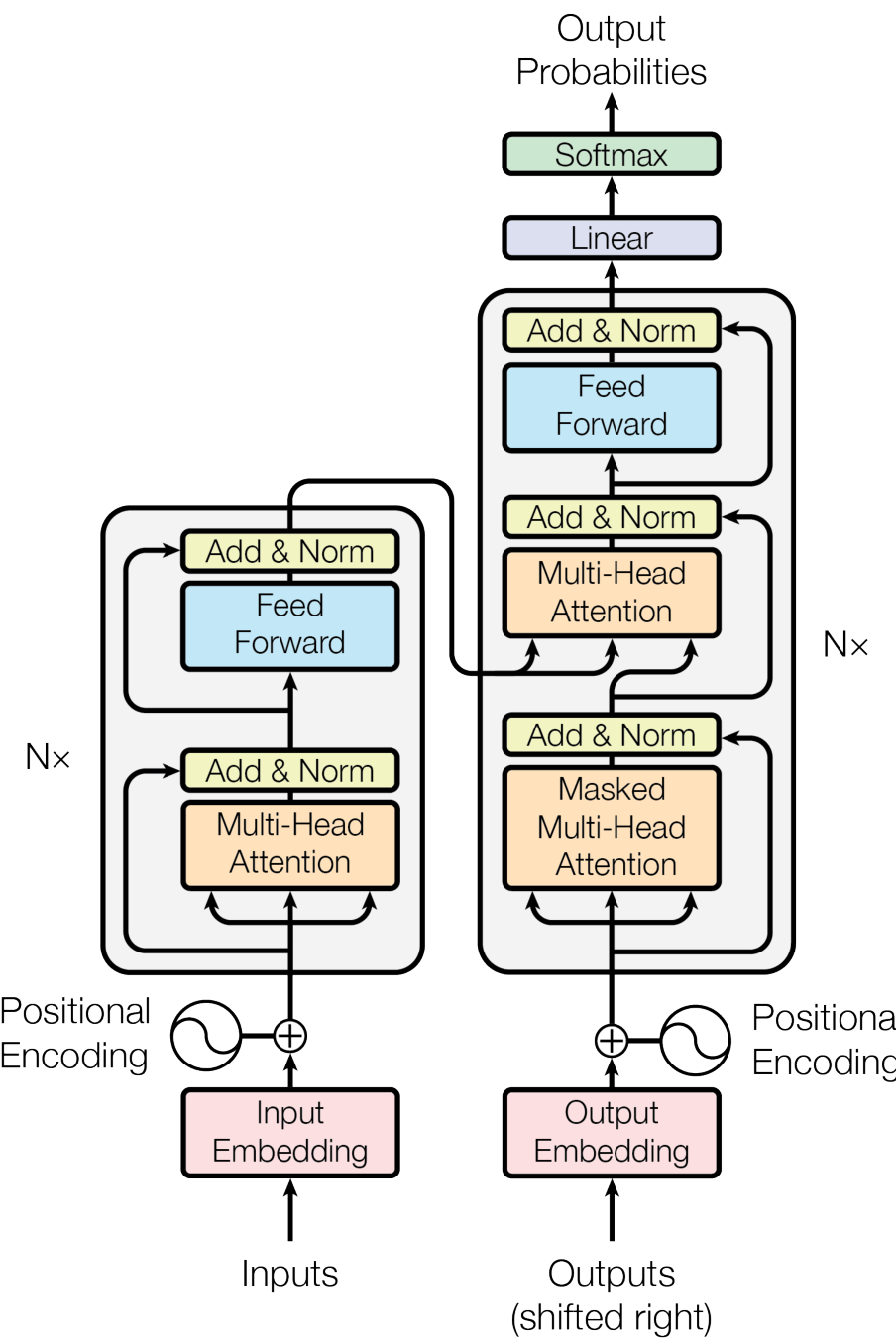
The Transformer follows this overall architecture using stacked self-attention and point-wise, fully connected layers for both the encoder and decoder, shown in the left and right halves of Figure 1, respectively.
3.1 Encoder and Decoder Stacks
Encoder: The encoder is composed of a stack of
Decoder: The decoder is also composed of a stack of
3.2 Attention
An attention function can be described as mapping a query and a set of key-value pairs to an output, where the query, keys, values, and output are all vectors. The output is computed as a weighted sum
of the values, where the weight assigned to each value is computed by a compatibility function of the query with the corresponding key.
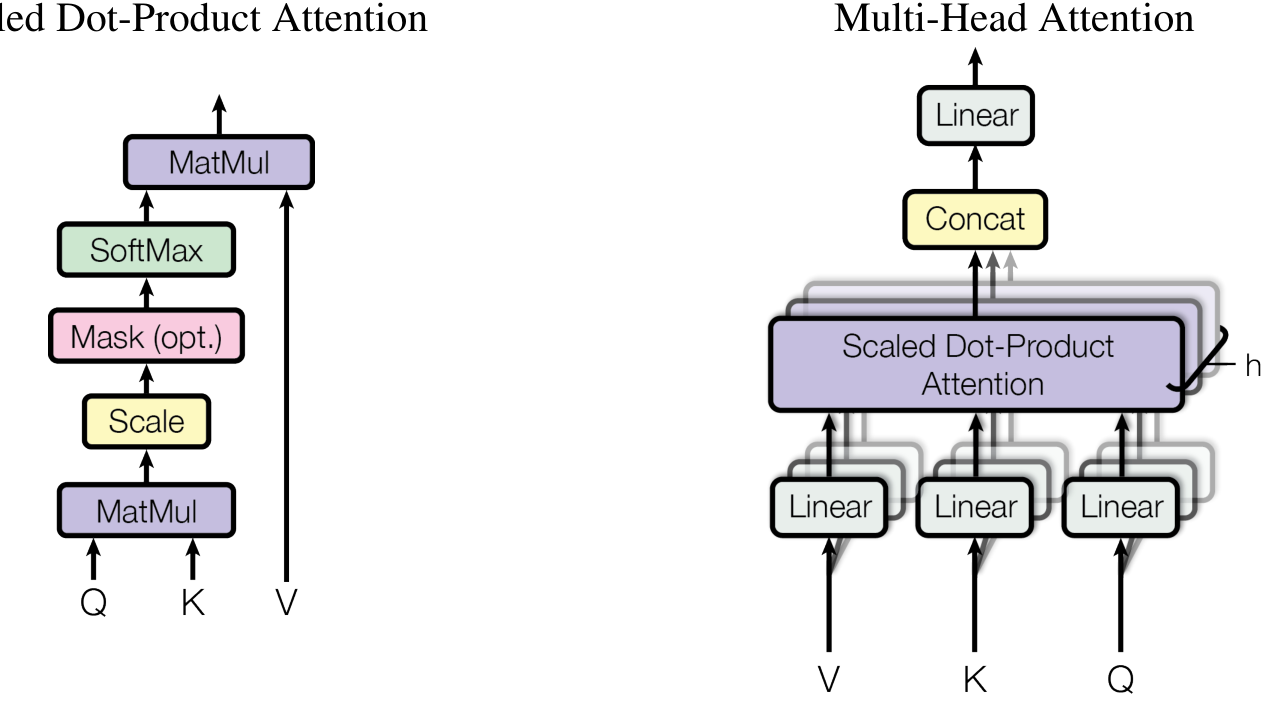
3.2.1 Scaled Dot-Product Attention
We call our particular attention “Scaled Dot-Product Attention” (Figure 2). The input consists of queries and keys of dimension
In practice, we compute the attention function on a set of queries simultaneously, packed together into a matrix
The two most commonly used attention functions are additive attention
While for small values of
3.2.2 Multi-Head Attention
Instead of performing a single attention function with -dimensional
output values. These are concatenated and once again projected, resulting in the final values, as depicted in Figure 2.
Multi-head attention allows the model to jointly attend to information from different representation subspaces at different positions. With a single attention head, averaging inhibits this.
Where the projections are parameter matrices
In this work we employ
3.2.3 Applications of Attention in our Model
The Transformer uses multi-head attention in three different ways:
- In “encoder-decoder attention” layers, the queries come from the previous decoder layer, and the memory keys and values come from the output of the encoder. This allows every position in the decoder to attend over all positions in the input sequence. This mimics the typical encoder-decoder attention mechanisms in sequence-to-sequence models such as
[38, 2, 9] . - The encoder contains self-attention layers. In a self-attention layer all of the keys, values and queries come from the same place, in this case, the output of the previous layer in the encoder. Each position in the encoder can attend to all positions in the previous layer of the encoder.
- Similarly, self-attention layers in the decoder allow each position in the decoder to attend to all positions in the decoder up to and including that position. We need to prevent leftward information flow in the decoder to preserve the auto-regressive property. We implement this inside of scaled dot-product attention by masking out (setting to
negative infinity ) all values in the input of the softmax which correspond to illegal connections. See Figure 2.
3.3 Position-wise Feed-Forward Networks
In addition to attention sub-layers, each of the layers in our encoder and decoder contains a fully connected feed-forward network, which is applied to each position separately and identically. This consists of two linear transformations with a ReLU activation in between.
While the linear transformations are the same across different positions, they use different parameters from layer to layer. Another way of describing this is as two convolutions with kernel size 1. The dimensionality of input and output is
3.4 Embeddings and Softmax
Similarly to other sequence transduction models, we use learned embeddings to convert the input tokens and output tokens to vectors of dimension
Table 1: Maximum path lengths, per-layer complexity and minimum number of sequential operations for different layer types. is the sequence length, is the representation dimension, is the kernel size of convolutions and the size of the neighborhood in restricted self-attention.
| Layer Type | Complexity per Layer | Sequential Operations | Maximum Path Length |
|---|---|---|---|
| Self-Attention | |||
| Recurrent | |||
| Convolutional | |||
| Self-Attention (restricted) |
3.5 Positional Encoding
Since our model contains no recurrence and no convolution, in order for the model to make use of the order of the sequence, we must inject some information about the relative or absolute position of the tokens in the sequence. To this end, we add “positional encodings” to the input embeddings at the bottoms of the encoder and decoder stacks. The positional encodings have the same dimension
In this work, we use sine and cosine functions of different frequencies:
where
We also experimented with using learned positional embeddings
4 Why Self-Attention
In this section we compare various aspects of self-attention layers to the recurrent and convolutional layers commonly used for mapping one variable-length sequence of symbol representations
One is the total computational complexity per layer. Another is the amount of computation that can be parallelized, as measured by the minimum number of sequential operations required.
The third is the path length between long-range dependencies in the network. Learning long-range dependencies is a key challenge in many sequence transduction tasks. One key factor affecting the ability to learn such dependencies is the length of the paths forward and backward signals have to traverse in the network. The shorter these paths between any combination of positions in the input and output sequences, the easier it is to learn long-range dependencies
As noted in Table 1, a self-attention layer connects all positions with a constant number of sequentially executed operations, whereas a recurrent layer requires
length
A single convolutional layer with kernel width
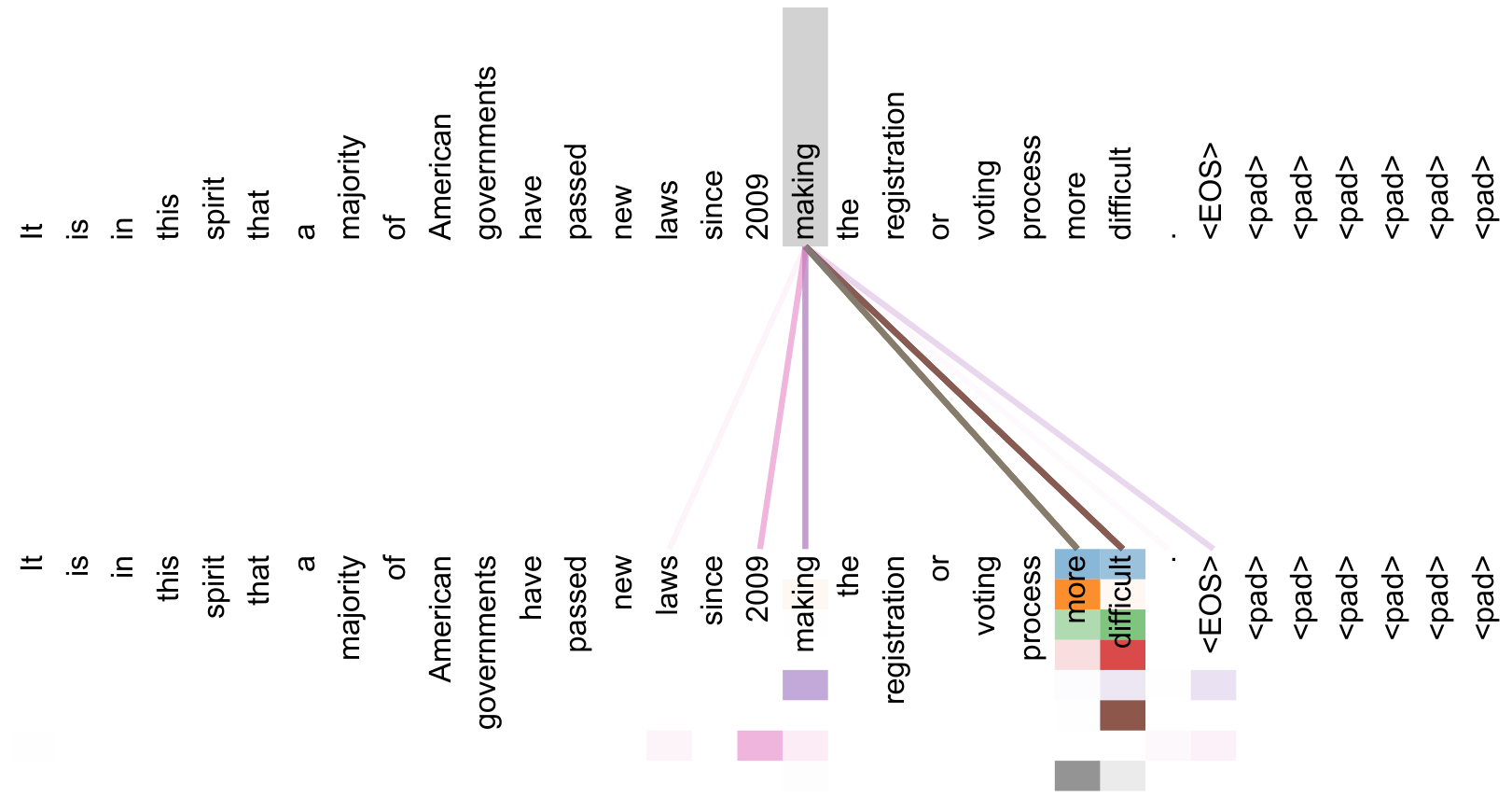
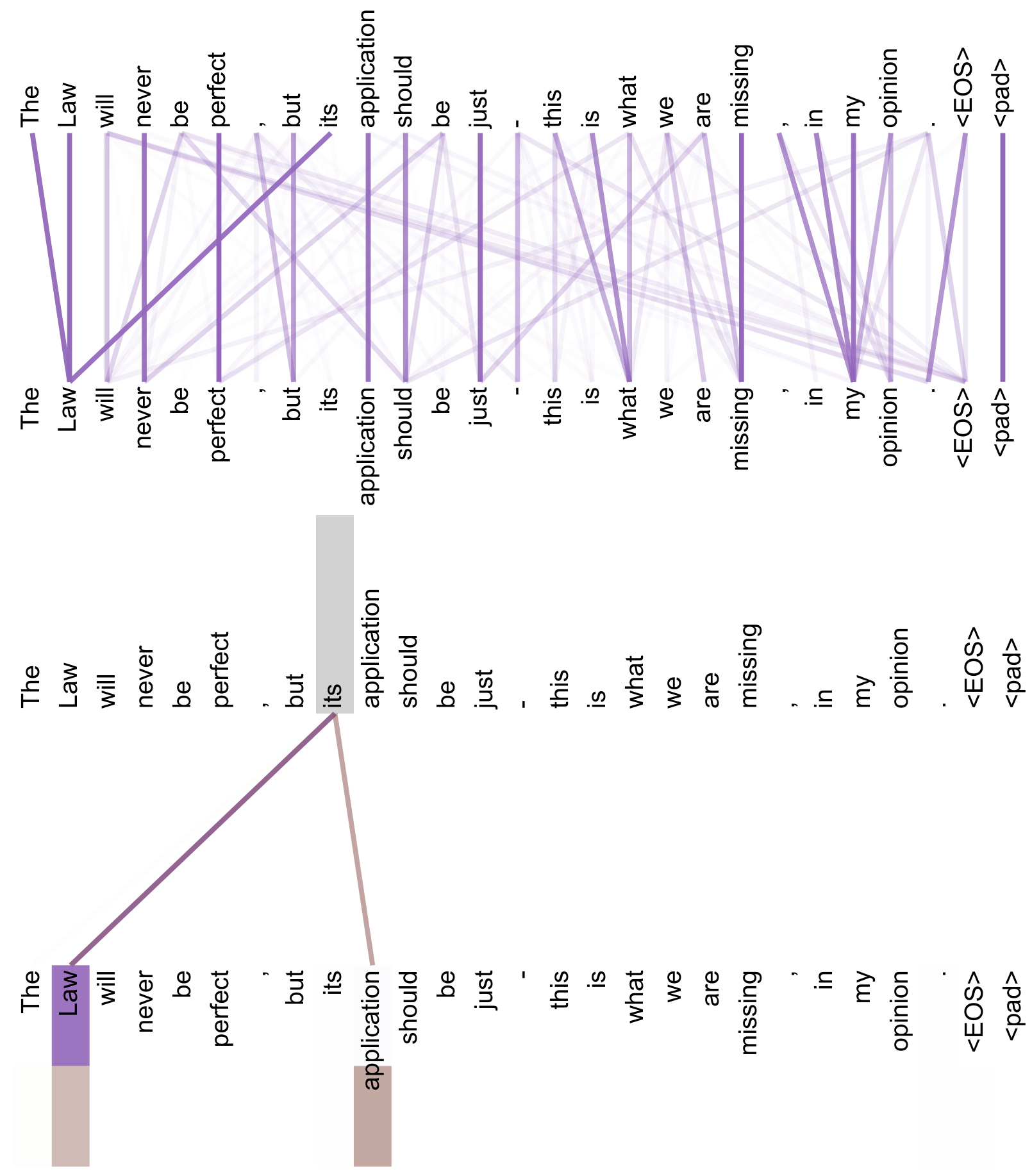
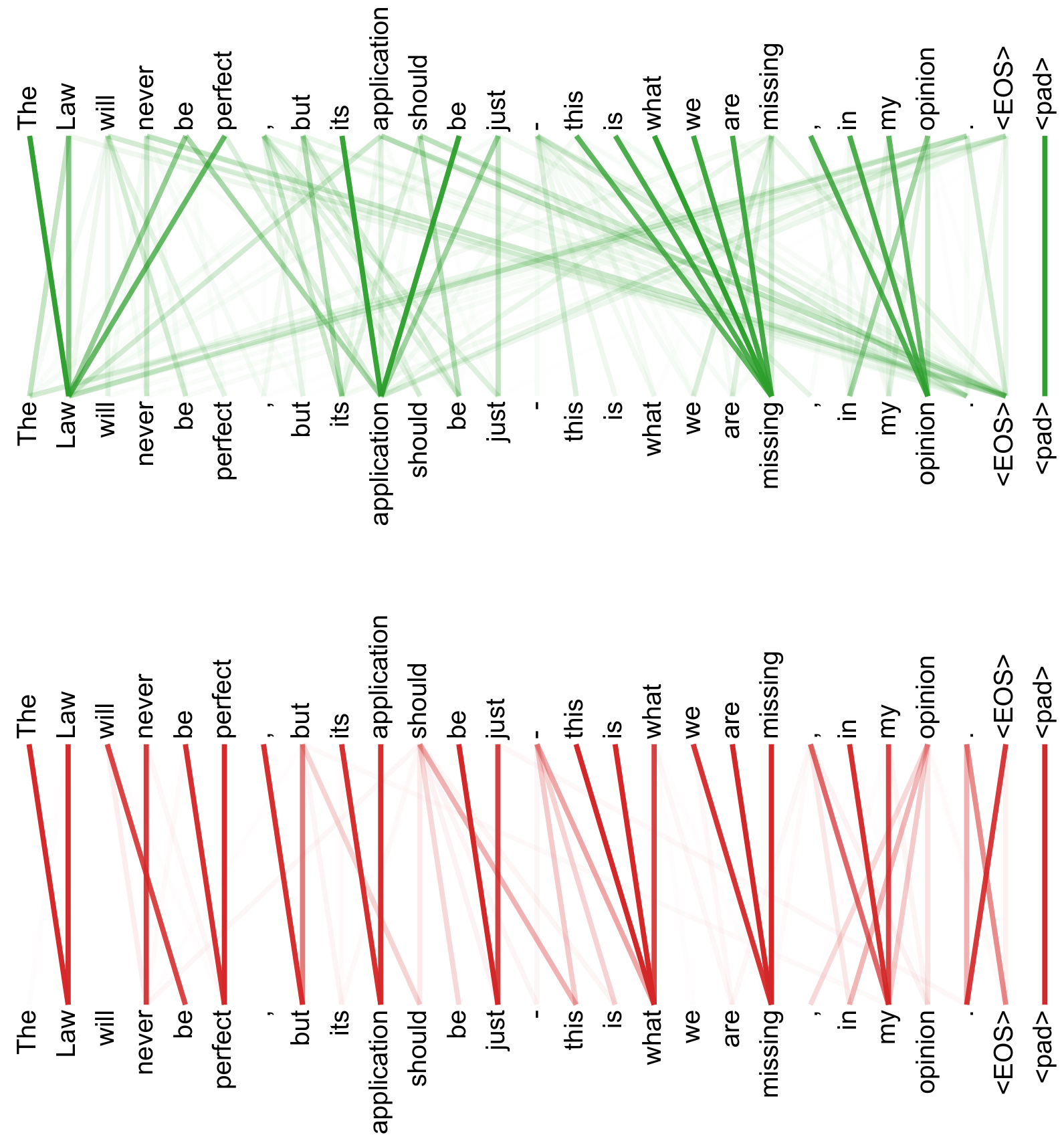
As side benefit, self-attention could yield more interpretable models. We inspect attention distributions from our models and present and discuss examples in the appendix. Not only do individual attention heads clearly learn to perform different tasks, many appear to exhibit behavior related to the syntactic and semantic structure of the sentences.
5 Training
This section describes the training regime for our models.
5.1 Training Data and Batching
We trained on the standard WMT 2014 English-German dataset consisting of about 4.5 million sentence pairs. Sentences were encoded using byte-pair encoding
5.2 Hardware and Schedule
We trained our models on one machine with 8 NVIDIA P100 GPUs. For our base models using the hyperparameters described throughout the paper, each training step took about 0.4 seconds. We trained the base models for a total of 100,000 steps or 12 hours. For our big models,
5.3 Optimizer
We used the Adam optimizer
This corresponds to increasing the learning rate linearly for the first
5.4 Regularization
We employ three types of regularization during training:
Table 2: The Transformer achieves better BLEU scores than previous state-of-the-art models on the English-to-German and English-to-French newstest2014 tests at a fraction of the training cost.
| Model | BLEU EN-DE | BLEU EN-FR | Training Cost (FLOPs) EN-DE | Training Cost (FLOPs) EN-FR |
|---|---|---|---|---|
| ByteNet | 23.75 | |||
| Deep-Att + PosUnk | 39.2 | |||
| GNMT + RL | 24.6 | 39.92 | ||
| ConvS2S | 25.16 | 40.46 | ||
| MoE | 26.03 | 40.56 | ||
| Deep-Att + PosUnk Ensemble | 40.4 | |||
| GNMT + RL Ensemble | 26.30 | 41.16 | ||
| ConvS2S Ensemble | 26.36 | 41.29 | ||
| Transformer (base model) | 27.3 | 38.1 | ||
| Transformer (big) | 28.4 | 41.8 |
Residual Dropout We apply dropout
Label Smoothing During training, we employed label smoothing of value
6 Results
6.1 Machine Translation
On the WMT 2014 English-to-German translation task, the big transformer model (Transformer (big) in Table 2) outperforms the best previously reported models
On the WMT 2014 English-to-French translation task, our big model achieves a BLEU score of 41.0, outperforming all of the previously published single models, at less than 1/4 the training cost of the previous state-of-the-art model. The Transformer (big) model trained for English-to-French used dropout rate
For the base models, we used a single model obtained by averaging the last 5 checkpoints, which were written at 10-minute intervals. For the big models, we averaged the last 20 checkpoints. We used beam search with a beam size of 4 and length penalty
Table 2 summarizes our results and compares our translation quality and training costs to other model architectures from the literature. We estimate the number of floating point operations used to train a model by multiplying the training time, the number of GPUs used, and an estimate of the sustained single-precision floating-point capacity of each GPU2.
6.2 Model Variations
To evaluate the importance of different components of the Transformer, we varied our base model in different ways, measuring the change in performance on English-to-German translation on the
Table 3: Variations on the Transformer architecture. Unlisted values are identical to those of the base model. All metrics are on the English-to-German translation development set, newstest2013. Listed perplexities are per-wordpiece, according to our byte-pair encoding, and should not be compared to per-word perplexities.
| train steps | PPL (dev) | BLEU (dev) | params | |||||||||
|---|---|---|---|---|---|---|---|---|---|---|---|---|
| base | 6 | 512 | 2048 | 8 | 64 | 64 | 0.1 | 0.1 | 100K | 4.92 | 25.8 | 65 |
| (A) | 1 4 16 32 | 512 128 32 16 | 512 128 32 16 | 5.29 5.00 4.91 5.01 | 24.9 25.5 25.8 25.4 | |||||||
| (B) | 16 32 | 5.16 5.01 | 25.1 25.4 | 58 60 | ||||||||
| (C) | 2 4 8 | 6.11 5.19 4.88 | 23.7 25.3 25.5 | 36 50 80 | ||||||||
| 256 1024 | 32 128 | 32 128 | 5.75 4.66 | 24.5 26.0 | 28 168 | |||||||
| 1024 4096 | 5.12 4.75 | 25.4 26.2 | 53 90 | |||||||||
| (D) | 0.0 0.2 | 5.77 4.95 | 24.6 25.5 | |||||||||
| 0.0 0.2 | 4.67 5.47 | 25.3 25.7 | ||||||||||
| (E) | \multicolumn{8}{c | }{positional embedding instead of sinusoids} | 4.92 | 25.7 | ||||||||
| big | 6 | 1024 | 4096 | 16 | 0.3 | 300K | 4.33 | 26.4 | 213 |
development set, newstest2013. We used beam search as described in the previous section, but no checkpoint averaging. We present these results in Table 3.
In Table 3 rows (A), we vary the number of attention heads and the attention key and value dimensions, keeping the amount of computation constant, as described in Section 3.2.2. While single-head attention is 0.9 BLEU worse than the best setting, quality also drops off with too many heads.
In Table 3 rows (B), we observe that reducing the attention key size
6.3 English Constituency Parsing
To evaluate if the Transformer can generalize to other tasks we performed experiments on English constituency parsing. This task presents specific challenges: the output is subject to strong structural constraints and is significantly longer than the input. Furthermore, RNN sequence-to-sequence models have not been able to attain state-of-the-art results in small-data regimes
We trained a 4-layer transformer with
We performed only a small number of experiments to select the dropout, both attention and residual
Table 4: The Transformer generalizes well to English constituency parsing (Results are on Section 23 of WSJ)
| Parser | Training | WSJ 23 F1 |
|---|---|---|
| Vinyals & Kaiser el al. (2014) [37] | WSJ only, discriminative | 88.3 |
| Petrov et al. (2006) [29] | WSJ only, discriminative | 90.4 |
| Zhu et al. (2013) [40] | WSJ only, discriminative | 90.4 |
| Dyer et al. (2016) [8] | WSJ only, discriminative | 91.7 |
| Transformer (4 layers) | WSJ only, discriminative | 91.3 |
| Zhu et al. (2013) [40] | semi-supervised | 91.3 |
| Huang & Harper (2009) [14] | semi-supervised | 91.3 |
| McClosky et al. (2006) [26] | semi-supervised | 92.1 |
| Vinyals & Kaiser el al. (2014) [37] | semi-supervised | 92.1 |
| Transformer (4 layers) | semi-supervised | 92.7 |
| Luong et al. (2015) [23] | multi-task | 93.0 |
| Dyer et al. (2016) [8] | generative | 93.3 |
increased the maximum output length to input length + 300. We used a beam size of 21 and
Our results in Table 4 show that despite the lack of task-specific tuning our model performs surprisingly well, yielding better results than all previously reported models with the exception of the Recurrent Neural Network Grammar
In contrast to RNN sequence-to-sequence models
7 Conclusion
In this work, we presented the Transformer, the first sequence transduction model based entirely on attention, replacing the recurrent layers most commonly used in encoder-decoder architectures with multi-headed self-attention.
For translation tasks, the Transformer can be trained significantly faster than architectures based on recurrent or convolutional layers. On both WMT 2014 English-to-German and WMT 2014 English-to-French translation tasks, we achieve a new state of the art. In the former task our best model outperforms even all previously reported ensembles.
We are excited about the future of attention-based models and plan to apply them to other tasks. We plan to extend the Transformer to problems involving input and output modalities other than text and to investigate local, restricted attention mechanisms to efficiently handle large inputs and outputs such as images, audio and video. Making generation less sequential is another research goals of ours.
The code we used to train and evaluate our models is available at GitHub.
Acknowledgements We are grateful to Nal Kalchbrenner and Stephan Gouws for their fruitful comments, corrections and inspiration.
References
[references omitted]
[references omitted]
[references omitted]
Attention Visualizations