Brains and where else? Mapping theories of consciousness to unconventional embodiments
Nicolas Rouleau and Michael Levin
Department of Health Sciences, Wilfrid Laurier University, Waterloo, Ontario, Canada
Allen Discovery Center, Tufts University, Medford, MA, USA
Wyss Institute for Biologically Inspired Engineering, Harvard University, Boston, MA, USA
GRAY
It is assumed that a useful theory of consciousness
(ToC) T o C will explain why consciousness is associated with brains. However, the findings of evolutionary biology, developmental bioelectricity and synthetic bioengineering reveal ancient pre-neural roots of many mechanisms and algorithms occurring in brains: minds may have preceded brains. Most work in the emerging field of diverse intelligence emphasizes externally observable problem-solving competencies in unconventional media, such as cells, tissues and life-technology chimeras. Here, we inquire about the implications of these developments forToCs theories of consciousness . Specifically, we analyse popular currentToCs theories of consciousness to ask: What features of each theory specifically pick out brains as a privileged substrate of inner perspective, or do the features emphasized by the theory occur elsewhere? We find that the operations and functional principles of mostToCs theories of consciousness are not confined to neural substrates, and that the focus on brains is more driven by convention than by the specific content of existingToCs theories . Encouragingly, several contemporary theorists have made explicit efforts to apply their theories to synthetic systems in light of recent technological developments in artificial intelligence and organoid bioengineering. We suggest that the science of consciousness should remain open to minds in unconventional embodiments.This article is part of the theme issue ‘World models in natural and artificial intelligence’.
Cite this article: Rouleau N, Levin M. 2026 Brains and where else? Mapping theories of consciousness to unconventional embodiments. Phil. Trans. R. Soc. A 384: 20250082. https://doi.org/10.1098/rsta.2025.0082
Received: 25 April 2025
Accepted: 17 September 2025
One contribution of 18 to a theme issue ‘World models in natural and artificial intelligence’.
Subject Areas:
artificial intelligence, robotics, software, systems theory
Keywords:
consciousness, aneural cognition, functionalism, organizational invariance, unconventional minds
Authors for correspondence:
Nicolas Rouleau
e-mail: nrouleau@wlu.ca
Michael Levin
e-mail: michael.levin@tufts.edu
© 2026 The Authors. Published by the Royal Society under the terms of the Creative Commons Attribution License http://creativecommons.org/licenses/by/4.0/, which permits unrestricted use, provided the original author and source are credited.
royalsocietypublishing.org/rsta
1. Introduction
What processes or algorithms underlie the ability of certain physical objects, such as living bodies, to form memories, implement decision-making, have an inner perspective with preferences and navigate their environment in a goal-directed manner? This question is crucial to our understanding of ourselves, the development of ethics and social systems and the status of hybrid and fully synthetic artificial intelligence (AI). A number of formalisms, including that of Turing
This seems like an odd question—surely neurons are unique, and there must be a reason why minds associate with brains? This assumption, which permeates discussions of AI and philosophy of mind, is becoming increasingly difficult to hold for several reasons. First, evolutionary developmental biology shows how brains evolved gradually from other cell types. Indeed, the molecular mechanisms that set up the bioelectric networks of the brain are ancient—existing in all cells of the body and having their origin in bacterial biofilms
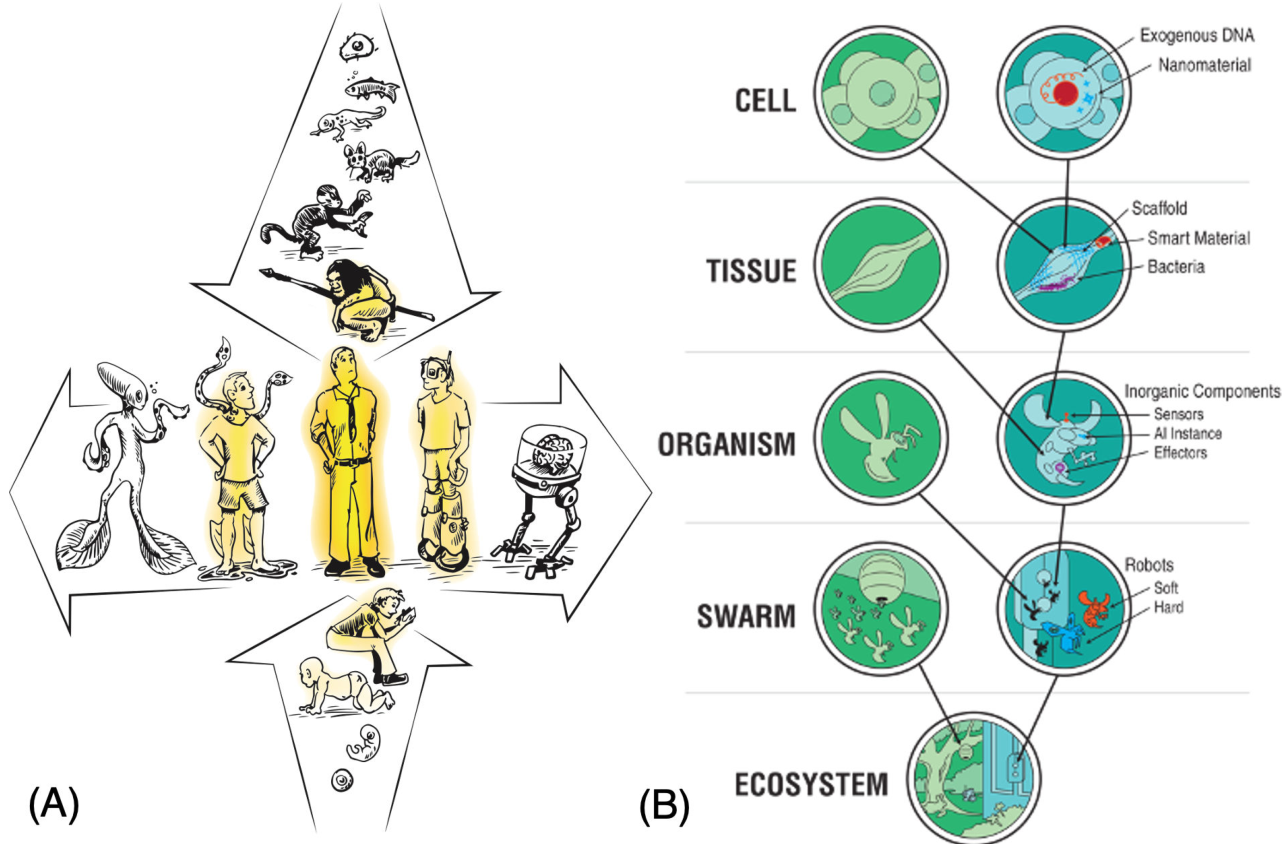
Thus, the emerging field of diverse intelligence reveals that the focus on brains, and on the readily observable movement of organism-sized (cm, m) objects at behavioural time scales (ms, s) through the three-dimensional world, is a result of our evolutionary firmware. Efforts to expand from this neuro- and anthropocentric myopia are underway via research on the problem-solving competencies of a wide range of living and synthetic agents, which is helping to erode our limited evolutionary firmware for visualizing minds in unconventional embodiments
Here, we explore the state of consciousness research with a focus on ToCs and inquire about the implications of recent breakthroughs in biology for theories that make a claim about what is necessary and/or sufficient for consciousness. Specifically, we analyse popular current ToCs to ask: What features of the theory specifically pick out brains as a privileged substrate of inner perspective, or do the features emphasized by each theory occur elsewhere, in natural bodies and perhaps even in the world of engineering? We find that most ToCs rely on functional
principles that are not specific to neuronal networks, which means that their claims about consciousness should apply to a wide range of unconventional substrates. We find few specifics about why neuronal assemblies, in particular, would be an exclusive substrate for consciousness and suggest that the focus on brains is more driven by convention and understandable limitations of imagination than by any specific content of existing ToCs. Thus, it is interesting to explore the relationships of various ToCs with the nervous system per se and the consequences of taking seriously the features they emphasize when they occur outside of brains.
1.1. Theories of consciousness as tools to counteract pervasive mind-blindness
Specific ToCs offer long-awaited explanatory and predictive power amid a history of confusion about the nature of experience. By what standard can a ToC be assessed as useful? Insofar as it can reliably point to subjects in the world, a ToC accomplishes its most basic function. But what if the theory can only reliably point to a particular type of subject? The validity of any theory that purports to explain how and where experience manifests is impacted not only by its positive identifications of mind but also by the number of true minds that it leaves unidentified. Though practical distinctions have always been made to classify the contents of experience, there is yet no consensus definition of consciousness or ToC that accounts for its mechanisms. We usually have no problem being epistemically confident about our own inner perspective. However, the existence of other minds with private thoughts and feelings may be fundamentally unknowable
Mind-blindness—or a failure to form a theory of mind in the presence of other humans—is a defining characteristic of some common neuropathologies but is relatively rare in the general population
Our apparent inability to model worlds full of unconventional minds could indicate that such a capacity was orthogonal to fitness outcomes throughout our evolutionary history. However, it is more likely that mind-blindness confers fitness advantages in the same way that other distortions of perception are thought to have increased survival and reproduction relative to unfiltered windows to reality
and their analogous subjective states. Being aware of another animal’s pain, fear, suffering or distress of any kind in a way that registers as a reflection of one’s own emotional state is unlikely to benefit predators, whose survival is dependent on regularly killing and eating other organisms. Therefore, some minds may be perceptually siloed from others by virtue of their competitive advantage. On the other hand, it is conceivable that some minds were not shaped by similar selective pressures and readily engage in world modelling that includes or even privileges awareness of other embodied minds in the environment. In any case, we propose that regardless of the origins and pressures that shaped our limitations with respect to modelling the full spectrum of agency in our world (and others’ worlds), we now have the opportunity (and responsibility) to go beyond those native limitations as we have surpassed so many others.
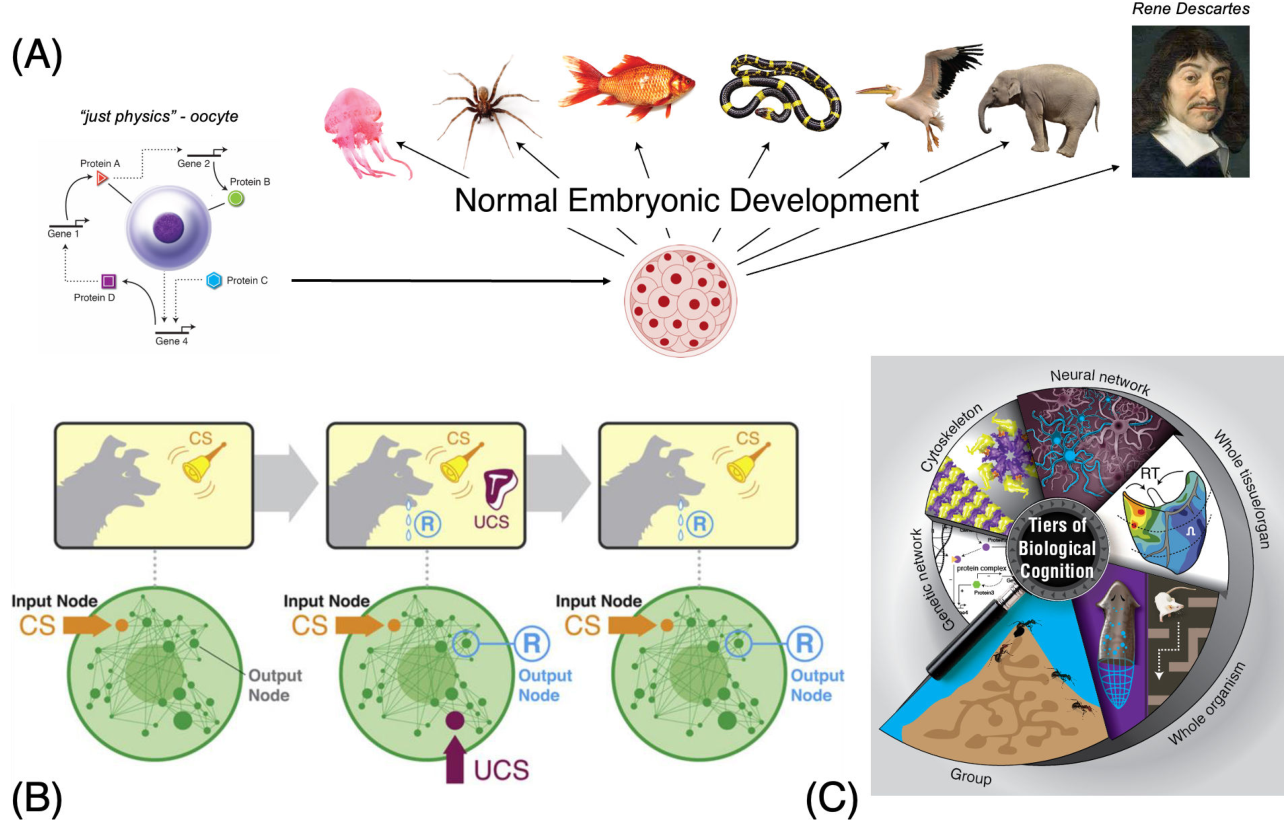
Developmental biology and evolutionary theory emphasize the continuity of conserved mechanisms and algorithms spanning slowly and gradually from single cells (such as microbes and fertilized eggs) to adult metacognitive humans and the gradual modification of generic cells and cell networks into neurons (figure 1). The gradual self-construction of the body suggests the natural possibility of the gradual appearance of consciousness (and thus its presence, in degrees, in substrates different from an adult brainy animal), as perhaps reflected in Turing’s interest in synthetic intelligence and the spontaneous patterning of embryonic morphogens
1.2. Why neural correlates fall short as consciousness criteria
Consciousness cannot be directly measured; therefore, correlates have been used as indirect signs of an underlying mind in the same way that the presence of a black hole is inferred on the basis of how light is bent or ‘lensed’ by distortions of space–time. Many contemporary ToCs refer to ‘neural correlates’ of consciousness (NCCs), which are a set of conserved relationships between human brain structure–function and self-reported experiences
‘reverse inference’
Unfortunately, any movement across the phylogenetic tree decreases the predictive power of reverse inference because NCCs are fundamentally correlates and can only be used to infer consciousness in precisely the same way that behaviours motivate the same inferences. If the associations in question are non-generalizable, such as involving very specific nervous systems with defined organizations, the logic of reverse inference breaks down. While many ToCs have highlighted the relevance of NCCs, their poor generalization to non-human subjects limits their utility. How would an NCC-dependent ToC map onto the distributed nervous system of a jellyfish or the ganglia of a mollusc? What can current ToCs offer in terms of predicting a capacity for experience when comparing three-layered and six-layered cortices or their intermediates? Unless a ToC can account for differences in neural organization, it will return the same predictive errors that human intuitions commit when assessing the mental status of anything other than a human. Some authors have suggested the use of perturbational complexity as a measure of consciousness, which, despite its focus on the responses of neural tissues, has the potential to transcend a historical reliance on specific NCCs because, in principle, other systems can display brain-independent perturbational markers that predict conscious experience
Despite the long-standing absence of any direct measure of consciousness and strong philosophical reasons to doubt its existence in others, humans often extend a theory of mind to infer non-human animal sentience
subjectivity on the basis of their behaviours
While recent developments in synthetic biological intelligence and AI research have accelerated discussion around the topic of unconventional minds, the emergence of neural-robotic hybrids in the late twentieth century represented a major branching point in the conversation. That cultured neural networks could be coupled with robotic or virtual ‘bodies’ to solve real-world problems challenged long-standing dichotomies between the living and
non-living or the agential and automatic
ToCs are important. Whether or not they hold construct validity (i.e. how well the ToC not just predicts the presence of a subject but actually describes true features or mechanisms of consciousness), they enable us to make meaningful distinctions that inform decisions related to lifestyle, ethics, public policy and law. Frameworks must now be developed to identify unfamiliar minds in unconventional spaces that betray long-standing neurocentric assumptions
2. Neural tissues as non-exclusive specialists of cognitive function
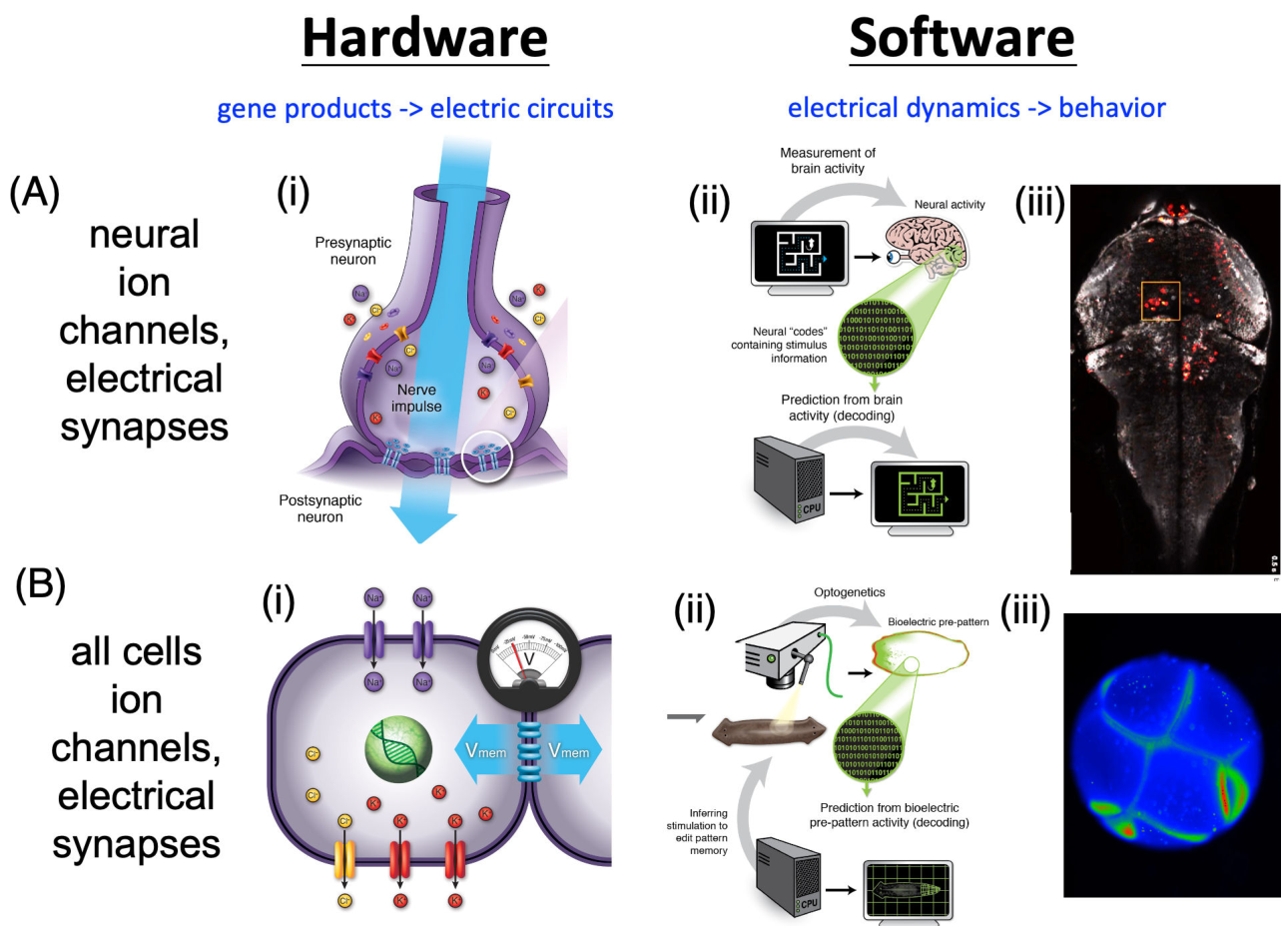
Because ToCs that reference NCCs or any specific neurobiological details will likely fail to generate a true positive prediction of unconventional minds, the role of the brain within the cognitive landscape must be revisited. Neurons—and specifically, pyramidal cells—were once described by Ramón y Cajal as ‘the butterflies of the soul’. The implication, of course, was that neural cells conferred the properties of minds, which remains a central assumption of modern neuroscience. However, there is no single feature of the neuron that is not also displayed by some other cell, living system, inorganic material or natural process (figure 3). Whether it is a capacity for long-range signalling, cell shape plasticity, chemical communication, electrotonic coupling, electromagnetic sensing, membrane polarization, chemotaxis, galvanotaxis, ephaptic coupling or networking, the neuron holds no exclusive capacity or function
Many living systems display electrochemical patterns that are homologous to those of neurons, including the electromagnetic fields that have been hypothesized to be important for consciousness
phenomenon known as cardiac memory
Dynamical properties of neurons are also displayed by simple molecular interactions at sub-cellular scales
and detected hundreds of microns away from the surface
Neither the composition nor the dynamics of neurons is sufficiently unique to justify their special status as mind generators. Either individual cell properties are insufficient or many types of simple systems are similarly capable of generating conscious states. The third possibility is that brains deserve exclusive status because of their connective properties, local circuitry and network architectures. It is often suggested that structural complexity is what sets brains apart from other systems. However, contrary to popular assumption, a network architecture with sparse rather than dense connectivity is likely to specialize brains as implementers of cognition
3. Theories of consciousness to map diverse embodied minds
A universalizable ToC should be substrate-independent, scale-invariant and organization-invariant
Table 1. Aneurocentric formulations of prominent theories of consciousness. The table contains the main ToCs (taken after
| theory | primary claim | references | |
|---|---|---|---|
| active inference | original formulations (verbatim from [21]) | consciousness depends on temporally and counterfactually deep inference about self-generated actions | [147,148] |
| substitutions | none | ||
| expanded aneurocentric formulation | consciousness arises from an embodied system’s continuous predictions about inputs, adjusting internal states and outputs based on prediction errors to minimize differences between expected and actual inputs | ||
| attention schema theory | original formulation | consciousness depends on a neurally encoded model of the control of attention | [149] |
| substitutions | neurally information-processing system | ||
| expanded aneurocentric formulation | consciousness arises from an information-processing system assigning high degrees of certainty about the claim that the system itself contains an attention schema or subject | ||
| attended intermediate representation theory | original formulation | consciousness depends on the attentional amplification of intermediate-level representations | [150,151] |
| substitutions | none | ||
| expanded aneurocentric formulation | consciousness arises when intermediate-level or partially processed information becomes amplified by attentional resources and can enter working memory | ||
| beast machine theory | original formulation | consciousness is grounded in allostatic control-oriented predictive inference | [152–154] |
| substitutions | none | ||
| expanded aneurocentric formulation | consciousness is the effect of combining a subjective frame, or internal reference point generated by constantly updated representations of internal states, with perceptual content evoked by external stimuli | ||
| dendritic integration theory | original formulation | consciousness depends on integration of top-down and bottom-up signalling at a cellular level | [155] |
| substitutions | cellular processor | ||
| expanded aneurocentric formulation | consciousness depends on a coupling between bottom-up and top-down processing that generates a reverberating or looped function | ||
| dynamic core theory | original formulation | consciousness depends on a functional cluster of neural activity combining high levels of dynamical integration and differentiation | [156] |
(Continued.)
Table 1. (Continued.)
| theory | primary claim | references |
|---|---|---|
| substitutions | neural processor | |
| expanded aneurocentric formulation | consciousness arises from an integrated cluster of high-complexity re-entrant processors, or a compositionally dynamic ‘core’, within an information-processing system that is much more strongly interactive with itself than with other parts of the system | |
| electromagnetic field theory | original formulation | consciousness is identical to physically integrated, and causally active, information encoded in the brain’s global electromagnetic field |
| substitutions | brain information-processor | |
| expanded aneurocentric formulation | consciousness depends on information-processing activities by processors interacting with the complex interference patterns of time-varying electromagnetic field oscillations | |
| global workspace theories (GWTs) | original formulation | consciousness depends on ignition and broadcast within a neuronal global workspace where frontoparietal cortical regions play a central, hub-like role |
| substitutions | neuronal information-processing system frontal/parietal cortical regions processors | |
| expanded aneurocentric formulation | consciousness arises from the attention-gated integration of information within an exclusive global workspace or ‘hub’ that uses working memory and can selectively broadcast to multiple processors simultaneously that are within the system but outside of the hub | |
| higher order theory (HOT) | original formulation | consciousness depends on meta-representations of lower order mental states |
| substitutions | mental states states | |
| expanded aneurocentric formulation | consciousness is the higher-order, meta-representational monitoring of the processing activities associated with lower-order states | |
| information closure theory | original formulation | consciousness depends on non-trivial information closure with respect to an environment at particular coarse-grained scales |
| substitutions | none | |
| expanded aneurocentric formulation | consciousness is a process that forms information closure with a stochastic process of which it is a coarse-grained product | |
| integrated information theory (IIT) | original formulation | consciousness is identical to the cause–effect structure of a physical substrate that specifies a maximum of irreducible integrated information |
(Continued.)
Table 1. (Continued.)
| theory | primary claim | references | |
|---|---|---|---|
| substitutions | none | ||
| expanded aneurocentric formulation | consciousness corresponds to the level of integrated information within a system, quantified by a measure () where higher integration indicates richer, more coherent experiences | ||
| local recurrency | original formulation | consciousness depends on local recurrent or re-entrant cortical processing and promotes learning | |
| substitutions | cortical processor | ||
| expanded aneurocentric formulation | consciousness arises from recurrent or re-entrant feedback at points of interaction between higher and lower level processors | ||
| multiple drafts model | original formulation | consciousness depends on multiple (potentially inconsistent) representations rather than a single, unified representation that is available to a central system | |
| substitutions | none | ||
| expanded aneurocentric formulation | consciousness consists of highly parallelized, multi-track processes of informational interpretation and elaboration with continuous editorial revision that are not represented as unified narratives | ||
| neural Darwinism | original formulation | consciousness depends on re-entrant interactions reflecting a history of value-dependent learning events shaped by selectionist principles | |
| substitutions | none | ||
| expanded aneurocentric formulation | consciousness is a re-entrant interaction between perceptual processors and relay nodes along their pathways, conferring selective advantages by linking current inputs with a history of weighted input values | ||
| neural subjective frame | original formulation | consciousness depends on neural maps of the bodily state, providing a first-person perspective | |
| substitutions | neural system/processor; bodily environmental interface | ||
| expanded aneurocentric formulation | consciousness is a dynamic frame of reference that is dependent on continuously updated maps of the system’s internal states that do not directly interface with the environment, but which are impinged upon by processors of external stimulation | ||
| neuro-representationalism | original formulation | consciousness depends on multi-level neurally encoded predictive representations | |
| substitutions | neurally non-environment/system |
(Continued.)
Table 1. (Continued.)
| theory | primary claim | references | |
|---|---|---|---|
| expanded aneurocentric formulation | consciousness is a multi-modal, context-dependent survey that predicts representations of input stimulation (i.e. superinferences) from the environment and enables goal-directed actions upon the environment | ||
| orchestrated objective reduction | original formulation | consciousness depends on quantum computations within microtubules inside neurons | link |
| substitutions | microtubules qubit reservoirs/processors neurons cell/system | ||
| expanded aneurocentric formulation | consciousness is the terminal product of complex, quantum computations performed by oscillating electromagnetic dipoles as qubits that undergo state reduction with a definite outcome | ||
| predictive processing | original formulation | perception depends on predictive inference of the causes of sensory signals; provides a framework for systematically mapping neural mechanisms to aspects of consciousness | link |
| substitutions | sensory inputs neural internal/processor | ||
| expanded aneurocentric formulation | consciousness arises from the process of actively testing hypotheses as internal predictive models of expected inputs against streams of actual inputs | ||
| sensorimotor theory | original formulation | consciousness depends on mastery of the laws governing sensorimotor contingencies | link |
| substitutions | sensorimotor input-output/embodiment | ||
| expanded aneurocentric formulation | consciousness is a system’s capacity to display embodied engagement (output) with stimuli (input) from the environment without the necessity of internal representations | ||
| self comes to mind theory | original formulation | consciousness depends on interactions between homeostatic routines and multi-level interoceptive maps, with affect and feeling at the core | link |
| substitutions | none | ||
| expanded aneurocentric formulation | consciousness is a state that occurs when a system contains an informationally closed internal representation of itself, situated relative to an external environment. | ||
| self-organizing meta-representational theory | original formulation | consciousness is the brain’s (meta-representational) theory about itself | link |
| substitutions | brain system | ||
| expanded aneurocentric formulation | consciousness occurs in systems that can attend to their first-order internal states, which are generated by impinging external stimuli, and have learnt to value some states over others |
(Continued.)
Table 1. (Continued.)
| theory | primary claim | references | |
|---|---|---|---|
| unlimited associative learning | original formulation | consciousness depends on a form of learning that enables an organism to link motivational value with stimuli or actions that are novel, compound and non-reflex inducing | |
| substitutions | organism system | ||
| expanded aneurocentric formulation | consciousness arises when a system’s states are processed by high-level integrating units, learning about itself in an open-ended way with compounds of paired patterns of stimuli and actions |
When the substrate- and scale-dependent contents of each theory are separated from their functional principles, it becomes clear that, among the most prominent ToCs, there are only a handful of distinct concepts or themes including: (i) predictive modelling, (ii) enactivism/ecological interactions, (iii) re-entrancy or looped feedback, (iv) meta-representations, (v) attentional gating/monitoring, (vi) emergence from computation, (vii) integration of information, and (viii) coarse-graining. Some ToCs are mutually incompatible; however, viewed through a functionalist lens, many more display broad conceptual overlap. While there is no doubt that particular brain regions
4. Implications of consciousness in agents living in unconventional spaces
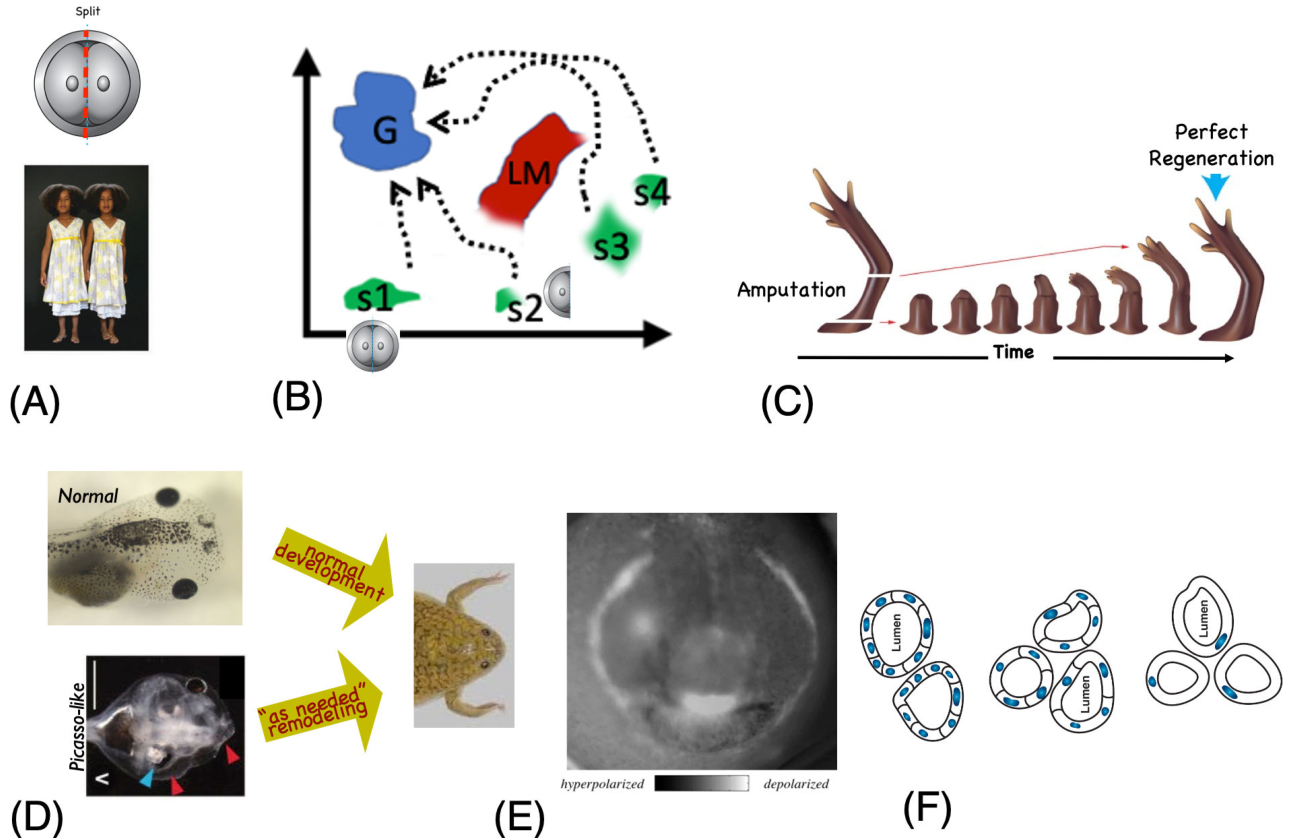
Observable phenomena by which we typically infer some degree of consciousness, including learning, decision-making, navigation, eye tracking and goal-directedness, typically occur in three-dimensional behavioural space at familiar, human-centred scales. However, it is now known that many cells, tissues and aneural organs can do all of these things in metabolic, physiological, transcriptional (gene expression) and anatomical spaces
hybrots architectures could have inner experience as they intelligently navigate, strive, achieve and suffer in their own worlds of possibility. And indeed, as known from advances in the field of morphological computation
5. Developing research programmes
This perspective, grounded in developmental and evolutionary biology of the biophysics underlying neural networks, has a number of implications for a research roadmap. The use of tools and concepts of neuroscience and behavioural science is already paying off in terms of empirical discoveries and new experimental vistas in these fields, for example, in the use of the collective intelligence of cells navigating anatomical morphospace to impact birth defects, regeneration and cancer
An obvious next step is to use metrics from causal information theory and
One of the key lynchpins in discussions of both AI and organoid consciousness has been the criterion of embodiment
By loosening historical constraints on the nature of conscious embodiments and the spaces within which they must navigate, the science of consciousness gains access to a wide range of beings that, while seemingly alien, are functionally familiar. Many questions abound with respect to the kinds of minds that exo-biological life forms would have; while we do not have access to true aliens, we now have the opportunity to try to understand minds that are on the same evolutionary tree as us, and thus perhaps tractable, but will force us to expand and refine our conceptual apparatus because they are not tractable to anthropocentric, brain-focused formalisms. The recognition of possible consciousness in living material more broadly
will recalibrate current debates about octopuses, crustaceans, plants, etc., and raise fascinating
questions about ethical relationships with this much broader class of beings.
6. Conclusion
Taking the slow, gradual scale-up seriously from single cells revealed by developmental and
evolutionary biology makes the continuity thesis the null hypothesis. The high conservation of
mechanisms and behaviours in brains all the way back to pre-cellular material implies that a kind of panpsychism, committed to understanding the scaling and transformation of embodied minds from physical dynamics, is not only viable but should also be the baseline assumption. Indeed, our approach places consciousness on a functional continuum not unlike any other capacity. The claim that an organism (or any system) is or is not conscious is, in our view, equivalent to the claim that an organism can or cannot fly, swim, see, hear or carry out any particular function. Rather than forcing binary categorization, it may be useful instead to ask about the degree to which an organism is able to resist gravity, displace fluids or transduce waveforms. Competing ideas, relying on sharp phase transitions and brain-specific theories, need to specify principled reasons for discontinuities and explain the ‘emergence’ of novel natural kinds.
The state of the art in physiology and diverse intelligence research, combined with the compatibility of current ToCs with aneural substrates, suggests that consciousness may be common throughout the body. Our mind supervenes on a collection of cells, working together by means of a bioelectric network that aligns them towards larger cognitive light cones in abstract problem spaces. That architecture is ubiquitous throughout our bodies and throughout evolution. Thus, consciousness in a collective intelligence made of cells is not a wild claim—indeed, it is the only kind of consciousness we have ever seen, because each of us is a collective intelligence (of neurons). For all the reasons discussed above, we can drop the part in parentheses from the list of requirements and get on with the task of understanding collective intelligence in all of its general guises and the ways in which it enables intelligence to come into the world.
But it is often objected: ‘we don’t feel our liver being conscious!”. While that is true, we do not feel each other being conscious either. Indeed, if the liver or its parts were capable of subjective experience, that point of view would be quite independent from the consciousness of a brain with which it shared a body. We suggest dropping the unfounded requirement that a body has only one consciousness, as well as the privileged perspective of the one body organ that can eloquently proclaim its lonely unity by way of the left hemisphere’s capacity for language. Many brain structures are mirrored across hemispheres and can function independently following interhemispheric disconnections, including callosotomy. While perception can clearly be divided into split-brain patients, the evidence for divided consciousness is mixed
of the Army Research Office or the US Government. We also acknowledge support from the Natural Sciences and Engineering Research Council of Canada
Acknowledgements. We thank Daniel C. Dennett, Chris Fields, Karl Friston, Pamela Lyon, Anil Seth, Mark Solms and many other members of the community for numerous helpful discussions. We thank Julia Poirier for invaluable assistance with manuscript preparation.
References
-
Turing AM. 1950 Computing machinery and intelligence. Mind 59, 433–460. (doi:10.1093/mind/LIX.236.433)
-
Rosenblatt F. 1967 Recent work on theoretical models of biological memory. In Computer and information sciences (ed. J Tou). Washington, DC, USA: Spartan Books.
-
McCulloch WS. 1988 Embodiments of mind, pp. 28–402, vol. xxviii. Cambridge, MA: MIT Press.
-
Minsky M, Papert S. 1969 Perceptrons; an introduction to computational geometry, p. 258. Cambridge, MA: MIT Press.
-
Rosenblatt F. 1958 The perceptron: a probabilistic model for information storage and organization in the brain. Psychol. Rev. 65, 386–408. (doi:10.1037/h0042519)
-
Hopfield JJ. 1982 Neural networks and physical systems with emergent collective computational abilities. Proc. Natl Acad. Sci. USA 79, 2554–2558. (doi:10.1073/pnas.79.8.2554)
-
Hopfield JJ, Tank DW. 1986 Computing with neural circuits: a model. Science 233, 625–633. (doi:10.1126/science.3755256)
-
Yang CY, Bialecka-Fornal M, Weatherwax C, Larkin JW, Prindle A, Liu J, Garcia-Ojalvo J, Süel GM. Yang and colleagues 2020 Encoding membrane-potential-based memory within a microbial community. Cell Syst. 10, 417–423. (doi:10.1016/j.cels.2020.04.002) -
Martinez-Corral R, Liu J, Prindle A, Süel GM, Garcia-Ojalvo J. Martinez-Corral and colleagues 2019 Metabolic basis of brain-like electrical signalling in bacterial communities. Phil. Trans. R. Soc. B Biol. Sci. 374, 20180382. (doi:10.1098/rstb.2018.0382) -
Prindle A, Liu J, Asally M, Ly S, Garcia-Ojalvo J, Süel GM. Prindle and colleagues 2015 Ion channels enable electrical communication in bacterial communities. Nature 527, 59–63. (doi:10.1038/nature15709) -
Levin M. 2023 Bioelectric networks: the cognitive glue enabling evolutionary scaling from physiology to mind. Anim. Cogn. 26, 1865–1891. (doi:10.1007/s10071-023-01780-3)
-
Vallverdú J et al. Vallverdú and colleagues 2018 Slime mould: the fundamental mechanisms of biological cognition. BioSystems 165, 57–70. (doi:10.1016/j.biosystems.2017.12.011) -
Baluška F, Levin M. 2016 On having no head: cognition throughout biological systems. Front. Psychol. 7, 902. (doi:10.3389/fpsyg.2016.00902)
-
Lyon P. 2020 Of what is ‘minimal cognition’ the half-baked version? Adapt. Behav. 28, 407–424. (doi:10.1177/1059712319871360)
-
Lyon P. 2006 The biogenic approach to cognition. Cogn. Process. 7, 11–29. (doi:10.1007/s10339-005-0016-8)
-
Pezzulo G, Levin M. 2015 Re-membering the body: applications of computational neuroscience to the top-down control of regeneration of limbs and other complex organs. Integr. Biol. 7, 1487–1517. (doi:10.1039/c5ib00221d)
-
Levin M. 2022 Technological approach to mind everywhere: an experimentally-grounded framework for understanding diverse bodies and minds. Front. Syst. Neurosci. 16, 768201. (doi:10.3389/fnsys.2022.768201)
-
Levin M. 2019 The computational boundary of a ‘self’: developmental bioelectricity drives multicellularity and scale-free cognition. Front. Psychol. 10, 2688. (doi:10.3389/fpsyg.2019.02688)
-
Fields C, Levin M. 2022 Competency in navigating arbitrary spaces as an invariant for analyzing cognition in diverse embodiments. Entropy 24, 819. (doi:10.3390/e24060819)
-
Chalmers D. 2017 The hard problem of consciousness. In The Blackwell companion to consciousness (eds S Schneider, M Velman), pp. 32–42. New York, NY: John Wiley & Sons. (doi:10.1002/9781119132363)
-
Seth AK, Bayne T. 2022 Theories of consciousness. Nat. Rev. Neurosci. 23, 439–452. (doi:10.1038/s41583-022-00587-4)
-
Kuhn RL. 2024 A landscape of consciousness: toward a taxonomy of explanations and implications. Prog. Biophys. Mol. Biol. 190, 28–169. (doi:10.1016/j.pbiomolbio.2023.12.003)
-
Malcolm N. 1958 I. Knowledge of other minds. J. Philos. 55, 969–978. (doi:10.2307/2021905)
-
Price HH. 1938 Our evidence for the existence of other minds. Philosophy 13, 425–456. (doi:10.1017/S0031819100014200)
-
Sober E. 1995 Why not solipsism? Philos. Phenomenol. Res. 55, 547–566. (doi:10.2307/2108438)
-
Bayne T et al. Bayne and colleagues 2024 Tests for consciousness in humans and beyond. Trends Cogn. Sci. 28, 454–466. (doi:10.1016/j.tics.2024.01.010) -
Povinelli DJ, Giambrone S. 1999 Inferring other minds: failure of the argument by analogy. Philos. Top. 27, 167–201. (doi:10.5840/philtopics199927120)
-
Frith U. 2001 Mind blindness and the brain in autism. Neuron 32, 969–979. (doi:10.1016/s0896-6273(01)00552-9)
-
Hoffman DD. 2019 The case against reality: why evolution hid the truth from our eyes. New York, NY: W. W. Norton & Company.
-
Hoffman DD, Singh M, Prakash C. 2015 The interface theory of perception. Psychon. Bull. Rev. 22, 1480–1506. (doi:10.3758/s13423-015-0890-8)
-
Shirakawa T, Gunji YP, Miyake Y. 2011 An associative learning experiment using the plasmodium of Physarum polycephalum. Nano Commun. Netw. 2, 99–105. (doi:10.1016/j.nancom.2011.05.002)
-
Hennessey TM, Rucker WB, McDiarmid CG. 1979 Classical-conditioning in paramecia. Anim. Learn. Behav. 7, 417–423. (doi:10.3758/BF03209695)
-
Biswas S, Clawson W, Levin M. 2022 Learning in transcriptional network models: computational discovery of pathway-level memory and effective interventions. Int. J. Mol. Sci. 24, 285. (doi:10.3390/ijms24010285)
-
Biswas S, Manicka S, Hoel E, Levin M. 2021 Gene regulatory networks exhibit several kinds of memory: quantification of memory in biological and random transcriptional networks. iScience 24, 102131. (doi:10.1016/j.isci.2021.102131)
-
Kukushkin NV, Carney RE, Tabassum T, Carew TJ. 2024 The massed-spaced learning effect in non-neural human cells. Nat. Commun. 15, 9635. (doi:10.1038/s41467-024-53922-x)
-
Gershman SJ, Balbi PE, Gallistel CR, Gunawardena J. 2021 Reconsidering the evidence for learning in single cells. eLife 10, e61907. (doi:10.7554/eLife.61907)
-
Katz Y, Fontana W. 2022 Probabilistic inference with polymerizing biochemical circuits. Entropy 24, 629. (doi:10.3390/e24050629)
-
Katz Y, Springer M, Fontana W. 2018 Embodying probabilistic inference in biochemical circuits. arXiv:1806.10161.
-
Kaygisiz K, Ulijn RV. 2024 Can molecular systems learn? ChemSystemsChem 7, e202400075. (doi:10.1002/syst.202400075)
-
Levin M, Martyniuk CJ. 2018 The bioelectric code: an ancient computational medium for dynamic control of growth and form. BioSystems 164, 76–93. (doi:10.1016/j.biosystems.2017.08.009)
-
Turing AM. 1952 The chemical basis of morphogenesis. Phil. Trans. R. Soc. Lond. B Biol. Sci. 237, 37–72. (doi:10.1098/rstb.1952.0012)
-
Rouleau N, Levin M. 2024 Discussions of machine versus living intelligence need more clarity. Nat. Mach. Intell. 6, 1424–1426. (doi:10.1038/s42256-024-00955-y)
-
Yampolskiy RV. 2014 The universe of minds. arXiv abs/1410.0369.
-
Dennett DC. 1996 Kinds of minds: toward an understanding of consciousness, p. 184, 1st edn. New York, NY: Basic Books. (doi:10.1002/cplx.6130010605)
-
Nagel T. 1995 Other minds: critical essays. Oxford, UK: Oxford University Press.
-
Sloman A. 1984 The structure of the space of possible minds. In The mind and the machine: philosophical aspects of artificial intelligence (eds S Torrance, E Horwood), pp. 35–42. Chichester, UK: MIT.
-
Morgan CL. 1903 Other minds than ours. In An introduction to comparative psychology (ed. W Scott), pp. 36–59. London, UK: Walter Scott Publishing Co.
(doi:10.1037/13701-003) -
Koch C, Massimini M, Boly M, Tononi G. 2016 Neural correlates of consciousness: progress and problems. Nat. Rev. Neurosci. 17, 307–321.
(doi:10.1038/nrn.2016.22) -
Di Perri C et al. 2016 Neural correlates of consciousness in patients who have emerged from a minimally conscious state: a cross-sectional multimodal imaging study. Lancet Neurol. 15, 830–842.
(doi:10.1016/S1474-4422(16)00111-3) -
Gawryluk JR, D’Arcy RCN, Connolly JF, Weaver DF. 2010 Improving the clinical assessment of consciousness with advances in electrophysiological and neuroimaging techniques. BMC Neurol. 10, 11.
(doi:10.1186/1471-2377-10-11) -
Boly M, Massimini M, Tononi G. 2009 Theoretical approaches to the diagnosis of altered states of consciousness. Prog. Brain Res. 177, 383–398.
(doi:10.1016/S0079-6123(09)17727-0) -
Tononi G, Koch C. 2015 Consciousness: here, there and everywhere? Phil. Trans. R. Soc. B Biol. Sci. 370, 20140167.
(doi:10.1098/rstb.2014.0167) -
Poldrack RA. 2011 Inferring mental states from neuroimaging data: from reverse inference to large-scale decoding. Neuron 72, 692–697.
(doi:10.1016/j.neuron.2011.11.001) -
Sinitsyn DO et al. 2020 Detecting the potential for consciousness in unresponsive patients using the perturbational complexity index. Brain Sci. 10, 917.
(doi:10.3390/brainsci10120917) -
Casarotto S et al. 2016 Stratification of unresponsive patients by an independently validated index of brain complexity. Ann. Neurol. 80, 718–729.
(doi:10.1002/ana.24779) -
Spence CE, Osman M, McElligott AG. 2017 Theory of animal mind: human nature or experimental artefact? Trends Cogn. Sci. 21, 333–343.
(doi:10.1016/j.tics.2017.02.003) -
Urquiza-Haas EG, Kotrschal K. 2015 The mind behind anthropomorphic thinking: attribution of mental states to other species. Anim. Behav. 109, 167–176.
(doi:10.1016/j.anbehav.2015.08.011) -
Harnad S. 2016 Animal sentience: the other-minds problem. Animal Sentience 1, 1.
(doi:10.51291/2377-7478.1065) -
DeGrazia D. 1997 Great apes, dolphins, and the concept of personhood + moral philosophy, categories. South. J. Philos. 35, 301–320.
(doi:10.1111/j.2041-6962.1997.tb00839.x) -
Staker A. 2017 Should chimpanzees have standing? The case for pursuing legal personhood for non-human animals. Transnatl. Environ. Law 6, 485–507.
(doi:10.1017/S204710251700019X) -
Bar-On YM, Phillips R, Milo R. 2018 The biomass distribution on Earth. Proc. Natl Acad. Sci. USA 115, 6506–6511.
(doi:10.1073/pnas.1711842115) -
Jennings HS. 1906 Behavior of the lower organisms, pp. 14–366, vol. xiv. New York, NY: The Columbia University Press, The Macmillan Company, Agents.
-
Baluška F, Reber AS, Miller WB. 2022 Cellular sentience as the primary source of biological order and evolution. BioSystems 218, 104694.
(doi:10.1016/j.biosystems.2022.104694) -
Baluška F, Miller WB, Reber AS. 2022 Cellular and evolutionary perspectives on organismal cognition: from unicellular to multicellular organisms. Biol. J. Linn. Soc. 139, 503–513.
(doi:10.1093/biolinnean/blac005) -
Reber AS, Baluška F. 2021 Cognition in some surprising places. Biochem. Biophys. Res. Commun. 564, 150–157.
(doi:10.1016/j.bbrc.2020.08.115) -
DeMarse TB, Wagenaar DA, Blau AW, Potter SM. 2000 Interfacing neuronal cultures to a computer-generated virtual world. In 7th Joint Symposium on Neural Computation, Los Angeles, CA, pp. 36–42. Institute for Neural Computation.
-
Potter SM, Fraser SE, Pine J. 1997 Animat in a Petri dish: cultured neural networks for studying neural computation. In 4th Joint Symposium on Neural Computation, San Diego, CA, pp. 167–174. Institute for Neural Computation.
-
Demarse TB, Wagenaar DA, Blau AW, Potter SM. 2001 The neurally controlled animat: biological brains acting with simulated bodies. Auton. Robots 11, 305–310.
(doi:10.1023/a:1012407611130) -
Wagenaar DA, Madhavan R, Pine J, Potter SM. 2005 Controlling bursting in cortical cultures with closed-loop multi-electrode stimulation. J. Neurosci. 25, 680–688.
(doi:10.1523/JNEUROSCI.4209-04.2005) -
Madhavan R, Wagenaar DA, Potter SM. 2003 Multisite stimulation quiets bursts and enhances plasticity in cultured networks. In 33rd Society for Neuroscience Annual Meeting, New Orleans, LA, pp. 45–56. Society for Neuroscience. Reference 70. Madhavan and colleagues, 2003, Multisite stimulation quiets bursts and enhances plasticity in cultured networks. -
Potter AM et al. 2004 Hybrots: hybrids of living neurons and robots for studying neural computation. In Brain inspired cognitive systems (eds AMG Peebles, RP Cooper), pp. 1–6. Stirling, UK: World Scientific. Reference 71. Potter and colleagues, 2004, Hybrots: hybrids of living neurons and robots for studying neural computation. -
Lobov SA, Mikhaylov AN, Shamshin M, Makarov VA, Kazantsev VB. 2020 Spatial properties of STDP in a self-learning spiking neural network enable controlling a mobile robot. Front. Neurosci. 14, 88. doi:10.3389/fnins.2020.00088 Reference 72. Lobov and colleagues, 2020, Spatial properties of S T D P in a self-learning spiking neural network enable controlling a mobile robot. -
Ebrahimkhani MR, Levin M. 2021 Synthetic living machines: a new window on life. iScience 24, 102505. doi:10.1016/j.isci.2021.102505 Reference 73. Ebrahimkhani and Levin, 2021, Synthetic living machines: a new window on life. -
Kamm RD et al. 2018 Perspective: the promise of multi-cellular engineered living systems. APL Bioeng. 2, 040901. doi:10.1063/1.5038337 Reference 74. Kamm and colleagues, 2018, Perspective: the promise of multi-cellular engineered living systems. -
Blackiston D, Kriegman S, Bongard J, Levin M. 2023 Biological robots: perspectives on an emerging interdisciplinary field. Soft Robot. 10, 674–686. doi:10.1089/soro.2022.0142 Reference 75. Blackiston and colleagues, 2023, Biological robots: perspectives on an emerging interdisciplinary field. -
Gumuskaya G, Srivastava P, Cooper BG, Lesser H, Semegran B, Garnier S, Levin M. 2023 Motile living biobots self-construct from adult human somatic progenitor seed cells. Adv. Sci. 11, e2303575. doi:10.1002/advs.202303575 Reference 76. Gumuskaya and colleagues, 2023, Motile living biobots self-construct from adult human somatic progenitor seed cells. -
Clawson WP, Levin M. 2022 Endless forms most beautiful 2.0: teleonomy and the bioengineering of chimaeric and synthetic organisms. Biol. J. Linn. Soc. 139, 457–486. doi:10.1093/biolinnean/blac073 Reference 77. Clawson and Levin, 2022, Endless forms most beautiful 2.0: teleonomy and the bioengineering of chimaeric and synthetic organisms. -
Pio-Lopez L. 2021 The rise of the biocyborg: synthetic biology, artificial chimerism and human enhancement. New Genet. Soc. 40, 599–619. doi:10.1080/14636778.2021.2007064 Reference 78. Pio-Lopez, 2021, The rise of the biocyborg: synthetic biology, artificial chimerism and human enhancement. -
Orive G, Taebnia N, Dolatshahi-Pirouz A. 2020 A new era for cyborg science is emerging: the promise of cyborganic beings. Adv. Healthc. Mater. 9, e1901023. doi:10.1002/adhm.201901023 Reference 79. Orive and colleagues, 2020, A new era for cyborg science is emerging: the promise of cyborganic beings. -
Li Q, Nan K, Le Floch P, Lin Z, Sheng H, Blum TS, Liu J. 2019 Cyborg organoids: implantation of nanoelectronics via organogenesis for tissue-wide electrophysiology. Nano Lett. 19, 5781–5789. doi:10.1021/acs.nanolett.9b02512 Reference 80. Li and colleagues, 2019, Cyborg organoids: implantation of nanoelectronics via organogenesis for tissue-wide electrophysiology. -
Mehrali M et al. 2018 Blending electronics with the human body: a pathway toward a cybernetic future. Adv. Sci. 5, 1700931. doi:10.1002/advs.201700931 Reference 81. Mehrali and colleagues, 2018, Blending electronics with the human body: a pathway toward a cybernetic future. -
Ding S, O’Banion CP, Welfare JG, Lawrence DS. 2018 Cellular cyborgs: on the precipice of a drug delivery revolution. Cell Chem. Biol. 25, 648–658. doi:10.1016/j.chembiol.2018.03.003 Reference 82. Ding and colleagues, 2018, Cellular cyborgs: on the precipice of a drug delivery revolution. -
Aaser P et al. 2017 Towards making a cyborg: a closed-loop reservoir-neuro system. In ECAL 2017: the 14th European Conf. on Artificial Life, pp. 430–437. Lyon, France: MIT Press. doi:10.7551/ecal_a_072 Reference 83. Aaser and colleagues, 2017, Towards making a cyborg: a closed-loop reservoir-neuro system. -
Stern M, Pinson MB, Murugan A. 2020 Continual learning of multiple memories in mechanical networks. Phys. Rev. X 10, 031044. doi:10.1103/PhysRevX.10.031044 Reference 84. Stern and colleagues, 2020, Continual learning of multiple memories in mechanical networks. -
Stern M, Arinze C, Perez L, Palmer SE, Murugan A. 2020 Supervised learning through physical changes in a mechanical system. Proc. Natl Acad. Sci. USA 117, 14843–14850. doi:10.1073/pnas.2000807117 Reference 85. Stern and colleagues, 2020, Supervised learning through physical changes in a mechanical system. -
Ozkan-Aydin Y, Goldman DI, Bhamla MS. 2021 Collective dynamics in entangled worm and robot blobs. Proc. Natl Acad. Sci. USA 118, e2010542118. doi:10.1073/pnas.2010542118 Reference 86. Ozkan-Aydin and colleagues, 2021, Collective dynamics in entangled worm and robot blobs. -
Bernheim-Groswasser A, Gov NS, Safran SA, Tzlil S. 2018 Living matter: mesoscopic active materials. Adv. Mater. 30, e1707028. doi:10.1002/adma.201707028 Reference 87. Bernheim-Groswasser and colleagues, 2018, Living matter: mesoscopic active materials. -
Čejková J, Banno T, Hanczyc MM, Štěpánek F. 2017 Droplets as liquid robots. Artif. Life 23, 528–549. doi:10.1162/ARTL_a_00243 Reference 88. Čejková and colleagues, 2017, Droplets as liquid robots. -
Rouleau N, Levin M. 2023 The multiple realizability of sentience in living systems and beyond. eNeuro 10, ENEURO.0375-23.2023. doi:10.1523/ENEURO.0375-23.2023 Reference 89. Rouleau and Levin, 2023, The multiple realizability of sentience in living systems and beyond. -
Rosenblueth A, Wiener N, Bigelow J. 1943 Behavior, purpose and teleology. Philos. Sci. 10, 18–24. doi:10.1086/286788 Reference 90. Rosenblueth and colleagues, 1943, Behavior, purpose and teleology. -
Levin M. 2024 The multiscale wisdom of the body: collective intelligence as a tractable interface for next-generation biomedicine. BioEssays 47, e202400196. doi:10.1002/bies.202400196 Reference 91. Levin, 2024, The multiscale wisdom of the body: collective intelligence as a tractable interface for next-generation biomedicine. -
Cho ES, Han S, Kim G, Eom M, Lee KH, Kim CH, Yoon YG. 2023 In vivo whole-brain imaging of zebrafish larvae using three-dimensional fluorescence microscopy. J. Vis. Exp. 194, 65218. doi:10.3791/65218 Reference 92. Cho and colleagues, 2023, In vivo whole-brain imaging of zebrafish larvae using three-dimensional fluorescence microscopy. -
Fields C, Bischof J, Levin M. 2020 Morphological coordination: a common ancestral function unifying neural and non-neural signaling. Physiology 35, 16–30. (doi:10.1152/physiol.00027.2019) -
Koshland DE. 1983 The bacterium as a model neuron. Trends Neurosci. 6, 133–137. (doi:10.1016/0166-2236(83)90066-8) -
Koshland DE. 1980 Bacterial chemotaxis in relation to neurobiology. Annu. Rev. Neurosci. 3, 43–75. (doi:10.1146/annurev.ne.03.030180.000355) -
McMillen P, Oudin MJ, Levin M, Payne SL. 2021 Beyond neurons: long distance communication in development and cancer. Front. Cell Dev. Biol. 9, 739024. (doi:10.3389/fcell.2021.739024) -
Blackiston D, Adams DS, Lemire JM, Lobikin M, Levin M. 2011 Transmembrane potential of GlyCl-expressing instructor cells induces a neoplastic-like conversion of melanocytes via a serotonergic pathway. Dis. Model. Mech. 4, 67–85. (doi:10.1242/dmm.005561) -
Hunt T, Jones M, McFadden J, Delorme A, Hales CG, Ericson M, Schooler J. 2023 Editorial: electromagnetic field theories of consciousness: opportunities and obstacles. Front. Hum. Neurosci. 17, 1342634. (doi:10.3389/fnhum.2023.1342634) -
Kitchener PD, Hales CG. 2022 What neuroscientists think, and don’t think, about consciousness. Front. Hum. Neurosci. 16, 767612. (doi:10.3389/fnhum.2022.767612) -
Hales CG, Ericson M. 2022 Electromagnetism’s bridge across the explanatory gap: how a neuroscience/physics collaboration delivers explanation into all theories of consciousness. Front. Hum. Neurosci. 16, 836046. (doi:10.3389/fnhum.2022.836046) -
Hales CG. 2014 The origins of the brain’s endogenous electromagnetic field and its relationship to provision of consciousness. J. Integr. Neurosci. 13, 313–361. (doi:10.1142/S0219635214400056) -
Pinotsis DA, Miller EK. 2023 In vivo ephaptic coupling allows memory network formation. Cereb. Cortex 33, 9877–9895. (doi:10.1093/cercor/bhad251) -
Pinotsis DA, Fridman G, Miller EK. 2023 Cytoelectric coupling: electric fields sculpt neural activity and ‘tune’ the brain’s infrastructure. Prog. Neurobiol. 226, 102465. (doi:10.1016/j.pneurobio.2023.102465) -
Pinotsis DA, Miller EK. 2022 Beyond dimension reduction: stable electric fields emerge from and allow representational drift. Neuroimage 253, 119058. (doi:10.1016/j.neuroimage.2022.119058) -
Draper MH, Weidmann S. 1951 Cardiac resting and action potentials recorded with an intracellular electrode. J. Physiol. 115, 74–94. (doi:10.1113/jphysiol.1951.sp004653) -
Chakravarthy SV, Ghosh J. 1997 On Hebbian-like adaptation in heart muscle: a proposal for ‘cardiac memory’. Biol. Cybern. 76, 207–215. (doi:10.1007/s004220050333) -
Zoghi M. 2004 Cardiac memory: do the heart and the brain remember the same? J. Interv. Card. Electrophysiol. 11, 177–182. (doi:10.1023/B:JICE.0000048567.18088.a2) -
Kurtz J. 2005 Specific memory within innate immune systems. Trends Immunol. 26, 186–192. (doi:10.1016/j.it.2005.02.001) -
Banskota S, Ghia JE, Khan WI. 2019 Serotonin in the gut: blessing or a curse. Biochimie 161, 56–64. (doi:10.1016/j.biochi.2018.06.008) -
Levin M, Buznikov GA, Lauder JM. 2006 Of minds and embryos: left-right asymmetry and the serotonergic controls of pre-neural morphogenesis. Dev. Neurosci. 28, 171–185. (doi:10.1159/000091915) -
Segundo-Ortin M, Calvo P. 2023 Plant sentience? Between romanticism and denial: science. Animal Sentience 8, 1. (doi:10.51291/2377-7478.1772) -
Miguel-Tomé S, Llinás RR. 2021 Broadening the definition of a nervous system to better understand the evolution of plants and animals. Plant Signal. Behav. 16, 1927562. (doi:10.1080/15592324.2021.1927562) -
Alipour A, Dorvash M, Yeganeh Y, Hatam G. 2018 Paramecium learning: new insights. J. Protozool. Res. 28, 22–32. (doi:10.32268/jprotozoolres.28.1-2_22) -
Boisseau RP, Vogel D, Dussutour A. 2016 Habituation in non-neural organisms: evidence from slime moulds. Proc. R. Soc. B 283, 20160446. (doi:10.1098/rspb.2016.0446) -
Boussard A, Delescluse J, Pérez-Escudero A, Dussutour A. 2019 Memory inception and preservation in slime moulds: the quest for a common mechanism. Phil. Trans. R. Soc. B Biol. Sci. 374, 20180368. (doi:10.1098/rstb.2018.0368) -
Murugan NJ et al. 2021 Murugan and colleagues, 2021, Mechanosensation mediates long-range spatial decision-making in an aneural organism. Adv. Mater. 33, e2008161. (doi:10.1002/adma.202008161) -
Bonzanni M, Rouleau N, Levin M, Kaplan DL. 2019 Bonzanni and colleagues, 2019, On the generalization of habituation: how discrete biological systems respond to repetitive stimuli: a novel model of habituation that is independent of any biological system. BioEssays 41, e1900028. (doi:10.1002/bies.201900028) -
Bonzanni M, Rouleau N, Levin M, Kaplan DL. 2020 Bonzanni and colleagues, 2020, Optogenetically induced cellular habituation in non-neuronal cells. PLoS One 15, e0227230. (doi:10.1371/journal.pone.0227230) -
Lyon P. 2015 Lyon, 2015, The cognitive cell: bacterial behavior reconsidered. Front. Microbiol. 6, 264. (doi:10.3389/fmicb.2015.00264) -
Keijzer F, van Duijn M, Lyon P. 2013 Keijzer and colleagues, 2013, What nervous systems do: early evolution, input–output, and the skin brain thesis. Adapt. Behav. 21, 67–85. (doi:10.1177/1059712312465330) -
Calvo P, Baluška F. 2015 Calvo and Baluška, 2015, Conditions for minimal intelligence across eukaryota: a cognitive science perspective. Front. Psychol. 6, 1329. (doi:10.3389/fpsyg.2015.01329) -
Grémiaux A, Yokawa K, Mancuso S, Baluška F. 2014 Grémiaux and colleagues, 2014, Plant anesthesia supports similarities between animals and plants: Claude Bernard’s forgotten studies. Plant Signal. Behav. 9, e27886. (doi:10.4161/psb.27886) -
Trewavas AJ, Baluška F. 2011 Trewavas and Baluška, 2011, The ubiquity of consciousness. EMBO Rep. 12, 1221–1225. (doi:10.1038/embor.2011.218) -
Aur D. 2012 Aur, 2012, From neuroelectrodynamics to thinking machines. Cognit. Comput. 4, 4–12. (doi:10.1007/s12559-011-9106-3) -
Scott HL et al. 2022 Scott and colleagues, 2022, Evidence for long-term potentiation in phospholipid membranes. Proc. Natl Acad. Sci. USA 119, e2212195119. (doi:10.1073/pnas.2212195119) -
Zheng JM, Chin WC, Khijniak E, Khijniak E, Pollack GH. 2006 Zheng and colleagues, 2006, Surfaces and interfacial water: evidence that hydrophilic surfaces have long-range impact. Adv. Colloid Interface Sci. 127, 19–27. (doi:10.1016/j.cis.2006.07.002) -
Craddock TJ, Hameroff SR, Ayoub AT, Klobukowski M, Tuszynski JA. 2015 Craddock and colleagues, 2015, Anesthetics act in quantum channels in brain microtubules to prevent consciousness. Curr. Top. Med. Chem. 15, 523–533. (doi:10.2174/1568026615666150225104543) -
Hameroff S. 2014 Hameroff, 2014, Quantum walks in brain microtubules-a biomolecular basis for quantum cognition? Top. Cogn. Sci. 6, 91–97. (doi:10.1111/tops.12068) -
Hameroff SR, Craddock TJ, Tuszynski JA. 2010 Hameroff and colleagues, 2010, ‘Memory bytes’ - molecular match for CaMKII phosphorylation encoding of microtubule lattices. J. Integr. Neurosci. 9, 253–267. (doi:10.1142/s0219635210002482) -
Hameroff S, Nip A, Porter M, Tuszynski J. 2002 Hameroff and colleagues, 2002, Conduction pathways in microtubules, biological quantum computation, and consciousness. BioSystems 64, 149–168. (doi:10.1016/s0303-2647(01)00183-6) -
Dimonte A, Adamatzky A, Erokhin V, Levin M. 2016 Dimonte and colleagues, 2016, On chirality of slime mould. BioSystems 140, 23–27. (doi:10.1016/j.biosystems.2015.12.008) -
Lewis OL, Zhang S, Guy RD, del Álamo JC. 2015 Lewis and colleagues, 2015, Coordination of contractility, adhesion and flow in migrating Physarum amoebae. J. R. Soc. Interface 12, 20141359. (doi:10.1098/rsif.2014.1359) -
Wright M et al. 1988 Wright and colleagues, 1988, Microtubule cytoskeleton and morphogenesis in the amoebae of the myxomycete Physarum polycephalum. Biol. Cell 63, 239–248. (doi:10.1016/0248-4900(88)90061-5) -
McMillen P, Levin M. 2024 McMillen and Levin, 2024, Collective intelligence: a unifying concept for integrating biology across scales and substrates. Commun. Biol. 7, 378. (doi:10.1038/s42003-024-06037-4) -
Kim T, Kao MT, Hasselbrink EF, Meyhöfer E. 2007 Kim and colleagues, 2007, Active alignment of microtubules with electric fields. Nano Lett. 7, 211–217. (doi:10.1021/nl061474k) -
Stracke R, Böhm KJ, Wollweber L, Tuszynski JA, Unger E. 2002 Stracke and colleagues, 2002, Analysis of the migration behaviour of single microtubules in electric fields. Biochem. Biophys. Res. Commun. 293, 602–609. (doi:10.1016/S0006-291X(02)00251-6) -
Liao M, Liang X, Howard J. 2021 Liao and colleagues, 2021, The narrowing of dendrite branches across nodes follows a well-defined scaling law. Proc. Natl Acad. Sci. USA 118, e2022395118. (doi:10.1073/pnas.2022395118)
-
Tononi G, Boly M, Massimini M, Koch C. 2016 Integrated information theory: from consciousness to its physical substrate. Nat. Rev. Neurosci. 17, 450–461. (doi:10.1038/nrn.2016.44)
-
Oizumi M, Albantakis L, Tononi G. 2014 From the phenomenology to the mechanisms of consciousness: integrated information theory 3.0. PLoS Comput. Biol. 10, e1003588. (doi:10.1371/journal.pcbi.1003588)
-
Lamme VAF. 2006 Towards a true neural stance on consciousness. Trends Cogn. Sci. 10, 494–501. (doi:10.1016/j.tics.2006.09.001)
-
Lamme VAF. 2010 How neuroscience will change our view on consciousness. Cogn. Neurosci. 1, 204–220. (doi:10.1080/17588921003731586)
-
Dennett DC. 1991 Consciousness explained. Boston, MA; New York, NY; London, UK: Little, Brown.
-
Edelman GM. 1987 Neural darwinism: the theory of neuronal group selection. New York, NY: Basic Books Inc.
-
Edelman GM. 1989 The remembered present: a biological theory of consciousness. New York, NY: Basic Books Inc.
-
Park HD, Tallon-Baudry C. 2014 The neural subjective frame: from bodily signals to perceptual consciousness. Phil. Trans. R. Soc. B Biol. Sci. 369, 20130208. (doi:10.1098/rstb.2013.0208)
-
Pennartz CMA. 2018 Consciousness, representation, action: the importance of being goal-directed. Trends Cogn. Sci. 22, 137–153. (doi:10.1016/j.tics.2017.10.006)
-
Hameroff S, Penrose R. 2014 Consciousness in the universe: a review of the ‘Orch OR’ theory. Phys. Life Rev. 11, 39–78. (doi:10.1016/j.plrev.2013.08.002)
-
Hohwy J, Seth A. 2020 Predictive processing as a systematic basis for identifying the neural correlates of consciousness. PhiMiSci 1, 3. (doi:10.33735/phimisci.2020.II.64)
-
Clark A. 2013 Whatever next? Predictive brains, situated agents, and the future of cognitive science. Behav. Brain Sci. 36, 181–204. (doi:10.1017/S0140525X12000477)
-
Hohwy J. 2013 The predictive mind. Oxford, UK: Oxford University Press.
-
Marvan T, Havlík M. 2021 Is predictive processing a theory of perceptual consciousness? New Ideas Psychol. 61, 100837. (doi:10.1016/j.newideapsych.2020.100837)
-
O’Regan JK, Noë A. 2001 A sensorimotor account of vision and visual consciousness. Behav. Brain Sci. 24, 939–973. (doi:10.1017/s0140525x01000115)
-
Damasio A. 2010 Self comes to mind: constructing the conscious brain. New York, NY: Pantheon.
-
Damasio A. 2000 The feeling of what happens: body and emotion in the making of consciousness. New York, NY: HarperCollins.
-
Cleeremans A, Achoui D, Beauny A, Keuninckx L, Martin JR, Muñoz-Moldes S, Vuillaume L, de Heering A. 2020 Learning to be conscious. Trends Cogn. Sci. 24, 112–123. (doi:10.1016/j.tics.2019.11.011)
-
Ginsburg S, Jablonka E. 2019 The evolution of the sensitive soul: learning and the origins of consciousness. Cambridge, MA: MIT Press.
-
Birch J, Ginsburg S, Jablonka E. 2020 Unlimited associative learning and the origins of consciousness: a primer and some predictions. Biol. Philos. 35, 56. (doi:10.1007/s10539-020-09772-0)
-
Vandenberg LN, Adams DS, Levin M. 2012 Normalized shape and location of perturbed craniofacial structures in the Xenopus tadpole reveal an innate ability to achieve correct morphology. Dev. Dyn. 241, 863–878. (doi:10.1002/dvdy.23770)
-
Vandenberg LN, Morrie RD, Adams DS. 2011 V-ATPase-dependent ectodermal voltage and pH regionalization are required for craniofacial morphogenesis. Dev. Dyn. 240, 1889–1904. (doi:10.1002/dvdy.22685)
-
Pezzulo G, Levin M. 2016 Top-down models in biology: explanation and control of complex living systems above the molecular level. J. R. Soc. Interface 13, 20160555. (doi:10.1098/rsif.2016.0555)
-
Blackiston DJ, Levin M. 2013 Ectopic eyes outside the head in Xenopus tadpoles provide sensory data for light-mediated learning. J. Exp. Biol. 216, 1031–1040. (doi:10.1242/jeb.074963)
-
Fankhauser G. 1945 Maintenance of normal structure in heteroploid salamander larvae, through compensation of changes in cell size by adjustment of cell number and cell shape. J. Exp. Zool. 100, 445–455. (doi:10.1002/jez.1401000310)
-
Levin M. 2023 Darwin’s agential materials: evolutionary implications of multiscale competency in developmental biology. Cell. Mol. Life Sci. 80, 142. (doi:10.1007/s00018-023-04790-z)
-
Levin M. 2023 Collective intelligence of morphogenesis as a teleonomic process. In Evolution ‘on purpose,’: teleonomy in living systems (eds PA Corning, SA Kauffman, D Noble, JA Shapiro, RI Vane-Wright, A Pross), pp. 175–198. Cambridge, UK: The MIT Press. (doi:10.7551/mitpress/14642.003.0013)
-
Lyon P, Keijzer F, Arendt D, Levin M. 2021 Reframing cognition: getting down to biological basics. Phil. Trans. R. Soc. B Biol. Sci. 376, 20190750. (doi:10.1098/rstb.2019.0750)
-
Levin M, Keijzer F, Lyon P, Arendt D. 2021 Uncovering cognitive similarities and differences, conservation and innovation. Phil. Trans. R. Soc. B Biol. Sci. 376, 20200458. (doi:10.1098/rstb.2020.0458)
-
Pfeifer R, Bongard J, Grand S. 2007 How the body shapes the way we think: a new view of intelligence, pp. xxiv–394. Cambridge, MA: MIT Press. (doi:10.7551/mitpress/3585.001.0001)
-
Pfeifer R, Iida F, Lungarella M. 2014 Cognition from the bottom up: on biological inspiration, body morphology, and soft materials. Trends Cogn. Sci. 18, 404–413. (doi:10.1016/j.tics.2014.04.004)
-
Pfeifer R, Gómez G. 2009 Morphological computation – connecting brain, body, and environment. In Creating brain-like intelligence: from basic principles to complex intelligent systems (eds B Goertzel, N Geisweiller), pp. 66–83, vol. 5436. Springer. (doi:10.1007/978-3-642-00616-6_5)
-
Mathews J, Chang AJ, Devlin L, Levin M. 2023 Cellular signaling pathways as plastic, proto-cognitive systems: implications for biomedicine. Patterns 4, 100737. (doi:10.1016/j.patter.2023.100737)
-
Lagasse E, Levin M. 2023 Future medicine: from molecular pathways to the collective intelligence of the body. Trends Mol. Med. 29, 687–710. (doi:10.1016/j.molmed.2023.06.007)
-
Csermely P, Kunsic N, Mendik P, Kerestély M, Faragó T, Veres DV, Tompa P. 2020 Learning of signaling networks: molecular mechanisms. Trends Biochem. Sci. 45, 284–294. (doi:10.1016/j.tibs.2019.12.005)
-
Gyurkó DM, Veres DV, Módos D, Lenti K, Korcsmáros T, Csermely P. 2013 Adaptation and learning of molecular networks as a description of cancer development at the systems-level: potential use in anti-cancer therapies. Semin. Cancer Biol. 23, 262–269. (doi:10.1016/j.semcancer.2013.06.005)
-
Tononi G. 2012 Integrated information theory of consciousness: an updated account. Arch. Ital. Biol. 150, 56–90. (doi:10.4449/aib.v149i5.1388)
-
Albantakis L
et al. and colleagues 2023 Integrated information theory (IIT) 4.0: formulating the properties of phenomenal existence in physical terms. PLoS Comput. Biol. 19, e1011465. (doi:10.1371/journal.pcbi.1011465) -
McMillen P, Walker SI, Levin M. 2022 Information theory as an experimental tool for integrating disparate biophysical signaling modules. Int. J. Mol. Sci. 23, 9580. (doi:10.3390/ijms23179580)
-
Blackiston D
et al. and colleagues 2024 Revealing non-trivial information structures in aneural biological tissues via functional connectivity. bioRxiv, 2024.2005.2009.593467. (doi:10.1101/2024.05.09.593467) -
Varley TF, Pai VP, Grasso C, Lunshof J, Levin M, Bongard J. 2024 Identification of brain-like complex information architectures in embryonic tissue of Xenopus laevis. bioRxiv. (doi:10.1101/2024.12.05.627037)
-
Pigozzi F, Goldstein A, Levin M. 2024 Associative conditioning in gene regulatory network models increases integrative causal emergence. OSF Preprints. (doi:10.31219/osf.io/2bc4n)
-
McMillen P, Levin M. 2024 Optical estimation of bioelectric patterns in living embryos. Methods Mol. Biol. 2745, 91–102. (doi:10.1007/978-1-0716-3577-3_6)
-
Hausmann D
et al. and colleagues 2023 Autonomous rhythmic activity in glioma networks drives brain tumour growth. Nature 613, 179–186. (doi:10.1038/s41586-022-05520-4) -
Quicke P, Sun Y, Arias-Garcia M, Beykou M, Acker CD, Djamgoz MBA, Bakal C, Foust AJ. 2022 Voltage imaging reveals the dynamic electrical signatures of human breast cancer cells. Commun. Biol. 5, 1178. (doi:10.1038/s42003-022-04077-2)
-
Kamm RD, Bashir R. 2014 Creating living cellular machines. Ann. Biomed. Eng. 42, 445–459. (doi:10.1007/s10439-013-0902-7)
-
Ebrahimkhani MR, Ebisuya M. 2019 Synthetic developmental biology: build and control multicellular systems. Curr. Opin. Chem. Biol. 52, 9–15. (doi:10.1016/j.cbpa.2019.04.006)
-
Kitamura T, Tahara T, Asami KI. 2000 How can a robot have consciousness? Adv. Robot. 14, 263–275. (doi:10.1163/156855300741573)
-
Singh S, Chaudhary D, Gupta AD, Prakash Lohani B, Kushwaha PK, Bibhu V. 2022 Artificial intelligence, cognitive robotics and nature of consciousness. In 2022 3rd Int. Conf. on Intelligent Engineering and Management (ICIEM), pp. 447–454. London, UK: IEEE. (doi:10.1109/ICIEM54221.2022.9853081)
-
Cardon A. 2006 Artificial consciousness, artificial emotions, and autonomous robots. Cogn. Process. 7, 245–267. (doi:10.1007/s10339-006-0154-7)
-
Rouleau N. 2022 Embodied 3D neural tissue cultures for cognitive research. In Brain and cognitive intelligence control in robotics (ed. B Wei), pp. 81–101. Boca Raton, FL: CRC Press. (doi:10.1201/9781003050315-5)
-
Rouleau N, Murugan NJ, Kaplan DL. 2021 Toward studying cognition in a dish. Trends Cogn. Sci. 25, 294–304. (doi:10.1016/j.tics.2021.01.005)
-
Powers WT. 1973 Behavior: the control of perception, p. 296, vol. xi. Chicago, IL: Aldine Pub. Co.
-
Friston K, Samothrakis S, Montague R. 2012 Active inference and agency: optimal control without cost functions. Biol. Cybern. 106, 523–541. (doi:10.1007/s00422-012-0512-8)
-
Pezzulo G, Rigoli F, Friston KJ. 2018 Hierarchical active inference: a theory of motivated control. Trends Cogn. Sci. 22, 294–306. (doi:10.1016/j.tics.2018.01.009)
-
Kirchhoff M, Parr T, Palacios E, Friston K, Kiverstein J. 2018 The Markov blankets of life: autonomy, active inference and the free energy principle. J. R. Soc. Interface 15, 20170792. (doi:10.1098/rsif.2017.0792)
-
Maciejewicz B. 2022 Neuroscience of consciousness in the locked-in syndrome: prognostic and diagnostic review. Ibrain 8, 476–480. (doi:10.1002/ibra.12077)
-
Darwin C. 1859 On the origin of species by means of natural selection, or the preservation of favoured races in the struggle for life, pp. 1–502, vol. ix. London, UK: John Murray.
-
de Haan EHF et al. 2020 Split-brain: what we know now and why this is important for understanding consciousness. Neuropsychol. Rev. 30, 224–233. (doi:10.1007/s11065-020-09439-3)