Cognitive glues are shared models of relative scarcities: the economics of collective intelligence
Research
Michael Levin and Benjamin Lyons
Tufts Center for Regenerative and Developmental Biology, and Allen Discovery Center, Tufts University, Medford, MA, USA
Independent Researcher, Denver, CO, USA
Collective intelligence has emergent problem-solving capacities that are different than those of its subunits. The plethora of multi-scale systems within nature and society makes it imperative to understand the interaction policies necessary and sufficient for emergence of collective intelligences. The economy is a complex system consisting of autonomous elements at multiple scales and which exhibits adaptive problem-solving capabilities, suggesting that the economy offers an interesting, important example of collective intelligence. We identify the price system as the cognitive glue of the economy by acting as a coordinating affordance that enables members to form plans that are mutually compatible. Using the collective intelligence framework of Technological Approach to Mind Everywhere, we elaborate on various aspects of the economy that make it useful to model the economy as a collective intelligence. We argue that any cognitive glue must solve the same kind of problem that the price system solves in broadly the same way that the price system solves it, and thus the price system serves as a generic template or abstract model for all cognitive glues. Finally, we describe some research ideas that combine concepts from biology and economics in the hopes of inspiring interdisciplinary collaboration.
This article is part of the theme issue ‘World models in natural and artificial intelligence’.
Cite this article: Levin M, Lyons B. 2026 Cognitive glues are shared models of relative scarcities: the economics of collective intelligence. Phil. Trans. R. Soc. A 384: 20240528. https://doi.org/10.1098/rsta.2024.0528
Received: 8 December 2024
Accepted: 18 July 2025
One contribution of 18 to a theme issue ‘World models in natural and artificial intelligence’.
Subject Areas:
mathematical finance, systems theory
Keywords:
basal cognition, diverse intelligence, economics
Author for correspondence:
e-mail: michael.levin@tufts.edu
© 2026 The Author(s). Published by the Royal Society under the terms of the Creative Commons Attribution License http://creativecommons.org/licenses/by/4.0/, which permits unrestricted use, provided the original author and source are credited.
1. Introduction
(a) Collective intelligence: ubiquitous in biology
All intelligence is collective intelligence, because all active agents are made of parts, and the intelligent behaviour of the system is due to some specific properties of the parts and their interaction policies. The hallmark of successful intelligent systems, from human brains made of neurons (in turn made of chemical networks) to autonomous robots and software artificial intelligences, is having memories, goals, preferences and other properties that none of their parts have. Thus, a fundamental aspect of intelligence is the emergent, non-local, system-level aspect. While there are many definitions of intelligence that emphasize different aspects, here we focus on its problem-solving aspect: the ability to reach specific goals in an action space, with some degree of ingenuity to accomplish tasks despite novel circumstances [1].
The emerging field of Diverse Intelligence seeks to understand this capacity broadly: not just to characterize intelligence exhibited by familiar brainy animals, but to understand its fundamental nature in a range of implementations—evolved, engineered, biological, technological and exo-biological possibilities [2–4]. In emphasizing the collective nature of intelligence, we focus on the question of scaling: How do the competencies of individual components contribute to those of the emergent intelligence of which they are part [5]? How do cognitive light cones (the spatio-temporal size of the biggest goal a system can pursue) scale up during evolution, and where do the goals and competencies of a given collective system come from? Learning to answer these questions requires as wide as possible a diversity of different kinds of collective intelligences as model systems.
Importantly, human beings are not naturally good at detecting intelligence. We are primed, by our evolutionary past and sensory-motor architecture to recognize intelligence in medium-sized objects moving at medium speeds in three-dimensional space. More recently, we have begun to expand our understanding, and now recognize collective intelligence (CI) in flocks of organisms such as bees, ants and birds [6–12]. However, we are still relatively poor at discovering and interacting with intelligences in unfamiliar embodiments and problem spaces. And yet, learning to recognize, predict, construct and ethically control collective intelligences is likely to be an existential-level task for our species in the coming decades [13]. Swarm robotics, Internet of Things, social and political structures, and the cell collectives we hope to harness for definitive regenerative medicine all strongly impact human flourishing and contribute to large-scale survival risk. It is thus essential that we address the gaps in our ability to know how CIs arise and to improve our ability to form an actionable theory of mind with respect to new types of CI agents.
It is often not realized how pervasive CI is—even human beings are not some indivisible monad of intelligence but the CI of neural and non-neural cells (figure 1). More broadly, the entire body is a CI of cell groups that navigate physiological space, gene expression space and anatomical morphospace from the time of fertilization of an oocyte and throughout the lifespan [14]. Biology offers an especially fascinating set of CIs, because it utilizes a multi-scale competency architecture: each layer, from molecular networks that can learn from experience [15–19] to cell groups that navigate anatomical morphospace, tissues, organs, and ultimately the entire organism has its own competencies, agendas and proto-cognitive capabilities [20,21]. Recent efforts to understand morphogenesis and physiology in terms of the behaviour of a CI have led to new approaches to birth defects, regenerative medicine and cancer [22–24].
The increasing understanding that CI can be implemented in many different substrates and at different scales gives rise to a fundamentally interdisciplinary research programme: the effort to characterize ‘cognitive glue’. Cognitive glue refers to a set of policies and behaviours needed for individual subunits to interact with each other in a way that produces a collective that is more than the sum of its parts. For example, consider a rat trained to press a lever and get a food pellet. No individual cell in that body has the experience of both, pressing the
 Figure 1 Multi-scale collective intelligence: the architecture of life. (A) Every biological organism is a collective intelligence. For example, in a rat trained to press a lever to receive a delicious reward, no individual cell has both experiences. The associative memory belongs to the ‘rat’, which is a collective of neurons and other cells. (B) In living bodies, each level of organization has its own competency: from the molecular networks to cells, tissues, organs and of course whole organisms, each layer solves problems by navigating different spaces such as physiological, metabolic, anatomical or the familiar three-dimensional space of conventional behaviour. Panels A,B courtesy of Jeremy Guay of Peregrine Creative.
lever and receiving the nutrient reward. The owner of this associative memory is ‘the rat’, and the cognitive glue holding it together is implemented by a very specific set of mechanisms—bioelectricity studied by neuroscience.
Several features of cognitive glue have been proposed, including the anonymization of memories (leading to a kind of mind-meld among the parts) [4,5], stress sharing (which distributes problems and the incentive to solve them among components) [25,26], trust and alignment (which enable cooperation, delegation and specialization), etc. Unconventional model systems forCI include slime moulds [27,28], cells [29,30], robots [31–38] and numerous others. However, it is important to expand our toolkit by developing conceptual approaches to seek and test hypotheses aboutCI in a broader range of systems, especially those at larger scales than single organisms and those that are of immediate relevance to human welfare. Thus, here we explore the economy as an instance ofCI, towards two main goals: use this as a case study of how to think aboutCI in novel implementations, and how to develop an improved understanding of cognitive glue by analysing the abstract character of cognitive glue from an economic perspective.
(b) The economy: a model system for collective intelligence
Connections between biology and economics have long been observed, going back at least to Thomas Malthus, whose work on the relationship between population growth and food production [39]influenced the development of both economics and biology. Alfred Marshall was greatly impressed with analogies between economics and biology [40].In his Nobel Prize lecture, Friedrich Hayek argued that economics and biology share a common analytical structure [41].Indeed, there is a noteworthy degree of commentary from economists on conceptual relationships between biology and economics [42–44]. Specific economic models of biological phenomena, such as Tullock’s analysis of bird behaviour [45], have also been produced. Also very significant is the work of Ghiselin [46], who predates us in perceiving a unity of biology and economics. More recently, efforts have been made to describe analogies
between economics and new discoveries and ideas in biology, with a comparable focus to ours on multi-scale causality and specific structural similarities between economics and biology [47].
Attempts to draw on biological analogies to economics have often focused on the extent to which evolutionary models and metaphors can be applied to economics [48–55]. There has also been a good deal of overlap in the study of game theory [56–59]. Additionally, the fact that concepts of learning can be applied to firms rather than to people [60] suggests some implicit recognition of collective intelligences in the economy. Nevertheless, explicit invocation of collective intelligence has been rare in economics, though economists sometimes describe collective concepts such as the general welfare. Indeed, many important properties of the economy, such as general equilibrium and efficient markets, can be interpreted within a collective intelligence framework [61]. It is also noteworthy that economists often model firms as coherent entities even though firms are made of people, again indicating that economists are comfortable with collective intelligence in familiar contexts. The literature on the conditions under which firms will choose to trade with each other versus integrate into a single larger firm [62,63] could also be thought of as a study of collective intelligence in economics. However, explicit attempts to take a framework for understanding collective intelligence and apply it to the economy are rare.
A noteworthy exception is the COIN model, which stands for COllective INtelligence. A COIN is a distributed collection of reinforcement learning algorithms along with a world utility function. COINs are studied to understand how to achieve high utility according to the provided function by choosing the individual utility functions of the algorithms and letting them act on that basis instead of instituting centralized control. Economies can be seen as naturally occurring COINs [64], and so perhaps unsurprisingly, COINs have interesting applications to game theory [65]. However, COINs are interested in achieving a global utility target by adjusting the utility functions of the individual members of the system, whereas standard economic analysis takes the utility functions of the economic agents as given and studies how adjusting environmental circumstances yields different global outcomes.
Efforts to describe the economy as a collective intelligence also include simulation methods [66] and the Market Mind Hypothesis [67–69], which describes the market as a conscious, cognitive entity according to modern psychological principles. We focus instead on how the economy fits the principles of the collective intelligence framework described at the beginning of this section, and explain how economics can clarify the abstract character of existing empirical findings within the aforementioned theory of collective intelligence, as we do here by relating the idea of cognitive glue to the idea of a shared model of relative scarcities.
Our argument that the economy is a collective intelligence stems from two simple observations. First, the economy is a collective, i.e. made up of parts, and those parts, being individual humans, firms, governments, etc., are autonomous, suggesting that the collaborative aspects of their behaviour cannot be fully reduced to the control exerted over them by some higher command system. In other words, the collective aspects of the economy are genuinely relevant for understanding the economy’s behaviour. Second, the economy exhibits extraordinary problem-solving abilities, able to adapt to ever-changing global circumstances to maintain the production and allocation of resources. A simple example is the use of video conferencing to achieve face-to-face interactivity in a safe way during a pandemic. All intelligences solve problems in some problem space. The economy can plausibly be seen as solving problems in allocation space—the problem of the allocation of scarce resources—and solving problems in production space—the problem of how to produce goods and services for consumption.
While the idea that the economy can be thought of as a collective intelligence has been brought up before [64], economists have usually de-emphasized this perspective. Collective action is well-studied in economics, but its focus has primarily been on the difficulties of forming and maintaining collectives that are coordinated enough to act as a single entity. For example, economists have shown that social choices must be dictatorial in order to be rational [70,71], and the identification of a collective interest is insufficient to create collective behaviour
since individuals may have incentives to go against the interest of the group [72]. The role that methodological individualism [73] plays in economics also undoubtedly constrains the study of the economy as a collective intelligence.
Nevertheless, the extraordinary coordinative properties exhibited by the economy indicate that a collective intelligence perspective may be useful. The economy is made up of individuals, but its production processes are too complex in their totality for any individual human to understand on their own [74,75]. Similarly, preferences are too diverse and too private, and goods and services are too multifarious, for any individual to solve problems in allocation space at the same scale and speed that the economy does [76]. As a result, people must be organized into collective behaviour so that their many diverse skills and sources of information can combine and scale up so as to enable the production and allocation of the goods and services that we demand. Economic production is also able to navigate around obstacles, which fits with William James’definition of intelligence as the ability to achieve the same goal in multiple ways [1]. For example, international shipping makes fruits and vegetables available when not in season by shipping the produce from countries where it is currently in season. It is reasonable, therefore, to wonder if the emerging study of collective intelligence in biology has applications to economics as well.
We claim that the economy is a model system for collective intelligence. This has two meanings. First, it means that the economy is an example of a collective intelligence. Second, it means that the economy is a particularly useful example of a collective intelligence as a subject of study so as to come to understand general principles of collective intelligence. There are many counterintuitive ideas about collective intelligence that are rendered relatively obvious by studying the economy. These ideas include, but are not limited to:
(1) A collective intelligence implies a strong degree of unity among the members of the collective; however, the well-functioning of a collective intelligence relies on the ability of its individual members to disagree with the collective and thereby correct it.
(2) A collective intelligence is constructed by its constituent members and yet also governs them, and there is no tension whatsoever between these two perspectives.
(3) Collective intelligences could theoretically be totally internally cohesive; however, in real life, they virtually never are. Some degree of internal disarray does not stop observers from usefully categorizing a system as a collective intelligence.
However, the most important and unique sense in which the economy serves as a model system for collective intelligence is in how the economy clarifies the nature and function of cognitive glue, or the system that binds the members of a system into a collective intelligence. A cognitive glue, simply put, is the system of relationships between the members of the collective that allows them to behave as a singular entity [20]. The price system, as we will show in the next section, is the cognitive glue of the economy. While the term ‘cognitive glue’ was originally applied to bioelectricity, a signalling system between cells that allows them to behave as collective intelligences, i.e. as multicellular organisms, the price system is a very simple, highly abstractable and well-studied example of a cognitive glue, allowing for general principles of cognitive glues to easily be tested against centuries of observations. In short, the price system is uniquely well suited for analysing the general properties of cognitive glues.
The price system coordinates the people in the economy, or the members of the collective intelligence, by serving as a model of the key parameters for enabling cooperative behaviour. These key parameters are relative scarcities, a term we will explain in §1d. Equipped with this elementary but crucial understanding of the price system, we proceed to lay out in §2 how the economy fits with the emerging study of collective intelligence in biology, showing how the economy is capable of learning, memory and even developmental pathologies via the price system and its limitations. This view of the economy as a collective intelligence is then extended to a brief analysis of the price system itself as an intelligence in §3. We then argue that any collective intelligence must rely on a cognitive glue that operates according to the same basic
principles as the price system in §4. Finally, we suggest some ways in which economists and biologists might collaborate on research that brings together ideas from economics and biology to advance our collective understanding of collective intelligence.
(c) The price system as a shared model of relative scarcities
The challenge of coordinating a collection of entities (such as cells or humans) such that they form a collective intelligence (such as a body or an economy, respectively) can be framed as a problem of achieving mutually compatible plans [77] among the entities. In this view, every member of the collective has a plan, and conflict arises when the plans are not compatible with each other. However, when plans are mutually compatible, then the behaviour of the collective is internally consistent with itself. When the collective is internally coherent because the members of the collective are well coordinated in terms of their plans, then the collective system may fruitfully be modelled as an agent in itself, justifying the term ‘collective intelligence’.
The term ‘plan’ is used in a fairly specific way here. Both humans and non-human entities such as cells can be fruitfully thought of in terms of performing variational Bayesian inference [78]. In this active inference approach to behaviour [79], plans are actions that the entity’s internal model constructs because they reduce or optimize differences between what the entity anticipates (its goal states) and what the entity perceives. For example, an animal may act to eat some food in order to generate the goal state of feeling satiated. Plans, then, can simply be thought of as potential actions that the entity will take to achieve goal states so long as the action turns out to be consistent with the environmental conditions. For organisms, these plans are often motor behaviours like locomoting, biting, inhaling, etc. Correspondingly, environmental conditions that are inconsistent with these motor behaviours include things like a surface that prevents locomoting, or a hard material that resists being bitten.
In an ecosystem of multiple agents, however, the environmental conditions that prevent plans from accomplishing goal states are often the plans of other agents. In such systems, plans must be functions of other plans if they are to succeed. A prey animal hides in one spot because it predicts that a predator does not plan to search there; a predator lies in wait at another spot because it anticipates that prey plans to come nearby. Some plans are necessarily incompatible with other plans: if a predator plans to eat a prey animal, and the prey animal plans to survive, then only one of the two plans can come true. In the cellular case, the plan of a cell to move somewhere may be incompatible with another cell’s plan to occupy the intervening space.
Plans do not have to directly contest each other to be mutually incompatible. For example, if 100 high school graduates plan to matriculate at a particular college in a given semester, and that college only has the capacity to accept 99 new students for that semester, then at least one high school graduate will not be able to fulfil their plans. Even if every high school graduate wants all of their peers to fulfil their plans, or is simply ignorant of the plans of all of their peers, at least one plan cannot be fulfilled simply because of how those plans interact with environmental constraints. Cells, similarly, do not have to wish ill on other cells to have plans that are incompatible with the plans of other cells.
In a system consisting of billions of humans or trillions of cells, it is unlikely that plans will reach a sufficient level of mutual compatibility by random chance. Some kind of system is necessary to regulate plans so that the members of the collective intelligence tend to form mutually compatible plans rather than mutually incompatible plans. In economics, this system is widely understood to be the price system [76,80]. We will show how the price system accomplishes this goal by erasing distinctions between the plans of the economic agents in the system, thereby ‘glueing together’ the cognitions of the economic agents. This observation motivates the claim that the price system is a candidate for a cognitive glue.
In this section, we will lay out the basic abstract details of the price system. We will show that the price system operates by serving as a shared model of parameters that are constructed
to track variables, called relative scarcities, that reflect the degree of incompatibility between plans. As a result, every member of the collective intelligence can use the shared model to choose a plan that does not conflict with the plans of other members, not out of altruism but simply to maximize the probability of their own plan being fulfilled. Once equipped with a basic understanding of the price system, we will be able to see that it has the following properties of a cognitive glue, and we will hence be ready to analyse the economy as a collective intelligence within the Technological Approach to Mind Everywhere, or TAME, framework.
There are many important properties of cognitive glues that have been catalogued in the case of bioelectricity, the cognitive glue of multicellular organisms, that are clearly replicated in the price system. These are:
-
Control over form. A cognitive glue should enable control over form, such as the three-dimensional form of an organism [20]. The price system controls the form the economy takes in allocation space because goods will be sold wherever they are high-priced and bought wherever they are low-priced.
-
Encoding goal states. A cognitive glue should encode patterns that guide the subagents of the system to achieve target states without any of the subagents intending to do so, such as in the case of salamander regeneration [81,82]. Prices guide economic agents to equilibrium states in response to economic shocks by raising prices to induce selling activity and to inhibit buying activity if there is too little of the former and too much of the latter, or by lowering prices to inhibit selling activity and to induce buying activity if there is too much of the former and too little of the latter.
-
Encoding multiple goal states. A cognitive glue should be able to encode multiple goal states to enable counterfactual thinking, such as two-headed patterns existing in a one-headed animal [20]. Counterfactuals in the price system exist most obviously as financial derivatives such as options contracts, where two different events are planned for simultaneously depending on whether future prices are higher or lower than expected.
-
Mnemonic improvization. A cognitive glue should be able to remap information onto new media and new contexts, such as in the case of metamorphosis from caterpillar to butterfly [83]. The price system is able to remap information in the context of new or changing goods and services. For example, if a new breed of fruit is introduced to the market, it is easily priced and therefore incorporated into the price system, and the prices of all other goods in the market acquire new meaning in relation to the newly priced fruit.
-
Prepatterns. A cognitive glue should guide the behaviour of the subagents by providing prepatterns for them to follow to reach goal states, such as in the case of electrical patterns that guide embryogenesis [84–87]. The price system provides prepatterns for buyers and sellers in the way that trading activity follows prices: goods will flow away from where they are low-priced to where they are high-priced until prices equilibrate, at which point reallocation activity will cease.
-
Hijackability/external control. A cognitive glue should be ‘hijackable’, or manipulated by an external agent to control the behaviour of the system that the cognitive glue belongs to, such as the ability of some bacteria to manipulate planaria so as to regenerate two heads rather than one [88]. The price system can be ‘hijacked’ by a government that uses taxes and subsidies to manipulate the pattern of prices to achieve social goals. Grants, prizes and awards might also be thought of as ‘hijacking’ the price system by an external agent.
-
Scaling. The most consequential effect of a cognitive glue is that it scales up individual plans and competencies into a collective entity with larger and different goals and competencies than can be found among the members of the collective. The price system achieves this scaling by providing a shared model of economic conditions (specifically, a model of relative scarcities, a term defined in §1d) to all of the members of the economy. This model serves as an affordance that everyone can use to form much greater plans and develop systems with much greater competencies than they would have been able to on their own. In this view, scaling is an interaction between individual ambitions and global affordances.
-
‘Owner wiping’/partial erasure of identity/anonymization of memory/stress sharing. A cognitive glue should blur the lines between the cognitions of the subagents in the system such that the agents attend to the problems of others as if they were their own [20]. For example, cells are able to coordinate to achieve morphological outcomes in part because when one cell is unable to reach where it wants to go because another cell is in its way, the former cell is able to share stress with the latter cell such that the latter cell feels stressed as well and resolves its own stress by moving out of the way of the former cell, allowing the former cell to reach its goal [26]. The price system achieves stress sharing by enabling people to share stress via prices by bidding up the prices of goods that they want. When other buyers see the higher price, they are in a state of stress (as in, are further from their goal state of buying the goods that they most prefer given current prices than they expected) and respond to this stress by choosing to buy less of the newly expensive good, thus enabling the person who was originally stressed to buy more of the good that they want. This property is the property that justifies the term ‘cognitive glue’, and it is noteworthy that the price system naturally achieves this property.
-
Credit assignment. A cognitive glue should be able to assign credit to the subagents that do useful work that benefits other subagents. For example, when a rat presses a lever to get a reward, the cells that press the lever are not the cells that get the reward. Cells cooperate in this context because the tissue network enables the rat as a whole to develop an association between pressing the lever and receiving the reward [20]. In economics, we analogously see situations such as farmers producing food for other people to eat. This is done by the price system assigning credit in terms of profit to successful farmers.
In §1d, we provide some crucial vocabulary for understanding the price system and describe the price system’s basic task, which is to model relative scarcities. In §1e, we describe the basic mechanics of the price system to a degree sufficient to understand how the price system achieves all of the above properties of a cognitive glue. An intriguing hypothesis, which we elaborate in §4, is that every cognitive glue works by creating a shared model of the relative scarcities within the system.
(d) Scarcity and relative scarcity
For an economy to operate as a collective intelligence, people’s plans must be mutually compatible. This economics-driven perspective on collective intelligence is new to the TAME framework, necessitating some elaboration of basic economics. This begins with defining two terms, scarcity and relative scarcity, which are foundational to economic analysis.
A resource is scarce if its availability is not compatible with all plans to use it. For example, if there is one apple, and two people each plan to eat one apple, then there are not enough apples to make every plan attainable. A resource can be scarce even if there is only one person in the system so long as they have multiple competing plans. For example, an individual on a desert island might see a log of wood and generate two plans: one to use the log to fuel a fire, and the
other to sharpen it into a spear for hunting. Because there is one log of wood and two plans that are mutually incompatible relative to the availability of the log, the log of wood is scarce.
In the context of scarcity, virtually anything that can be perceived as an affordance can be considered a resource and therefore potentially be scarce. For example, if a cell wants to move in a certain direction, but another cell is occupying the pathway, then the path is scarce, or the space is scarce. In the market, goods and services are the scarce resources: not everyone can buy the same house, for example.
The scarcity of one resource relative to another is called relative scarcity. For example, if there is one apple and one orange, and 10 people plan to eat an apple whereas only two people plan to eat an orange, then both the apple and the orange are scarce, but the apple is more scarce than the orange.
The more one resource increases in scarcity relative to another resource, the less likely it is that all plans to use the more relatively scarce resource are mutually compatible with each other. Therefore, achieving the mutual coordination of plans requires people to adjust their plans to substitute away from using more relatively scarce resources to using resources that are less relatively scarce. However, two constraints must be satisfied. The first is that people are self-interested: they will not change their own plans to help the collective be coordinated, but only to best serve their own interests. The second is that people must have access to a variable that tracks relative scarcities; otherwise, they would not be able to know which resources to substitute away from and which resources to substitute towards. In other words, people cannot necessarily ascertain the relative scarcity of a resource; they have a highly constrained understanding of the global system of resources and plans to use those resources. Therefore, to achieve the mutual coordination of plans, we require a system that encourages and enables people to adjust their plans to substitute away from using more relatively scarce resources to using resources that are less relatively scarce by providing them the incentives and information with which to do so.
The price system is this system [80]. In the price system, prices track relative scarcities such that more relatively scarce resources are higher priced. Because people do not like paying higher prices, this incentivizes them to use fewer resources that are more relatively scarce and to use more resources that are less relatively scarce simply for their own self-interest. Information about the relative scarcities of resources is implicitly provided by prices, though the operation of the system only requires that people prefer to buy lower-priced resources, all else held even; they do not need to understand that changes in prices are caused by changes in scarcity.
Since the operation of the price system as a cognitive glue is crucial to the existence of the economy as a collective intelligence, we will examine the basic functioning of the price system in terms of how prices track relative scarcities such that people who use prices to form their plans end up adjusting their plans in ways that cause their plans to be mutually compatible with everyone else’s plans. Once equipped with an understanding of the price system as a cognitive glue, we will be able to analyse the economy as a collective intelligence.
(e) Supply and demand: how prices track relative scarcities
The price system encourages and enables people to bring their plans into mutual compatibility with everyone else’s plans by serving as a shared model of relative scarcities. Understanding what this means requires an elementary but non-trivial comprehension of the price system. Fortunately, developing a basic grasp of the price system is made relatively easy by the fact that much of the operation of the price system is usefully contained in the familiar graph of supply and demand for an arbitrary resource, or ‘good’ in economics (figure 2). An arbitrary good is usually denoted a ‘widget’.
The demand for widgets is the sum of every individual’s plan to purchase some quantity of widgets at every possible price. For example, if the quantity of widgets demanded at a price
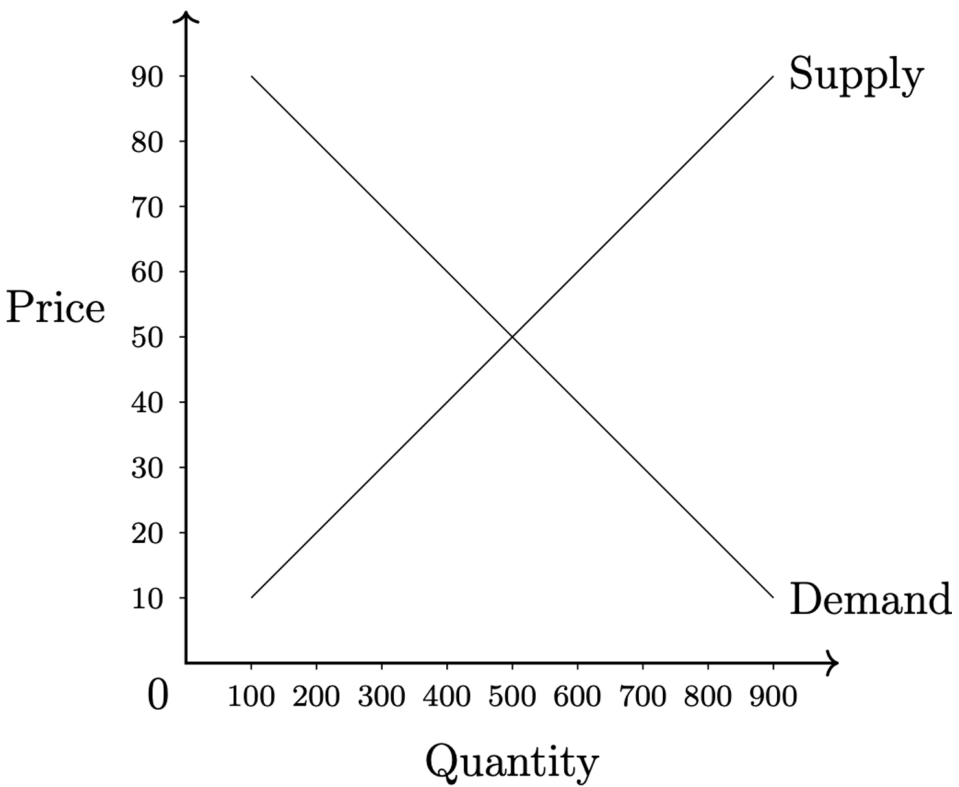 Figure 2 A supply and demand graph for an arbitrary good, a ‘widget’. Note that the independent variable, Price, is listed on the y-axis, while the dependent variable, Quantity, is listed on the x-axis. The point at which the supply and demand curves intersect is the equilibrium price and quantity for the market.
of $10is 100 widgets, then this could mean that one person plans to buy 30 widgets at a price of $10, another person plans to buy 20 widgets at a price of $10, a third person plans to buy 50 widgets at a price of $10and no one else plans to buy any widgets at a price of $10. Of course, many other combinations are possible. For simplicity, we can say that the demand curve for widgets shows how many widgets the economy plans to purchase at every possible price. Note that, for historical reasons, the independent variable, price, is listed on the -axis, while the dependent variable, quantity, is listed on the -axis.
Similarly, the supply of widgets is the sum of every individual’s plan to sell some quantity of widgets at every possible price. As with the case of demand, we can say that the supply curve for widgets shows how many widgets the economy plans to sell at every possible price.
The demand curve slopes down because people plan to buy fewer widgets when they are priced higher and more widgets when they are priced lower. The supply curve slopes upward because people plan to sell more widgets when they are priced higher and fewer widgets when they are priced lower.
The meaning of the term ‘plan’ must be clarified in the context of supply and demand. In ordinary language, the word ‘plan’ is often understood as an intellectual object without real-world implications. For example, someone might plan a dream vacation without ever expecting to actually embark upon it. In the context of supply and demand, however, when we say that someone plans to buy a certain number of widgets at a certain price, we mean that they will act to do so, and they will succeed if their plan is feasible given all of the other plans in the economy. Plans in economics are real intentions, not vague hopes. This means that supply and demand curves tell us what people will try to do, at least in terms of buying and selling, which makes supply and demand a powerful tool for analysing economic behaviour.
The supply and demand model is a useful way of understanding the price system because of the degree of dimensionality reduction that it offers. Relative scarcities are determined by the interactions of many plans, which are themselves summaries of a tremendous degree of information regarding the planner’s brain, their body and the environment they occupy [89]. However, in the market, where all plans to use or obtain resources are plans to buy resources, then plans to use resources are condensed into demand functions. Similarly, plans to make resources available are condensed into supply functions. Demand and supply functions are in turn condensed into prices, allowing a single number, the price, to summarize an enormous amount of information—specifically, information that determines relative scarcities.
The point at which the supply and demand curves intersect is the equilibrium point, and the market for widgets is said to be in equilibrium at this point. The price and quantity that correspond to this point are the equilibrium price and equilibrium quantity, respectively. At the equilibrium point, the number of widgets the economy plans to buy is the same as the number of widgets the economy plans to sell. It follows that all plans to buy and to sell widgets are mutually compatible with each other: at the equilibrium price, anyone and everyone’s plan to buy and/or sell widgets is compatible with everyone else’s plans to buy and/or sell widgets. (Recalling that plans are genuine expectations to act—if someone merely wishes they were buying or selling more than they currently are, this does not mean that their plans are incompatible with anyone else’s plans when the market is in equilibrium.)
If all markets are in equilibrium, not just the market for widgets, then the economy is said to be in general equilibrium. In the case of general equilibrium, all plans to buy and to sell across all markets are mutually compatible. It is known that there are conditions under which general equilibrium exists [90].
Our focus is not on the existence and other properties of general equilibrium but instead a more basic and fundamental understanding of how the price system enables people to bring their plans into mutual compatibility. The crucial idea is that when a good becomes more relatively scarce, it becomes proportionately higher priced, and when a good becomes less relatively scarce, it becomes proportionately lower priced.
To understand this, recall that a good’s scarcity is how much it is planned to be used relative to how available it is, and a good’s relative scarcity is how scarce it is relative to other goods. Note that in the context of market activity, a ‘use’ is simply a ‘purchase’, with the actual use of the good left up to the private goals of the individual economic agent who purchased it. That is to say, when a good is planned to be purchased, details about how the good is used are irrelevant for the question of how to achieve the mutual compatibility of plans.
Now consider the effect of a change in plans on the relative scarcity of a good. If people plan to use more of a good while its availability remains fixed, then the good becomes more scarce relative to other goods. As just stated, the use of the good can be equated with the purchase of it. Therefore, an increase in the amount of the good that people plan to use can be reframed as an increase in the amount of the good that people plan to purchase at every price. An increase in the amount of the good that people plan to purchase at every price is an increase in demand. Therefore, an increase in demand tracks an increase in the relative scarcity of a good (noting that the demand for all goods cannot increase simultaneously under the assumptions that people have fixed budgets and are always planning to spend the entirety of their budgets).
As can be seen in the graph (figure 3), when the demand for widgets increases, the equilibrium price goes up as well. The more demand increases, the greater the resulting increase in the equilibrium price will be. Thus, an increase in the relative scarcity of a good corresponds to an increase in the price of the good. This idea, that prices vary with relative scarcities, is the key point of this exposition. By a symmetric argument, when people plan to purchase fewer widgets, the demand for it goes down, and it becomes less relatively scarce and lower priced (figure 4).
Similarly, when people plan to make widgets more or less available, thus decreasing or increasing, respectively, the relative scarcity of widgets, this translates to an increase (figure 5) or decrease (figure 6) in supply, which lowers or raises the equilibrium price, respectively.
So as we have seen, increases in demand and decreases in supply correspond to increases in the relative scarcity of widgets and cause increases in the equilibrium price of widgets by a proportional amount. Similarly, decreases in demand and increases in supply correspond to decreases in the relative scarcity of widgets and cause decreases in the equilibrium price of widgets by a proportional amount. Therefore, equilibrium prices track relative scarcities. It follows that in general equilibrium, when all prices are at their equilibrium values, all relative prices convey relative scarcities: if apples are twice as expensive as oranges, then we can infer that apples are twice as scarce as oranges.
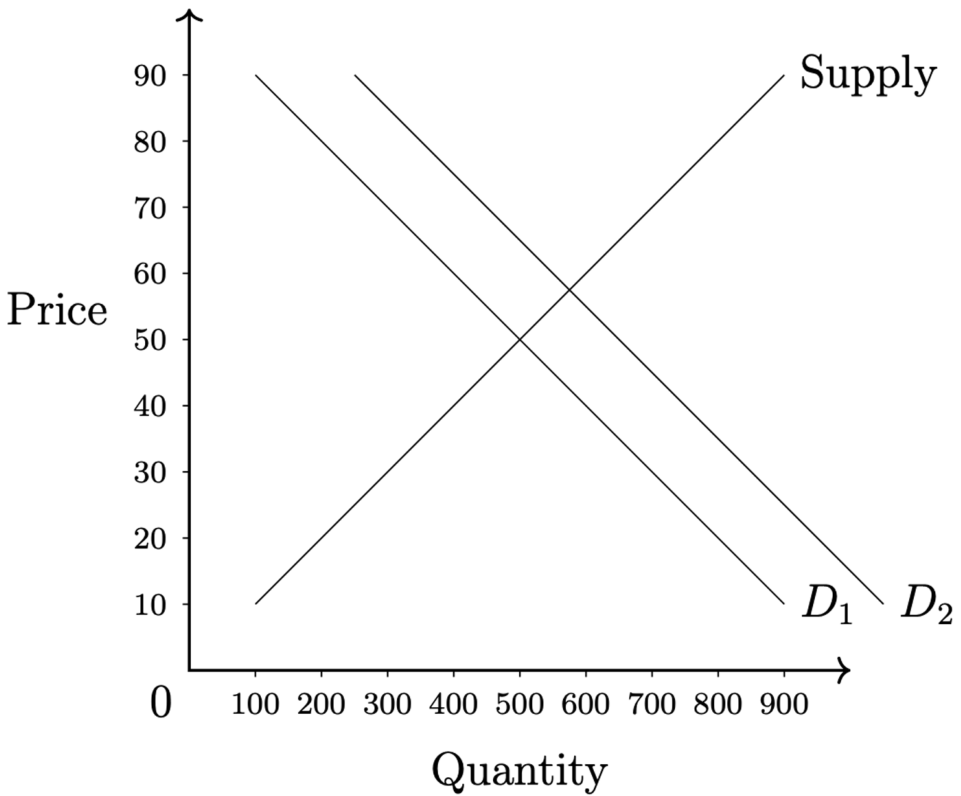 Figure 3 An increase in the demand for widgets. This increase is denoted by the shift in initial demand, , to . Note that the intersection of the supply curve with has gone up and to the right, indicating an increase in the equilibrium price and quantity for the market.
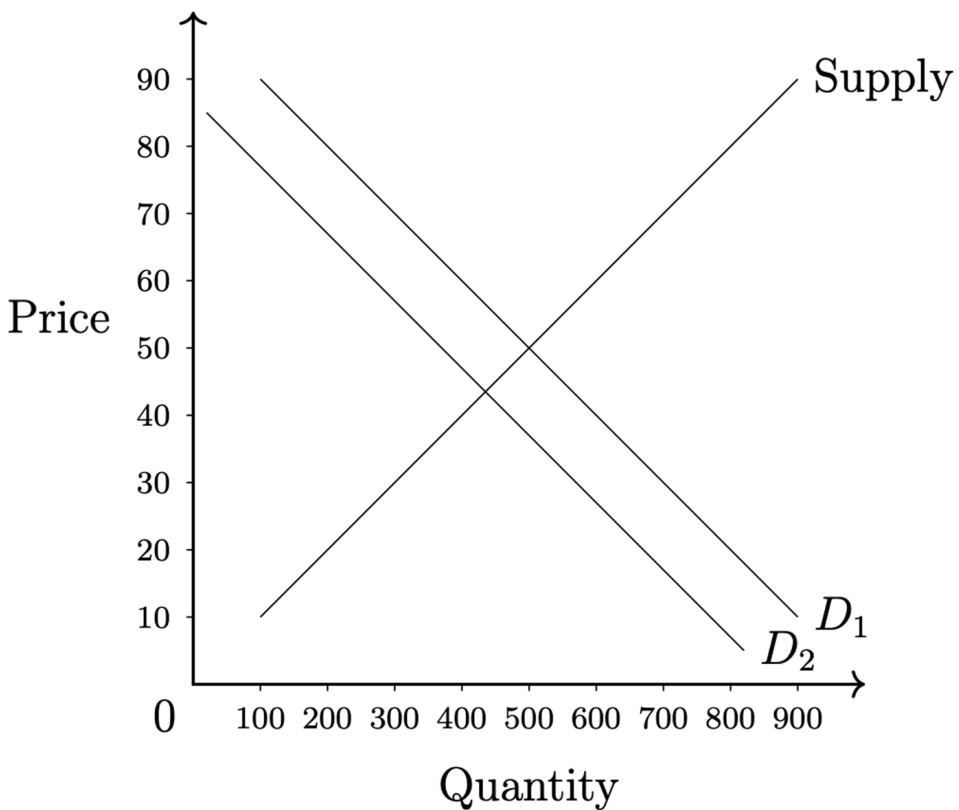 Figure 4 A decrease in the demand for widgets. This decrease is denoted by the shift in initial demand, , to . Note that the intersection of the supply curve with has gone down and to the left, indicating a decrease in the equilibrium price and quantity for the market.
Why would prices ever reach equilibrium? If the price is above the equilibrium point, then the quantity of widgets that suppliers expect to sell will exceed the quantity of widgets that buyers expect to buy. Since suppliers would rather sell their goods for something rather than nothing, they have an incentive to lower the price. If the price is too low, then suppliers will plan to sell fewer widgets than buyers expect to buy. Since the unavailability of a good is equivalent to facing an infinite price, buyers have an incentive to raise the price so that they can actually fulfil their plans to buy widgets. In short, suppliers are incentivized to bid prices down so that they can sell widgets, and buyers are incentivized to bid prices up so that they can buy widgets. The only logical stopping point is the equilibrium price.
When all prices reach equilibrium, people do not want to change their plans given the plans of other people, i.e. plans are mutually compatible. Therefore, this process by which people
Downloaded from royalsocietypublishing.org by guest on 05 July 2026
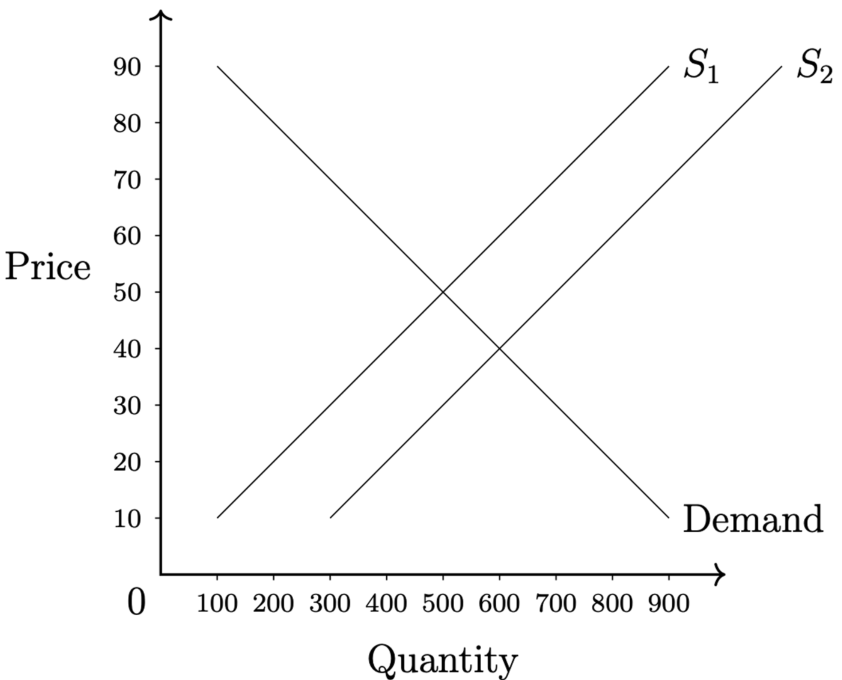 Figure 5 An increase in the supply for widgets. This increase is denoted by the shift in initial supply, , to . Note that the intersection of the demand curve with has gone down and to the right, indicating a decrease in the equilibrium price and an increase in the equilibrium quantity for the market.
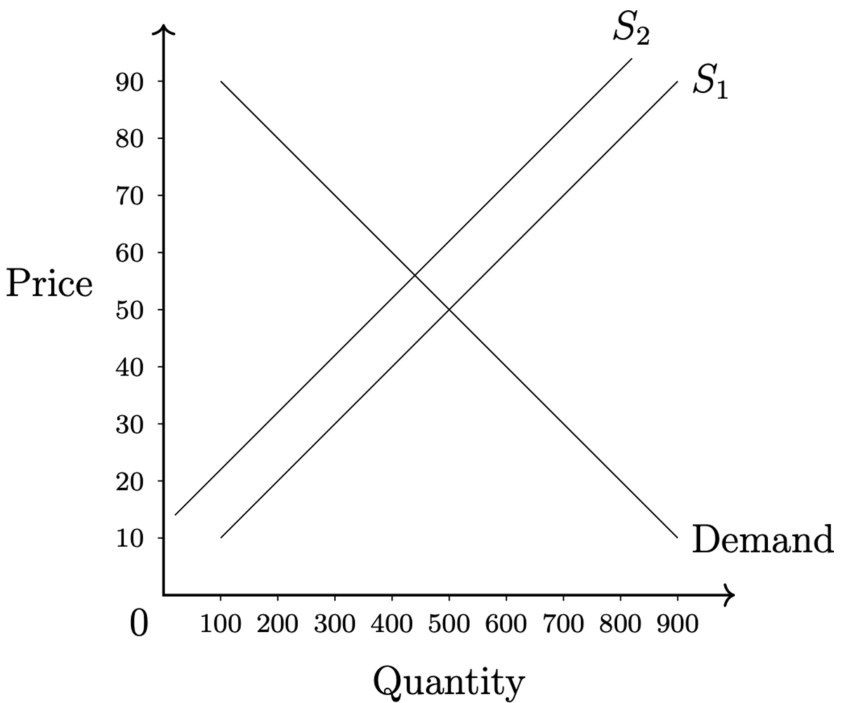 Figure 6 A decrease in the supply for widgets. This decrease is denoted by the shift in initial supply, , to . Note that the intersection of the demand curve with has gone up and to the left, indicating an increase in the equilibrium price and a decrease in the equilibrium quantity for the market.
adjust their plans for their own self-interest based on variables that track changes in relative scarcities (i.e. based on changes in relative prices)naturally leads to achieving the mutual compatibility of plans. Notably, this means that coherence within a group can be achieved without any shared goals among the individual members of the group.
This simple but powerful process describes how the price system encourages and enables people to adjust their plans so as to be mutually compatible with the plans of other people. Low prices encourage people to plan to use resources that are less relatively scarce, and high prices discourage people from planning to use resources that are more relatively scarce. Those same prices also effectively inform people as to which resources are more relatively scarce and which are less relatively scarce, though the system in no way requires that people actually understand the concept of relative scarcity. Notably, it would be very difficult for any individual to directly observe the relative scarcities of available resources. However, it is very easy for individuals to directly observe the relative prices of available goods and services, which they can do by going shopping. Ultimately, the price system serves as an affordance that people can exploit to choose plans that are mutually compatible with everyone else’s plans.
Equipped with the price system, and with prices at equilibrium or close to it in most markets, it becomes very easy for an individual to choose a plan that is mutually consistent with all other plans. They do not need to think about other people’s plans. Instead, they only need to know two things. The first is their budget, or simply how much money they have. For example, a person might have $100. The second thing people need to know is the set of currently existing prices. This data combined with their budget instantly tells consumers every possible bundle of goods available to them for $100or less. Bundles that the individual is actually able to purchase according to their budget are called feasible bundles. When prices are at equilibrium, then relative prices perfectly reflect the relative scarcities of all goods available for purchase in the economy, and so any feasible bundles are in fact possible to be purchased: the plan to buy one is mutually compatible with all other plans in the economy.
In reality, the economy is rarely if ever at general equilibrium. At any point in time, there are some prices that are not at their equilibrium value, and therefore relative prices do not perfectly match relative scarcities. However, we know from personal experience with the economy that it is usually possible to buy what you expect to be able to buy given prevailing prices. Therefore, it seems that as long as not too many prices are too far from their equilibrium value, the price system works well in practice to render most people’s plans mostly mutually compatible with each other.
Sometimes there are circumstances in which prices are kept significantly far from their equilibrium values for a long time (figures 7 and 8). An example is price caps on the price of gasoline in the 1970s. The result was a situation in which people planned to buy far more gasoline than people planned to sell. The price of gasoline relative to the price of other goods did not reflect the scarcity of gasoline relative to the scarcity of other goods to a greater degree than is usual for the economy. The result was mutually incompatible plans that manifested in long lines to buy gasoline, with people often finding out that the gasoline station had sold out by the time they finally got to the pump [91]. Empirical examples like this show that when plans conflict with each other, this creates real difficulties for people’s attempts to achieve goal states, as their behaviour is genuinely at odds with other people’s behaviour.
This brings us to the end of our exposition on the functioning of the price system. With this information in mind, we can now understand how the price system does the following things that a cognitive glue is expected to do:
-
Control over form. The economy will take whatever form in allocation space the price system guides it to. In particular, discrepancies between the prices of two similar goods will prompt reorganization of the system until the prices equilibrate. That is to say, if apples are low-priced in California and high-priced in New York, then economic agents will reallocate apples from California to New York. The form the economy takes in production space will similarly be determined by the relative prices of production inputs and the relative prices of production outputs. These relative prices determine whether a business is profitable or not, which determines the activity of the business. Interest rates, which are prices that allow people to coordinate through time, allow the economy to navigate from the present to the future, solving the complex problem of coordinating allocation and production through time as well as space.
-
Encoding goal states. In the economy, goal states are target points in allocation space and production space. The target point is reached when the economy is in equilibrium, meaning no one wants to change their plans given everyone else’s plans. Therefore, the price system cannot ascertain goal states prior to acquiring information about people’s plans but must observe, via the resulting changes of relative prices, how economic actors compete over scarce resources so as to infer their plans, or more precisely, to infer equilibrium prices given people’s plans, plans which remain private but observable in their consequences on the relative scarcities of resources. The price system thus infers or discovers goal states by the way that prices adjust in response to how people behave in the market. Goal states are encoded by the price system, not in the sense that the price
**Figure 7** The effect of a price below the equilibrium price. When the price is capped at \30, the quantity demanded, 700 units of widgets, exceeds the quantity supplied, 300 units of widgets. Thus, plans are in conflict.
**Figure 8** The effect of a price above the equilibrium price. When the price is floored at \70, the quantity demanded, 300 units of widgets, is exceeded by the quantity supplied, 700 units of widgets. Thus, plans are in conflict.
system can be decoded to infer what should be sold where and why, but in the sense that the price system constitutes a constellation of patterns that, in conjunction with people’s plans, defines the goal state of the economy.
— Encoding multiple goal states. As stated above, options contracts, which allow holders of those contracts to choose whether to buy an asset based on the current price of the asset, provide a relatively explicit example of encoding multiple goal states via prices. More generally, all prices may be thought of as allowing for counterfactual thinking due to how prices only have meaning relative to each other. If apples cost $1and oranges cost $2, for example, then the decision to buy one apple means the decision to not buy half an orange. Therefore, the meaning of a price can change radically when other prices change, and when new goods and services enter the economy and old ones enter, even if the price in question stays constant. This means that at any given time, the price system contains patterns that imply many different possible goal states when appropriately evinced by changing circumstances in the economy.
Downloaded from Royal Society Publishing by guest on 05 July 2026
-
Mnemonic improvization. Prices are extremely flexible at applying to new contexts. Prices can easily be applied to new goods and services, or removed from old goods and services that are no longer worth selling at any price. Prices can also be conveyed by many forms of communication, such as speech, ink, electrical signals, etc. Prices also change meaning automatically when other prices change, as indicated above, simply by virtue of the fact that prices are numbers, and the relative value of a number changes automatically when the other numbers it is being compared with change.
-
Prepatterns. A seller who knows nothing about non-price trends in the economy can still make a profit and unwittingly aid in bringing the economy to its goal state simply by following prices. For example, if the seller makes hamburgers, and the seller observes that cheeseburgers sell for a higher price than hamburgers do beyond simply the additional cost of adding cheese, then the seller will also start selling cheeseburgers and rake in the profits, even if the seller does not understand why cheeseburgers are popular relative to hamburgers. Similarly, a buyer can follow low prices to make desirable purchases, as long as they can evaluate the quality of the goods they buy.
-
Hijackability/external control. The price system is simply an array of numbers and so are highly manipulable by external agents who can change the array of numbers. Governments, for example, can tax some goods to increase the corresponding prices, and subsidize other goods to lower the corresponding prices. Internal agents may also be able to hijack the price system, such as via attempts to corner a market or to manipulate a market via a large amount of buying or selling. Price-setting firms might usefully be thought of as hijacking the price system as well. Note that for all three examples, the use of the term ‘hijack’ is meant in a purely positive sense with no normative implications.
-
Scaling. Under what might be considered ‘natural conditions’, a human has few goals other than to find food and shelter. When presented with the price system as an affordance for forming plans, people’s goals scale up radically to the point of running enormous multinational corporations with production and allocation plans that span many countries and many decades. Similarly, under ‘natural conditions’, people can perhaps coordinate in small bands that rarely exceed a few hundred people. But with the price system, people can coordinate with millions or even billions of people, as evidenced by the modern global economy.
-
‘Owner wiping’/partial erasure of identity/anonymization of memory/stress sharing. When someone experiences a novel stress, they change their plans. Given a fixed budget, a change in plans necessarily means buying more of some good and buying less of another good. As a result, demand for one good goes up, and so does the price of the good, and demand for another good goes down, along with its price. When other buyers see the higher price of the first good, this makes their plans, formed based on the previous, lower price, incompatible with this new price, thus causing ‘stress’, or the perception of distance from a goal state. As a result, other buyers will form new plans to buy less of the first good and more of the second good, which solves the problem of the person who first experienced the novel stress by making the good they plan to buy more of more available to be bought. Nothing about the way the price system shares stress conveys whose stress started the process or what caused the stress they experienced. The price system turns one person’s problem into everyone’s problem, compelling the entire economy to seek a solution, without requiring that anyone think about anyone’s plans but their own.
-
Credit assignment. When farmers grow food and sell that food to other people, they spend a great deal of time and effort while other people literally enjoy the fruits of their labour. Nevertheless, the survival of a large population requires farmers to engage in such
seemingly self-sacrificial behaviour. The price system solves this problem by assigning credit in the form of profit to the farmers who did the hard work. It is noteworthy that if a farmer uses a large amount of relatively scarce resources to produce very little food—say, a thousand tractors to yield one turnip—then the price system will assign very little credit to them, possibly negative credit in the form of a net loss. If the farmer uses very few relatively scarce resources, or substitutes the use of less relatively scarce resources for the use of more relatively scarce resources, to produce a large amount of food, then the price system will assign a great deal of credit to them, as their costs are low and their revenues high. Note also that this is true only if the farmer produces food that other people would actually plan to eat, and their revenues are a function of the degree to which people will plan to eat the food they grow.
In sum, the basic picture of the price system as cognitive glue is quite straightforward. To achieve a well-coordinated economy that may reasonably be called a collective intelligence, it is necessary to render everyone’s plans mutually compatible. The degree to which plans are mutually incompatible with each other is described by the scarcities of the resources that the plans expect to use. To solve this problem, it is necessary to convince people to change their plans to substitute away from plans that use more scarce resources and towards plans that use less scarce resources. However, people cannot easily perceive how scarce one good is relative to another, nor would this information necessarily motivate them to plan to use less relatively scarce resources. Prices solve this problem by varying with relative scarcities while also being very easy for people to observe. Moreover, since higher prices discourage people from buying and encourage people to sell, the price system naturally incentivizes people to substitute away from planning to attain more relatively scarce resources towards planning to attain less relatively scarce resources. Because it is very easy for people to use prices in conjunction with their budget to determine their set of feasible bundles, it is consequently easy for people to use the price system to form plans that are mutually compatible with everyone else’s plans, not out of care for others but out of self-interest. The result is that when people solve their own problem—the problem of choosing which feasible bundle of goods they want to purchase—they unintentionally end up solving the collective problem of how to render their plans mutually compatible with everyone else’s.
2. The economy as a collective intelligence
Equipped with the above elementary but vital understanding of the price system as a cognitive glue, we are ready to analyse the properties of the economy from the perspective of viewing it as a collective intelligence. We consider established properties of collective intelligence from the literature [21,92] and show how the economy shares these properties.
(a) Economy as intelligence
That an economy is a collective is clear from the mere observation that it is composed of people, businesses and governments. To justify calling it an intelligence, however, and to motivate the use of CI concepts to analyse and control the economy, we must observe that it has problem-solving capabilities.
Different intelligences solve problems in different spaces. Collections of cells, for example, solve problems in morphospace [4]; without this collective problem-solving ability, multicellular bodies could not form in nature except by random chance. The economy primarily solves problems in ‘allocation space’: it solves the problem of determining the optimal allocation of scarce resources.
Here is a simple example of a problem in allocation space. Suppose that there are two people, Alice and Bob, and one bottle of wine that can be allocated to one of them but not the
other. Suppose also that Alice greatly enjoys wine, while Bob barely cares for it. Who should get the bottle of wine?
The obvious answer is that Alice should get the bottle of wine because she will enjoy it more. But how is the system supposed to know that Alice enjoys wine more than Bob? Alice could say that she greatly enjoys wine, but Bob can also say that he greatly enjoys wine. We need a way of reliably evoking true information.
Imagine a human tasked with solving this problem. Putting their intelligence to the task, the human might conceive of interviewing Alice and Bob to determine who will enjoy the bottle of wine using lie detection. With sufficiently advanced lie detection technology, the human might catch Bob in his lie. However, humans have yet to produce a reliable method for detecting lies [93,94]. Even if such methods did work, they and other methods that directly try to observe inner properties of Alice and Bob, such as their wine preferences, are costly and do not scale to the size of the entire economy.
A cleverer technique is one that is unlikely to be a human’s first idea despite their intelligence but which the economy routinely and naturally employs. The technique is to use prices to induce honest behaviour from Alice and Bob. An auction would swiftly reveal that Alice is willing to pay more for the bottle of wine than Bob because while it is one thing for Bob to say that he likes wine as much as Alice, it is quite another thing for him to actually pay the same prices as she. As a result, Alice would outbid Bob and buy the bottle of wine, achieving the optimal outcome or goal state in allocation space. Using prices to induce honest behaviour allows the problem of the allocation of the wine bottle to be solved quickly and correctly.
The real-life problem of the allocation of scarce resources is much greater than allocating a single wine bottle. There are billions of people in the world and millions of goods and services of all different kinds are produced every year. How should these cars be allocated, and how should they be sent to where they are going? This is an incredibly complicated question, but the economy nevertheless determines an answer.
Complex intelligent systems can convert problem-solving strategies from one problem space to another, for example repurposing competency in navigating morphospace into navigating behavioural problem-solving in three-dimensional space [20]. The economy similarly exhibits an ability to repurpose its ability to solve problems in allocation space into solving problems in production space, that is, solving problems about the economic production of goods and services. The production of a good as seemingly simple as a pencil actually requires a tremendous degree of coordination across many people separated by space and time [74], but because production problems can be approached as problems of the allocation of production inputs, including labour, the economy is able to solve challenging production problems.
Not only is finding solutions in production space sensitive to a tremendous amount and variety of data, but the data are constantly changing. Nevertheless, supply chains are able to adjust to new and changing obstacles related to supply, demand and cost [95], for example by finding substitute inputs for a production process. The ability to achieve the same goal in different ways is William James’ definition of intelligence [1].
James’ definition can be expanded to the concept of a ‘perceptual field’, or the range of space and time across which the agent can examine to find ways of solving problems [21]. The economy has the observed ability to coordinate across Earth-sized spaces, as evidenced by trade between, e.g. the USA and China, and the ability to coordinate up to at least a century in time, as evidenced by the existence of 100 year bonds.
Additionally, the economy’s intelligence is demonstrated by its ability to construct and maintain markets in situations where even professional economists are sceptical of solutions (e.g. [96–98]), and the ability of markets to reach equilibrium faster and under less restrictive conditions than economists had assumed [99]. The comparison with economists is relevant because economists are intelligent, and so if the economy produces solutions that economists did not think of, then this indicates that a concept of intelligence can reasonably be applied to the economy.
Of course, the economy is hardly a conventional example of an intelligence. It has no singular mind (at least, not of a form we can recognize), it has no face, and no detectable consciousness, given current technology. Its ‘thoughts’ are not processed by neurons, nor does it run on electrical connections. Instead, the economy is a form of diverse or basal intelligence, an intelligence that occurs in an unconventional substrate [5,100,101].
These observations show that the economy is plausibly an example of basal cognition, a diverse intelligence. We next consider its properties as a collective intelligence specifically.
(b) The economy as a collective of autonomous entities
All collective intelligences derive their competencies from the organization of competent subagents [92]. The competencies of brains do not exist without some organization of the competencies of neurons; the competencies of bodies do not exist without some organization of the competencies of cells. Similarly, the competencies of the economy rely on an organization of the competencies of individual human beings.
The competency of the collective accordingly depends on the autonomy of the entities that compose it [5,102]; otherwise the collective would not be able to exploit their individual competencies. The economy similarly relies on the autonomy of the human beings who compose it. There are broadly two reasons why.
The first reason is that the well-functioning of the price system, the cognitive glue that enables the economy to operate, depends on the problem-solving capabilities of the humans in the economy, capabilities that they can only exhibit if allowed to pursue their own ends. The price system can only do one thing: it adjusts prices, which encourages people to change plans—to plan to use less of what is higher-priced and more of what is lower-priced. But it does not and cannot tell them how to change their plans, or what to change their plans to. Consequently, without the ability of human beings to form new plans using their own intelligence, the price system would be useless. Additionally, prices that are not at equilibrium and therefore do not reflect relative scarcities are motivated to find equilibrium when and only when people discover that their plans fail based on existing prices, which again requires that people be pursuing their own plans.
The second reason is decentralized information. To solve problems in allocation space, the economy relies on information that is dispersed among people rather than being centralized in one location [76]. For example, in the above example with Alice, Bob and the bottle of wine, solving the problem of where to allocate the bottle of wine requires information about Alice’s preferences and Bob’s preferences, but this information is located only within Alice and within Bob respectively. To acquire this information, it is necessary to induce Alice and Bob to behave so as to reveal it. If Alice and Bob can only do what is instructed to them by a system that does not already have information about their preferences, then the system will not be able to instruct Alice and Bob to behave in ways that induce the necessary information to achieve the optimal allocation of scarce resources except by random chance.
Simply put, if a subagent can only do what you command them to do, then you cannot exploit them to solve problems that you do not already know how to solve.
The economic subagents who make up the economy do not deliberately contribute their competencies to the greater economic whole. Instead, they simply solve local problems based on their local circumstances. A similar pattern is observed with multicellular organisms and the individual cells that compose them [92].
Because the economy can solve problems that none of its subagents can, the intelligence of the economy cannot be reduced to the intelligence of the economic agents, nor can the competencies of the economic agents be attributed to the instructions provided by the price system because the economic agents have information and competencies that the price system lacks. Instead, the economy and the humans who compose it solve problems in different
problem spaces, a relationship exhibited by other collective intelligences [14,103]. Tissues, for example, can solve large-scale morphogenetic problems that individual cells cannot [104].
We take up next the question of how the economy can be composed of nothing but economic agents in combination with each other and yet exhibit a different set of competencies from any of those economic agents.
(c) Intelligence as an organization or structuring of the autonomous agents brought about via connections
There are three salient hypotheses for how a collective intelligence can be more than the sum of its parts. The first is that there is a privileged substrate or set of concrete phenomena that produce collective intelligence. The second is that, notwithstanding the above argument regarding autonomy, there is some set of instructions provided by the collective to the parts that ensures the correct behaviour of the parts. The third hypothesis is that the organization or structuring of the parts via connections between the parts that constitute a cognitive glue in the aggregate leads to collective intelligence.
In a general sense, basal cognition does rely on a privileged substrate. However, that substrate is not neurons, transistors, or any other kind of special arrangement of molecules. Instead, the privileged substrate is agential material: by working with a substrate that is itself capable of solving problems, the collective gains the potential to aggregate those abilities and apply them to new problem spaces [14,105]. In multicellular organisms, the ability of individual cells to find their right place in a larger structure of cells [22] is aggregated and applied to three-dimensional behavioural problem-solving; in the economy, the ability of individual humans to purchase their optimal feasible bundle of goods given their budget and publicly available prices is aggregated and applied to solving problems in allocation space.
While an agential substrate is apparently necessary for collective intelligence, it is not sufficient. A mass of human beings is not an economy any more than a mass of cells is a body. Something must organize the collective into a coherent whole. How is this done?
One potential answer is that there is a set of instructions, somehow accessible to each individual agent, that tells them what to do from the perspective of the collective. In biology, this might be thought to be DNA: each cell has the organism’s DNA inside it, so if they follow the DNA’s instructions, this might explain how cells are organized. However, the DNA does not contain morphological instructions [106]. Studying the DNA does not tell you, for example, whether a frog-axolotl hybrid will have legs made of frog cells or axolotl cells [3].
The example of the economy is even more devastating for the hypothesis that instructions are necessary and present somewhere, as economics simply does not have a DNA analogy. No economist believes in a set of instructions guiding individual behaviour to create a coherent economic whole, as there is no empirical basis for such a belief.
Not only has a set of instructions not been discovered in both biology and economics for explaining the coordinated activity of parts, but instructions have been shown to be unnecessary for such a task. Instructions were once believed to be necessary for complex motor behaviour to exist, with familiar activities such as walking being explained by the brain enacting some kind of genetically determined programme [107]. However, no such motor programme has been found, and experiments have shown that infants are able to walk earlier than the programme is supposed to have developed when environmental conditions are appropriate [108,109].
A rote walking programme probably seems adequate if envisioning the simplest example of walking: walking in a straight direction on a flat, featureless plain with no distractions. However, what about a scenario where you are walking upstairs while carrying a hot cup of coffee and navigating around a toy your child left on the staircase? It is hard to imagine how an evolutionarily sculpted walking programme could suffice for this challenge. Too much crucial
information lies in the particulars of the situation to be solved by a preprogrammed response consisting of precise instructions. Successful locomotion requires a process that incorporates decentralized information such as the distribution of pressure on the bottom of the foot, the flexion in the left hamstring, etc. Motor behaviour is assembled out of the optimization of the resulting affordances and constraints in both the body and the environment based on the task, not designed and implemented top-down [110].
The task-assembled, body-dependent nature of motor behaviour indicates that it is an example of embodied cognition, from which comes a number of examples of the non-necessity of instructions for achieving complex, goal-oriented behaviour [111]. Such solutions are ‘smart’ when they are customized to the local physical, biological and environmental conditions [112]. Such solutions are also much less computationally demanding than general programmes based on physical principles, as ‘smart’ solutions exploit local affordances to equate natural outcomes with optimal outcomes. For example, the ‘swing’ of a leg that is necessary for walking is naturally achieved by the stretch and pull of the muscles in the leg and the resulting pendulum-like behaviour of the leg [107], which minimizes computational costs relative to a system that has to deliberately determine the entirety of the motion of the leg during each step.
Competencies that might be thought to be purely mental have also been shown to lack instructions. Historically, emotions were thought to be the result of evolutionarily designed mental programmes producing obligatory physical consequences such as obligatory facial expressions, e.g. smiling when happy or frowning when angry [113], but modern research based on active inference suggests instead that emotions are psychologically constructed for their utility in the moment [114]. As with motor behaviour, models of the brain that describe mental activity as the assembly of a task-oriented solution based on existing affordances and constraints are well-supported by evidence [89]. The ability of the brain to construct mental solutions to problems may rely on the agential properties of neurons [115].
To explain the coordination of agential parts that yields collective intelligence without invoking a set of instructions that have yet to be found in any collective intelligence, and which evidently does not exist in the economy, we resort instead to a theory of connectionism: relationships between the agential parts that allow them to achieve a large-scale organization as the natural result of each agent solving local problems based on, and resulting from, their relationships with other agential parts. In doing so, capabilities and phenomena are constructed, possibly in a manner analogous to how psychological phenomena such as emotions are constructed. The relational substrate that creates and updates these connections is the collective intelligence’s cognitive glue.
(d) Connectionism
Collective intelligence relies on the intelligence of its subagents, but their intelligence is always insufficient to explain the greater collective intelligence. That is to say, collective intelligence does not come about because the intelligent subagents are smart enough to solve the relevant coordination problems simply by applying their intelligence to them. Instead, functional relationships between the subagents is what enables a greater collective to emerge [92].
The idea that collective intelligence, whether a nervous system, a brain or an economy, emerges when the relevant subagents are organized by their relationships with each other is called connectionism [116–118]. Connectionism moves our focus from the individual nodes of the system to the distributed network that relates the nodes to each other. The utility of connectionist models is in helping us to identify and describe situations in which intelligence emerges from nothing but the local problem-solving of the subagents, where the connections transmit problems and solutions throughout the system such that the result is a coordinated whole.
In economics, the connections are prices, and the resulting system of connections is the price system. The usefulness of the price system to the collective is that it achieves the mutual compatibility of plans of the subagents, but despite the apparent complexity of this problem, the operation of the price system only requires that each individual economic agent solves their own local problem, the problem of buying the optimal bundle of goods and services given their budget and the existing set of prices. In this sense, the price system operates as an affordance that exists to be exploited by all members of the economy. As long as prices are at or near equilibrium, then every member of the economy can confidently expect that their plans to buy and sell goods will be fulfilled with high probability. Moreover, if prices are not at equilibrium, people can expect to better achieve their own plans by acting to bring prices to equilibrium, such as by buying goods where the price is below equilibrium and selling goods where the price is above equilibrium, which raises the price in the former region and lowers the price in the latter region.
The connectionist system of prices reduces a hugely complex problem into a relatively simple one. A basic general equilibrium model, for example, consists of little more than a set of feasible production plans for producers and a set of feasible consumption plans for consumers, along with their preferences over said plans and the determinants of their budget [119]. The essential transformation is to take a system of many independent variables, such as details about the location of a particular good, the internal facts of a particular person, etc., and instead represent it as a system of relationships between variables [92], specifically the relative scarcities that sum up all of the inconsistencies between people’s plans that result from the main independent variables. As a result, the system need not compute nearly as many variables as it initially may seem but instead can simply display in relative terms the results of the interactions of the variables.
The role of relative values rather than absolute ones is crucial. In the brains of frog embryos, downstream gene expression is driven by the spatial difference in voltage between regions rather than absolute values [120,121]. Similarly, any price in isolation is meaningless. Only relative prices matter. For example, if an apple is twice as scarce relative to an orange, then it does not matter whether apples cost $2 and oranges cost $1, or whether apples cost $4 and oranges cost $2, so long as the price of apples relative to the price of oranges reflects the scarcity of apples relative to the scarcity of oranges.
The result of such a system is a ‘cascading control architecture’ where the manipulation of a few variables causes large changes throughout the system [92]. Capping the price of oil can cause significant shortages leading to long lines and the frustration of many plans [122]. Simple auction mechanisms [123] and incentives [124] can enable a nation, and even the entire world, to rapidly produce and allocate vaccines in response to pandemics.
But while the price system clearly enables people to achieve mutually compatible plans, this does not clarify why their behaviour appears collective rather than merely non-contradictory. The collective nature of economic behaviour is clarified by understanding how prices solve the credit assignment problem and achieve stress sharing and reward sharing.
(e) Credit assignment, stress sharing and reward sharing
Rats can be trained to push a lever and receive a reward [125,126]. However, the rat is composed of many cells, and the cells that push the lever are not the cells that consume the reward [92]. If the skin cells of the rat’s paw did not press the lever, and the cells of the rat’s intestine did not expect to eat, then these plans would be mutually compatible, but the collective intelligence of the rat would not be apparent (figure 1a). The rat would be a society of individuals rather than a coherent whole.
Any collective intelligence must solve the problem of credit assignment [92]. This problem is clearly visible in the economy, and so is its solution. In the economy, the farmer who grows food is not the consumer who eats it. The same can be said for virtually every other good. Outside
of home production [127], most goods and services are produced by some individuals for other, different individuals. Often, the producers have no idea who their customers are and feel no sentiment for them. How, then, are people coordinated to work for other people whom they do not see and do not psychologically care for?
The answer lies in stress sharing and its corollary, reward sharing. Stress refers to the distance between an agent and its goal state [26]. The intuitive idea of how stress sharing enables collective action is that if one agent is able to share its stress with another agent, then the second agent is motivated now to solve the problem posed to it, creating a solution that may well reduce the stress for the other agent as well.
The operation of the price system can easily be understood in terms of stress sharing, as well as reward sharing. Suppose that someone’s power goes out and all of the food stored in their freezer goes bad. This new source of stress will motivate them to update their plan, which will be condensed into their increased demand for food, meaning they will plan to buy more food at every price. The result of increased demand is an increased price (see Figure 3). Other food buyers will see this higher price and find that their plans to purchase food are no longer feasible given the higher price. This means these other buyers are now in stress, so prices have shared the stress from the original person to all other buyers in the market. To reduce their stress, buyers of food will determine new plans that reduce the amount of food that they plan to purchase, leaving more food available for the first person, which is exactly what they need to solve their own problem.
From a bird’s-eye view, it looks as though the person whose power went out communicated their problem and needs to everyone else in the economy, who graciously chose to accommodate them. But in reality, the person whose power went out was simply able to convey their stress through the price system, which naturally incentivized everyone who consequently shared in that stress to adjust their own behaviour in ways that enabled the first person to solve their own problem.
The same price relationship also enables reward sharing. Just as the higher price of food stresses out food buyers, it excites food sellers, who are motivated to adjust their plans to sell more food. The reward that sellers receive from the higher price is the reward shared from the food buyer who can restock their freezer. This reward sharing assigns credit to the problem-solvers, solving the mystery of the altruistic farmer described above.
(f) Memories, multi-modal summaries and generalization
Intelligence often benefits from memory. Biological memory is not, however, a system for storing and recalling precise patterns because it involves a complex physiological layer of interpretation of the information, whose result is not an exact copy of prior actions but rather a context-sensitive, creative, adaptive behaviour prompted by the engrams of prior experience. In effect, it optimizes for salience, not fidelity, of information on the evolutionary, developmental and behavioural scales (reviewed in [83]). Many diverse intelligences remember useful patterns or lessons, not exact literal details, by generalizing from previous experience.
Because memories do not need to recall exact details, they can be constructed somewhat on the fly, out of available elements rather than ‘stored’ somewhere [89,128]. Memories are consequently not constrained to particular substrates or even particular elemental combinations within some substrate (e.g. particular molecules or molecular combinations within a molecular substrate). Therefore, it is useful instead to relate memories to ensembles of interrelated physical signals that coevolve through time across the entire system, which in combination represent patterns of possible features as multi-modal summaries [89,129,130] that can be tested against incoming physical signals from the external environment. The constructed, relational, coevolving nature of these signal ensembles are consequently flexible and can be adjusted in response to unexpected external signals, enabling learning and therefore a kind of predictive processing [131–137].
The economy exhibits memory in several respects, the most important of which is probably the phenomenon of economic growth. Like organisms, the economy develops and grows over time. Unlike organisms, it does not have a mature target point but instead grows continually. The sense in which an economy gets bigger is also much more abstract than the sense in which an organism gets bigger. However, both economic growth and organismal growth share the same abstract character.
When an organism grows, it does not do so by creating additional mass and energy for itself, as it has no ability to do so. Instead, the organism grows by extending how much control it has over the mass and energy already present in the environment. Even when an organism maintains its size or target morphogenetic state, it does so by perpetuating its control over an existing environmental range, which requires continually solving new problems by generalizing from old problems as conditions change in and around that controlled subset of the environment. Over time, this is an example of memory. To accomplish this, the organism cannot simply maintain control over a fixed set of cells or molecules, as individual cells die and individual molecules are used up and transformed, or exhaled or otherwise removed, etc. Instead, the organism has to remember, in the functional (cybernetic) sense of the word ‘remember’ as we are using it here, how to maintain a level of control over a pattern of cells or molecules that is not only not ever the same set of cells or molecules from one point in time to another point in time, but is not even isomorphic to the previous set because the number of cells or molecules is not fixed over time. This means that memory is not a passive, continual application of a stored pattern but an active process of problem-solving to take an ever-changing dynamic system and constrain and manipulate it into exhibiting a pattern of behaviour—that pattern being the organism itself.
Economic growth is analogous. When an economy grows, it does not do so by adding mass and energy into the system, as it has no ability to do so. Instead, it grows by extending its control over the mass and energy that already exists, transforming them into resources that contribute to allocation and production processes. Over time, these resources change dramatically—one oil reservoir is drained too low for it to be economical to extract more, for example, while another oil reservoir elsewhere is discovered—but the pattern of economic activity is maintained—in particular, a pattern of abstract conditions, such as market equilibrium and the equality of marginal revenue with marginal cost, etc. Similarly, the economy’s ability to engage in any form of activity depends entirely on the behaviour of the people and firms who make up the economy, but those people and firms are constantly changing. People are born and die, and over time change their skills and interests. For example, a programmer with one set of skills and programming knowledge retires, while a different programmer reaches maturity and joins the job market with different skills and programming knowledge. Firms, similarly, change over time. Some go out of business, others are founded; some firms grow, other firms shrink; a given firm may substantially change what goods and services it provides and how it provides them over time. Individual consumers change their preferences over time, and the set of consumers changes over time as well. Thus, an economy can never rely on a fixed agential substrate with which to sustain fixed memories. Instead, the size and development of an economy is actively maintained as a dynamic process of anticipating and adapting to changing environmental circumstances to maintain efficient use of resources, akin to allostasis [138]. The economy’s memory is its ability to apply lessons and abilities acquired in the past to current situations to maintain efficient allocation and production, and economic growth describes the ability to acquire new and more effective memories that apply to broader classes of events. Interestingly, the economy’s memories can also degrade to the point where the economy experiences negative growth, which is called a recession.
The price system also exhibits memory. In doing so, it provides an example of memory that greatly simplifies and clarifies our understanding of what memory is. Prices are memories most obviously in the sense that they are caused by events in the past, and ‘store’ that information in the sense that if the future were to stay the same as the past, then the prices formed in the past
would stay the same as well. However, it is not possible to decode prices to deduce any specific details of the past. If apples cost $1, there is no way to use that fact to determine any historical details about apples or about any factors relating to apples. It is not even possible to deduce that apples existed in the past because the price of apples might be determined by a futures contract for a good that does not yet exist but is anticipated to exist in the future.
The non-decodability of prices limits their utility for making sense of the past. However, it increases their utility for preparing for the future. Because the interpretation of prices is not constrained to the past, it is also not constrained to a particular future that resembles the past in some specific way. Therefore, economic agents are free to interpret prices according to their preferences, constraints, affordances and expectations.
The meaning of a price is also easily understood. Prices are relative: they have meaning only in relation to each other. A price of $1 tells you nothing; the fact that one good costs $1 and another good costs $2 tells you that buying one unit of the first good means giving up half a unit of the second good. The meaning of a price, consequently, is what it means for your plans: the actions you intend to take and the perceptions you expect to experience as a result. The impact of a price on your plans is its opportunity cost. Opportunity cost is what you give up by making a decision; it is the choice you could have made, but did not. That an apple costs $1 means that buying it gives up $1 of other goods you would have bought instead.
Which other goods would you have bought instead? That is determined by you and your environment. If you would have spent the dollar on oranges, and oranges cost $2, then the meaning of the $1 price of an apple is that you give up half an orange. If you would have spent the dollar on plums, and plums cost $0.50, then the meaning of the $1 price of an apple is that you give up two plums.
In real life, choices and therefore comparisons may be more complex than this. The meaning of the price of an apple may consist of several comparisons to the prices of other goods rather than only one comparison. For example, you could compare the price of apples with the price of oranges, or you could compare the price of apples with the price of oranges and with the price of plums, or you could compare the price of apples with the price of plums and with the price of office chairs and with the price of a share of a stock market index fund. The appropriate set of comparisons is determined by the agent in their environment as they construct their alternatives and assemble a choice. The ‘total meaning’ of the price of apples, then, is the set of all possible comparisons with other prices, which suggests a ‘relational realism’ approach to meaning [89,129] in which the meaning of physical signals is entirely relational. Patterns are stored in the relationships between prices, and which patterns are picked out and how they are used is determined by the economic agent based on their goals and constraints.
The flexibility in how the meaning of a price can be determined subjectively by the economic agent means that the meaning of a price can easily be generalized. Generalization is a fundamental principle of intelligence [92], allowing simple competencies to scale up in surprising and novel ways, allowing the agent in question to construct solutions in novel problem spaces. For example, the development of an infant’s ability to crawl can be understood as generalizing its abilities to reach, kick and orient itself with respect to a surface [139]. No special mental programme is required for crawling; the capacity to generalize from other motor behaviours is all that is necessary. Similarly, the ability of an infant to bang its arm against a table to make a loud noise and attract attention can be seen as the generalization of the infant’s ability to wave its arm [140].
The simplicity of prices and how they relate to each other makes it easy to see what generalization means in the context of economic exchange. If there is an economy with two goods and two prices, say apples at a price of $1 and oranges at a price of $2, and then a third good gets introduced, say plums at a price of $0.50, it is immediately obvious how to generalize the existing prices to relate to the new one. Another way of seeing the generalization of prices is how meaning changes when bringing in new data from body, brain and environment [89]. If you are craving fruit, the relevant comparison between the price of an apple and other goods
may be to compare it with the price of an orange. If some change brings about a craving for sweetness instead, the relevant comparison may be with the price of a slice of cake. The ability of the meaning of a price to be changed based on changing circumstances is generalization, and the ease with which it can be done indicates a tremendous capacity for generalization.
The powerful ability of the price system to generalize comes from the fact that the parameters that are adjusted occupy a different space from the data that the parameters adjust [118, 141]. Prices are the parameters of a model that, when properly adjusted, produces a network of relationships between people’s plans such that those plans are mutually compatible. This separation of parameters and the solution space is necessary for the former to be able to adjust to changing targets in the latter, i.e. generalization [118].
(g) The price system shapes the ‘energy landscape’ for economic agents
Collective intelligence relies on the competencies of its members, but it does not simply leave them to their own devices. It would be too much of a coincidence to expect them to use their competencies to solve the problems that are the most consequential for the collective. One conceivable solution is for the collective to directly tell its members, ‘Please solve these problems; they are the most important’. However, it is not clear that collectives have such messaging capabilities to their individual members, and such a messaging system would be informationally redundant and computationally complex. It is also not obvious why the members of the collective would be motivated by such a message, nor why they should believe its veracity.
An alternative method by which the collective can manipulate its members to behave in socially useful ways is to deform their energy landscape so that when they solve their own local problems for their own individual rewards, the result is something that the collective finds rewarding [21, 92].
The economy’s tool for deforming the energy landscape of the members of the economy is the price system. Regardless of what the particular set of relative prices are, economic agents will plan to buy their most preferred feasible bundle. However, which bundles are feasible is determined by the price system. Therefore, manipulation of the price system allows for a tremendous degree of control over individual behaviour. The ‘deformation’ of prices, really just any change in relative prices, is driven by high-level problem-solving in allocation space, but is perceived by any individual as a change in the landscape of their bundle-purchasing space, which enables the adaptive behaviour of the economy.
Beyond the price system and biological examples, are many simple and obvious examples of the phenomenon by which collective outcomes can be achieved by manipulating the energy landscape of the members of the collective. For example, if you want a group of people to sit by the northern wall of a meeting room, you can do so by arranging chairs against that wall. As each individual takes the path of least resistance and sits in the nearest available chair without moving it, then without anyone necessarily having any regard for or awareness of the larger goal, the behaviour of all such individuals in aggregate will nevertheless achieve it. By contrast, a verbal or written instruction to sit by the northern wall may go ignored or neglected if the existing arrangement of chairs does not facilitate this request at a group level.
Another intriguing example is the manipulation of a collection of iron filings [77]. If you place a collection of filings on a sheet of paper with a magnet underneath, the iron filings will form themselves around the magnetic field lines. Fascinatingly, despite the fact that iron filings are not even living beings, unlike cells, it is not necessary to precisely control their individual behaviour to achieve the intended outcome. Instead, the process by which iron filings naturally seek certain individual outcomes can be exploited at a group level by using a magnet to deform their energy landscape.
** (h) Autonomy at multiple scales**
Multi-scale autonomy is a hallmark of multicellular organisms [21,92]. Cells form tissue, organs, muscles, fibres, etc., which themselves can be usefully thought of as autonomous agents within the greater collective. For example, the adaptive, anticipatory, problem-solving capabilities of the cardiovascular system [142] and the immune system [143] are well known. A multi-scale architecture is useful because each level exhibits competencies not displayed at levels below or above it, and because each level can deform the energy landscape of the level below it in useful ways while also serving as an affordance for higher and lower levels that can deform its energy landscape to accomplish goals.
The multi-scale autonomous architecture of the economy is evident. The economy consists of individual humans, firms, markets, industries and governments, as well as other forms of organization such as families, neighbourhoods, clubs, teams and so on.
We might call the combination of individual members into more complex parts, such as the combination of cells into tissues, ‘vertical’ scaling because the parts seem to increase in size and complexity. The economy, however, also exhibits what might be called ‘horizontal’ scaling where people specialize in production tasks and the division of labour expands. The division of labour is a form of multi-scale competency architecture because each such division solves problems in its own domain, regardless of whether this is associated with any vertical scaling of economic agents into larger units of organization such as firms.
** (i) Competition and cooperation**
There is an apparent paradox in collective intelligence where the collective exists as an entity because of the aggregate cooperative outcome of the behaviour of its members, but that cooperative outcome is achieved via competition between the members. Despite this apparent contradiction, competition has been shown to be vital to achieving cooperative outcomes [144,145].
A related paradox has to do with the subagent’s likely competitors and cooperators. Naively, it might seem preferable to cooperate with those similar to you and to compete with those different from you. Instead, the opposite is observed: similar cells compete with each other, while different ones cooperate [146,147].
These observations are made more intuitive with the understanding that cells are autonomous: incentivized by the larger multicellular organism, but not enslaved by it. To a cell, the body is an environment. In an environment, it is often easier for two organisms that are different from each other to cooperate, while similar organisms will compete. For example, if two organisms of the same species eat a particular plant, and that plant is scarce, then they will compete over access to that plant. But two organisms of different species may eat different plants and therefore live peaceably side by side.
In the economy, we observe these principles as well. People who are similar to each other compete, while people who are different from each other cooperate. For example, two people with similar qualifications compete for the same job, while two people with very different careers, e.g. a sales representative and an accountant, may cooperate without issue. Moreover, competition helps to enable cooperative outcomes. Buyers are in competition with each other for access to scarce resources. Since buyers compete with each other by bidding up the price to induce the seller to sell the good to them rather than to a different buyer, the effect of their competition with each other is to push the price up should it fall below the equilibrium value. Similarly, sellers are in competition with each other for access to dollars, and since they compete with each other by lowering the price to induce buyers to buy from them rather than from other sellers, the effect of their competition with each other is to push the price down should it rise above the equilibrium value. Therefore, competition plays a crucial role in keeping prices close to their equilibrium values.
Competition can broadly be thought of as playing two roles in the economy. The first is that competition incentivizes honesty. Recalling the above discussion of stress sharing, suppose that a widget seller decides to pretend that a new stress is being conveyed through the price system and raises the price of widgets in order to make more money. If they do so, they open up the opportunity for competing widget sellers to undercut them and steal their customers, driving the price back down to the equilibrium value and punishing the liar with lost revenue.
The second role that competition plays is discovery [148,149]. How can people know the equilibrium price for the goods they buy and sell? How can firms know which goods to produce for customers and the most efficient ways to produce them? The economy has no inherent way of knowing the answers to these questions. Instead, answers emerge during the competitive process, as people who make more accurate pricing decisions or produce more desirable goods or produce goods more efficiently outcompete those who choose inferior strategies.
There is evidence that organisms require internal competition to determine optimal strategies for motor behaviour, which is a form of collective behaviour because motor behaviour requires the coordination of parts. When preparing a motor behaviour, people have many options, with those options coevolving through time as aspects of the task change, along with the salient details of the internal and external environments [150]. There is no obvious or given choice for which of many possible motor behaviours to implement [107]. A likely alternative is that the brain constructs several options in parallel and has them compete against each other; the winner is discovered as the optimal action plan and implemented as the outcome of the competition process [151].
(j) Training and learning
Agents should be able to learn and to be trained to solve problems [21,92]. There are a few obvious candidate examples for the economy’s ability to learn and to be trained.
First, the economy can be controlled with carrots and sticks. In the economic case, carrots are subsidies, and sticks are taxes. The economy can be encouraged to produce anything with a sufficient amount of subsidies for that thing; the economy can be discouraged from producing anything with a sufficient amount of taxes for that thing.
Second, economic growth can be thought of as a form of learning. Economic growth describes the economy getting ‘bigger’, but the economy does not have an obvious physical form that can be said to increase in length or mass. Instead, economies grow when they reorganize their internal activities to more efficiently use resources. The fact that an economy can grow and maintain the level it has grown to (as measured in, e.g. Gross Domestic Product or GDP) indicates the ability of the economy to learn and to remember what it has learnt.
Third, the economy can be encouraged to learn particular kinds of activities by various methods, such as by sheltering those activities from competition through a development phase [152]. The fact that interventions in the economy can encourage an economy to learn one type of activity over another indicates the ability of the economy to learn as a generalized capability rather than something fixed and rote.
(k) Externality
When connected to a network that enables a collection of parts to behave as a collective whole, each individual member of the collective can be expected to ‘play their part’ and behave as if the collective’s problems are their own through stress sharing. However, if a member is disconnected from this network, then they can become cancer [153–156]; this effect can be reversed by forcing connections between the cells once more [157].
In economics, processes that are disconnected from the rest of the economy because they are not incorporated into the price system are called externalities. The production of carbon
dioxide, specifically its allocation into the atmosphere, is an externality because the effects of this activity are not incorporated into the price that people pay when engaging in such production-and-allocation activities, including the effects caused by consumers of goods that produce such effects. Just like being disconnected from the bioelectric network causes cells to see the surrounding body as the environment, so too are carbon producers incentivized to treat the rest of the economy as the environment, i.e. something to dump waste heat into rather than something to expel waste from. The standard solution to externality in economics is to force connections between the economic agents via Pigovian taxes [158].
More generally, externalities explain all ‘developmental defects’ in economics. If a firm is producing too much or too little of something, or if a market is misallocating resources, etc., this is always in principle due to an externality, as indicated by the generally accepted truism that such outcomes are either not possible or would swiftly be corrected in the absence of externalities [159,160].
3. The price system’s goals
The price system is a useful affordance that people can make use of to achieve their goals, but does the price system have goals of its own? This question is an extension of ideas in the field of Diverse Intelligence which seeks to develop tools for recognizing goal-directedness in very unconventional substrates (whether the system is advanced enough to know/alter its goals or not). While not a necessary implication of the above ideas, we entertain this possibility here to stretch the theoretical framework further and explore the implications of unexpected goal-directedness in this system. If the price system were to have goals, in the homeostatic sense, it would be logical to hypothesize that it seeks to be accurate, and it seeks to be rational.
The price system is a model of relative scarcities. In this context, accuracy means that the price of apples is twice as high as the price of oranges when and only when apples are twice as scarce as oranges. That is to say, the relative prices should accurately reflect the relative scarcities. Rationality means that prices should update rationally in a Bayesian sense. For example, prices should move as a random walk rather than updating in a predictable direction. It is useful to say that the price system has the goals of accurately and rationally modelling relative scarcities if we consistently observe the price system anticipating and correcting deviations from its goal states of accurately and rationally modelling relative scarcities.
The reason to think that the price system has these goals is that the price system incentivizes people to improve its accuracy and rationality. Prices direct the flow of incomes, and traders can make a great deal of money by placing trades that make prices more accurate and make the system more rational. Because the system incentivizes people to achieve certain outcomes, it is reasonable to call those outcomes its goals.
The idea that the price system can usefully be modelled as pursuing accuracy and rationality has been studied most notably in asset markets, as has been the study of how well the price system pursues these goals, in the form of the efficient market hypothesis (EMH) (where the ‘market’ is the setting in which the price system operates). The EMH states that prices are accurate in the sense that assets are not systematically mispriced, with no assets being systematically mispriced given all historical, public, and perhaps all private information, and prices are rational in the sense that they reflect all available information and update as a random walk [161].
How well do asset markets achieve these goals? The question can be studied in terms of how much information asset markets incorporate into prices. Economists usually accept that asset markets, though never literally maximally efficient [162], typically incorporate close to all public and historical information into prices, but some private information is not incorporated. Particularly noteworthy is the ability of the market to correct pricing flaws, such as seasonal changes in stock prices [163]. Such situations can be modelled as challenges that deviate the system from its goal—a technique often used in behavioural science to determine the degree of
autonomous ingenuity that a system has in meeting those goals despite the external interventions.
The degree of information incorporated by asset markets into prices implies that asset markets have large cognitive light cones because publicly available information that is incorporated into prices now may have implications that span countries or decades into the future. In particular, the corrective effects of the price system that governs the asset market spans a tremendous range of space and time, with the price system able to reach and maintain goal states regarding, say, the price of an American asset based on an event in China, or the price of an asset today based on expectations that run decades into the future. The cognitive light cone of asset markets also spans widely over the dimension of asset types, as the asset market can find and maintain goal states of efficient prices as assets enter, transform, and exit the market as businesses go public, merge or otherwise reorganize, or go out of business. It may be the case that incorporating so much information while maintaining rationality over that information is precisely what scales up the cognitive light cones of asset markets.
Also of note is the ability of the price system to persist in reaching goal states despite changes to the internal functioning of the price system. For example, if the price system is unable to raise the price of a good, e.g. the price of gasoline due to a price ceiling, it can transfer the price increase elsewhere, such as by offering a ‘free’ gallon of gasoline along with a lube job that ‘coincidentally’ costs as much as a lube job plus the uncapped price of a gallon of gasoline. The development of ‘key money’, where renters pay an under-the-table fee to landlords to secure a rent-controlled apartment, is a similar innovation. More generally, the emergence of extralegal price systems, or ‘black markets’, to govern the allocation of goods and services where their trade is legally banned, demonstrates a tendency to fill niches and work towards goal states akin to the implacability of ants at a picnic.
It may seem like the price system cannot help but achieve its goals in the absence of barriers to those goals, and therefore the price system appears to work automatically rather than deliberately. However, the same argument would apply to human beings. The reason that systems do not appear to be intelligent in the absence of obstacles is because, as per the aforementioned Jamesian definition of intelligence, intelligence is only observable in the presence of obstacles.
There are three interesting observations to make about the relationship between the price system and the members of the economy. First, while the price system can only achieve its goals of rationality and accuracy through the actions of the subagents in the economy, this observably does not depend on the subagents recognizing the goals of the price system in any way, as most people are unaware of the functioning of the price system beyond their personal experiences in the market. Nor does economic theory require that subagents recognize the goals of the price system or deliberately take any action to increase the accuracy or rationality of the price system instead of simply pursuing their own self-interest. Second, while the purpose of the price system from a collective intelligence perspective is to bring about a great deal of internal cohesion within the economy, the price system depends on people being able to disagree with it—to reject the shared model when it contradicts other data they have. The price system cannot be corrected to be more rational and accurate, and therefore create a more unified collective, unless the individual members of the collective have the freedom and the competency to defy it. Third, the prices of the price system emerge from the interactions of the individual members of the economy, but at the same time, the prices of the price system govern those very same individuals. We expand on this topic, the question of the price system as a means of governance, in the next section.
4. The price system as generic model or abstract template of cognitive glue
We have now established that the price system acts as a cognitive glue by varying with relative scarcities such that the resulting array of prices serves as a model of relative scarcities to the
economic agents in the economy, who can therefore use it to form plans that will be mutually compatible with the plans of other economic agents. We have also shown that the economy behaves as a collective intelligence according to the framework for studying collective intelligence established in the literature, which justifies labelling the price system as a cognitive glue. Our purpose in this section is to outline the main points of an argument that all cognitive glues behave in a manner analogous to the price system, such that the price system can be thought of as a generic or abstract template for all cognitive glues that might arise in various contexts, such as bioelectricity.
A collection of parts operates as a society when the plans of each part are mutually compatible with the plans of every other part [77]. In economics, plans are incompatible with each other because they conflict over the allocation of resources. For example, two hungry people might each plan to buy and eat the same apple. Resources can also include things like a space or pathway, in which case incompatibilities between movement plans can also be reduced to conflict over the allocation of resources. In general, the concept of ‘resource’ is very broad and could conceivably encompass all possible sources of conflict between plans. Resources that plans are in conflict over are termed scarce.
Ideally, the economy would determine the scarcities of all resources and therefore how scarce every resource is relative to every other resource. This information could then be used to tell people which resources to plan to use less of and which resources to plan to use more of. However, actually determining the scarcities of all resources, and therefore how scarce one resource is relative to another, would be extremely computationally demanding, as it would seem to require knowledge of all the plans in the system, be they the plans of all 8 billion people in the world or the plans of all 36 trillion cells in the human body. Instead, a system that constitutes a model of relative scarcities with the following properties seems to be ideal:
- A model consisting of parameters, the units of which are not the scarcities of resources but instead are units that vary with changes in the scarcities of resources such that the relative equilibrium values of the parameters reflect the relative scarcities of the resources.
- The parameters should not constitute ‘mere information’ but should connect with the members of the collective—the individual agents who form the plans that need to be made compatible with each other—such that individual agents are motivated by the information so as to plan to use less of a resource when the model updates to show that it is more relatively scarce and to plan to use more of a resource when the model updates to show that it is less relatively scarce.
- The model should not direct the members of the collective as to how to change their plans but instead entrust this problem to the competencies of the individual members.
- The model’s updates should be swift, accurate and rational. Here, ‘accurate’ means that, e.g. an increase in the value of a parameter corresponding to an increase in the scarcity of a resource should occur only when and to the extent that the resource has become more scarce, such that in equilibrium, the relative values of the parameters reflect the relative scarcities of the resources. ‘Rational’ means rational in a Bayesian sense, e.g. prices should update as a random walk under appropriate conditions.
- To achieve conditions 1–4, the model’s updates should be direct causal consequences of changes in plans, such that changes in plans that increase/decrease the scarcity of a resource predictably increases/decreases the relevant parameter by a proportional amount because it is in the interest of the members to increase/decrease the relevant parameter so as to optimize the odds of fulfilling their changed plans.
If these parameters are shared with everyone, then they constitute a shared model. Suppose for the sake of argument that the plans of an individual agent are the output of its internal model [114]. It follows that if everyone shares one model, then everyone will form the same plan, making the concept of a ‘collective intelligence’ very literal. At the very least, if the shared model is rational (internally coherent), then everyone will form mutually compatible plans.
Is it possible to construct a shared model by having everyone convey changes to their plans via changes to the parameters of the model? Aumann’s agreement theorem [164] suggests that the answer is yes. Aumann’s agreement theorem is often understood to say that rational actors cannot agree to disagree. Since plans are expectations, we can reframe the concept of mutually incompatible plans as disagreements about a fixed event, namely, the use of a scarce resource. By this theorem, a system of honest, rational communication should suffice to bring about agreement, i.e. the mutual compatibility of plans. Honesty is achieved by the rewards offered by the price system to improve its accuracy, and rationality in this context can be reframed as a description of the competency of the agents [165], who update the model in ways that are most useful for themselves to make their own plans achievable, which, since their plans are functions of the plans of other agents, requires rendering their plans mutually compatible with everyone else’s. Recently, the ability of individual models to scale to a group model has been simulated [166].
Although this shared model is not a controlling entity in the usual sense, it can be said to control the allocation of resources, as any intended allocation can be caused by adjusting the parameters of the model, perhaps with appropriate adjustment of the initial endowments [167,168]. The price system could therefore be thought of as governing the economy, but, because its hand is ‘invisible’ [169] rather than felt, it acts as a virtual governor [170] that controls a system through adjusting parameters rather than by issuing commands. Virtual governors may be necessary for complex systems with many options to behave rationally, as there are theorems showing that such systems cannot behave rationally unless controlled by a dictator [70,171]. Virtual governors are dictators that do not control by force but by adjusting parameters to achieve a distributed consensus among the parts [151]. All cognitive glues might constitute virtual governors of the parts that they glue together, serving as ‘dictators’ of the collective system, albeit dictators that are constructed by the members of the collective and which can only incentivize rather than command their behaviour.
The price system is one example of the type of system described in this section. Moreover, it is in a sense the example of this type of system: any system for allocating scarce resources that is as efficient as the price system must be mathematically analogous to it [172,173], and any system that achieves optimal outcomes by exploiting the natural tendencies of economic subagents, as the price system does, must achieve the same market outcomes as the price system does [174]. It is therefore plausible that any cognitive glue that is as efficient as the price system or which solves the same problems that the price system does is the price system in a mathematical sense. The discovery of biological markets, in which land plants and fungi interact with each other in a manner described by Walrasian general equilibrium theory [175], suggests that there may be a great deal of interesting empirical findings to be made by exploring price-like mechanisms in biological systems.
These results suggest that while on the surface, there are many collective intelligences, from economies to people to cells, nevertheless it is all ‘just economics’ on a deeper level. In this view, economics might properly be thought of as the science of collective intelligence. This is happy news because much is known about how to use the price system to implement social goals [176]. Perhaps this knowledge could be generalized to a theory of implementing goals in arbitrary collective intelligences.
5. How biologists and economists can learn from each other
Economics is often a very abstract science, giving us a bird’s-eye view of phenomena that are too complex to understand in great detail, such as economic production on a global scale. Biology, by contrast, can be very concrete, studying microscopic phenomena with startling intensity. As we should expect given the differences between these two sciences, there is great potential for cooperation and gains from trade. Here we propose some broad research ideas that
seek to understand how abstract economic theories could be concretely observed in biological systems.
(a) Perfect competition
Perfect competition is a well-known economic model in which there are many sellers who sell an identical product and with no barriers to entry or exit. Because of the amount of competition, each seller is tiny with respect to the overall market and thus cannot affect the price but rather must accept the market price. As a result, sellers must set price equal to marginal cost to survive in the marketplace and cannot make economic profit.
Many biological structures appear to consist of a large number of cells that do identical work. Can such systems be modelled as perfect competition? What price do cells charge, and what is their marginal cost function? Can it be empirically verified that price equals marginal cost in this context?
Perfect competition notably eliminates the possibility of strategic or dishonest behaviour among the individual members of the collective, thus enabling the construction of the most accurate shared model. Consequently, confirming the existence of perfect competition in multicellular organisms would help justify the term ‘collective intelligence’ in application to them.
(b) Computational models of economics in biology
Computational models are useful sources of insight in biology [177]. In economics, a wide range of computational approaches have been developed to study how individual behavior gives rise to aggregate outcomes. A complementary opportunity exists to deploying economic-style computational models in biological contexts, where they may generate new kinds of explanatory and predictive traction.
One specific possibility is the application of economic geography models to the study of morphogenesis. Economic geography studies how to explain the location of production—e.g. banking in New York and technology in San Francisco—by modelling how individual optimization leads to aggregate location outcomes [178]. Such models might be useful for explaining consistent location patterns in morphogenesis, e.g. why the human heart always ends up located in the chest and not the buttocks. Notably, such models tend to rely on theories of imperfect competition rather than perfect competition, suggesting a lack of complete internal cohesion as to the shared model of relative scarcities. However, as per the concept of ‘distributed consensus’, allowing people to disagree with the shared model may be crucial for driving the progress of the collective, just as the progress of science depends on the ability of individual scientists to disagree with widely shared models. If perfect competition is a state where everyone agrees with the shared model, then imperfect competition is a state where some people question it, creating some inefficiencies now in exchange for potentially larger gains later. Relatedly, the theory of the firm, which explains human clustering when prices are difficult to use [179], may be useful for explaining the agglomeration of cells into organs, tissues, etc. If so, then the fact that firms can be modelled very simply as profit-maximizers without requiring a complex, detailed explanation of their inner workings may offer powerful tools for control over biological agglomerations of cells.
(c) The Coase theorem for bodies
The Coase theorem states that when transaction costs are low, the economy will reach its optimal allocation regardless of its initial distribution [180]. A simple intuitive example is as
follows: Suppose that Alice likes apples and hates oranges, while Bob likes oranges and hates apples. Suppose also that Alice is given an orange while Bob is given an apple. Then as long as Alice and Bob can easily trade with each other, they will be able to exchange fruits and reach the optimal allocation where Alice has an apple and Bob has an orange.
The Coase theorem may prove to be a useful theoretical perspective on how tadpole faces are able to achieve a correct morphology even when initially misarranged [181], and many other phenomena in which biological systems are able to navigate from a suboptimal initial state to an optimal end state.
(d) Computing an organism’s Gross Domestic Product
A country’s Gross Domestic Product, or GDP, calculates the total monetary amount of goods and services produced by an economy in a given year. Since a growing economy will produce more goods and services, GDP is a useful way of measuring the growth of the economy. Insofar as the goods and services produced by the economy are likely to attend to the goals of the individual members of the economy and the constraints of the system, an economy’s GDP growth is a proxy for its growing ability to adapt to its environment and transform its environment to achieve its ends. Rather than measuring length or mass, GDP lets us measure the system’s optimization growth.
Can a useful definition of an organism’s gross domestic product be constructed and measured? Might this be a useful way of analysing an organism’s growth as an optimizer with respect to its environment rather than merely its growth in terms of size and weight?
(e) Cancer and externality
Cancer may usefully be modelled as the result of cells becoming disconnected from the broader bioelectric network, causing them to treat the body as the external environment rather than as a part of themselves [156,182]. In economic terminology, this view of cancer posits that cancer cells are no more self-interested than other cells but rather have smaller ‘selves’ since they are separated from a system that anonymizes memories and shares stress and rewards between cells. The obvious comparison in economics is to the concept of externality, which describes activities that are not connected to the rest of the economy by the price system, leading to problems such as climate change [183]. Firms that produce externalities are not more self-interested than other firms, but their selves can be thought of as smaller than the selves of other firms because the effects of their actions on others is not incorporated into their selves via the price system. Ideally, we would be able to apply economic models to cancer and help develop cures. This may be possible, but economics has difficulty defining the concept of externality [165,184], a problem called the problem of externality. Therefore, rather than applying economics to biology in this context, it is more likely that collaboration between biologists and economists in studying cancer may help lead to solutions to the problem of externality, which in turn will have many applications to problems with our health and our society, as externality might plausibly be argued to refer to gaps, holes, limitations or blind spots in the regulatory processes of the relevant cognitive glue. Indeed, various kinds of artificial intelligence may themselves function as useful cognitive glue in diverse settings.
6. Limitations
Our analysis describes how the price system has the properties of a cognitive glue that have been established in the literature and argues that the price system serves as an abstract template for all cognitive glues because of mathematical results showing that any system that solves
the same kind of problem that the price system does as efficiently as the price system does must be mathematically analogous to the price system. The most obvious limitation with this analysis is simply the relative novelty of the idea of cognitive glue and the corresponding fact that examples of cognitive glue, such as bioelectricity and the price system, are only beginning to be discovered. Right now, the sample size is limited. It is possible that as more examples of cognitive glue are discovered, our understanding of the crucial properties of cognitive glues will change, as may our perception of the general abstract character of cognitive glues.
Another limitation worth noting is that prices are not the only means by which resources may be allocated in the economy. Quantity rationing is an alternative. In our discussion of supply and demand in §1e, we had prices vary with people’s plans, from which new optimal quantities followed. However, it is also possible to have an economy where quantities vary with people’s plans, and then new optimal prices are discovered as a result. This may particularly be useful when there is a good deal of uncertainty around optimal prices [185]. For example, it may be difficult to price carbon emissions when there is a lack of capital markets relating to atmospheric conditions. An alternative solution is to assign quantity limits to each firm in the form of emissions permits that permit the firm to emit a certain quantity of pollution. Firms can then trade these permits with each other, allowing them to discover optimal prices for emitting pollution. The possibility that biological collective intelligences use quantity rationing instead of or in addition to price rationing should not be overlooked.
In addition to quantity rationing, there are many non-market means of allocating scarce resources. Firms, for example, typically lack internal markets for making decisions. Instead of a purely decentralized economy, economic agglomerations are observed in the form of large businesses. No real-world economy relies purely on prices, and no real-world organism relies purely on bioelectricity. Because a lack of internal markets in the economy is associated with agglomerations of humans such as firms, clubs and cities, further work could explore whether cellular agglomerations, such as organs and tissue, are analogous to large businesses. Additionally, because non-market systems must either imitate the price system or be less efficient than it, empirical work could explore how limitations as to the extent of the internal market are associated with cognitive and health issues.
A critical empirical limitation to be aware of is the existence of market failure, which refers to transactions that do not take place because the price system, or something analogous to it, is too expensive to use. When markets ‘fail’, i.e. when markets do not exist, then relative prices will not reflect relative scarcities. If a system of ‘complete markets’, where prices govern every and all interactions, defines the maximum extent to which a collective intelligence can be internally self-consistent, then a system characterized by some degree of market failure is a system where the ‘collective’ nature of a collective intelligence is not perfectly so, i.e. the plans of the subagent members of the system will be in conflict to some degree. The existence of market failure may stymie some efforts to detect collective intelligence because of conflicting behaviour within the collective. On the other hand, studying how collective systems adjust to the presence of market failure could yield significant evidence as to the intelligence of the systems. Thus, while market failures are problems for the members of a collective intelligence, they are very useful for scientists studying that collective intelligence.
It is noteworthy that all market failures can be viewed as examples of externalities, or interactions that fail to be mediated by the price system, including phenomena such as monopoly and monopsony [165,184,186–188]. If market failures are the ‘developmental defects’ of the economy, then all developmental defects are due to difficulties with using the price system, which may occur for many reasons that are generally lumped under the heading of transaction costs. Therefore, while market failure constitutes exceptions to the price system’s governance, it is not an exception to our analysis but is instead entirely consistent with and expected by it.
A summary of the preceding limitations is that the analysis of the price system presented in this paper is an idealized one. We have studied the essential logic of the system as if there
are no barriers to trade or sources of friction in the market. In some respects, this idealization limits the empirical applicability of our analysis. However, this idealization is also very useful for serving the main point of our paper, which is to describe the general abstract template of cognitive glues, a purpose that would be harmed by introducing complications too soon. Hopefully future work can extend analysis to situations in which transaction costs are positive and significant.
Perhaps the most significant limitation of our analysis is that it implies that the structure of the price system may be found in systems of non-human subagents. Our analysis of economics in the main body of this paper is entirely ‘textbook’; however, we write as if economics applies to subagents in general rather than specifically human beings. Strictly speaking, the mathematics of rational agency, utility functions and choice, is simple and general. Nevertheless, economics has traditionally focused almost exclusively on the study of humans and human social systems. It may be the case that other subagents such as cells can be adequately described by ordinary economic theory, but this has yet to be established in the economics literature.
** (a) A note on artificial intelligence **
In modern times it would be remiss not to at least briefly describe some possible connections of our theory to the burgeoning field of artificial intelligence research. While we do not propose any specific applications here to either the creation or control of artificial intelligences, we do briefly outline an economic theory of intelligence: intelligence, artificial or otherwise, as the allocation of scarce resources.
We draw on a few sources of ideas. The first is the theory of constructed emotion [89,113,114,189]. The theory of constructed emotion, despite its name, is not limited to emotion. It claims that all psychological and behavioural are the results of the process of allostasis, or the anticipatory regulation of the physiological state of the body [138]. The theory of constructed emotion treats allostasis as occurring due to the allocation of scarce energetic resources within the body—meeting the resource demands of the brain and body in an anticipatory fashion [190,191]. As we have discussed above, efficiently allocating scarce resources requires economic processes, so it is plausible that the theory of constructed emotion can be used to support an argument that all psychological and behavioural processes are the result of economic processes within the brain and body.
A second source of ideas is research on the economic processes—competition and cooperation to determine the allocation of scarce resources—that occur in the brain and body to produce solutions to problems. The brain may be modelled as a selfish agent that prioritizes securing resources for itself, a problem to which the concepts of supply and demand can be fruitfully applied [192,193]. The allocation of scarce resources within the brain and body plays a vital role in many processes and developmental outcomes: the development and structure of the brain [194–196]; cognitive development [197]; decision-making [198]; memory formation [199]; hallucinations [200]; the production of motor behaviour [151]; health [201,202]; interoceptive inference [203]; (morphogenesis [145,146]; gene expression [204]; and the functioning of many organic systems and processes [205]. Indeed, cells themselves may be understood as economies that allocate scarce metabolic resources [206].
Third is the argument made in this paper: that collective intelligence can be understood as an economic process, using a price-like system to coordinate competent parts towards collective goals. With these ideas in mind, we can postulate that intelligence is constructed out of an assembly of competent parts bound together by a cognitive glue, coordinated as an economic system. If so, then artificial intelligences would also be economies. This idea may be helpful for developing ideas about how to create artificial intelligences by bringing in ideas about how to create and grow economies, and for developing ideas about how to control intelligences by bringing in ideas about how to regulate and control economies. For example, problematic
behaviour in the economy often reflects a ‘missing market’; if an analogous theory could be developed for artificial intelligence, then tools from economics might be used to help regulate artificial intelligence towards better outcomes.
7. Conclusion
Cooperative behaviour within a system of subagents cannot be left to chance, nor, when the system is sufficiently large, to the raw problem-solving abilities of the subagents. No individual human being can determine how to optimally interact with 8 billion other human beings on their own. Large-scale cooperation that persists across time requires a system for binding the subagents’ plans together such that their plans become mutually consistent. Such systems are usefully described under the same label as cognitive glues because they share a number of critical properties exhibited by such systems. In particular, we analyse how the price system fulfils these properties and serves as an abstract template for understanding all other cognitive glues.
There are several obvious directions for future research. On a theoretical level, further work can be done fleshing out a theory of cognitive glue based on economic principles. If the price system really is the abstract template for cognitive glue, then it should be possible to produce a general mathematical theory of cognitive glue by using the existing theory of the price system as a base. Relatedly, work should be done explicitly adapting economic theory from a study of humans as rational economic agents to a study of members of collective intelligences in general, with an eye towards developing testable conditions for identifying members as economic agents.
Empirically, perhaps the most critical challenge is to determine how to detect economic structure as to the information flow and functionality in biological systems at different scales. The price system could function around metabolic resources, or informational ones (infotaxis) [145,207–210]. If cells did interact with each other via a price-like system, how would we verify this? Our analysis shows that the price system and bioelectricity accomplish analogous functions, but to verify that bioelectricity achieves these functions in a price-like manner, it is necessary to verify that cells interact with bioelectric signals in the same abstract manner that humans interact with price signals. When we study humans in the context of the price system, we consider them as agents with preferences and endowments. What, then, are the preferences and endowments of the cell?
Ideally, answers to these questions would be addressed with already developed methods in the study of basal cognition, with economics serving as the general theoretical background structure of basal cognition, in broadly the same way that physics serves as the general theoretical background structure of engineering. Quantitative models based on empirical data could describe goals in terms of the states that the system under study, such as a cell or a collection of cells, tends to achieve, and preferences could be described quantitatively in terms of the factors that bias how the system constructs and selects its actions. The rationality of the system could similarly be described quantitatively in terms of its ability to model different environments, demonstrated by the degree to which the organism can navigate around obstacles to reach goal states, or by some quantitative measure of the degree to which the system can develop novel solutions, or ‘hidden competencies’, to new problems [165].
Computational models may prove crucial for bridging the gap between theoretical and empirical work. It is easier to manipulate biological systems than to manipulate economic systems, so work should be done applying computational economic models to biological systems. If it can be shown that biological systems verify economic predictions, then this will corroborate the idea that biological systems are organized via price-like connective structures. Relatedly, if computational models of biological phenomena can import economic models
to yield systematic biological behaviour—e.g. if an economic model is sufficient to generate morphogenesis—then this would also corroborate such claims.
As indicated in the discussion on quantity rationing, prices require markets to exist. When there are missing markets, prices cannot control form or guide the system to achieve goal states. In the absence of complete markets, therefore, both economic and biological systems must rely on alternatives to prices to form mutually compatible plans. In the economy, organizational structures such as firms are understood to form in the absence of markets [179]. Whether, e.g. organs and tissues form in biological systems as an equivalent response to a lack of markets, might fruitfully be studied by computational models that show how biological systems organize depending on how completely the interactions between cells are mediated by a price-like structure.
Relatedly, market frictions are an important area for future study. While idealized markets exhibit globally accessible prices that update almost instantly in response to new information, other markets are only locally accessible and update more slowly. Rigorous empirical work must be done to discover and evaluate analogies in biological systems. Under what conditions is it optimal for the system to be fully decentralized, and what are the cognitive and health consequences of frictions and slowdowns? Do collective intelligences in practice consist of several smaller models shared among subsets of the system that then coordinate among each other to produce a larger shared model?
The economy depends on legal concepts like property rights and contract enforcement. A curious but intriguing question is whether analogies can be found in biological systems. It would be very interesting if empirical work found that biological systems gravitate to certain optima that mirror the behaviour of legal regimes. If so, we could use biological systems to study ways to improve our systems of property rights and contract enforcement!
Other work might study how the human sense of self changes as they are incorporated into larger selves via the price system. Currently, economics assumes that, e.g. business owners simply seek profit for themselves without regard for larger goals beyond themselves. In principle, no other motives are required for the price system to function well. In practice, however, business owners and consumers alike both have goals beyond their own material self-interest. Can such goals be fruitfully understood as an increase in the size of the ‘self’ of the individual, and is such an increase due to being embedded into a cognitive glue such as the price system?
Efforts to draw analogies between economics and biology go back to at least the work of Henri Milne Edwards, whose elucidation on the connection between the division of tasks among organs in a body and Adam Smith’s idea of the division of labour among workers in the economy was acknowledged by Darwin himself [211]. Our analysis of the economy as a collective intelligence continues this tradition. If both economies and organisms are coordinated by comparable price-like systems, then this may point the way to an ultimate conceptual fusing of biology and economics, united by an abstract equivalence no matter how diverse the individual subjects of their seemingly separate inquiries. This suggests that the emerging field of Diverse Intelligence could serve as a kind of Rosetta Stone allowing the insights of behavioural science and those of economics to enrich each other, with numerous possible pay-offs for basic science and human flourishing.
Data accessibility. This article has no additional data.
Declaration of AI use. We have not used AI-assisted technologies in creating this article.
Authors’ contributions. M.L.: conceptualization, writing—review and editing; B.L.: conceptualization, writing—original draft, writing—review and editing.
Both authors gave final approval for publication and agreed to be held accountable for the work performed therein.
Conflict of interest declaration. We declare we have no competing interests.
Funding. No funding has been received for this article.
References
-
James W. 1890 The principles of psychology. New York, NY: H. Holt and Company. (doi:10.1037/10538-000)
-
Rahwan I et al. 2019 Machine behaviour. Nature. 568, 477–486. (doi:10.1038/s41586-019-1138-y)
-
Clawson WP, Levin M. 2023 Endless forms most beautiful 2.0: teleonomy and the bioengineering of chimaeric and synthetic organisms. Biol. J. Linn. Soc. 139, 457–486. (doi:10.1093/biolinnean/blac073)
-
Levin M. 2022 Technological approach to mind everywhere: an experimentally-grounded framework for understanding diverse bodies and minds. Front. Syst. Neurosci. 16, 768201. (doi:10.3389/fnsys.2022.768201)
-
Levin M. 2019 The computational boundary of a ‘self’: developmental bioelectricity drives multicellularity and scale-free cognition. Front. Psychol. 10, 2688. (doi:10.3389/fpsyg.2019.02688)
-
Marais E. 1973 The soul of the white ant, pp. 154–158. Harmondsworth, BA: Penguin.
-
Strandburg-Peshkin A, Farine DR, Couzin ID, Crofoot MC. 2015 GROUP DECISIONS. Shared decision-making drives collective movement in wild baboons. Science 348, 1358–1361. (doi:10.1126/science.aaa5099)
-
Couzin ID. 2009 Collective cognition in animal groups. Trends Cogn. Sci. 13, 36–43. (doi:10.1016/j.tics.2008.10.002)
-
Ward AJW, Sumpter DJT, Couzin ID, Hart PJB, Krause J. 2008 Quorum decision-making facilitates information transfer in fish shoals. Proc. Natl Acad. Sci. USA 105, 6948–6953. (doi:10.1073/pnas.0710344105)
-
Bazazi S, Buhl C, Hale JJ, Anstey ML, Sword GA, Simpson SJ, Couzin ID. 2008 Collective motion and cannibalism in locust migratory bands. Curr. Biol. 18, 735–739. (doi:10.1016/j.cub.2008.04.035)
-
Couzin I. 2007 Collective minds. Nature 445, 715. (doi:10.1038/445715a)
-
Couzin ID, Krause J, James R, Ruxton GD, Franks NR. 2002 Collective memory and spatial sorting in animal groups. J. Theor. Biol. 218, 1–11. (doi:10.1006/jtbi.2002.3065)
-
Witkowski O, Doctor T, Solomonova E, Duane B, Levin M. 2023 Toward an ethics of autopoietic technology: stress, care, and intelligence. BioSystems 231, 104964. (doi:10.1016/j.biosystems.2023.104964)
-
Fields C, Levin M. 2022 Competency in navigating arbitrary spaces as an invariant for analyzing cognition in diverse embodiments. Entropy (Basel). 24, 819. (doi:10.3390/e24060819)
-
Katz Y, Fontana W. 2022 Probabilistic inference with polymerizing biochemical circuits. Entropy (Basel). 24, 629. (doi:10.3390/e24050629)
-
Katz Y, Springer M, Fontana W. 2018 Embodying probabilistic inference in biochemical circuits. arXiv arXiv:1806.10161.
-
Katz Y, Springer M. 2016 Probabilistic adaptation in changing microbial environments. PeerJ 4, e2716. (doi:10.7717/peerj.2716)
-
Biswas S, Clawson W, Levin M. 2022 Learning in transcriptional network models: computational discovery of pathway-level memory and effective interventions. Int. J. Mol. Sci. 24, 285. (doi:10.3390/ijms24010285)
-
Biswas S, Manicka S, Hoel E, Levin M. 2021 Gene regulatory networks exhibit several kinds of memory: quantification of memory in biological and random transcriptional networks. iScience 24, 102131. (doi:10.1016/j.isci.2021.102131)
-
Levin M. 2023 Bioelectric networks: the cognitive glue enabling evolutionary scaling from physiology to mind. Anim. Cogn. 26, 1865–1891. (doi:10.1007/s10071-023-01780-3)
-
McMillen P, Levin M. 2024 Collective intelligence: a unifying concept for integrating biology across scales and substrates. Commun. Biol. 7, 378. (doi:10.1038/s42003-024-06037-4)
-
Friston K, Levin M, Sengupta B, Pezzulo G. 2015 Knowing one’s place: a free-energy approach to pattern regulation. J. R. Soc. Interface 12, 20141383. doi:10.1098/rsif.2014.1383
-
Lagasse E, Levin M. 2023 Future medicine: from molecular pathways to the collective intelligence of the body. Trends Mol. Med. 29, 687–710. doi:10.1016/j.molmed.2023.06.007
-
Mathews J, Chang AJ, Devlin L, Levin M. 2023 Cellular signaling pathways as plastic, proto-cognitive systems: Implications for biomedicine. Patterns 4, 100737. doi:10.1016/j.patter.2023.100737
-
Pio-Lopez L, Bischof J, LaPalme JV, Levin M. 2023 The scaling of goals from cellular to anatomical homeostasis: an evolutionary simulation, experiment and analysis. Interface Focus 13, 20220072. doi:10.1098/rsfs.2022.0072
-
Shreesha L, Levin M. 2024 Stress sharing as cognitive glue for collective intelligences: a computational model of stress as a coordinator for morphogenesis. Biochem. Biophys. Res. Commun. 731, 150396. doi:10.1016/j.bbrc.2024.150396
-
Vallverdú J et al. 2018 Slime mould: The fundamental mechanisms of biological cognition. BioSystems 165, 57–70. doi:10.1016/j.biosystems.2017.12.011
-
Beekman M, Latty T. 2015 Brainless but multi-headed: decision making by the acellular slime mould physarum polycephalum. J. Mol. Biol. 427, 3734–3743. doi:10.1016/j.jmb.2015.07.007
-
Lyon P. 2015 The cognitive cell: bacterial behavior reconsidered. Front. Microbiol. 6, 264. doi:10.3389/fmicb.2015.00264
-
Lyon P. 2006 The biogenic approach to cognition. Cogn. Process. 7, 11–29. doi:10.1007/s10339-005-0016-8
-
Abdel-Rahman A, Cameron C, Jenett B, Smith M, Gershenfeld N. 2022 Self-replicating hierarchical modular robotic swarms. Commun. Eng. 1, 1–10. doi:10.1038/s44172-022-00034-3
-
Talamali MS, Saha A, Marshall JAR, Reina A. 2021 When less is more: robot swarms adapt better to changes with constrained communication. Sci. Robot. 6, eabf1416. doi:10.1126/scirobotics.abf1416
-
Ozkan-Aydin Y, Goldman DI, Bhamla MS. 2021 Collective dynamics in entangled worm and robot blobs. Proc. Natl Acad. Sci. USA 118, e2010542118. doi:10.1073/pnas.2010542118
-
Slavkov I, Carrillo-Zapata D, Carranza N, Diego X, Jansson F, Kaandorp J, Hauert S, Sharpe J. 2018 Morphogenesis in robot swarms. Sci. Robot. 3, eaau9178. doi:10.1126/scirobotics.aau9178
-
Solé R, Amor DR, Duran-Nebreda S, Conde-Pueyo N, Carbonell-Ballestero M, Montañez R. 2016 Synthetic collective intelligence. BioSystems 148, 47–61. doi:10.1016/j.biosystems.2016.01.002
-
Brambilla M, Ferrante E, Birattari M, Dorigo M. 2013 Swarm robotics: a review from the swarm engineering perspective. Swarm Intell. 7, 1–41. doi:10.1007/s11721-012-0075-2
-
Barca JC, Sekercioglu YA. 2013 Swarm robotics reviewed. Robotica 31, 345–359. doi:10.1017/S026357471200032X
-
Werfel J. 2012 Collective construction with robot swarms. In Morphogenetic engineering (eds R Doursat, H Sayama, O Michel), pp. 115–140. Berlin, Heidelberg: Springer. doi:10.1007/978-3-642-33902-8_5
-
Malthus TR. 1798 An essay on the principle of population, as it affects the future improvement of society. with remarks on the speculations of Mr. Godwin, M. condorcet and other writers, p. 432. London: J. Johnson.
-
Marshall A. 1920 Principles of economics, 8th ed. London, UK: Macmillan and Co.
-
Hayek FA. 1989 The pretence of knowledge. Am. Econ. Rev. 79, 3–7.
-
Hirshleifer J. 1977 Economics from a biological viewpoint. J. Law Econ. 20, 1–52. doi:10.1086/466891
-
Hirshleifer J. 1978 Competition, cooperation, and conflict in economics and biology. Am. Econ. Rev. 68, 238–243.
-
Samuelson PA. 1985 Modes of thought in economics and biology. Am. Econ. Rev. 75, 166–172.
-
Tullock G. 1971 The Coal tit as a careful shopper. Am. Nat. 105, 77–80. doi:10.1086/282704
-
Ghiselin MT. 1978 The Economy of the body. Am. Econ. Rev. 68, 233–237.
-
Lee Y, Mayer C, Snower D, Noble D. 2024 New lessons from biology for economics and business: a systems approach to non-market environments. J. R. Soc. Interface 21, 20240457. (doi:10.1098/rsif.2024.0457)
-
Alchian AA. 1950 Uncertainty, evolution, and economic theory. J. Political Econ. 58, 211–221. (doi:10.1086/256940)
-
Nelson RR, Winter SG. 1982 An evolutionary theory of economic change, p. 437. Cambridge, MA: The Belknap Press of Harvard University Press.
-
Nelson RR, Winter SG. 2002 Evolutionary theorizing in economics. J. Econ. Perspect 16, 23–46. (doi:10.1257/0895330027247)
-
Metcalfe JS. 1994 Evolutionary economics and technology policy. The Economic Journal 104, 931. (doi:10.2307/2234988)
-
Boschma RA, Lambooy JG. 1999 Evolutionary economics and economic geography. J. Evol. Econ. 9, 411–429. (doi:10.1007/s001910050089)
-
Witt U. 2008 What is specific about evolutionary economics? J. Evol. Econ. 18, 547–575. (doi:10.1007/s00191-008-0107-7)
-
Nelson RR, Dosi G, Helfat CE, Pyka A, Saviotti PP, Lee K, Dopfer K, Malerba F, Winter SG. 2018 Modern evolutionary economics: an overview. Cambridge, UK: Cambridge University Press.
-
Witt U, Chai A. 2018 Understanding economic change. Cambridge, UK: Cambridge University Press.
-
Samuelson PA. 1993 Altruism as a problem involving group versus individual selection in economics and biology. Am. Econ. Rev. 83, 143–148.
-
Hammerstein P, Hagen EH. 2005 The second wave of evolutionary economics in biology. Trends Ecol. Evol. (Amst.) 20, 604–609. (doi:10.1016/j.tree.2005.07.012)
-
Samuelson L. 2002 Evolution and game theory. J. Econ. Perspect 16, 47–66. (doi:10.1257/0895330027256)
-
Leimar O, McNamara JM. 2023 Game theory in biology: 50 years and onwards. Philos. Trans. R. Soc. Lond. B Biol. Sci. 378, 20210509. (doi:10.1098/rstb.2021.0509)
-
Zollo M, Winter SG. 2002 Deliberate learning and the evolution of dynamic capabilities. Organization Science 13, 339–351. (doi:10.1287/orsc.13.3.339.2780)
-
Lo AW. 2015 The wisdom of crowds vs. the madness of mobs. In Handbook of collective intelligence (eds TW Malone, MS Bernstein). Cambridge, MA: MIT Press.
-
Klein B, Crawford RG, Alchian AA. 1978 Vertical integration, appropriable rents, and the competitive contracting process. J. Law Econ. 21, 297–326. (doi:10.1086/466922)
-
Grossman SJ, Hart OD. 1986 The costs and benefits of ownership: a theory of vertical and lateral integration. J. Pol. Econ 94, 691–719. (doi:10.1086/261404)
-
Wolpert DH, Tumer K. 1999 An introduction to collective intelligence. Moffett Field, CA: NASA Ames Research Center.
-
Wolpert DH, Wheeler KR, Tumer K. 2000 Collective intelligence for control of distributed dynamical systems. Europhys. Lett. 49, 708–714. (doi:10.1209/epl/i2000-00208-x)
-
Skrzynski P, Szuba T, Szydło S. 2011 Collective intelligence approach to measuring invisible hand of the market, (eds P Jędrzejowicz, NT Nguyen, K Hoang), pp. 435–444. Berlin, Heidelberg: Springer.
-
Schotanus P. 2022 Cognitive economics and the market mind hypothesis: exploring the final frontier of economics. Econ. Aff. 42, 87–114. (doi:10.1111/ecaf.12505)
-
Schotanus P. 2023 The market mind hypothesis: understanding markets and minds through cognitive economics, 1st edn. Boston MA: De Gruyter.
-
Johnson SGB, Schotanus PR, Kelso JAS. 2024 Minds and markets as complex systems: an emerging approach to cognitive economics. Trends Cogn. Sci. 28, 1037–1050. (doi:10.1016/j.tics.2024.07.003)
-
Arrow KJ. 1950 A difficulty in the concept of social welfare. J. Pol. Econ. 58, 328–346. (doi:10.1086/256963)
-
Satterthwaite MA. 1975 Strategy-proofness and Arrow’s conditions: existence and correspondence theorems for voting procedures and social welfare functions. J. Econ. Theory 10, 187–217. (doi:10.1016/0022-0531(75)90050-2)
-
Olson M. 1971 The logic of collective action: public goods and the theory of groups, rev. Cambridge, MA: Harvard University Press.
-
Hodgson GM. 2007 Meanings of methodological individualism. J. Econ. Methodol. 14, 211–226. Hodgson (2007)
-
Read LE. 1958 I, pencil. Freeman 8, 32–37. Read (1958)
-
Thwaites T. 2011 The toaster project: or a heroic attempt to build a simple electric appliance from scratch, p. 192, 1st edn. New York, NY: Princeton Architectural Press. Thwaites (2011)
-
Hayek FA. 1945 The use of knowledge in society. Am. Econ. Rev. 35, 519–530. Hayek (1945)
-
Hayek FA. 1964 Kinds of order in society. New Individualist Rev. 3, 3–12. Hayek (1964)
-
Friston K, Schwartenbeck P, FitzGerald T, Moutoussis M, Behrens T, Dolan RJ. 2014 The anatomy of choice: dopamine and decision-making. Phil. Trans. R. Soc. B 369, 20130481. Friston et al. (2014)
-
Parr T, Pezzulo G, Friston KJ. 2022 Active inference: the free energy principle in mind, brain, and behavior. Cambridge, MA: MIT Press. Parr et al. (2022)
-
Mises LV. 1935 Economic calculation in the socialist commonwealth. In Collectivist economic planning (ed. FA Hayek). London, UK: Routledge. Mises (1935)
-
Pezzulo G, Levin M. 2016 Top-down models in biology: explanation and control of complex living systems above the molecular level. J. R. Soc. Interface 13, 20160555. Pezzulo and Levin (2016)
-
Harris AK. 2018 The need for a concept of shape homeostasis. BioSystems 173, 65–72. Harris (2018)
-
Levin M. 2024 Self-Improvising memory: a perspective on memories as agential, dynamically reinterpreting cognitive glue. Entropy 26, 481. Levin (2024)
-
Wolpert L. 1971 Positional information and pattern formation. Curr. Top. Dev. Biol. 6, 183–224. Wolpert (1971)
-
Gierer A. 1981 Generation of biological patterns and form: some physical, mathematical, and logical aspects. Prog. Biophys. Mol. Biol. 37, 1–47. Gierer (1981)
-
Cooke J. 1988 The early embryo and the formation of body pattern. Am. Sci. 76, 35–41. Cooke (1988)
-
Tseng A, Levin M. 2013 Cracking the bioelectric code: probing endogenous ionic controls of pattern formation. Commun. Integr. Biol. 6, e22595. Tseng and Levin (2013)
-
Williams KB, Bischof J, Lee FJ, Miller KA, LaPalme JV, Wolfe BE, Levin M. 2020 Regulation of axial and head patterning during planarian regeneration by a commensal bacterium. Mech. Dev. 163, 103614. Williams et al. (2020)
-
Barrett LF, Lida T. 2025 Constructionist theories of emotions in psychology and neuroscience. In Emotion theory: the Routledge comprehensive guide: history, contemporary theories, and key elements (ed. A Scarantino), pp. 350–387. London, UK: Routledge. Barrett and Lida (2025)
-
Arrow KJ, Debreu G. 1954 Existence of an equilibrium for a competitive economy. Econometrica 22, 265–290. Arrow and Debreu (1954)
-
Rockoff H. 1984 Drastic measures: a history of wage and price controls in the United States, p. 302, 1st edn. Cambridge, UK; New York, NY: Cambridge University Press. Rockoff (1984)
-
Watson R, Levin M. 2023 The collective intelligence of evolution and development. Collective Intelligence 2, 263391372311683. Watson and Levin (2023)
-
Fischbach RL, Fischbach GD. 2005 The brain doesn’t lie. Am. J. Bioeth. 5, 54–55. Fischbach and Fischbach (2005)
-
Bond CF Jr, Uysal A. 2007 On lie detection ‘wizards’. Law Hum. Behav. 31, 109–115. Bond and Uysal (2007)
-
Hull B. 2005 The role of elasticity in supply chain performance. Int. J. Prod. Econ. 98, 301–314. Hull (2005)
-
Cheung SNS. 1973 The fable of the bees: an economic investigation. J. Law Econ. 16, 11–33. Cheung (1973)
-
Coase RH. 1974 The lighthouse in economics. J. Law Econ. 17, 357–376. Coase (1974)
-
Candela RA, Geloso VJ. 2018 The lightship in economics. Public Choice 176, 479–506. Candela and Geloso (2018)
-
Smith VL. 1962 An experimental study of competitive market behavior. J. Pol. Econ. 70, 111–137. Smith (1962)
-
Baluška F, Levin M. 2016 On having no head: cognition throughout biological systems. Front. Psychol. 7, 902. Baluška and Levin (2016)
-
Manicka S, Levin M. 2019 The cognitive lens: a primer on conceptual tools for analysing information processing in developmental and regenerative morphogenesis. Phil. Trans. R. Soc. Lond. B Biol. Sci. 374, 20180369. (doi:10.1098/rstb.2018.0369)
-
Levin M. 2021 Life, death, and self: fundamental questions of primitive cognition viewed through the lens of body plasticity and synthetic organisms. Biochem. Biophys. Res. Commun. 564, 114–133. (doi:10.1016/j.bbrc.2020.10.077)
-
Levin M. 2023 Collective intelligence of morphogenesis as a teleonomic process. In Evolution ‘on purpose’: teleonomy in living systems (eds PA Corning, SA Kauffman, D Noble, JA Shapiro, RI Vane-Wright, A Pross). Cambridge, UK: MIT Press. (doi:10.7551/mitpress/14642.003.0013)
-
Birnbaum KD, Sánchez Alvarado A. 2008 Slicing across kingdoms: regeneration in plants and animals. Cell 132, 697–710. (doi:10.1016/j.cell.2008.01.040)
-
Fields C, Levin M. 2020 Scale-free biology: integrating evolutionary and developmental thinking. Bioessays 42, e1900228. (doi:10.1002/bies.201900228)
-
Levin M, Pietak AM, Bischof J. 2019 Planarian regeneration as a model of anatomical homeostasis: Recent progress in biophysical and computational approaches. Semin. Cell Dev. Biol. 87, 125–144. (doi:10.1016/j.semcdb.2018.04.003)
-
Thelen E. 1995 Motor development. A new synthesis. Am. Psychol. 50, 79–95. (doi:10.1037//0003-066x.50.2.79)
-
Thelen E. 1986 Treadmill-elicited stepping in seven-month-old infants. Child Dev. 57, 1498–1506. (doi:10.2307/1130427)
-
Davis DW, Thelen E, Keck J. 1994 Treadmill stepping in infants born prematurely. Early Hum. Dev. 39, 211–223. (doi:10.1016/0378-3782(94)90199-6)
-
Thelen E, Smith LB. 1994 A dynamic systems approach to the development of cognition and action, p. 376. Cambridge, MA: MIT Press.
-
Wilson AD, Golonka S. 2013 Embodied cognition is not what you think it is. Front. Psychol. 4, 58. (doi:10.3389/fpsyg.2013.00008)
-
Runeson S. 1977 On the possibility of ‘smart’ perceptual mechanisms. Scand. J. Psychol. 18, 172–179. (doi:10.1111/j.1467-9450.1977.tb00274.x)
-
Barrett LF. 2017 How emotions are made: the secret life of the brain, p. 449, illustrated edn. Boston, MA: Mariner Books.
-
Barrett LF. 2017 The theory of constructed emotion: an active inference account of interoception and categorization. Soc. Cogn. Affect. Neurosci. 12, 1–23. (doi:10.1093/scan/nsw154)
-
Mitchell KJ, Potter HD. 2025 Beyond Mechanism—Extending Our Concepts of Causation in Neuroscience. Euro. J. Neurosci 61. (doi:10.1111/ejn.70064)
-
LeCun Y, Bengio Y, Hinton G. 2015 Deep learning. Nature 521, 436–444. (doi:10.1038/nature14539)
-
Watson RA *et al.*2016 Evolutionary connectionism: algorithmic principles underlying the evolution of biological organisation in evo-devo, evo-eco and evolutionary transitions. Evol. Biol. 43, 553–581. (doi:10.1007/s11692-015-9358-z)
-
Watson RA, Szathmáry E. 2016 How can evolution learn? Trends Ecol. Evol. (Amst.) 31, 147–157. (doi:10.1016/j.tree.2015.11.009)
-
Maskin ES. 2019 The Economics of Kenneth J. Arrow: a selective review. Annu. Rev. Econom. 11, 1–26. (doi:10.1146/annurev-economics-080218-030323)
-
Pai VP, Lemire JM, Chen Y, Lin G, Levin M. 2015 Local and long-range endogenous resting potential gradients antagonistically regulate apoptosis and proliferation in the embryonic CNS. Int. J. Dev. Biol. 59, 327–340. (doi:10.1387/ijdb.150197ml)
-
Pai VP, Lemire JM, Paré JF, Lin G, Chen Y, Levin M. 2015 Endogenous gradients of resting potential instructively pattern embryonic neural tissue via Notch signaling and regulation of proliferation. J. Neurosci. 35, 4366–4385. (doi:10.1523/JNEUROSCI.1877-14.2015)
-
Knittel CR. 2014 The political economy of gasoline taxes: lessons from the oil embargo. Tax Policy and the Economy 28, 97–131. (doi:10.1086/675589)
-
Maskin E. 2022 Mechanism design for pandemics. Rev. Econ. Des. 26, 255–259. (doi:10.1007/s10058-021-00270-7)
-
Kremer M, Levin J, Snyder CM. 2022 Designing advance market commitments for new vaccines. Manage. Sci. 68, 4786–4814. (doi:10.1287/mnsc.2021.4163)
-
Rescorla RA, Solomon RL. 1967 Two-process learning theory: relationships between pavlovian conditioning and instrumental learning. Psychol. Rev. 74, 151–182. (doi:10.1037/h0024475)
-
Abramson CI. 1994 A primer of invertebrate learning: the behavioral perspective, p. 273, 1st edn. Washington, D.C: American Psychological Association.
-
Gronau R. 1980 Home production-a forgotten industry. Rev. Econ. Stat. 62, 408. (doi:10.2307/1927108)
-
Chater N. 2018 The mind is flat: the illusion of mental depth and the improvised mind, p. 251. London, UK: Allen Lane.
-
Hayek FA. 1999 The sensory order: an inquiry into the foundations of theoretical psychology, p. 232. Chicago, IL: University of Chicago Press.
-
Thelen E. 2005 Dynamic systems theory and the complexity of change. Psychoanal. Dialogues 15, 255–283. (doi:10.1080/10481881509348831)
-
Friston K. 2010 The free-energy principle: a unified brain theory? Nat. Rev. Neurosci. 11, 127–138. (doi:10.1038/nrn2787)
-
Seth AK, Suzuki K, Critchley HD. 2011 An interoceptive predictive coding model of conscious presence. Front. Psychol. 2, 395. (doi:10.3389/fpsyg.2011.00395)
-
Clark A. 2013 Whatever next? Predictive brains, situated agents, and the future of cognitive science. Behav. Brain Sci. 36, 181–204. (doi:10.1017/S0140525X12000477)
-
Clark A. 2013 The many faces of precision (Replies to commentaries on ‘Whatever next? Neural prediction, situated agents, and the future of cognitive science’). Front. Psychol. 4, 270. (doi:10.3389/fpsyg.2013.00270)
-
Hohwy J. 2013 The predictive mind, p. 293. Oxford, UK: Oxford University Press.
-
Seth AK. 2013 Interoceptive inference, emotion, and the embodied self. Trends Cogn. Sci. (Regul. Ed.) 17, 565–573. (doi:10.1016/j.tics.2013.09.007)
-
Barrett LF, Simmons WK. 2015 Interoceptive predictions in the brain. Nat. Rev. Neurosci. 16, 419–429. (doi:10.1038/nrn3950)
-
Sterling P. 2012 Allostasis: a model of predictive regulation. Physiol. Behav. 106, 5–15. (doi:10.1016/j.physbeh.2011.06.004)
-
Goldfield EC. 1989 Transition from rocking to crawling: postural constraints on infant movement. Dev. Psychol. 25, 913–919. (doi:10.1037/0012-1649.25.6.913)
-
Thelen E, Bates E. 2003 Connectionism and dynamic systems: are they really different? Dev. Sci. 6, 378–391. (doi:10.1111/1467-7687.00294)
-
Buckley CL, Lewens T, Levin M, Millidge B, Tschantz A, Watson RA. 2024 Natural induction: spontaneous adaptive organisation without natural selection. Entropy (Basel). 26, 765. (doi:10.3390/e26090765)
-
Sterling P, Eyer J. 1988 Allostasis: a new paradigm to explain arousal pathology. In Handbook of life stress, cognition and health (eds S Fisher, J Reason). Chichester, UK: John Wiley & Sons.
-
Farmer JD, Packard NH, Perelson AS. 1986 The immune system, adaptation, and machine learning. Physica D: Nonlinear Phenomena 22, 187–204. (doi:10.1016/0167-2789(86)90240-X)
-
Boddy AM, Fortunato A, Wilson Sayres M, Aktipis A. 2015 Fetal microchimerism and maternal health: a review and evolutionary analysis of cooperation and conflict beyond the womb. Bioessays 37, 1106–1118. (doi:10.1002/bies.201500059)
-
Smiley P, Levin M. 2022 Competition for finite resources as coordination mechanism for morphogenesis: an evolutionary algorithm study of digital embryogeny. BioSystems 221, 104762. (doi:10.1016/j.biosystems.2022.104762)
-
Gawne R, McKenna KZ, Levin M. 2020 Competitive and coordinative interactions between body parts produce adaptive developmental outcomes. Bioessays 42, e1900245. (doi:10.1002/bies.201900245)
-
Nanos V, Levin M. 2022 Multi-scale Chimerism: an experimental window on the algorithms of anatomical control. Cells Dev. 169, 203764. (doi:10.1016/j.cdev.2021.203764)
-
Hayek FA. 1948 The meaning of competition. In Individualism and economic order (ed. FA Hayek), pp. 92–106. Chicago, IL: The University of Chicago Press.
-
Hayek FA. 1968 Competition as a discovery procedure. In Classics in Austrian economics (ed. IM Kirzner), pp. 272–284, vol. 3. London, UK: Routledge. (doi:10.4324/9781003547952-13)
Downloaded from http://royalsocietypublishing.org/rsta/article-pdf/doi/10.1098/rsta.2024.0528/6137790/rsta.2024.0528.pdf
by guest
on 05 July 2026
-
Spencer JP, Smith LB, Thelen E. 2001 Tests of a dynamic systems account of the A-not-B error: the influence of prior experience on the spatial memory abilities of two-year-olds. Child Dev. 72, 1327–1346. (doi:10.1111/1467-8624.00351)
-
Cisek P. 2007 Cortical mechanisms of action selection: the affordance competition hypothesis. Philos. Trans. R. Soc. Lond. B Biol. Sci. 362, 1585–1599. (doi:10.1098/rstb.2007.2054)
-
Krugman P. 1987 The narrow moving band, the Dutch disease, and the competitive consequences of Mrs. Thatcher. J. Dev. Econ. 27, 41–55. (doi:10.1016/0304-3878(87)90005-8)
-
Radisky D, Hagios C, Bissell MJ. 2001 Tumors are unique organs defined by abnormal signaling and context. Semin. Cancer Biol. 11, 87–95. (doi:10.1006/scbi.2000.0360)
-
Soto AM, Sonnenschein C, Miquel PA. 2008 On physicalism and downward causation in developmental and cancer biology. Acta Biotheor. 56, 257–274. (doi:10.1007/s10441-008-9052-y)
-
Egeblad M, Nakasone ES, Werb Z. 2010 Tumors as organs: complex tissues that interface with the entire organism. Dev. Cell 18, 884–901. (doi:10.1016/j.devcel.2010.05.012)
-
Levin M. 2021 Bioelectrical approaches to cancer as a problem of the scaling of the cellular self. Prog. Biophys. Mol. Biol. 165, 102–113. (doi:10.1016/j.pbiomolbio.2021.04.007)
-
Chernet B, Levin M. 2013 Endogenous voltage potentials and the microenvironment: bioelectric signals that reveal, induce and normalize cancer. J. Clin. Exp. Oncol. Suppl 1, S1-002. (doi:10.4172/2324-9110.S1-002)
-
Baumol WJ. 1972 On taxation and the control of externalities. Am. Econ. Rev. 62, 307–322.
-
Coase RH. 1959 The federal communications commission. The Journal of Law and Economics 2, 1–40. (doi:10.1086/466549)
-
Hoffman E, Spitzer ML. 1982 The coase theorem: some experimental tests. The Journal of Law and Economics 25, 73–98. (doi:10.1086/467008)
-
Fama EF. 1970 Efficient capital markets: a review of theory and empirical work. J. Finance 25, 383. (doi:10.2307/2325486)
-
Fama EF. 1991 Efficient capital markets: II. J. Finance 46, 1575–1617. (doi:10.1111/j.1540-6261.1991.tb04636.x)
-
Malkiel BG. 2003 The efficient market hypothesis and Its critics. J. Econ. Perspect 17, 59–82. (doi:10.1257/089533003321164958)
-
Aumann RJ. 1976 Agreeing to disagree. Ann. Statist. 4, 1236–1239. (doi:10.1214/aos/1176343654)
-
Lyons BF. 2024 The problem of externality in 2024. NY: Rochester. (doi:10.2139/ssrn.4878765)
-
Thestrup Waade P, Lundbak Olesen C, Ehrenreich Laursen J, Nehrer SW, Heins C, Friston K, Mathys C. 2025 As one and many: relating individual and emergent group-level generative models in active inference. Entropy (Basel). 27, 143. (doi:10.3390/e27020143)
-
Arrow, KJ. 1951 An extension of the basic theorems of classical welfare economics. In Proceedings of the Second Berkeley Symposium on Mathematical Statistics and Probability, pp. 507–533. CA, USA: University of California Press. (doi:10.1525/9780520411586-038)
-
Debreu G. 1951 The coefficient of resource utilization. Econometrica 19, 273. (doi:10.2307/1906814)
-
Smith A. 1776 An inquiry into the nature and causes of the wealth of nations. London, UK: W. Strahan & T. Cadell.
-
Wiener N. 1965 Cybernetics, second edition: or the control and communication in the animal and the machine, p. 212, 2nd edition ed. Cambridge, MA: MIT Press.
-
Gibbard A. 1973 Manipulation of voting schemes: a general result. Econometrica 41, 587. (doi:10.2307/1914083)
-
Mount K, Reiter S. 1974 The informational size of message spaces. J. Econ. Theory 8, 161–192. (doi:10.1016/0022-0531(74)90012-X)
-
Jordan JS. 1982 The competitive allocation process is informationally efficient uniquely. J. Econ. Theory 28, 1–18. (doi:10.1016/0022-0531(82)90088-6)
-
Hammond PJ. 1979 Straightforward individual incentive compatibility in large economies. Rev. Econ. Stud. 46, 263. (doi:10.2307/2297050)
-
Loch-Temzelides T. 2021 Walrasian equilibrium behavior in nature. Proc. Natl Acad. Sci. USA 118, e2020961118. (doi:10.1073/pnas.2020961118)
-
Maskin ES. 2008 Mechanism design: how to implement social goals. Am. Econ. Rev 98, 567–576. (doi:10.1257/aer.98.3.567)
-
Brodland GW. 2015 How computational models can help unlock biological systems. Semin. Cell Dev. Biol. 47–48, 62–73. (doi:10.1016/j.semcdb.2015.07.001)
-
Krugman P. 1998 What’s new about the new economic geography? Oxf. Rev. Econ. Policy 14, 7–17. (doi:10.1093/oxrep/14.2.7)
-
Coase RH. 1937 The nature of the firm. Economica 4, 386–405. (doi:10.1111/j.1468-0335.1937.tb00002.x)
-
Medema SG. 2020 The Coase theorem at sixty. J. Econ. Lit. 58, 1045–1128. (doi:10.1257/jel.20191060)
-
Vandenberg LN, Adams DS, Levin M. 2012 Normalized shape and location of perturbed craniofacial structures in the Xenopus tadpole reveal an innate ability to achieve correct morphology. Dev. Dyn. 241, 863–878. (doi:10.1002/dvdy.23770)
-
Moore D, Walker SI, Levin M. 2017 Cancer as a disorder of patterning information: computational and biophysical perspectives on the cancer problem. Converg. Sci. Phys. Oncol. 3, 043001. (doi:10.1088/2057-1739/aa8548)
-
Nordhaus W. 2019 Climate change: the ultimate challenge for economics. Am. Econ. Rev 109, 1991–2014. (doi:10.1257/aer.109.6.1991)
-
Dahlman CJ. 1979 The problem of externality. J. Law Econ 22, 141–162. (doi:10.1086/466936)
-
Weitzman ML. 1974 Prices vs. Quantities. Rev. Econ. Stud. 41, 477. (doi:10.2307/2296698)
-
Calabresi G. 1968 Transaction costs, resource allocation and liability rules—a comment. J. Law Econ 11, 67–73. (doi:10.1086/466644)
-
Demsetz H. 1968 Why regulate utilities? J. Law Econ 11, 55–65. (doi:10.1086/466643)
-
Stigler GJ. 1972 The law and economics of public policy: a plea to the scholars. J. Legal Stud. 1, 1–12. (doi:10.1086/467476)
-
Barrett LF et al.2025 The theory of constructed emotion: more than a feeling. Perspect. Psychol. Sci. 20, 392–420. (doi:10.1177/17456916251319045)
-
Sterling P. 2004 Principles of allostasis: optimal design, predictive regulation, pathophysiology, and rational therapeutics, (ed. J Schulkin), pp. 17–64. Cambridge, UK: Cambridge University Press. See https://www.cambridge.org/core/….
-
Katsumi Y, Theriault JE, Quigley KS, Barrett LF. 2022 Allostasis as a core feature of hierarchical gradients in the human brain. Network Neuroscience 6, 1010–1031. (doi:10.1162/netn_a_00240)
-
Peters A, Schweiger U, Pellerin L, Hubold C, Oltmanns KM, Conrad M, Schultes B, Born J, Fehm HL. 2004 The selfish brain: competition for energy resources. Neuroscience & Biobehavioral Reviews 28, 143–180. (doi:10.1016/j.neubiorev.2004.03.002)
-
Hitze B, Hubold C, van Dyken R, Schlichting K, Lehnert H, Entringer S, Peters A. 2010 How the selfish brain organizes its supply and demand. Front. Neuroenergetics 2, 7. (doi:10.3389/fnene.2010.00007)
-
Sporns O. 2011 The non-random brain: efficiency, economy, and complex dynamics. Front. Comput. Neurosci. 5, 5. (doi:10.3389/fncom.2011.00005)
-
Bullmore E, Sporns O. 2012 The economy of brain network organization. Nat. Rev. Neurosci. 13, 336–349. (doi:10.1038/nrn3214)
-
Li YZ, Gao L, Sun XL, Duan L, Jiang M, Wu QF. 2025 Neural cell competition sculpting brain from cradle to grave. Natl. Sci. Rev. 12. (doi:10.1093/nsr/nwaf057)
-
de Ron J, Deserno M, Robinaugh D, Borsboom D, van der Maas HLJ. 2023 Towards a general modeling framework of resource competition in cognitive development. Child Dev. 94, 1432–1453. (doi:10.1111/cdev.13973)
-
Alonso R, Brocas I, Carrillo JD. 2014 Resource allocation in the brain. Rev. Econ. Stud. 81, 501–534. (doi:10.1093/restud/rdt043)
-
Han JH et al.2007 Neuronal competition and selection during memory formation. Science 316, 457–460. (doi:10.1126/science.1139438)
-
Hubl D, Koenig T, Strik WK, Garcia LM, Dierks T. 2007 Competition for neuronal resources: how hallucinations make themselves heard. British Journal of Psychiatry 190, 57–62. (doi:10.1192/bjp.bp.106.022954)
-
Sterling P. 2020 What is health?: allostasis and the evolution of human design. Cambridge, MA: MIT Press.
-
Lai KSP, Patience J, Burhan AM. 2023 Thinking, Feeling, and Moving: Competition for Brain Resources in Health and Disease. In Brain, decision making and mental health (ed. N Rezaei), vol. 12. Cham, Switzerland: Springer International Publishing. (Integrated Science). doi:10.1007/978-3-031-15959-6_13. See Springer.
-
Corcoran AW, Hohwy J. 2018 Allostasis, interoception, and the free energy principle: Feeling our way forward. In The interoceptive mind: from homeostasis to awareness (eds M Tsakiris, H De Preester), pp. 272–292. Oxford, UK: Oxford University Press. See doi.org.
-
Di Blasi R, Gabrielli J, Shabestary K, Ziarti I, Ellis T, Kontoravdi C, Ledesma-Amaro R, Ceroni F. Understanding resource competition to achieve predictable synthetic gene expression in eukaryotes. Nature Rev. Bioeng. 2, 721–732. doi:10.1038/s44222-024-00206-0
-
Baghdassarian HM, Lewis NE. 2024 Resource allocation in mammalian systems. Biotechnol. Adv. 71. doi:10.1016/j.biotechadv.2023.108305
-
Hofmeyr JHS, Cornish-Bowden A. 2000 Regulating the cellular economy of supply and demand. FEBS Lett. 476, 47–51. doi:10.1016/S0014-5793(00)01668-9
-
Karpas ED, Shklarsh A, Schneidman E. 2017 Information socialtaxis and efficient collective behavior emerging in groups of information-seeking agents. Proc. Natl Acad. Sci. USA 114, 5589–5594. doi:10.1073/pnas.1618055114
-
Martinez D, Moraud EM. 2013 Reactive and cognitive search strategies for olfactory robots. In Neuromorphic olfaction (eds KC Persaud, S Marco, A Gutiérrez-Gálvez). FL, USA: CRC Press/Taylor & Francis.
-
Gottlieb J, Oudeyer PY, Lopes M, Baranes A. 2013 Information-seeking, curiosity, and attention: computational and neural mechanisms. Trends Cogn. Sci. (Regul. Ed.) 17, 585–593. doi:10.1016/j.tics.2013.09.001
-
Vergassola M, Villermaux E, Shraiman BI. 2007 ‘Infotaxis’ as a strategy for searching without gradients. Nature New Biol. 445, 406–409. doi:10.1038/nature05464
-
Darwin C. 1872 The origin of species by means of natural selection, or, the preservation of favoured races in the struggle for life, 6th edn. London, UK: Murray. doi:10.5962/bhl.title.61216