SCALING FP8 TRAINING TO TRILLION-TOKEN LLMS
Maxim Fishman Brian Chmiel Ron Banner Daniel Soudry
ABSTRACT
We train, for the first time, large language models using FP8 precision on datasets up to 2 trillion tokens — a 20-fold increase over previous limits. Through these extended training runs, we uncover critical instabilities in FP8 training that were not observable in earlier works with shorter durations. We trace these instabilities to outlier amplification by the SwiGLU activation function. Interestingly, we show, both analytically and empirically, that this amplification happens only over prolonged training periods, and link it to a SwiGLU weight alignment process. To address this newly identified issue, we introduce Smooth-SwiGLU, a novel modification that ensures stable FP8 training without altering function behavior. We also demonstrate, for the first time, FP8 quantization of both Adam optimizer moments. Combining these innovations, we successfully train a 7B parameter model using FP8 precision on 256 Intel Gaudi2 accelerators, achieving on-par results with the BF16 baseline while delivering up to a
1 INTRODUCTION
Large Language Models (LLMs) have revolutionized natural language processing, demonstrating remarkable capabilities across a wide range of tasks. However, the computational demands of training these models have become increasingly challenging, driving the need for more efficient training methods. Low precision formats, particularly FP8, have emerged as a promising solution to reduce memory usage and accelerate training. Recent work by
In this paper, we present advancements in FP8 training for LLMs, successfully scaling to datasets of up to 2 trillion tokens — a 20-fold increase over previous limits. This leap in scale has revealed critical instabilities in FP8 training that were not observable in earlier, shorter-duration studies. Through rigorous analysis, we trace these instabilities to a previously unidentified phenomenon: the amplification of outliers by the SwiGLU activation function
To address this newly discovered challenge, we introduce Smooth-SwiGLU, a novel modification to the standard SwiGLU activation that effectively mitigates outlier amplification without altering the function’s behavior. This innovation ensures stable FP8 training across extended durations, enabling the use of FP8 precision in large-scale LLM training without compromising model performance.
Furthermore, we push the boundaries of low-precision optimization by demonstrating, for the first time, the successful quantization of both Adam optimizer moments to FP8. This advancement reduces memory usage during training, further enhancing the efficiency of large-scale LLM development.
By combining these innovations - Smooth-SwiGLU and FP8 quantization of optimizer moments - we successfully train a 7B parameter model using FP8 precision on 256 Intel Gaudi2 accelerators. Our approach achieves results on par with the BF16 baseline while delivering up to 34% throughput improvement, marking a significant leap in training efficiency for large-scale language models.
Our paper makes several key contributions:
- We demonstrate the first successful FP8 training of LLMs on datasets up to 2 trillion tokens, far surpassing previous limits and revealing critical instabilities in extended training regimes.
- We identify the root cause of these instabilities: outlier amplification by the SwiGLU activation function over prolonged training periods.
- We link, analytically and empirically, the outlier amplification to a weight alignment happening during training with
L 2 regularization, in the SwiGLUs with sufficiently large inputs. - We introduce Smooth-SwiGLU, a novel activation function that ensures stable FP8 training without altering model behavior, enabling efficient large-scale LLM training.
- We present the first implementation of FP8 quantization for both Adam optimizer moments, further optimizing memory usage in LLM training.
- We achieve on-par results with BF16 baselines on downstream tasks while providing throughput improvements on Intel Gaudi2 accelerators, demonstrating the practical viability of our approach for state-of-the-art LLM training.
2 BACKGROUND AND CHALLENGES OF FP8 TRAINING IN LLMS
The computational demands of Large Language Models (LLMs) have driven a shift from traditional FP32 to reduced-precision formats. While FP16 and BF16 have become standard in many training tasks
FP8 shows promise for large-scale training, especially with support from modern hardware like NVIDIA’s H100 and Intel’s Gaudi2. However, its limited range necessitates careful scaling techniques to maintain numerical stability and model performance.
The primary challenge in FP8 training for LLMs stems from its limited dynamic range. To address this, researchers have developed various scaling techniques. Global loss scaling
Implementation of these scaling techniques typically follows one of two approaches: just-in-time scaling or delayed scaling. Just-in-time scaling dynamically adjusts scaling factors based on the current data distribution. However, it often proves impractical in FP8 training due to the need for multiple data passes, which can negate the performance benefits of using FP8. Delayed scaling, on the other hand, selects scaling factors based on data distributions from preceding iterations. While more practical, it assumes consistent statistical properties across iterations, making it vulnerable to outliers that can disrupt this consistency and potentially destabilize the training process.
Recent work by
to address the challenges of FP8’s limited dynamic range and the instabilities that emerge in extended training scenarios. Our approach not only overcomes these limitations but also achieves substantial improvements in memory usage and training speed, demonstrating the viability of FP8 training for truly large-scale LLM development.
3 OUTLIER AMPLIFICATION IN LARGE-SCALE FP8 TRAINING
The presence of outliers has been observed in numerous studies
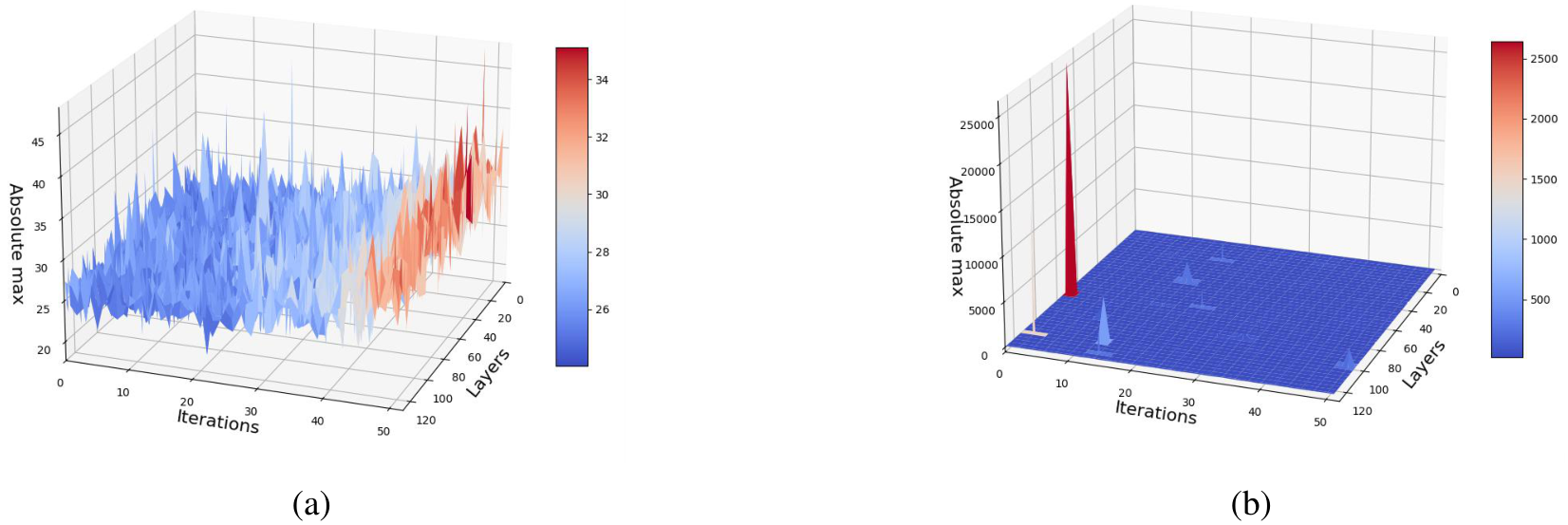
As shown in Figure 1, these outliers emerge only after processing approximately 200 billion tokens during training. This phenomenon poses significant challenges to maintaining numerical stability and model performance, especially when using methods that assume consistency across iterations. The sudden appearance of these outliers, which are crucial for model performance
The emergence of these outliers in the later stages of training is particularly problematic for FP8 formats due to their limited dynamic range. Unlike higher precision formats such as FP32 or even BF16, FP8 has a much narrower range of representable values. When outliers exceed this range, they can cause overflow or underflow, leading to a loss of critical information and potentially destabilizing the entire training process.
Moreover, the sporadic nature of these outliers, as evident in Figure 1b, makes them challenging to predict and manage. Traditional scaling techniques, which rely on consistent statistical properties across iterations, struggle to adapt to these sudden, extreme values. This unpredictability further complicates the task of maintaining numerical stability in FP8 training, especially as the scale of the dataset and the duration of training increase.
4 SWIGLU AND OUTLIER AMPLIFICATION
While the previous section highlighted the general problem of outlier emergence in large-scale FP8 training, our investigation reveals that the SwiGLU (Swish Gated Linear Unit) activation function plays a crucial role in amplifying these outliers. This section explores the structure of SwiGLU and demonstrates how its unique properties contribute to the generation and amplification of outliers.
4.1 SWIGLU STRUCTURE
The Transformer architecture
is the inclusion of the SwiGLU
Let
where
While other standard neuron types, such ReLU, GeLU, and Swish at most linear at large input magnitudes
4.2 THEORETICAL ANALYSIS OF WEIGHT CORRELATION IN SWIGLU
Next, we analyze the behavior of the SwiGLU neuron during training and show its weight vectors tend to align perfectly if the magnitude of its input increases above some threshold. This causes the SwiGLU output magnitude to increase significantly during training, potentially resulting in outliers.
To show this, we assume the SwiGLU neuron is embedded in a neural network with
where
Theorem 1. Suppose we converge to a stationary point of the loss function, and for all samples . Then, at this stationary point, or .
Proof. At a stationary point we have :
Using the chain rule we obtain the following two equations
where we defined and with a slight abuse of notation, we suppressed the dependence of and on . Given the assumption
at this limit we obtain
Now, defining , the above equations become
where
Since
Note this result holds also if we replace the swish activation
4.3 OBSERVING WEIGHT CORRELATION GROWTH AND TRAINING INSTABILITY
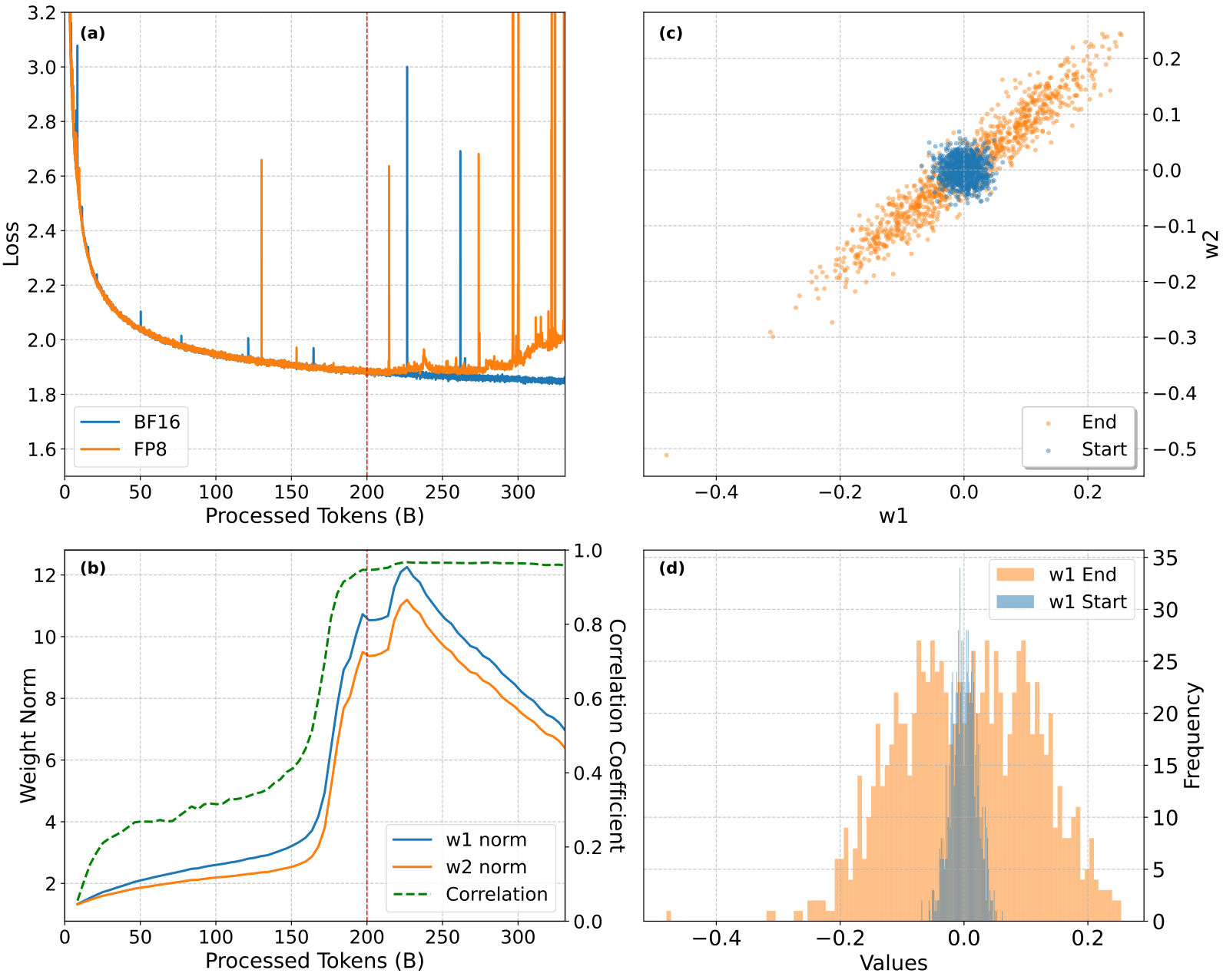
In our experiments, we observed a clear relationship between the increasing correlation of the weight matrices
In Fig. 2 we see the process of weight alignment and its impact on FP8 training develops precisely as our theory predicts. As training progresses,
These activation spikes, in turn, lead to the divergence of FP8 training, as shown in Fig. 2a. Importantly, while we primarily observe strong positive correlations in this example, our theory also predicts the possibility of strong negative correlations. We also observe these, as can be seen in Fig. 7 in the Appendix.
This phenomenon highlights the unique challenges posed by SwiGLU in FP8 training of large language models. The gradual alignment of weights, combined with norm growth, creates a scenario where outliers become increasingly likely and severe as training progresses. Consequently, instabilities may not be apparent in shorter training runs but emerge as critical issues in large-scale, long-duration training scenarios. This explains why such problems have not been observed in previous, smaller-scale studies of FP8 training.
4.4 Smooth-SwiGLU
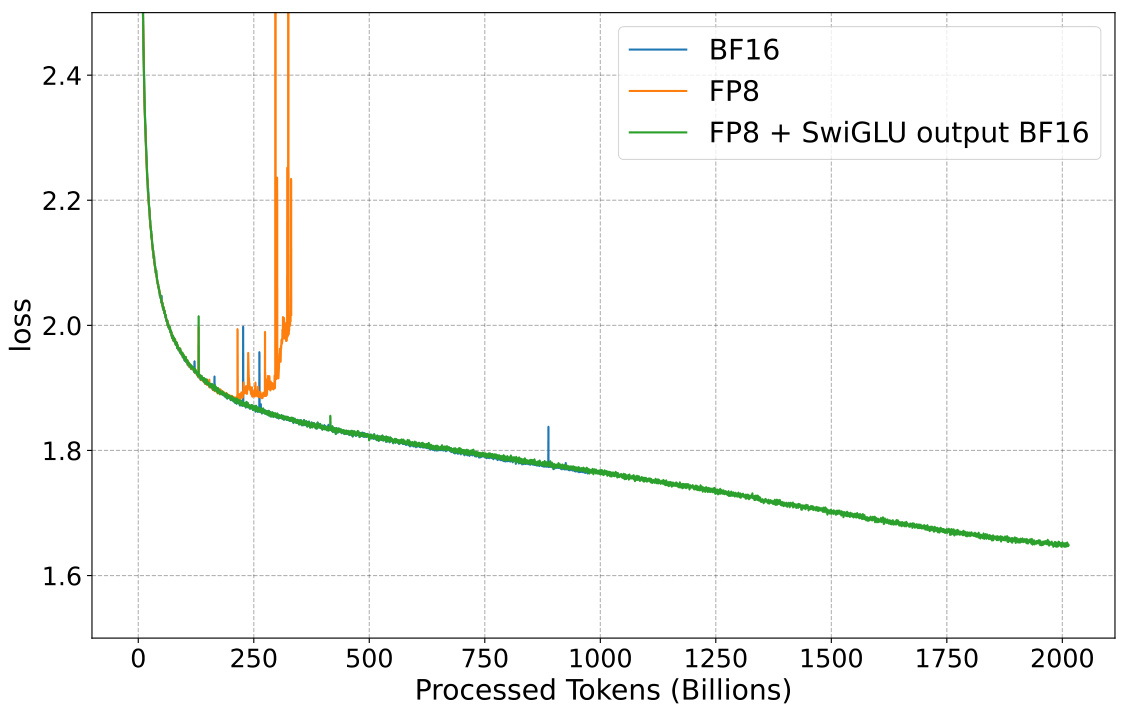
As demonstrated earlier, the SwiGLU activation function can lead to outliers in the input of the last linear layer of the MLP component. These outliers pose a significant challenge when using FP8 precision with delayed scaling, which relies on the assumption that statistical properties remain consistent across layers. The sudden spike in value caused by SwiGLU disrupts this continuity, leading to instability in the training process. In Fig. 3 we demonstrate that disabling the quantization of the last linear layer in the MLP component (output of SwiGLU) allows Llama2 FP8 to successfully converge with large datasets, addressing the previously observed divergence issues. This shows that other components in Llama architecture, such as RMS Norm or MHA are not the cause of instability in FP8 training.
While disabling quantization of the SwiGLU output effectively prevents divergence, it reduces the potential acceleration benefits of FP8. To maintain full FP8 acceleration while addressing the outlier problem, we propose a novel modification called Smooth-SwiGLU. Figure 4 illustrates the key idea
behind Smooth-SwiGLU: applying a scaling factor to the linear branch of the SwiGLU function and rescaling it back after the last linear layer. This approach prevents outliers in the quantization of the input to the last linear layer while preserving the overall function of the SwiGLU activation, enabling us to fully leverage FP8 precision throughout the network.
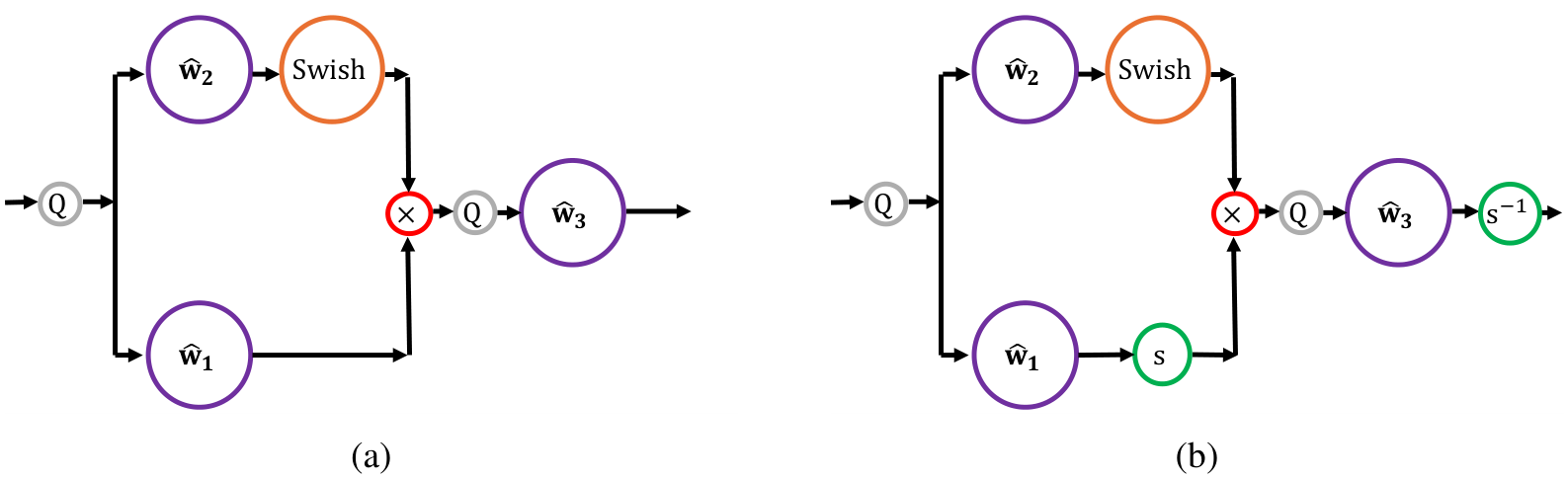
Mathematically, we express the quantized Smooth-SwiGLU function for each channel
where
To minimize computational overhead, we compute the scaling factors
- Split the tensor into chunks, where each chunk corresponds to a channel.
- For each chunk (channel), compute its maximum value in parallel.
- Use these per-channel maximum values to determine the individual scaling factors
s sub i for each channel.
This method allows for efficient per-channel scaling, as each channel’s scaling factor is computed independently and in parallel. The computational cost of this approach is moderate compared to the matrix multiplications in the linear layers, especially given the parallelization, even with our non optimized implementation. During inference, the scaling factors can be merged into the weights of the first and third linear layers in the MLP layer that includes the SwiGLU layer followed by a linear layer (see Figure 4), i.e.
So we can absorb the scalar by re-defining
5 FP8 OPTIMIZER
The Adam optimizer and its variants are widely used in deep learning due to their effectiveness in handling various training challenges. A key characteristic of the Adam optimizer is its storage of two moments, traditionally in high precision (FP32). This significantly increases memory usage, particularly for large-scale models. While previous research
Published as a conference paper at ICLR 2025
5.1 Challenges
The Adam optimizer uses two moments to adapt learning rates for each parameter:
- The first moment is an estimate of the mean of the gradients.
- The second moment is an estimate of the uncentered variance of the gradients.
A critical aspect of the Adam optimizer is the use of the inverse square root of the second moment in the parameter update step. This operation has important implications for precision requirements.
Due to this inverse square root operation, the smallest values in the second moment become the most significant in determining parameter updates. This characteristic creates a unique challenge when considering precision reduction for the second moment.
5.2 Methodology
We conducted extensive experiments to determine the optimal FP8 formats for both moments. Our investigation revealed that different precision requirements exist for each moment:
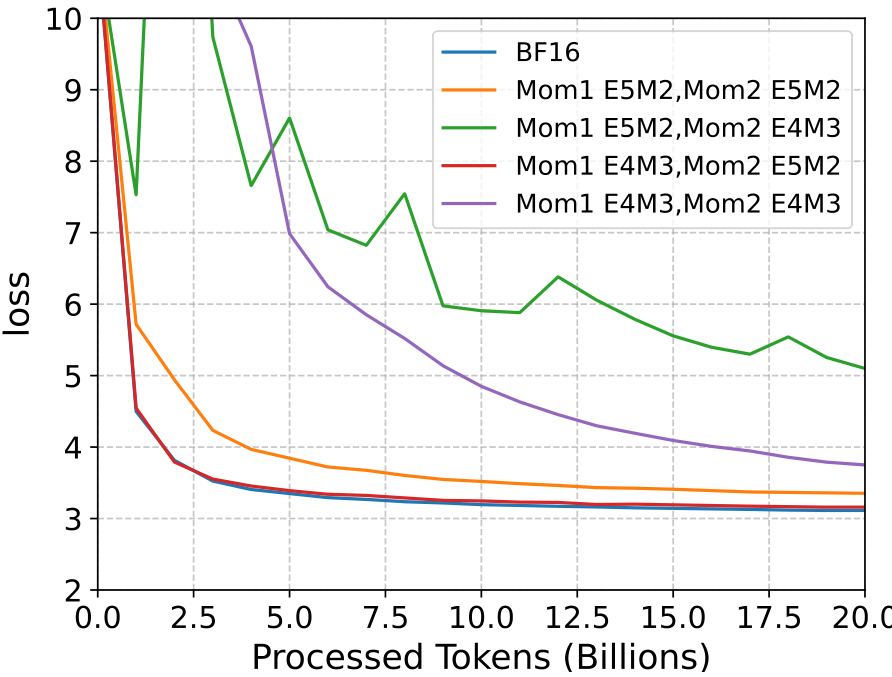
- First Moment: The E4M3 format (4 exponent bits, 3 mantissa bits) provides sufficient precision. This format offers a good balance between range and accuracy for representing the mean of the gradients.
- Second Moment: The E5M2 format (5 exponent bits, 2 mantissa bits) is necessary. This format provides a higher dynamic range, crucial for preserving information about the smallest values in the second moment. The additional exponent bit ensures that we can accurately represent both very small and moderately large values, which is critical given the inverse square root operation applied to this moment.
In our experiments, presented in Figure 5 we show that while the first moment is able to converge with E4M3, the second moment, which estimates the square of the gradients, requires a wider dynamic range and is able to converge only with E5M2 format. In Table 1 we compare the proposed quantization scheme for the optimizer moments with the one presented in
6 Experiments
We conducted extensive experiments to evaluate the effectiveness of our proposed FP8 training method for Large Language Models (LLMs) across various scales.
Table 1: Comparison of the different datatypes for the two Adam optimizer moments.
| Model | Mom 1 | Mom 2 |
|---|---|---|
| BF16 (Baseline) | FP32 | FP32 |
| FP8 (Peng et al., 2023) | FP8 | FP16 |
| FP8 (Ours) | FP8 | FP8 |
6.1 Experimental Setup
Model and Dataset. We used the Llama2 model
Hardware. All training was conducted on 256 Intel Gaudi2 devices.
6.2 Results
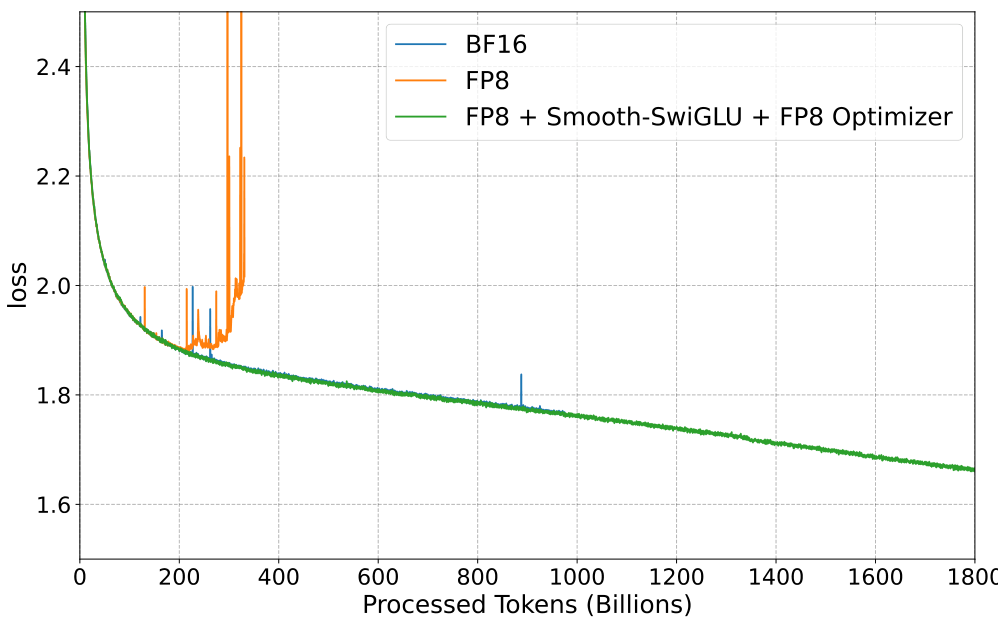
Training Stability. In Figure 6 we show the training loss of Llama2 with the proposed scheme, which includes the use of Smooth SwiGLU (Section 4.4) + FP8 quantization of both Adam moments (Section 5). Notice we can overcome the divergence point of standard FP8 training. The FP8 model was trained using the standard format
Zero-shot Performance. Table 2 compares the zero-shot performance (accuracy and perplexity) on downstream tasks between the BF16 baseline and our FP8 model. The results demonstrate that our FP8 approach achieves on-par performance with the BF16 baseline across all tested metrics.
Performance gains. Table 3 presents the performance of different configurations on Intel Gaudi2 hardware. While full FP8 quantization achieves the highest acceleration (37%
Table 2: Zero shot accuracy and perplexity comparison between the BF16 baseline and the proposed FP8. Notice both models achieve on-par results across all tests. FP8(1) refers to FP8 + SwiGLU output in BF16 while FP8(2) refers to FP8 + Smooth SwiGLU + FP8 optimizer.
| Precision | Accuracy ↑ | Perplexity ↓ | ||||
|---|---|---|---|---|---|---|
| Lambada | HellaSwag | Winogrande | Arc-C | Wikitext | Lambada | |
| BF16 | 61.98 | 68.3 | 64.25 | 37.37 | 5.59 | 5.75 |
| FP8 (1) | 61.73 | 68.03 | 64.4 | 37.2 | 5.56 | 5.89 |
| FP8 (2) | 62.1 | 68.37 | 65.43 | 37.8 | 5.55 | 5.9 |
Table 3: Performance acceleration with different configurations in our non optimized implementation in Llama2 7B model. The measurement were done on 8 Intel Gaudi2 devices.
| Configuration | Micro BS | Status | Throughput (Samples/sec) | TFLOPS |
|---|---|---|---|---|
| BF16 | 1 | 12.65 | 311 | |
| FP8 + SwiGLU output in BF16 | 1 | 16.07 () | 396 | |
| FP8 + Smooth SwiGLU | 1 | 16.89 () | 417 | |
| FP8 | 1 | 17.34 () | 428 |
Memory reduction. In Table 4 we present the memory reduction achieved by changing the optimizer moments from standard FP32 to FP8. Moreover, we reduce the master weight to FP16, as shown in
Table 4: Memory reduction when applying the proposed FP8 optimizer (Section 5). The measurements were done on 8 Intel Gaudi2 devices, using Deepspeed Zero-1.
| Configuration | Status | Memory (GB/HPU) | FP8 Optimizer |
|---|---|---|---|
| BF16 | 63.25 | ✗ | |
| FP8 + SwiGLU output in BF16 | 63.26 | ✗ | |
| FP8 + Smooth SwiGLU | 63.26 | ✗ | |
| FP8 | 63.24 | ✗ | |
| FP8 + SwiGLU output in BF16 | 44.08 | ✓ | |
| FP8 + Smooth SwiGLU | 44.08 | ✓ | |
| FP8 | 44.09 | ✓ |
7 CONCLUSIONS
In this paper, we successfully demonstrated FP8 training on datasets up to 2 trillion tokens, significantly exceeding the previous limit of 100 billion tokens
To address this issue, we applied per-channel quantization to the SwiGLU activation function, a technique we refer to as Smooth-SwiGLU. Although identical to SwiGLU in function, this method effectively reduces outlier amplification, ensuring stable FP8 training with a moderate effect on model performance during training, and without any effect on the inference. Additionally, we introduced the first implementation of FP8 quantization for both Adam optimizer moments, further optimizing memory usage.
Our proposed method, combining Smooth-SwiGLU and FP8 optimizer moments, achieved comparable performance to BF16 baselines on downstream tasks while providing significant throughput improvements. This approach successfully overcome the divergence challenges typically encountered in standard FP8 training on large datasets.
Reproducibility
Ethics
Acknowledgements
The research of DS was Funded by the European Union (ERC, A-B-C-Deep, 101039436). Views and opinions expressed are however those of the author only and do not necessarily reflect those of the European Union or the European Research Council Executive Agency (ERCEA). Neither the European Union nor the granting authority can be held responsible for them. DS also acknowledges the support of the Schmidt Career Advancement Chair in AI.
References
Tom Brown, Benjamin Mann, Nick Ryder, Melanie Subbiah, Jared D Kaplan, Prafulla Dhariwal, Arvind Neelakantan, Pranav Shyam, Girish Sastry, Amanda Askell, Sandhini Agarwal, Ariel Herbert-Voss, Gretchen Krueger, Tom Henighan, Rewon Child, Aditya Ramesh, Daniel Ziegler, Jeffrey Wu, Clemens Winter, Chris Hesse, Mark Chen, Eric Sigler, Mateusz Litwin, Scott Gray, Benjamin Chess, Jack Clark, Christopher Berner, Sam McCandlish, Alec Radford, Ilya Sutskever, and Dario Amodei. Language models are few-shot learners. In H. Larochelle, M. Ranzato, R. Hadsell, M.F. Balcan, and H. Lin (eds.), Advances in Neural Information Processing Systems, volume 33, pp. 1877–1901. Curran Associates, Inc., 2020. URL NeurIPS.
Aakanksha Chowdhery, Sharan Narang, Jacob Devlin, Maarten Bosma, Gaurav Mishra, Adam Roberts, Paul Barham, Hyung Won Chung, Charles Sutton, Sebastian Gehrmann, Parker Schuh, Kensen Shi, Sasha Tsvyashchenko, Joshua Maynez, Abhishek Rao, Parker Barnes, Yi Tay, Noam M. Shazeer, Vinodkumar Prabhakaran, Emily Reif, Nan Du, Ben Hutchinson, Reiner Pope, James Bradbury, Jacob Austin, Michael Isard, Guy Gur-Ari, Pengcheng Yin, Toju Duke, Anselm Levskaya, Sanjay Ghemawat, Sunipa Dev, Henryk Michalewski, Xavier García, Vedant Misra, Kevin Robinson, Liam Fedus, Denny Zhou, Daphne Ippolito, David Luan, Hyeontaek Lim, Barret Zoph, Alexander Spiridonov, Ryan Sepassi, David Dohan, Shivani Agrawal, Mark Omernick, Andrew M. Dai, Thanumalayan Sankaranarayana Pillai, Marie Pellat, Aitor Lewkowycz, Erica Moreira, Rewon Child, Oleksandr Polozov, Katherine Lee, Zongwei Zhou, Xuezhi Wang, Brennan Saeta, Mark Díaz, Orhan Firat, Michele Catasta, Jason Wei, Kathleen S. Meier-Hellstern, Douglas Eck, Jeff Dean, Slav Petrov, and Noah Fiedel. Palm: Scaling language modeling with pathways. J. Mach. Learn. Res., 24:240:1–240:113, 2022. URL Semantic Scholar.
Together Computer. Redpajama: an open dataset for training large language models, 2023. URL GitHub.
Joonhyung Lee, Jeongin Bae, Byeongwook Kim, Se Jung Kwon, and Dongsoo Lee. To fp8 and back again: Quantifying the effects of reducing precision on llm training stability. arXiv preprint arXiv:2405.18710, 2024.
Zechun Liu, Changsheng Zhao, Igor Fedorov, Bilge Soran, Dhruv Choudhary, Raghuraman Krishnamoorthi, Vikas Chandra, Yuandong Tian, and Tijmen Blankevoort. Spinquant: Llm
quantization with learned rotations. arXiv, abs/2405.16406, 2024.
Paulius Micikevicius, Sharan Narang, Jonah Alben, Gregory Frederick Diamos, Erich Elsen, David García, Boris Ginsburg, Michael Houston, Oleksii Kuchaiev, Ganesh Venkatesh, and Hao Wu. Mixed precision training. arXiv, abs/1710.03740, 2017.
Paulius Micikevicius, Dusan Stosic, Neil Burgess, Marius Cornea, Pradeep K. Dubey, Richard Grisenthwaite, Sangwon Ha, Alexander Heinecke, Patrick Judd, John Kamalu, Naveen Mellempudi, Stuart F. Oberman, Mohammad Shoeybi, Michael Siu, and Hao Wu. Fp8 formats for deep learning. arXiv, abs/2209.05433, 2022.
Houwen Peng, Kan Wu, Yixuan Wei, Guoshuai Zhao, Yuxiang Yang, Ze Liu, Yifan Xiong, Ziyue Yang, Bolin Ni, Jingcheng Hu, Ruihang Li, Miaosen Zhang, Chen Li, Jia Ning, Ruizhe Wang, Zheng Zhang, Shuguang Liu, Joe Chau, Han Hu, and Peng Cheng. Fp8-lm: Training fp8 large language models. arXiv, abs/2310.18313, 2023.
Teven Le Scao, Angela Fan, Christopher Akiki, Ellie Pavlick, Suzana Ili’c, Daniel Hesslow, Roman Castagn’e, Alexandra Sasha Luccioni, François Yvon, Matthias Gallé, Jonathan Tow, Alexander M. Rush, Stella Biderman, Albert Webson, Pawan Sasanka Ammanamanchi, Thomas Wang, Benoît Sagot, Niklas Muennighoff, Albert Villanova del Moral, Olatunji Ruwase, Rachel Bawden, Stas Bekman, Angelina McMillan-Major, Iz Beltagy, Huu Nguyen, Lucile Saulnier, Samson Tan, Pedro Ortiz Suarez, Victor Sanh, Hugo Laurencon, Yacine Jernite, Julien Launay, Margaret Mitchell, Colin Raffel, Aaron Gokaslan, Adi Simhi, Aitor Soroa Etxabe, Alham Fikri Aji, Amit Alfassy, Anna Rogers, Ariel Kreisberg Nitzav, Canwen Xu, Chenghao Mou, Chris C. Emezue, Christopher Klamm, Colin Leong, Daniel Alexander van Strien, David Ifeoluwa Adelani, Dragomir R. Radev, Eduardo Gonzalez Ponferrada, Efrat Levkovizh, Ethan Kim, Eyal Natan, Francesco De Toni, Gérard Dupont, Germán Kruszewski, Giada Pistilli, Hady ElSahar, Hamza Benyamina, Hieu Trung Tran, Ian Yu, Idris Abdulmumin, Isaac Johnson, Itziar Gonzalez-Dios, Javier de la Rosa, Jenny Chim, Jesse Dodge, Jian Zhu, Jonathan Chang, Jorg Frohberg, Josephine Tobing, Joydeep Bhattacharjee, Khalid Almubarak, Kimbo Chen, Kyle Lo, Leandro von Werra, Leon Weber, Long Phan, Loubna Ben Allal, Ludovic Tanguy, Manan Dey, Manuel Romero Muñoz, Maraim Masoud, Maria Grandury, Mario vSavsko, Max Huang, Maximin Coavoux, Mayank Singh, Mike Tian-Jian Jiang, Minh Chien Vu, Mohammad A. Jauhar, Mustafa Ghaleb, Nishant Subramani, Nora Kassner, Nurulaqilla Khamis, Olivier Nguyen, Omar Espejel, Ona de Gibert, Paulo Villegas, Peter Henderson, Pierre Colombo, Priscilla Amuok, Quentin Lhoest, Rheza Harliman, Rishi Bommasani, Roberto Lopez, Rui Ribeiro, Salomey Osei, Sampo Pyysalo, Sebastian Nagel, Shamik Bose, Shamsuddeen Hassan Muhammad, Shanya Sharma, S. Longpre, Somaieh Nikpoor, S. Silberberg, Suhas Pai, Sydney Zink, Tiago Timponi Torrent, Timo Schick, Tristan Thrush, Valentin Danchev, Vassilina Nikoulina, Veronika Laippala, Violette Lepercq, Vrinda Prabhu, Zaid Alyafeai, Zeerak Talat, Arun Raja, Benjamin Heinzerling, Chenglei Si, Elizabeth Salesky, Sabrina J. Mielke, Wilson Y. Lee, Abheesht Sharma, Andrea Santilli, Antoine Chaffin, Arnaud Stiegler, Debajyoti Datta, Eliza Szczechla, Gunjan Chhablani, Han Wang, Harshit Pandey, Hendrik Strobelt, Jason Alan Fries, Jos Rozen, Leo Gao, Lintang Sutawika, M Saiful Bari, Maged S. Al-Shaibani, Matteo Manica, Nihal V. Nayak, Ryan Teehan, Samuel Albanie, Sheng Shen, Srulik Ben-David, Stephen H. Bach, Taewoon Kim, Tali Bers, Thibault Févry, Trishala Neeraj, Urmish Thakker, Vikas Raunak, Xiang Tang, Zheng-Xin Yong, Zhiqing Sun, Shaked Brody, Y Uri, Hadar Tojarieh, Adam Roberts, Hyung Won Chung, Jaesung Tae, Jason Phang, Ofir Press, Conglong Li, Deepak Narayanan, Hatim Bourfoune, Jared Casper, Jeff Rasley, Max Ryabinin, Mayank Mishra, Minjia Zhang, Mohammad Shoeybi, Myriam Peyrounette, Nicolas Patry, Nouamane Tazi, Omar Sanseviero, Patrick von Platen, Pierre Cornette, Pierre Francois Lavall’ee, Rémi Lacroix, Samyam Rajbhandari, Sanchit Gandhi, Shaden Smith, Stéphane Requena, Suraj Patil, Tim Dettmers, Ahmed Baruwa, Amanpreet Singh, Anastasia Cheveleva, Anne-Laure Ligozat, Arjun Subramonian, Aurelie Nev’eol, Charles Lovering, Daniel H Garrette, Deepak R. Tunuguntla, Ehud Reiter, Ekaterina Taktasheva, Ekaterina Voloshina, Eli Bogdanov, Genta Indra Winata, Hailey Schoelkopf, Jan-Christoph Kalo, Jekaterina Novikova, Jessica Zosa Forde, Xiangru Tang, Jungo Kasai, Ken Kawamura, Liam Hazan, Marine Carpuat, Miruna Clinciu, Najoung Kim,
Newton Cheng, Oleg Serikov, Omer Antverg, Oskar van der Wal, Rui Zhang, Ruochen Zhang, Sebastian Gehrmann, Shachar Mirkin, S. Osher Pais, Tatiana Shavrina, Thomas Scialom, Tian Yun, Tomasz Limisiewicz, Verena Rieser, Vitaly Protasov, Vladislav Mikhailov, Yada Pruksachatkun, Yonatan Belinkov, Zachary Bamberger, Zdeněk Kašner, Zdeněk Kasner, Amanda Pestana, Amir Feizpour, Ammar Khan, Amy Faranak, Ananda Santa Rosa Santos, Anthony Hevia, Antigona Unldreaj, Arash Aghagol, Arezoo Abdollahi, Aycha Tammour, Azadeh HajiHosseini, Bahareh Behroozi, Benjamin Ayoade Ajibade, Bharat Kumar Saxena, Carlos Muñoz Ferrandis, Danish Contractor, David M. Lansky, Davis David, Douwe Kiela, Duong Anh Nguyen, Edward Tan, Emi Baylor, Ezinwanne Ozoani, Fatim Tahirah Mirza, Frankline Ononiwu, Habib Rezanejad, H.A. Jones, Indrani Bhattacharya, Irene Solaiman, Irina Sedenko, Isar Nejadgholi, Jan Passmore, Joshua Seltzer, Julio Bonis Sanz, Karen Fort, Lívia Dutra, Mairon Samagaio, Maraim Elbadri, Margot Mieskes, Marissa Gerchick, Martha Akinlolu, Michael McKenna, Mike Qiu, Muhammed Ghauri, Mykola Burynok, Nafis Abrar, Nazneen Rajani, Nour Elkott, Nourhan Fahmy, Olanrewaju Samuel, Ran An, R. P. Kromann, Ryan Hao, Samira Alizadeh, Sarmad Shubber, Silas L. Wang, Sourav Roy, Sylvain Viguier, Thanh-Cong Le, Tobi Oyebade, Trieu Nguyen Hai Le, Yoyo Yang, Zach Nguyen, Abhinav Ramesh Kashyap, Alfredo Palasciano, Alison Callahan, Anima Shukla, Antonio Miranda-Escalada, Ayush Kumar Singh, Benjamin Beilharz, Bo Wang, Caio Matheus Fonseca de Brito, Chenxi Zhou, Chirag Jain, Chuxin Xu, Clémentine Fourrier, Daniel León Perinán, Daniel Molano, Dian Yu, Enrique Manjavacas, Fabio Barth, Florian Fuhrimann, Gabriel Altay, Giyaseddin Bayrak, Gully Burns, Helena U. Vrabec, Iman I.B. Bello, Isha Dash, Ji Soo Kang, John Giorgi, Jonas Golde, Jose David Posada, Karthi Sivaraman, Lokesh Bulchandani, Lu Liu, Luisa Shinzato, Madeleine Hahn de Bykhovetz, Maiko Takeuchi, Marc Pàmies, María Andrea Castillo, Marianna Nezhurina, Mario Sanger, Matthias Samwald, Michael Cullan, Michael Weinberg, M Wolf, Mina Mihaljcic, Minna Liu, Moritz Freidank, Myungsun Kang, Natasha Seelam, Nathan Dahlberg, Nicholas Michio Broad, Nikolaus Muellner, Pascale Fung, Patricia Haller, Patrick Haller, Renata Eisenberg, Robert Martin, Rodrigo Canalli, Rosaline Su, Ruisi Su, Samuel Cahyawijaya, Samuele Garda, Shlok S Deshmukh, Shubhanshu Mishra, Sid Kiblawi, Simon Ott, Sinee Sangaroonsiri, Srishti Kumar, Stefan Schweter, Sushil Pratap Bharati, Tanmay Laud, Théo Gigant, Tomoya Kainuma, Wojciech Kusa, Yanis Labrak, Yashasvi Bajaj, Y. Venkatraman, Yifan Xu, Ying Xu, Yu Xu, Zhee Xao Tan, Zhongli Xie, Zifan Ye, Mathilde Bras, Younes Belkada, and Thomas Wolf. Bloom: A 176b-parameter open-access multilingual language model. ArXiv, abs/2211.05100, 2022. URL https://api.semanticscholar.org/CorpusID:253420279.
Noam M. Shazeer. Glu variants improve transformer. ArXiv, abs/2002.05202, 2020a. URL https://api.semanticscholar.org/CorpusID:211096588.
Noam M. Shazeer. Glu variants improve transformer. ArXiv, abs/2002.05202, 2020b. URL https://api.semanticscholar.org/CorpusID:211096588.
Shaden Smith, Mostofa Patwary, Brandon Norick, Patrick LeGresley, Samyam Rajbhandari, Jared Casper, Zhun Liu, Shrimai Prabhumoye, George Zerveas, Vijay Anand Korthikanti, Elton Zhang, Rewon Child, Reza Yazdani Aminabadi, Julie Bernauer, Xia Song, Mohammad Shoeybi, Yuxiong He, Michael Houston, Saurabh Tiwary, and Bryan Catanzaro. Using deepspeed and megatron to train megatron-turing nlg 530b, a large-scale generative language model. ArXiv, abs/2201.11990, 2022. URL https://api.semanticscholar.org/CorpusID:246411325.
Jianlin Su, Murtadha Ahmed, Yu Lu, Shengfeng Pan, Wen Bo, and Yunfeng Liu. Roformer: Enhanced transformer with rotary position embedding. Neurocomput., 568(C), mar 2024. ISSN 0925-2312. doi: 10.1016/j.neucom.2023.127063. URL https://doi.org/10.1016/j.neucom.2023.127063.
Mingjie Sun, Xinlei Chen, J. Zico Kolter, and Zhuang Liu. Massive activations in large language models. ArXiv, abs/2402.17762, 2024. URL https://api.semanticscholar.org/CorpusID:268041240.
Xiao Sun, Jungwook Choi, Chia-Yu Chen, Naigang Wang, Swagath Venkataramani, Vijayalakshmi Srinivasan, Xiaodong Cui, Wei Zhang, and K. Gopalakrishnan. Hybrid 8-bit floating point (hfp8) training and inference for deep neural networks. In Neural Information Processing Systems, 2019. URL https://api.semanticscholar.org/CorpusID:202779157.
Hugo Touvron, Louis Martin, Kevin R. Stone, Peter Albert, Amjad Almahairi, Yasmine Babaei, Nikolay Bashlykov, Soumya Batra, Prajjwal Bhargava, Shruti Bhosale, Daniel M. Bikel, Lukas Blecher, Cristian Cantón Ferrer, Moya Chen, Guillem Cucurull, David Esiobu, Jude Fernandes, Jeremy Fu, Wenyin Fu, Brian Fuller, Cynthia Gao, Vedanuj Goswami, Naman Goyal, Anthony S. Hartshorn, Saghar Hosseini, Rui Hou, Hakan Inan, Marcin Kardas, Viktor Kerkez, Madian Khabsa, Isabel M. Kloumann, A. V. Korenev, Punit Singh Koura, Marie-Anne Lachaux, Thibaut Lavril, Jenya Lee, Diana Liskovich, Yinghai Lu, Yuning Mao, Xavier Martinet, Todor Mihaylov, Pushkar Mishra, Igor Molybog, Yixin Nie, Andrew Poulton, Jeremy Reizenstein, Rashi Rungta, Kalyan Saladi, Alan Schelten, Ruan Silva, Eric Michael Smith, R. Subramanian, Xia Tan, Binh Tang, Ross Taylor, Adina Williams, Jian Xiang Kuan, Puxin Xu, Zhengxu Yan, Iliyan Zarov, Yuchen Zhang, Angela Fan, Melanie Kambadur, Sharan Narang, Aurelien Rodriguez, Robert Stojnic, Sergey Edunov, and Thomas Scialom. Llama 2: Open foundation and fine-tuned chat models. arXiv, 2023. URL Semantic Scholar.
Ashish Vaswani, Noam M. Shazeer, Niki Parmar, Jakob Uszkoreit, Llion Jones, Aidan N. Gomez, Lukasz Kaiser, and Illia Polosukhin. Attention is all you need. In Neural Information Processing Systems, 2017. URL Semantic Scholar.
Jaewoo Yang, Hayun Kim, and Younghoon Kim. Mitigating quantization errors due to activation spikes in glu-based llms. arXiv, 2024. URL Semantic Scholar.
Biao Zhang and Rico Sennrich. Root mean square layer normalization. In H. Wallach, H. Larochelle, A. Beygelzimer, F. d’Alché-Buc, E. Fox, and R. Garnett (eds.), Advances in Neural Information Processing Systems, volume 32. Curran Associates, Inc., 2019. URL NeurIPS.
Appendix
A.1 Training instability - additional data
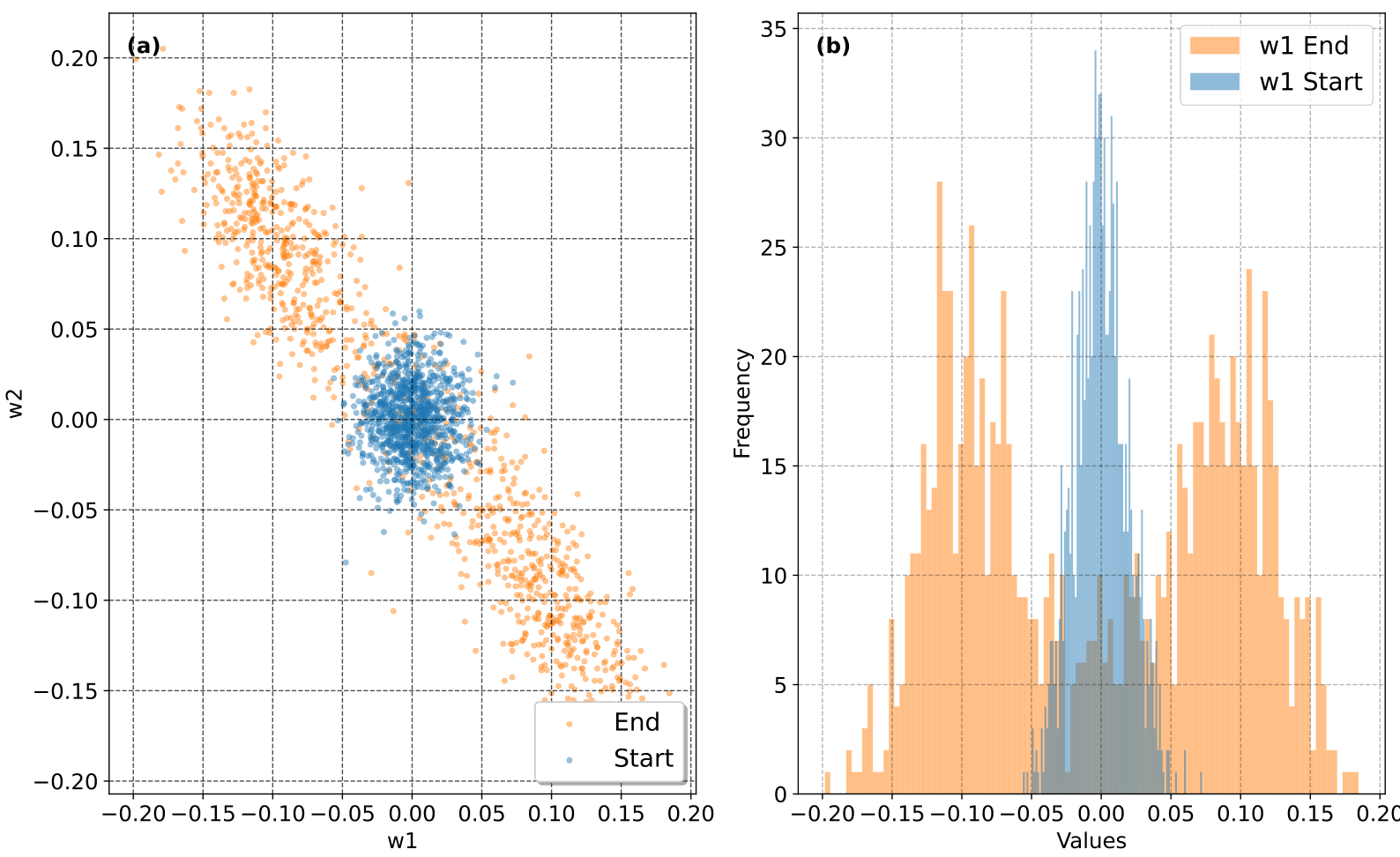
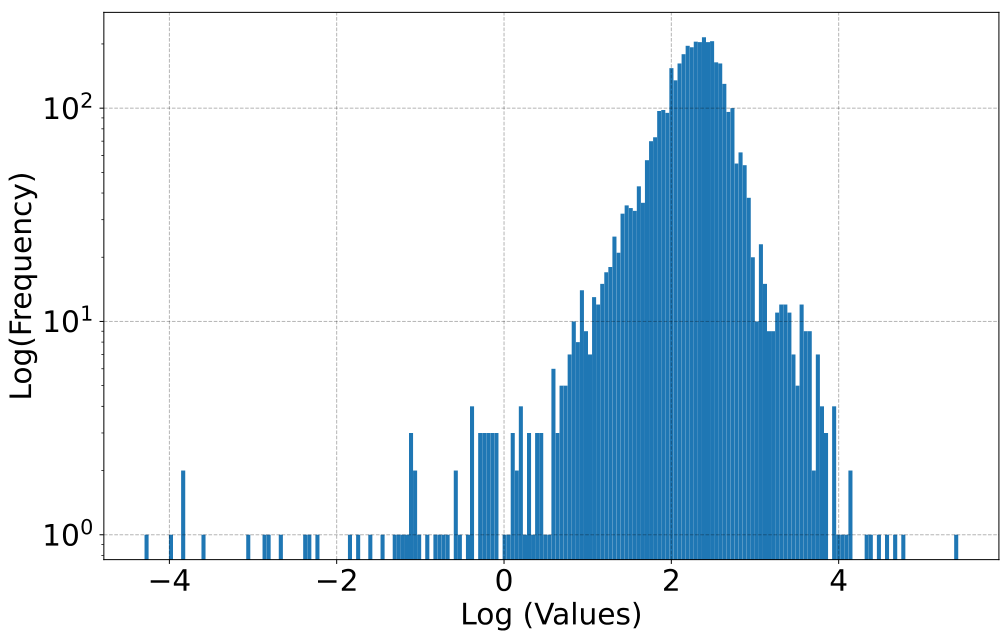
Figure 9: Histogram of
A.2 PERFORMANCE GAIN ON NVIDIA GPUS
In Table 5 we extend the perfomance acceleration comparison of Table 3 also for Nvidia GPUs.
Table 5: Performance acceleration with different configurations in our non optimized implementation in Llama2 7B model. The measurement were done on 8 Nvidia GPU A6000 Ada
| Configuration | Micro BS | Status | Throughput (Samples/sec) | TFLOPS |
|---|---|---|---|---|
| BF16 | 1 | 3.22 | 76 | |
| FP8 + SwiGLU output in BF16 | 1 | \textcolor[HTML]{228B22}{\text{Converge}} | 4.11 (\textcolor[HTML]{228B22}{+ 27.6 \%}) | 96.9 |
| FP8 + Smooth SwiGLU | 1 | \textcolor[HTML]{228B22}{\text{Converge}} | 4.32 (\textcolor[HTML]{228B22}{+ 34.16 \%}) | 101.9 |
| FP8 | 1 | \textcolor[HTML]{FF0000}{\text{Diverge}} | 4.43 (\textcolor[HTML]{228B22}{+ 37.58 \%}) | 104.5 |
A.3 SMOOTH-SWIGLU STUDY
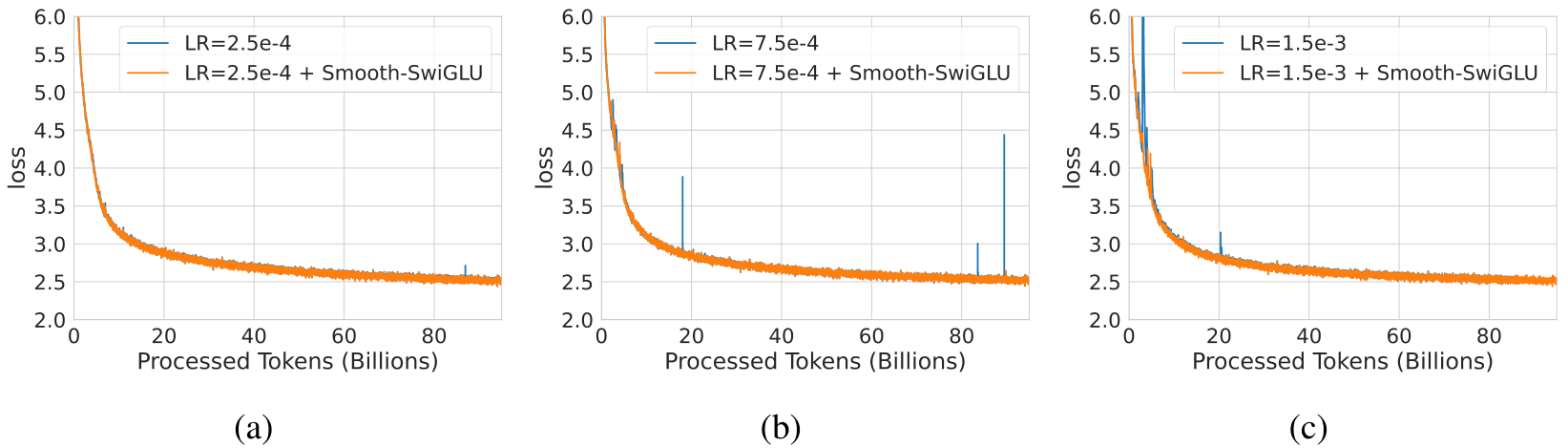
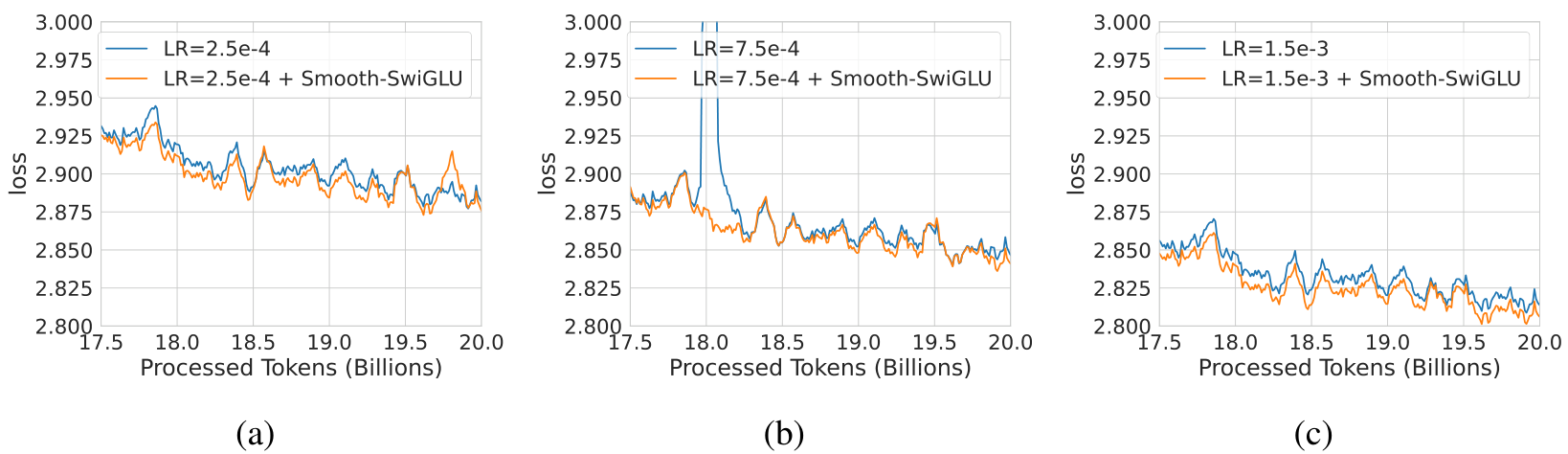
In Figure 10 we show a study of the effect of Smooth-SwiGLU on BF16 training with different LR
A.4 FP8 WITHOUT SWIGLU ACTIVATION FUNCTION
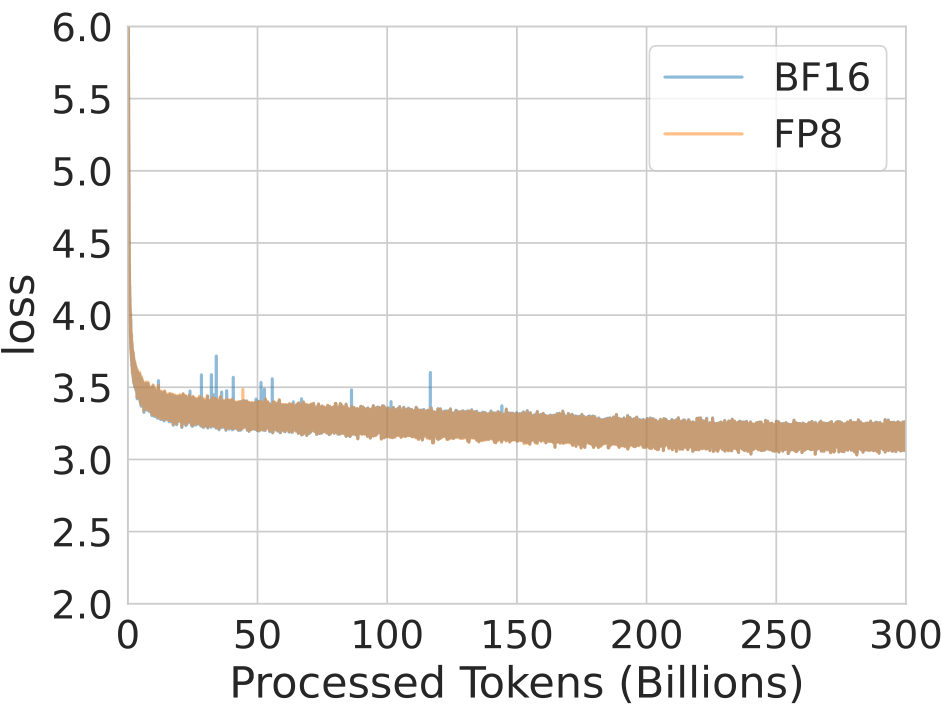
In Figure 12 we show FP8 training on c4 dataset of GPT3 model, which include GeLU activation function. Notice, in this scenario no training stability issues were observed.