Self-Play Pretraining with Zero Data
Aditya Cowsik, Kfir Dolev, Michael Y. Li, G. Bruno De Luca, Nourya Cohen, Noah D. Goodman, Yoav Levine
Independent Researcher, Tel Aviv University, Stanford University, LAPTh, USMB
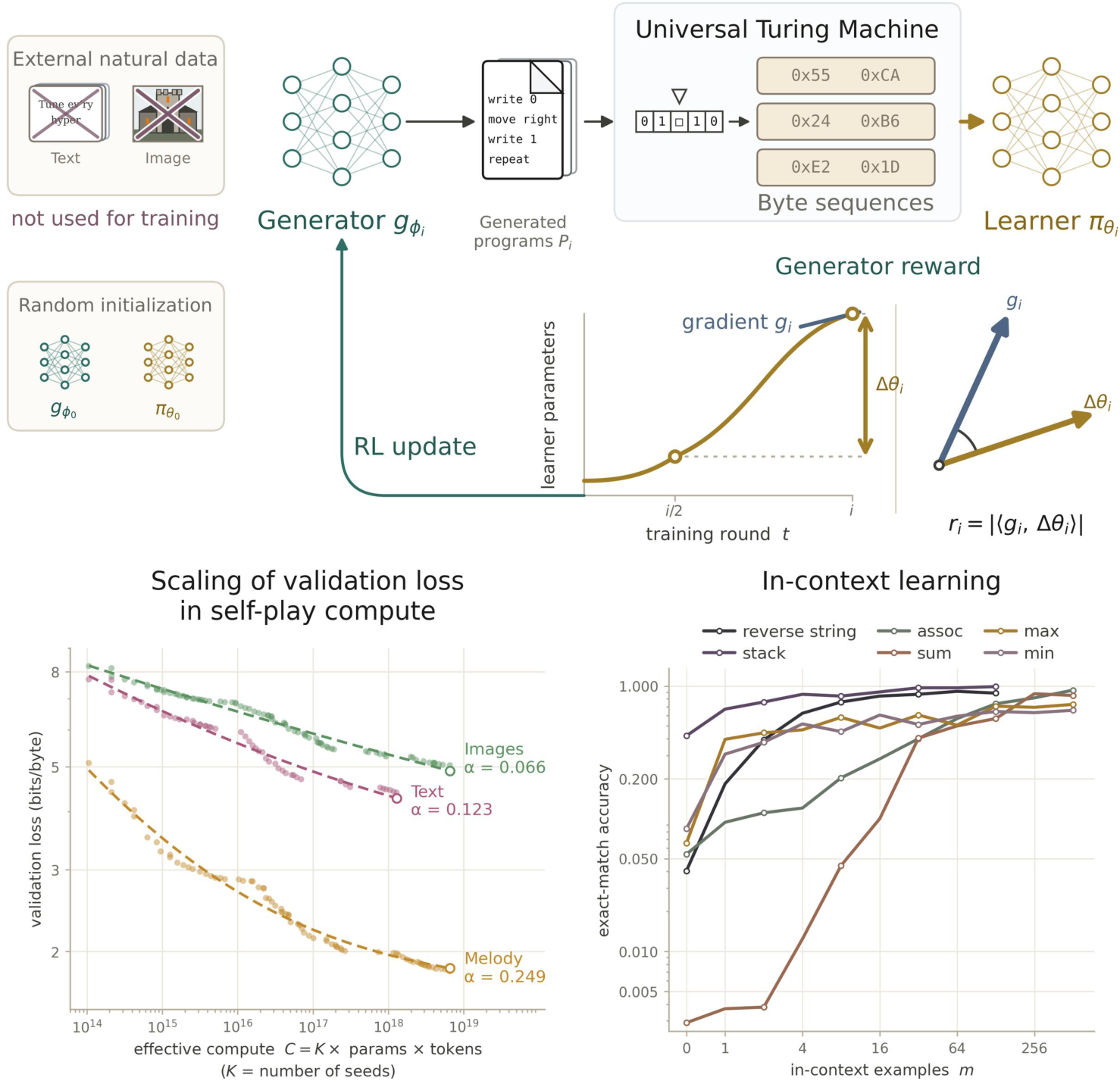
Advances in language modeling have been driven by scaling pretraining on ever more data. Yet, the training data is still largely curated on the model’s behalf. A more general approach to pretraining would let the model learn to generate the data most useful for its own improvement. This would provide an effectively unbounded source of training data, limited by compute rather than human knowledge. We introduce Self-Play Pretraining with Zero Data, an initial proof-of-concept towards realizing this vision. Our procedure casts synthetic data generation as a search over the space of all computable structure, taking inspiration from Solomonoff induction. Starting from random initialization, two models learn in tandem: a generator proposes programs interpreted by a universal Turing machine, generating byte sequences, while a learner autoregressively predicts these byte sequences. The learner is trained with standard cross-entropy, while the generator is trained with reinforcement learning to produce sequences at the frontier of the learner’s capabilities, yielding an adaptive curriculum. A universal Turing machine gives us a search space over all computable data-generating processes, imposing little domain-specific structure, and self-play searches over this space for useful training data. We test whether zero-shot performance on natural data improves predictably with self-play compute; this is a clean test of transfer since neither generator nor learner is trained on natural data. Across several natural datasets, zero-shot loss exhibits predictable scaling in compute. The models also exhibit in-context learning, and discover recognizable mathematical sequences during training.
“By teaching, we learn.”
Seneca
“So much from so little, almost everything from almost nothing.”
John Archibald Wheeler
1 Introduction
Advances in language modeling have been driven by pretraining on Internet data. Yet, the training data is still largely curated and constructed on the model’s behalf through large-scale data curation efforts
contained path to scaling, where compute alone can sustain continued improvement
As an initial step towards this vision, we introduce a self-play algorithm for pretraining from zero data. Starting from random initialization, two autoregressive transformers co-evolve: a generator proposes programs for a minimal universal Turing machine whose execution produces byte sequences, while a learner is trained on those sequences via next-token prediction. We use a universal Turing machine to make the space of all synthetic training data as expressive as possible while imposing minimal domain-specific structure: any computable data-generating process can, in principle, be represented as a program. However, the space of computable structure is enormous, and only a small subset of programs produce sequences that are useful for the learner. Moreover, whether a sequence is useful changes as the learner improves. This is why a self-play approach that adapts to the learner is natural: rather than specifying useful structure in advance, we let the generator discover which programs are most useful to the learner as training progresses. To encourage this behavior, the generator is trained with reinforcement learning using a learning-progress reward, shifting probability toward programs whose outputs lie near the frontier of the learner’s current capabilities. These design choices place our approach in the lineage of classical universal prediction
The resulting self-generated data is only valuable insofar as what the learner learns transfers to natural data. Our key hypothesis is that self-play over this space of computable data-generating processes can discover generic predictive regularities—such as copying, recursion, and hierarchical composition—that improve prediction on natural data. Importantly, we hypothesize that these regularities capture structure independent of contingent information—the particular facts, symbols, or modality of any one dataset—that can therefore transfer across data-generating processes. Indeed, prior work on formal, algorithmic, and non-linguistic pretraining distributions provides evidence that such cross-distribution transfer is possible
We test this hypothesis through a compute-optimal scaling law analysis. Concretely, we train randomly-initialized transformers at various scales via self-play and evaluate the resulting learners zero-shot on held-out datasets spanning natural language, images, speech, melodies, DNA, and mathematical sequences. For each dataset, we construct a compute-optimal frontier over model size, self-play rounds, and ensemble size. Across these diverse domains, a single family of self-play models exhibits predictable power-law improvements in zero-shot loss with compute, with scaling exponents comparable to those obtained by training directly on natural data. Importantly, this is a clean test of transfer since we deliberately run this process tabula rasa: both models are randomly initialized and all learner training data is generated through self-play. Thus, our experiments isolate the effect of our self-play procedure and test whether useful predictive structure can emerge ex nihilo. We also find that the learner develops in-context learning on completely held-out tasks, and the generator discovers known mathematical sequences.
Self-Play Pretraining with Zero Data
Learn from only self-generated synthetic data
2 Self-Play Pretraining with Zero Data
We introduce a self-play formulation of pretraining that involves searching over the space of computable structure. Every training sequence is the output of a program executed on a fixed universal Turing machine
Each round of self-play proceeds as follows:
- Program generation: Sample
N programs from the generatorx sub i from i equals one to N, sampled from g phi . - Execution: Run each program on
U to obtain output sequencesy sub i equals U of x sub i and omega sub i , whereomega sub i is a random input tape. - Learner and Generator update: The learner takes one gradient step on the output sequences, optimizing the standard next-token loss. The generator takes a policy gradient step with a learning-progress reward that encourages the generator to propose programs at the frontier of the learner’s capabilities. In addition, the generator is updated via a supervised fine-tuning objective on existing programs to mitigate catastrophic forgetting and on mutated programs to promote exploration.
2.1 Program space
We would like the generator’s search space to be as expressive as possible while imposing little domain-specific structure. We therefore use programs for a minimal universal Turing machine as the substrate for generating synthetic data. Specifically, we use a Brainf*ck-like Turing-complete language, following
Let
The random input tape allows a single program to represent a distribution over output sequences. These output bytes, rather than the programs themselves, constitute the learner’s training data. We design the execution semantics so that every generated string is executable: programs cannot fail through syntax or memory errors, and execution always produces a bounded-length output. We defer the precise execution semantics and resource limits to Appendix E.
2.2 Objectives
Program pool. At each self-play round
containing fresh samples from the current generator, local mutations of previously high-reward programs, and programs replayed from earlier rounds. Fresh samples provide global exploration,
mutations refine promising regions of program space, and replay preserves useful structures discovered earlier in training. We write
Learner Update. The learner is trained by standard next-token prediction on program outputs. For an output sequence
Thus fresh, mutated, and replay programs all train the learner.
Generator Reward. The generator’s reward must be capable of identifying programs with useful structure from programs without any external feedback. Initially, we considered a reward based on how difficult a sequence is to predict, motivated by prior work on self-play
To avoid this degeneracy, we evaluate a new program based on whether it builds on what the learner has actually been able to learn. Intuitively, the learner’s change in parameters summarizes this: learning signals arising from reusable structure accumulate, whereas we expect that idiosyncratic effects that are not learnable do not. Concretely, we reward the generator for producing programs whose learner gradients align with the learner’s current learning trajectory. Let
where
where
is the diagonal AdamW step operator obtained from the learner’s optimizer state. We use the lookback window of
We provide some additional intuition below, but we emphasize that we selected this reward after searching through several possibilities at small scale. Detailed analysis can be found in Table 5. Formally, this reward is a preconditioned gradient-alignment score, between the learner’s gradient on a program’s output and the learner’s parameter movement over the lookback window, with the diagonal AdamW preconditioner defining the inner product; we found that using this preconditioning was important in line with
avoid materializing full gradients by using forward mode automatic differentiation
Policy-Gradient RL Objective. We train the generator using a KL-regularized expected reward
where
Here F. This is the natural analog of the Solomonoff prior
Since the vanilla policy gradient estimator is high variance, we consider a GRPO (batch-level) based estimator
Since our bank consists of off-policy samples, we use a sequence-level importance ratio correction
Mutation rows are excluded because they were not sampled from a proposal distribution with a well-defined log probability. We clip the sequence-level importance ratio to ensure
Expert Iteration. To prevent forgetting, we replay previous programs by distilling high-reward programs back into the generator using reward-weighted supervised fine-tuning over the full pool
and optimize
The generator’s full training objective is
where
2.3 Architecture and Tokenization
The learner and generator are independently parameterized decoder-only Llama transformers with identical architecture
3 Empirical Results
3.1 Universal zero-shot transfer scaling laws
In standard pretraining, scaling compute typically entails both increasing model size and training the model on more natural data. Our scaling experiments study whether increasing compute via self-play, without any natural data, produces predictable improvements in zero-shot performance on held-out natural data.
Scaling recipe. We follow the scaling methodology of
Because tuning every possible hyperparameter at every scale is infeasible, we restrict the search to the most important hyperparameters based on preliminary experiments: the learner learning rate, the generator-to-learner learning-rate ratio, the batch size, and the generator KL regularization coefficient
For each dataset and algorithm, we construct a compute-optimal frontier
We fit each compute-optimal frontier with the asymptotic power law
where
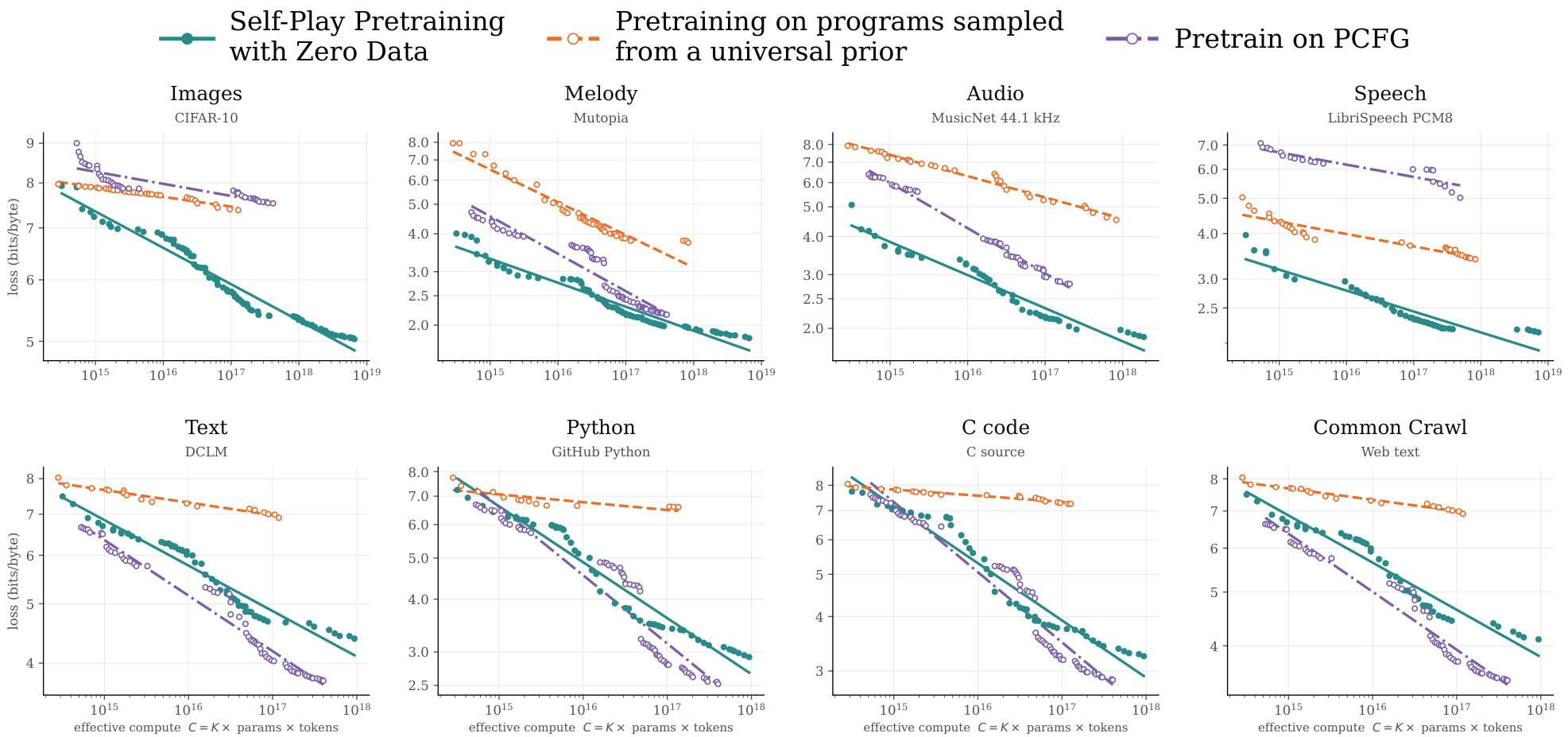
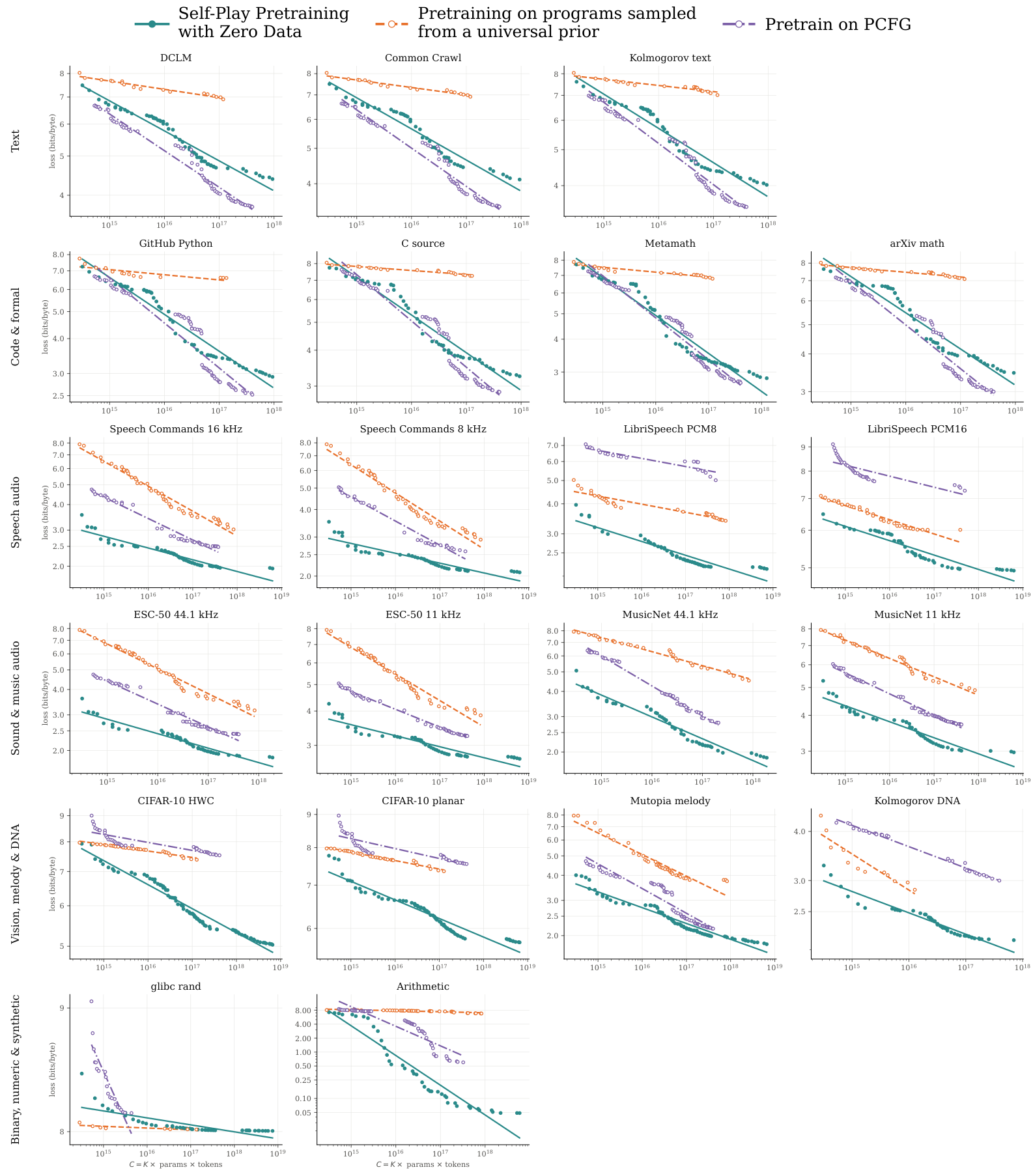
Self-play exhibits universal zero-shot power-law scaling in compute. As shown in Figure 1, we observe scaling laws over a diverse range of modalities: text, images, and music. We present additional results in Figure 7. The scaling laws over these modalities are broadly similar, as seen in Table 2,
Pretraining on a fixed universal program prior exhibits slow scaling. To isolate the value of self-play, we compare self-play against a non-adaptive baseline over exactly the same program space; we use the same mixture of validation loss on DCLM and DNA. Instead of learning a distribution over programs, the baseline samples programs from a fixed Solomonoff-style prior
Qualitatively, we see that self-play’s improvement is because it discovers programs whose outputs exhibit recognizable mathematical structure (Table 1) far earlier than we would expect under uniform sampling from the universal prior: across
| Family (mod 256) | Example program | Its output | Earliest round | [first round] (univ. prior) |
|---|---|---|---|---|
| Arithmetic | S+[.++] | 1, 3, 5, 7, 9, … | 0 | |
| Fibonacci | S,[[.C>.C>] | 1, 1, 2, 3, 5, … | 512 | |
| Geometric | S+[.L>] | 1, 3, 9, 27, 81, … | 256 | |
| Quadratic | S,.[<C>>VX<RX++] | 9, 25, 59, 111, … | 512 | |
| Cubic | S+[[-.L>L>-]-] | 0, 254, 236, 74, … | 512 |
Table 1: Program families with recognizable mathematical structure discovered by the generator during self-play. Earliest round gives the earliest round in which a member of the family first appears during training, while univ. prior gives the expected first appearance round if programs are drawn from the universal prior, including the added primitives. See section C for additional details.
PCFG pretraining is effective on language-like domains but lacks broad cross-domain transfer. In Figure 2, we also compare against pretraining on probabilistic context-free grammars (PCFGs), which provide a hand-designed source of hierarchical and compositional structure particularly well suited for language; for details of PCFG data generation see Section H. We expect pretraining on PCFG to be highly competitive on language-like domains, but its inductive bias is specialized to a particular class of structure. In contrast, our self-play procedure is, in principle, universal. Consistent with this interpretation, PCFG pretraining is stronger on text and code, where its inductive bias is well matched, while self-play substantially outperforms it on images, music, audio, and speech. Thus, self-play does not always match the performance of a specialized prior on domains where that prior is particularly well suited; however, it learns structure that transfers more broadly across modalities. We find that models trained on PCFG and the universal prior fail on our ICL evaluations in Figure 4.
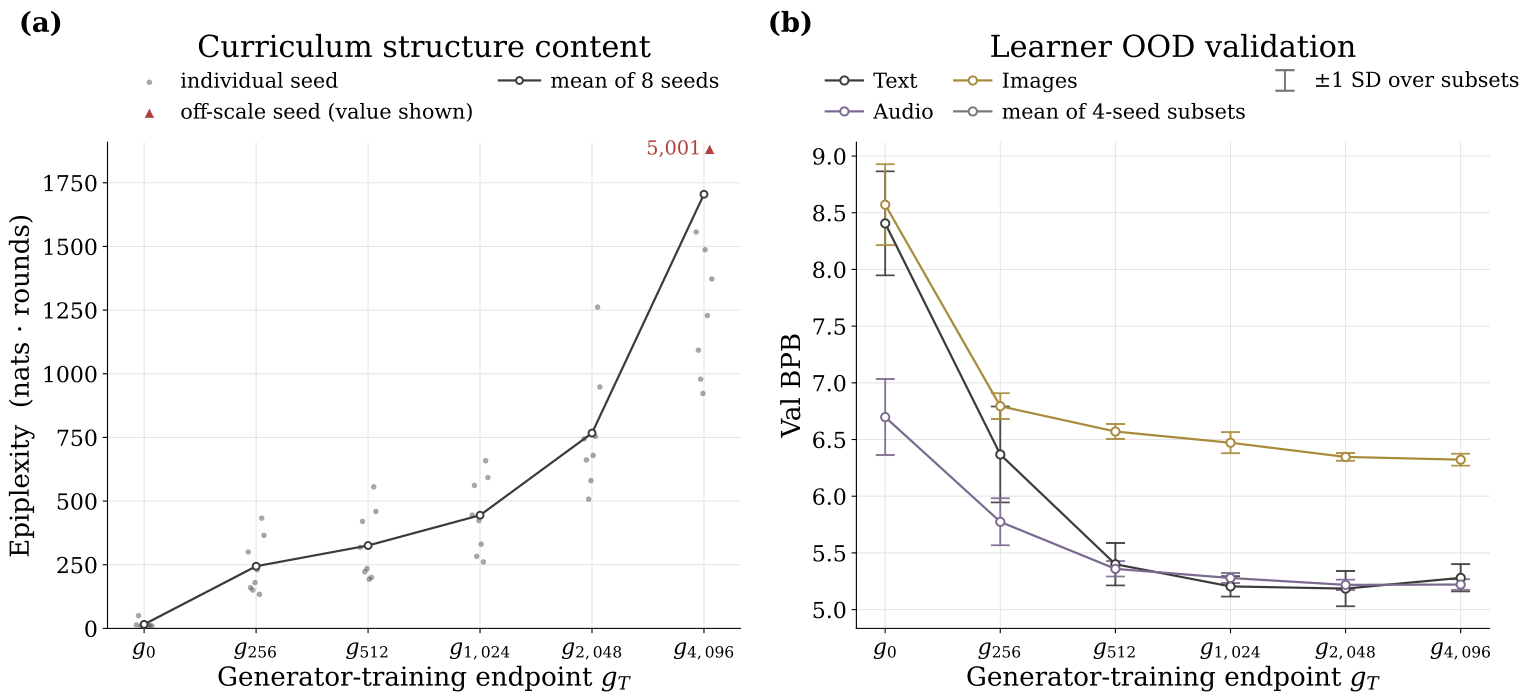
The generator produces increasingly useful training data. We next ask whether the generator improves over the course of self-play. For each endpoint
3.2 In Context Learning
An emergent property of large language models is their ability to infer a task from examples provided in context and apply the inferred rule to new inputs
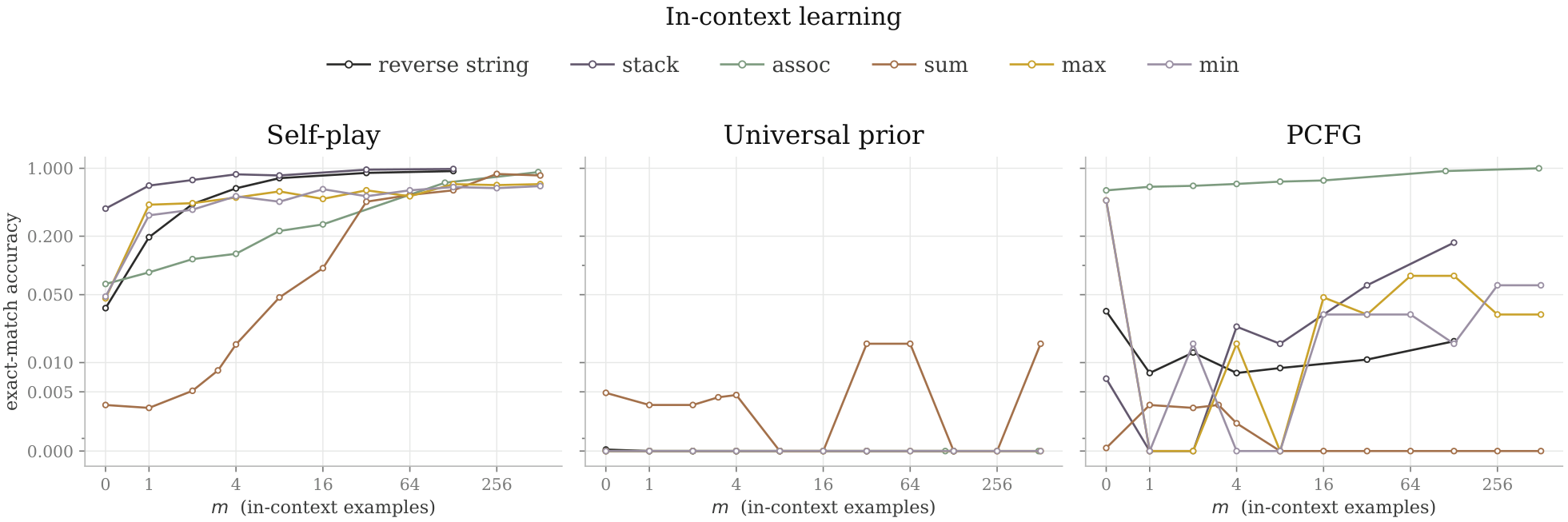
out loss, in-context learning provides a complementary test of whether self-play pretraining has produced a model that can infer latent structure in sequences. We evaluate our learner’s performance on several in-context learning tasks in Figure 1. We plot the empirical success rate under greedy
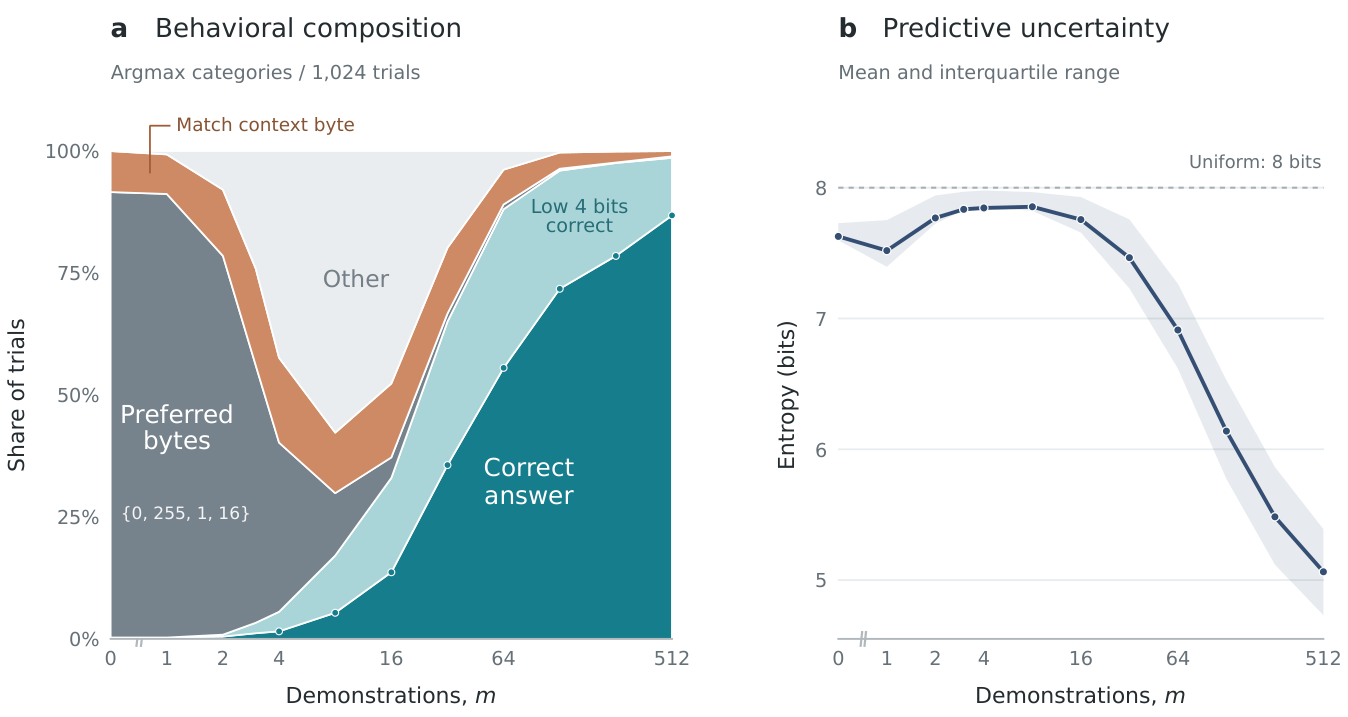
the latent structure underlying the sequence entirely in context. From the perspective of universal prediction and Solomonoff induction, this is precisely the kind of behavior we would hope to emerge after our self-play procedure. Section D contains task-specific details.
Self-play induces broad ICL where fixed synthetic pretraining does not. In Figure 4, we see that the model can achieve almost 100% accuracy on REVERSE STRING
Qualitative analysis of shifting model strategies during SUM task. In Figure 5, we study the behavior of the model on the SUM task as it receives more ICL examples. Initially, the model predicts trivial outputs which correspond to its prior (the marginally most common bytes, indicated in dark grey). After seeing a few examples it begins to copy previous bytes, but then loses confidence after several overconfident but incorrect predictions, reverting to a very broad distribution; we see this reflected in the increase in entropy in the right panel. After around 4 examples, it begins to sum the 4 low-order bits correctly and by 8 examples it begins to sum the 4 high-order bits correctly as well. From there the model improves its confidence in its strategy and locks in on the correct approach.
4 Explaining Self-Play Scaling laws via Universal Data Ansatz
Our experiments show that (1) prediction on natural data improves predictably even though the learner does not train on any natural data and (2) the observed scaling exponents are comparable to those obtained from standard pretraining on particular domains. We propose a simple interpretation of these two results by separating two sources of predictive information that are ordinarily entangled in natural data: contingent information, which is specific to the particular world or distribution that generated the data, and universal predictive structure, which is shared across many data-generating processes.
Decomposing natural-data scaling.
We refine the data term by treating contingent information and universal structure as separate resources:
where
Explaining self-play power law scaling in compute. We first use the ansatz in Equation 7 to understand why we might see power law scaling in self-play compute. Since our models are not trained on natural data, contingent information is fixed as training proceeds. We absorb the third term in Equation 7 into a dataset-specific constant . Only universal predictive structure generated through self-play can grow, giving
Here we write
then
Thus, the ansatz directly predicts the form of the scaling law we observe: natural-data loss can improve as a power law in the amount of self-play training data
Comparing self-play and natural-data exponents. Now, we show that, with some additional assumptions, the conventional one-term data-scaling law conflates gains from learning contingent information with gains from learning universal structure. In standard pretraining, increasing the amount of natural data
Substituting into Equation (7) gives
Asymptotically, the more slowly decaying of the two terms dominates, so we expect that a single fitted data exponent recovers
We observe self-play exponents, which estimate
5 Related Work
Synthetic data Since natural data is limited, synthetic data has increasingly been explored as a promising approach. One line of work uses generation to extract more learning signal from a fixed corpus of natural data. Synthetic continued pretraining generates diverse presentations and connections among facts in a small source corpus, improving the efficiency with which those facts are acquired
Self-play Early work on intrinsic motivation proposed rewarding agents for learning or compression progress, thereby directing exploration toward regularities that are neither already mastered nor currently unlearnable
Universal prediction and algorithmic pretraining Universal prediction provides a theoretical framework for understanding when prediction over arbitrary computable data-generating processes is possible
Epiplexity
6 Discussion
Our results show that predictable improvements in next-token prediction on natural data can emerge even when no natural data is used for training. This provides evidence that some of the structure ordinarily acquired through standard pretraining on natural data is beneficial because it teaches the model universal predictive regularities. At the same time, universal pretraining cannot recover contingent information: facts about a particular world must ultimately enter through interaction with that world. Therefore, we do not view universal pretraining as a replacement for natural data, but as a way to isolate universal structure and study whether that component can instead be generated from compute.
Implications on synthetic data. The decomposition in Equation (7) provides a useful way to interpret recent approaches to synthetic data. Some methods generate abstract, formal, procedural, or otherwise domain-independent data whose primary value is to expose the model to transferable structure
resource, then generating additional structured experience can improve prediction despite bearing little surface resemblance to the target distribution. If contingent information is limiting, synthetic transformations of a fixed corpus can increase the amount of learning signal extracted from each observation. Our results demonstrate an extreme point in this design space:
Why tabula rasa? Our tabula rasa setting is intended as a controlled scientific experiment rather than necessarily the most practical way to pretrain a model. Since the learner and generator are randomly initialized, any transfer to natural data must have been acquired through the self-play process. In practice, there is no requirement that self-play begin from scratch. The key question is whether self-generated experience can continue expanding the frontier after naturally available data has become expensive, redundant, or exhausted. Our results suggest that this possibility is worth studying: if an adaptive curriculum can bootstrap transferable structure from random initialization, then the same mechanism may also be useful when initialized from a non-random learner. This could make our self-play algorithm complementary to standard pretraining.
Future Directions The experiments reported here are confined to models below 25M parameters at a 4K context, and the most immediate question is whether these results persist for larger models. Achieving this may require a more expressive programming language, allowing reusable abstractions to co-evolve with the generator, alongside other modifications that improve program search efficiency and overall scalability. Future work could also test whether the discovered mathematical structures causally contribute to transfer through circuit analysis or curriculum ablations.
7 Acknowledgments
We especially thank Suhas Kotha and Marvin Li for detailed feedback on an earlier draft of the paper. We thank Xiao-Liang Qi for valuable discussions at the inception of this project. Kfir Dolev was supported by the Long Term Future Fund and later by the Zuckerman STEM leadership program.
References
Emre Can Acikgoz, Cheng Qian, Jonas Hübotter, Heng Ji, Dilek Hakkani-Tür, and Gokhan Tur. Tool-r0: Self-evolving llm agents for tool-learning from zero data, 2026. URL arXiv.
Armen Aghajanyan, Lili Yu, Alexis Conneau, Wei-Ning Hsu, Karen Hambardzumyan, Susan Zhang, Stephen Roller, Naman Goyal, Omer Levy, and Luke Zettlemoyer. Scaling laws for generative mixed-modal language models. In International Conference on Machine Learning, pages 265–279. PMLR, 2023.
AITDCC. Algorithmic information theory data compression challenge official data archive. GitHub. data/data.zip, member data/B, GitHub repository, commit 16887f9d68f273503eddb69e0c29aa7b4f39ba7a.
Jimmy Ba, Geoffrey Hinton, Volodymyr Mnih, Joel Z. Leibo, and Catalin Ionescu. Using fast weights to attend to the recent past. In Proceedings of the 30th International Conference on Neural Information Processing Systems, NIPS’16, page 4338–4346, Red Hook, NY, USA, 2016. Curran Associates Inc.
Luke Bailey, Kaiyue Wen, Kefan Dong, Tatsunori Hashimoto, and Tengyu Ma. Scaling self-play with self-guidance, 2026a. URL arXiv.
Luke Bailey, Kaiyue Wen, Kefan Dong, Tatsunori Hashimoto, and Tengyu Ma. Scaling self-play with self-guidance, 2026b. URL arXiv.
Manel Baradad, Jonas Wulff, Tongzhou Wang, Phillip Isola, and Antonio Torralba. Learning to see by looking at noise, 2022. URL arXiv.
Peter Bloem. Universal pre-training by iterated random computation, 2025. URL arXiv.
Tom Brown, Benjamin Mann, Nick Ryder, Melanie Subbiah, Jared D Kaplan, Prafulla Dhariwal, Arvind Neelakantan, Pranav Shyam, Girish Sastry, Amanda Askell, et al. Language models are few-shot learners. Advances in neural information processing systems, 33:1877–1901, 2020.
Lili Chen, Mihir Prabhudesai, Katerina Fragkiadaki, Hao Liu, and Deepak Pathak. Self-questioning language models, 2025. URL arXiv.
Mayee F. Chen, Tyler Murray, David Heineman, Matt Jordan, Hannaneh Hajishirzi, Christopher Ré, Luca Soldaini, and Kyle Lo. Olmix: A framework for data mixing throughout lm development, 2026. URL arXiv.
Caroline Choi, Zeyneb Kaya, Shirley Wu, Tengyu Ma, Tatsunori Hashimoto, and Ludwig Schmidt. Anchored self-play for code repair, 2026. URL arXiv.
Mutopia Project contributors. The mutopia project. URL mutopiaproject.org.
Santiago Cuervo and Ricard Marxer. Scaling properties of speech language models. In Proceedings of the 2024 Conference on Empirical Methods in Natural Language Processing, pages 351–361, 2024.
Grégoire Delétang, Anian Ruoss, Jordi Grau-Moya, Tim Genewein, Li Kevin Wenliang, Elliot Catt, Chris Cundy, Marcus Hutter, Shane Legg, Joel Veness, and Pedro A. Ortega. Neural networks and the chomsky hierarchy, 2023. URL arXiv.
Kefan Dong and Tengyu Ma. Stp: Self-play llm theorem provers with iterative conjecturing and proving, 2025a. URL arXiv.
Kefan Dong and Tengyu Ma. STP: Self-play LLM theorem provers with iterative conjecturing and proving. In Aarti Singh, Maryam Fazel, Daniel Hsu, Simon Lacoste-Julien, Felix Berkenkamp, Tegan Maharaj, Kiri Wagstaff, and Jerry Zhu, editors, Proceedings of the 42nd International Conference on Machine Learning, volume 267 of Proceedings of Machine Learning Research, pages 14114–14136. PMLR, 13–19 Jul 2025b. URL mlr.press.
Kefan Dong, Arvind Mahankali, and Tengyu Ma. Formal theorem proving by rewarding llms to decompose proofs hierarchically, 2024. URL arXiv.
Marc Finzi, Shikai Qiu, Yiding Jiang, Pavel Izmailov, J. Zico Kolter, and Andrew Gordon Wilson. From entropy to epiplexity: Rethinking information for computationally bounded intelligence, 2026. URL arXiv.
Jordi Grau-Moya, Tim Genewein, Marcus Hutter, Laurent Orseau, Grégoire Delétang, Elliot Catt, Anian Ruoss, Li Kevin Wenliang, Christopher Mattern, Matthew Aitchison, and Joel Veness. Learning universal predictors, 2024. URL arXiv.
A. Griewank and A. Walther. Evaluating Derivatives: Principles and Techniques of Algorithmic Differentiation, Second Edition. Other Titles in Applied Mathematics. Society for Industrial and Applied Mathematics (SIAM, 3600 Market Street, Floor 6, Philadelphia, PA 19104), 2008. ISBN 9780898717761. URL Google Books.
Suriya Gunasekar, Yi Zhang, Jyoti Aneja, Caio César Teodoro Mendes, Allie Del Giorno, Sivakanth Gopi, Mojan Javaheripi, Piero Kauffmann, Gustavo de Rosa, Olli Saarikivi, Adil Salim, Shital Shah, Harkirat Singh Behl, Xin Wang, Sébastien Bubeck, Ronen Eldan, Adam Tauman Kalai, Yin Tat Lee, and Yuanzhi Li. Textbooks are all you need, 2023. URL arXiv.
Daya Guo, Dejian Yang, Haowei Zhang, Junxiao Song, Peiyi Wang, Qihao Zhu, Runxin Xu, Ruoyu Zhang, Shirong Ma, Xiao Bi, Xiaokang Zhang, Xingkai Yu, Yu Wu, Z. F. Wu, Zhibin Gou, Zhihong Shao, Zhuoshu Li, Ziyi Gao, Aixin Liu, Bing Xue, Bingxuan Wang, Bochao Wu, Bei Feng, Chengda Lu, Chenggang Zhao, Chengqi Deng, Chong Ruan, Damai Dai, Deli Chen, Dongjie Ji, Erhang Li, Fangyun Lin, Fucong Dai, Fuli Luo, Guangbo Hao, Guanting Chen, Guowei Li, H. Zhang, Hanwei Xu, Honghui Ding, Huazuo Gao, Hui Qu, Hui Li, Jianzhong Guo, Jiashi Li, Jingchang Chen, Jingyang Yuan, Jinhao Tu, Junjie Qiu, Junlong Li, J. L. Cai, Jiaqi Ni, Jian Liang, Jin Chen, Kai Dong, Kai Hu, Kaichao You, Kaige Gao, Kang Guan, Kexin Huang, Kuai Yu, Lean Wang, Lecong Zhang, Liang Zhao, Litong Wang, Liyue Zhang, Lei Xu, Leyi Xia, Mingchuan Zhang, Minghua Zhang, Minghui Tang, Mingxu Zhou, Meng Li, Miaojun Wang, Mingming Li, Ning Tian, Panpan Huang, Peng Zhang, Qiancheng Wang, Qinyu Chen, Qiushi Du, Ruiqi Ge, Ruisong Zhang, Ruizhe Pan, Runji Wang, R. J. Chen, R. L. Jin, Ruyi Chen, Shanghao Lu, Shangyan Zhou, Shanhuang Chen, Shengfeng Ye, Shiyu Wang, Shuiping Yu, Shunfeng Zhou, Shuting Pan, S. S. Li, Shuang Zhou, Shaoqing Wu, Tao Yun, Tian Pei, Tianyu Sun, T. Wang, Wangding Zeng, Wen Liu, Wenfeng Liang, Wenjun Gao, Wenqin Yu, Wentao Zhang, W. L. Xiao, Wei An, Xiaodong Liu, Xiaohan Wang, Xiaokang Chen, Xiaotao Nie, Xin Cheng, Xin Liu, Xin Xie, Xingchao Liu, Xinyu Yang, Xinyuan Li, Xuecheng Su, Xuheng Lin, X. Q. Li, Xiangyue Jin, Xiaojin Shen, Xiaosha Chen, Xiaowen Sun, Xiaoxiang Wang, Xinnan Song, Xinyi Zhou, Xianzu Wang, Xinxia Shan, Y. K. Li, Y. Q. Wang, Y. X. Wei, Yang Zhang, Yanhong Xu, Yao Li, Yao Zhao, Yaofeng Sun, Yaohui Wang, Yi Yu, Yichao Zhang, Yifan Shi, Yiliang Xiong, Ying He, Yishi Piao, Yisong Wang, Yixuan Tan, Yiyang Ma, Yiyuan Liu, Yongqiang Guo, Yuan Ou, Yuduan Wang, Yue Gong, Yuheng Zou, Yujia He, Yunfan Xiong, Yuxiang Luo, Yuxiang You, Yuxuan Liu, Yuyang Zhou, Y. X. Zhu, Yanping Huang, Yaohui Li, Yi Zheng, Yuchen Zhu, Yunxian Ma, Ying Tang, Yukun Zha, Yuting Yan, Z. Z. Ren, Zehui Ren, Zhangli Sha, Zhe Fu, Zhean Xu, Zhenda Xie, Zhengyan Zhang, Zhewen Hao, Zhicheng Ma, Zhigang Yan, Zhiyu Wu, Zihui Gu, Zijia Zhu, Zijun Liu, Zilin Li, Ziwei Xie, Ziyang Song, Zizheng Pan, Zhen Huang, Zhipeng Xu, Zhongyu Zhang, and Zhen Zhang. Deepseek-r1 incentivizes reasoning in llms through reinforcement learning. Nature, 645(8081):633–638, September 2025. ISSN 1476-4687. doi: 10.1038/s41586-025-09422-z. URL http://dx.doi.org/10.1038/s41586-025-09422-z.
Tom Henighan, Jared Kaplan, Mor Katz, Mark Chen, Christopher Hesse, Jacob Jackson, Heewoo Jun, Tom B. Brown, Prafulla Dhariwal, Scott Gray, Chris Hallacy, Benjamin Mann, Alec Radford, Aditya Ramesh, Nick Ryder, Daniel M. Ziegler, John Schulman, Dario Amodei, and Sam McCandlish. Scaling laws for autoregressive generative modeling, 2020. URL arXiv.
Jordan Hoffmann, Sebastian Borgeaud, Arthur Mensch, Elena Buchatskaya, Trevor Cai, Eliza Rutherford, Diego de Las Casas, Lisa Anne Hendricks, Johannes Welbl, Aidan Clark, Tom Hennigan, Eric Noland, Katie Millican, George van den Driessche, Bogdan Damoc, Aurelia Guy, Simon Osindero, Karen Simonyan, Erich Elsen, Jack W. Rae, Oriol Vinyals, and Laurent Sifre. Training compute-optimal large language models, 2022. URL arXiv.
Michael Y Hu, Jackson Petty, Chuan Shi, William Merrill, and Tal Linzen. Between circuits and chomsky: Pre-pretraining on formal languages imparts linguistic biases. In Proceedings of the 63rd Annual Meeting of the Association for Computational Linguistics (Volume 1: Long Papers), pages 9691–9709, 2025.
Marcus Hutter. A theory of universal artificial intelligence based on algorithmic complexity, 2000. URL arXiv.
Adam Ibrahim, Benjamin Thérien, Kshitij Gupta, Mats L. Richter, Quentin Anthony, Timothée Lesort, Eugene Belilovsky, and Irina Rish. Simple and scalable strategies to continually pre-train large language models, 2024. URL arXiv.
Jared Kaplan, Sam McCandlish, Tom Henighan, Tom B Brown, Benjamin Chess, Rewon Child, Scott Gray, Alec Radford, Jeffrey Wu, and Dario Amodei. Scaling laws for neural language models. arXiv preprint arXiv:2001.08361, 2020.
Hirokatsu Kataoka, Kazushige Okayasu, Asato Matsumoto, Eisuke Yamagata, Ryosuke Yamada, Nakamasa Inoue, Akio Nakamura, and Yutaka Satoh. Pre-training without natural images, 2021. URL arXiv.
Konwoo Kim, Suhas Kotha, Yejin Choi, Tatsunori Hashimoto, Nick Haber, and Percy Liang. Data-efficient pre-training by scaling synthetic megadocs, 2026a. URL arXiv.
Konwoo Kim, Suhas Kotha, Percy Liang, and Tatsunori Hashimoto. Pre-training under infinite compute. In International Conference on Learning Representations, volume 2026, pages 74596–74636, 2026b.
Dan Lee, Seungwook Han, Akarsh Kumar, and Pulkit Agrawal. Training language models via neural cellular automata, 2026. URL arXiv.
Jeffrey Li, Alex Fang, Georgios Smyrnis, Maor Ivgi, Matt Jordan, Samir Gadre, Hritik Bansal, Etash Guha, Sedrick Keh, Kushal Arora, Saurabh Garg, Rui Xin, Niklas Muennighoff, Reinhard Heckel, Jean Mercat, Mayee Chen, Suchin Gururangan, Mitchell Wortsman, Alon Albalak, Yonatan Bitton, Marianna Nezhurina, Amro Abbas, Cheng-Yu Hsieh, Dhruba Ghosh, Josh Gardner, Maciej Kilian, Hanlin Zhang, Rulin Shao, Sarah Pratt, Sunny Sanyal, Gabriel Ilharco, Giannis Daras, Kalyani Marathe, Aaron Gokaslan, Jieyu Zhang, Khyathi Chandu, Thao Nguyen, Igor Vasiljevic, Sham Kakade, Shuran Song, Sujay Sanghavi, Fartash Faghri, Sewoong Oh, Luke Zettlemoyer, Kyle Lo, Alaaeldin El-Nouby, Hadi Pouransari, Alexander Toshev, Stephanie Wang, Dirk Groeneveld, Luca Soldaini, Pang Wei Koh, Jenia Jitsev, Thomas Kollar, Alexandros G. Dimakis, Yair Carmon, Achal Dave, Ludwig Schmidt, and Vaishaal Shankar. Datacomp-lm: In search of the next generation of training sets for language models, 2025. URL arXiv.
Bo Liu, Simon Yu, Yiding Jiang, Ao Qu, Andrew Zhao, Zichen Liu, Junsu Kim, Zijian Zhou, Seungone Kim, Tongzheng Ren, Mickel Liu, Hanfei Yu, Zhaorun Chen, Weiyan Shi, Paul Pu Liang, Luke Zettlemoyer, Yejin Choi, and Natasha Jaques. Spade: Self-play in adaptive synthetic executable environments, 2026. URL arXiv.
N. Merhav and M. Feder. Universal prediction. IEEE Transactions on Information Theory, 44(6): 2124–2147, 1998. doi: 10.1109/18.720534.
Metamath contributors. set.mm: Metamath proof database. GitHub. GitHub repository, commit bcfef9892b6103ba9046bf683b4903d2ad081a41.
Jean-Baptiste Mouret and Jeff Clune. Illuminating search spaces by mapping elites, 2015. URL arXiv.
NCBI. Homo sapiens genome assembly GRCh38. NCBI Datasets. URL NCBI. RefSeq assembly accession GCF_000001405.26.
Isabel Papadimitriou and Dan Jurafsky. Learning music helps you read: Using transfer to study linguistic structure in language models. In Proceedings of the 2020 Conference on Empirical Methods in Natural Language Processing (EMNLP), pages 6829–6839, 2020.
Guilherme Penedo, Quentin Malartic, Daniel Hesslow, Ruxandra Cojocaru, Alessandro Cappelli, Hamza Alobeidli, Baptiste Pannier, Ebtesam Almazrouei, and Julien Launay. The refinedweb dataset for falcon llm: Outperforming curated corpora with web data, and web data only, 2023. URL arXiv.
Gabriel Poesia, David Broman, Nick Haber, and Noah D. Goodman. Learning formal mathematics from intrinsic motivation, 2024. URL arXiv.
Yangjun Ruan, Neil Band, Chris J. Maddison, and Tatsunori Hashimoto. Reasoning to learn from latent thoughts, 2025. URL arXiv.
Tom Schaul, John Quan, Ioannis Antonoglou, and David Silver. Prioritized experience replay, 2016. URL arXiv.
Jürgen Schmidhuber. Driven by compression progress: A simple principle explains essential aspects of subjective beauty, novelty, surprise, interestingness, attention, curiosity, creativity, art, science, music, jokes. In Workshop on anticipatory behavior in adaptive learning systems, pages 48–76. Springer, 2008.
Jürgen Schmidhuber. Powerplay: Training an increasingly general problem solver by continually searching for the simplest still unsolvable problem, 2012. URL arXiv.
Arnav Shah, Junzhe Li, Parsa Idehpour, Adibvafa Fallahpour, Brandon Wang, Sukjun Hwang, Bo Wang, Patrick D. Hsu, Hani Goodarzi, and Albert Gu. dnahnet: A scalable and hierarchical foundation model for genomic sequence learning, 2026. URL arXiv.
David Silver and Richard Sutton. Welcome to the era of experience.
Luca Soldaini, Rodney Kinney, Akshita Bhagia, Dustin Schwenk, David Atkinson, Russell Authur, Ben Bogin, Khyathi Chandu, Jennifer Dumas, Yanai Elazar, Valentin Hofmann, Ananya Harsh Jha, Sachin Kumar, Li Lucy, Xinxi Lyu, Nathan Lambert, Ian Magnusson, Jacob Morrison, Niklas Muennighoff, Aakanksha Naik, Crystal Nam, Matthew E. Peters, Abhilasha Ravichander, Kyle Richardson, Zejiang Shen, Emma Strubell, Nishant Subramani, Oyvind Tafjord, Pete Walsh, Luke
Ray J Solomonoff. A formal theory of inductive inference. part i. Information and control, 7(1):1–22, 1964.
Richard S. Sutton. The bitter lesson. Incomplete Ideas (blog), 2019. URL Incomplete Ideas.
Tristan Thrush, Sung Min Park, Herman Brunborg, Luke Bailey, Marcel Rød, Neil Band, Christopher Potts, and Tatsunori Hashimoto. Synthetic data for any differentiable target. In Third Conference on Language Modeling, 2026. URL OpenReview.
Hugo Touvron, Thibaut Lavril, Gautier Izacard, Xavier Martinet, Marie-Anne Lachaux, Timothée Lacroix, Baptiste Rozière, Naman Goyal, Eric Hambro, Faisal Azhar, Aurelien Rodriguez, Armand Joulin, Edouard Grave, and Guillaume Lample. Llama: Open and efficient foundation language models, 2023. URL arXiv.
Aozhe Wang, Yuchen Yan, Nan Zhou, Zhengxi Lu, Weiming Lu, Jun Xiao, Yueting Zhuang, and Yongliang Shen. Code-a1: Adversarial evolving of code llm and test llm via reinforcement learning, 2026. URL arXiv.
Kaiyue Wen, David Leo Wright Hall, Tengyu Ma, and Percy Liang. Fantastic pretraining optimizers and where to find them. In The Fourteenth International Conference on Learning Representations, 2026. URL OpenReview.
Sang Michael Xie, Hieu Pham, Xuanyi Dong, Nan Du, Hanxiao Liu, Yifeng Lu, Percy Liang, Quoc V. Le, Tengyu Ma, and Adams Wei Yu. Doremi: Optimizing data mixtures speeds up language model pretraining, 2023. URL arXiv.
Zitong Yang, Neil Band, Shuangping Li, Emmanuel Candes, and Tatsunori Hashimoto. Synthetic continued pretraining. In International Conference on Learning Representations, volume 2025, pages 44379–44421, 2025.
Ori Yoran, Kunhao Zheng, Fabian Gloeckle, Jonas Gehring, Gabriel Synnaeve, and Taco Cohen. The kolmogorov test: compression by code generation. In International Conference on Learning Representations, volume 2025, pages 87896–87926, 2025.
Eric Zelikman, Georges Harik, Yijia Shao, Varuna Jayasiri, Nick Haber, and Noah D. Goodman. Quiet-star: Language models can teach themselves to think before speaking, 2024. URL arXiv.
Andrew Zhao, Yiran Wu, Yang Yue, Tong Wu, Quentin Xu, Yang Yue, Matthieu Lin, Shenzhi Wang, Qingyun Wu, Zilong Zheng, and Gao Huang. Absolute zero: Reinforced self-play reasoning with zero data, 2025. URL arXiv.
Chujie Zheng, Shixuan Liu, Mingze Li, Xiong-Hui Chen, Bowen Yu, Chang Gao, Kai Dang, Yuqiong Liu, Rui Men, An Yang, Jingren Zhou, and Junyang Lin. Group sequence policy optimization, 2025. URL arXiv.
Yifei Zhou, Sergey Levine, Jason E Weston, Xian Li, and Sainbayar Sukhbaatar. Self-challenging language model agents. In The Thirty-ninth Annual Conference on Neural Information Processing Systems, 2025. URL OpenReview.
| Modality / dataset | Ours | Literature | Ref. |
|---|---|---|---|
| Text | |||
| text (dclm) | 0.123 | 0.048–0.099 | Aghajanyan et al. (2023), Henighan et al. (2020) |
| Images | |||
| CIFAR-10 (HWC interl.) | 0.066 | ||
| CIFAR-10 image bytes | 0.145 | 0.065–0.10 | Aghajanyan et al. (2023); Henighan et al. (2020) |
| Audio / speech | |||
| audio 16-bit PCM | 0.141 | ||
| audio 8-bit PCM | 0.260 | 0.12–0.14 | Aghajanyan et al. (2023), Cuervo and Marxer (2024) |
| MIDI (Mutopia, 16th note grid) | 0.249 | — | |
| Math / formal | |||
| Metamath set.mm | 0.129 | 0.17 | Henighan et al. (2020) |
| Biological sequences | |||
| DNA (8-symbol) | 0.435 | 0.01–0.06 | Shah et al. (2026) |
| Code | |||
| AITDCC C source | 0.116 | 0.17 | Aghajanyan et al. (2023) |
| Python source (GitHub) | 0.113 |
Table 2: Per-modality compute exponents
A Additional experimental results
A.1 Pre-Pretraining with Self-Play Accelerates Pretraining on Natural Data
Our scaling results show that self-play produces transferable structure; a natural follow-up question is whether that structure remains useful once natural data becomes available. We therefore treat self-play as pre-pretraining
Setup. We compare downstream pretraining of a 24.4M-parameter model from two initializations: random weights (“from scratch”) and the final self-play checkpoint (“self-play warm start”). We evaluate both on DCLM text, CIFAR-10 images, and ESC-50 audio, using the same fixed natural-data corpus for each modality. Both methods are trained to convergence, with learning rate and weight decay tuned separately for each.
Results Figure 6 shows that self-play pre-pretraining accelerates downstream training across all three modalities. The warm-start models start with a lower loss than random initialization, as expected, and retain an advantage throughout training, reaching a low validation-loss level with fewer natural-data tokens. The savings are substantial on ESC-50 (320M vs. 496M tokens) and CIFAR-10 (421M vs. 588M). By the end of our training protocol, the loss gap has narrowed
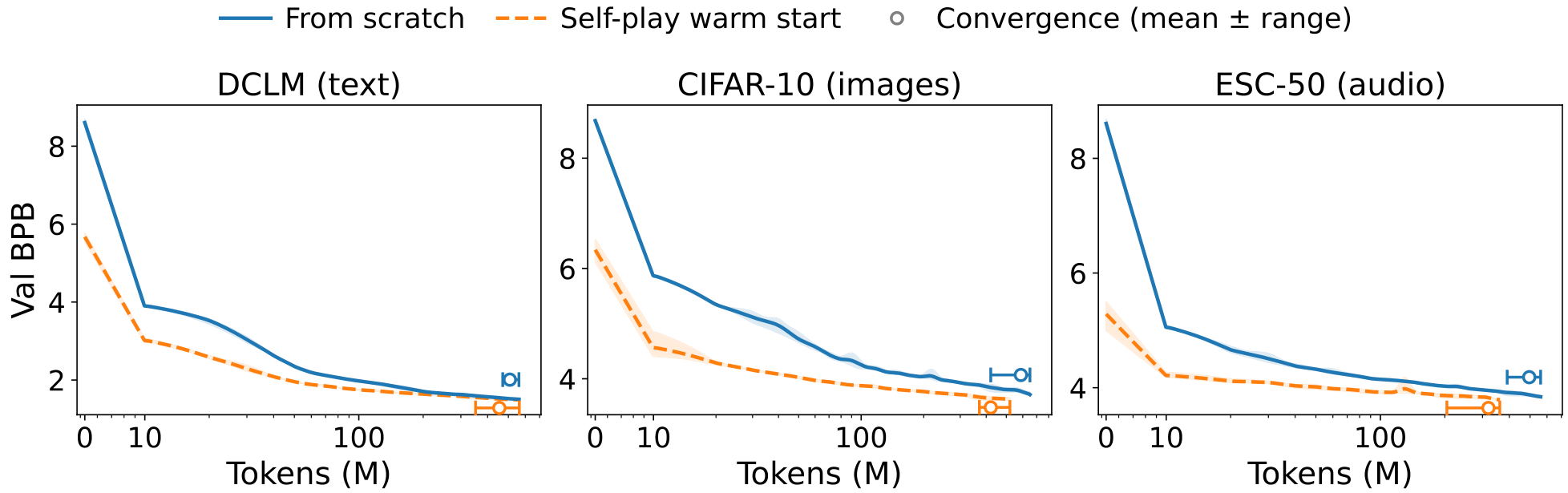
considerably, indicating that the clearest benefit of self-play pre-pretraining is accelerated learning from natural data.
A.2 Pre-pretraining details
After the validation split, the training corpora contain approximately 255M (DCLM), 146M (CIFAR-10), and 152M (ESC-50) tokens, and runs repeat this data over epochs, terminating at approximate convergence. The learning rate is held constant until validation BPB plateaus (improvement < 0.005 for 5 consecutive evaluations), then decayed to zero over a 200-step cosine schedule; we report the converged BPB, the validation loss after this final decay. Learning rate and weight decay are tuned separately for each arm, from
B Benchmark details
Here we collect more details on the benchmarks. To test the ability of the model to predict intrinsically different kinds of “natural” sequences, we designed a diverse set of benchmarks generated by different processes. Regardless of the provenance, they share the same interface, obtained by encoding them as byte sequences.
B.1 Natural text
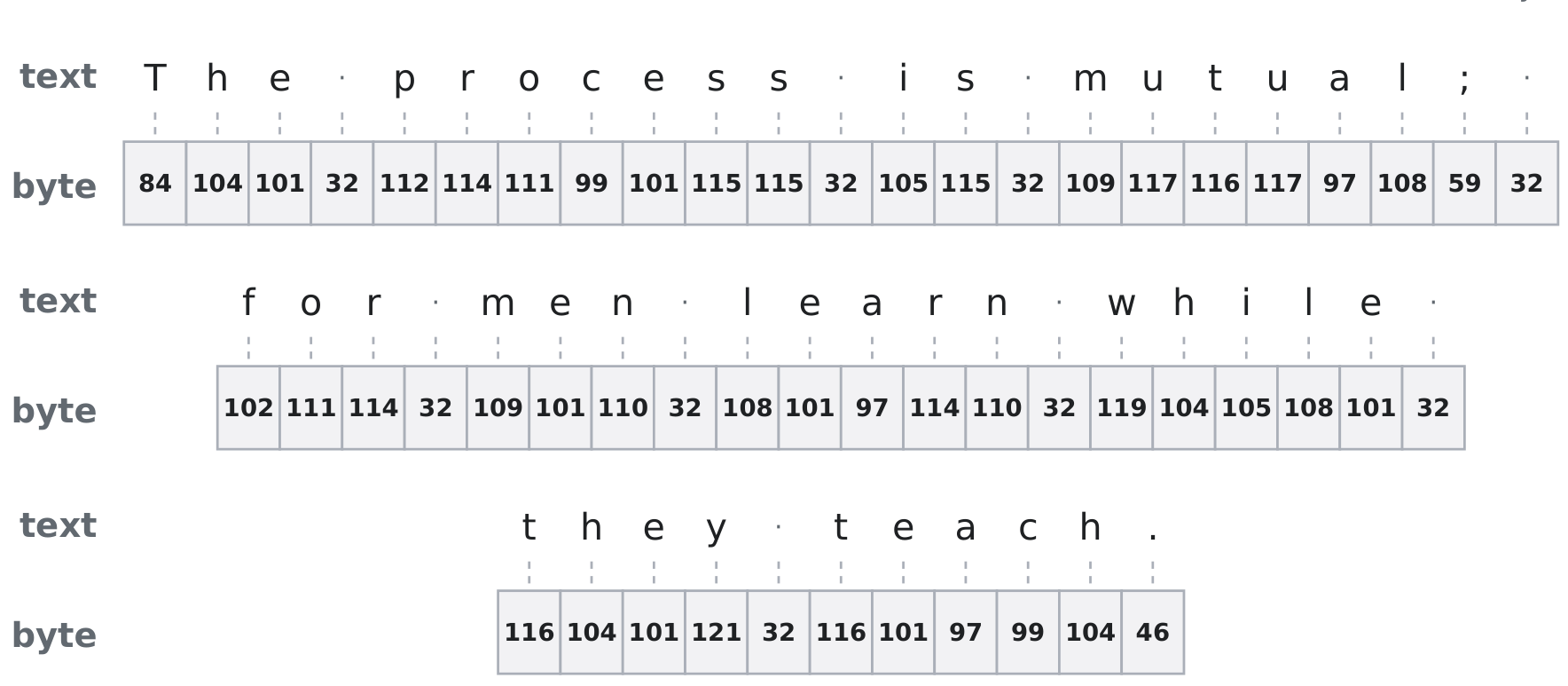
To construct this benchmark, we used DCLM-Baseline-1.0, a filtered collection of web text extracted from Common Crawl. Explicitly, we sampled the ten global DCLM shards so that the benchmark did
not come from only one part of the collection. Each DCLM record is stored in a JSON container, but the benchmark retains only its text field. We encode this text directly as UTF-8 bytes, concatenate the document texts within each shard, and divide the result into fixed windows for next-byte prediction. The predictor therefore has to exploit regularities such as spelling, punctuation, word structure, and local syntax through the same byte interface used for every other benchmark.
B.2 Natural images
To construct this benchmark, we used the official CIFAR-10 test batch. It contains
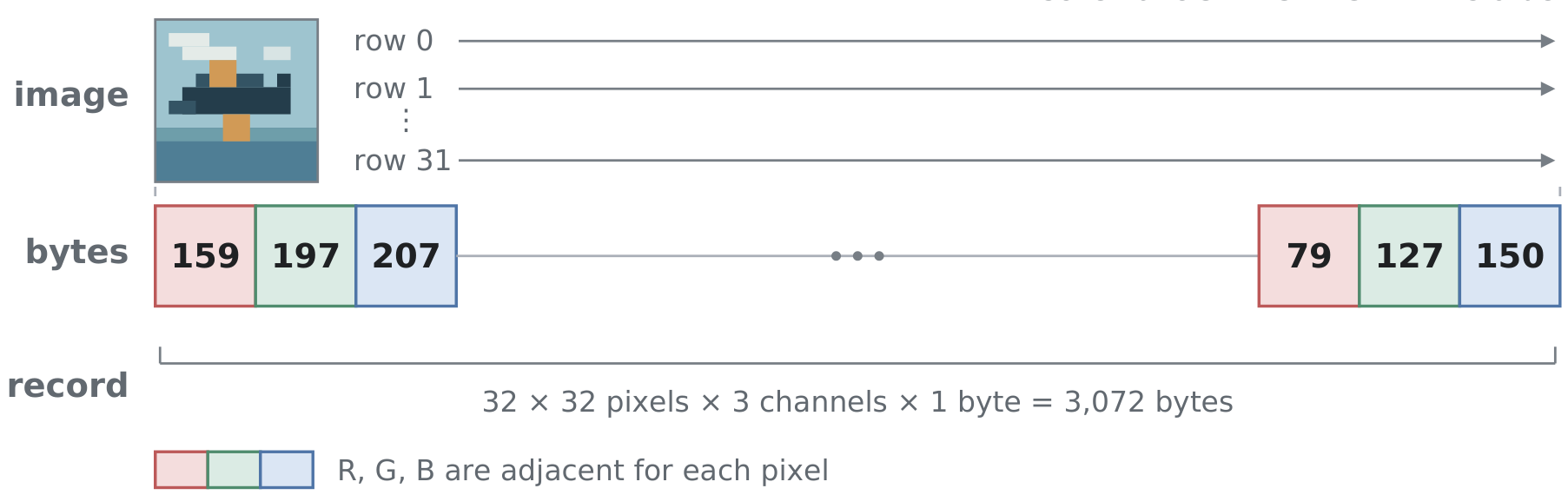
A two-dimensional image must still be arranged as a one-dimensional byte sequence. We included two lossless encodings of exactly the same images. The planar (CHW) encoding traverses each image row by row, storing all red values, then all green, and then all blue. The interleaved (HWC) encoding uses the same pixel order but places each pixel’s R, G, and B values next to one another. We considered both encodings to check whether this one dimensional ordering made a difference to next-byte prediction performance, but we did not find any appreciable effect.
B.3 RAW audio: Natural speech
Our raw-audio benchmarks use the official Speech Commands v0.02 test archive, released under CC BY 4.0. It contains 4,890 one-second mono recordings, encoded in WAV files, composed by ten target commands together with unknown-word and silence examples.
A WAV file mixes the waveform with a header, and its samples are signed 16-bit little-endian values. We discard the header, paths, category labels, and other metadata. Each amplitude
We provide three versions of the same recordings. The 16 kHz version quantizes the original samples directly. For the 8- and 4 kHz versions, fixed anti-aliasing filters downsample each recording independently by factors of two and four before the same quantization. These benchmarks test short-time acoustic prediction. With context length 256, each record contains 255 consecutive waveform bytes. The 255 bytes span 15.94 ms at 16 kHz, 31.88 ms at 8 kHz, and 63.75 ms at 4 kHz. Reducing the sample rate sacrifices high-frequency detail but exposes a longer interval to the same bounded-context model.
B.4 Music
Raw audio is physically direct but temporally expensive. PCM8 sampled at 16 kHz consumes 16,000 bytes per second; even the repository’s 4 kHz PCM8 variant consumes 4,000 bytes per second. So even a 4096 context length is only able to understand local features. Symbolic score music representation is instead much more compact. At four bytes per quarter note, 255 bytes represent 63.75 quarter-note grid units. They may contain several phrases or a substantial portion of a movement rather than a fraction of one acoustic event.
To construct this benchmark, we used the Mutopia project data. The Mutopia Project is a volunteer collection of open sheet music written in LilyPond and based on editions in the public domain contributors. Its contribution pages provide downloadable notation, PDF, and MIDI artifacts together with source, maintainer, typesetting, and license .
From the full Mutopia project, we took a selection of 40 highly recognizable Western classical pieces under Public Domain license, including familiar pieces by Beethoven, Mozart, Bach, Chopin, Debussy, Schubert, Tchaikovsky, and others. A Standard MIDI File serializes a technical event stream rather than a direct sequence of musical states. It can contain a header, format and track declarations, variable-length delta encodings, tempo events, time signatures, program changes, channels, velocities, controllers, text, copyright notices, names, and end-of-track events. Two files
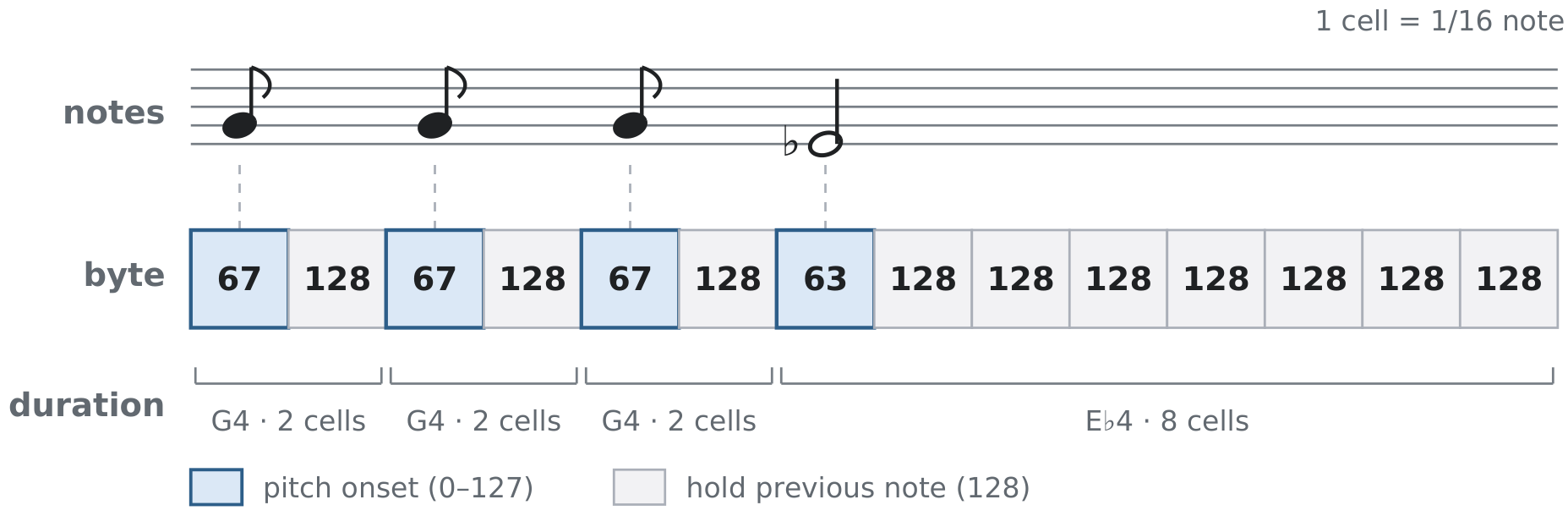
representing substantially the same score can differ in many raw bytes because of exporter, track layout, event ordering, and metadata choices. We stripped all this data, retaining only the melodies. To convert the complex music information in the MIDI melodies into a simple “time-sequence” byte encoding, we quantized the scores in 16th notes, each byte in the benchmark corresponding the state of that time grid cell: either a new note, a continuation of the previous one, or a silence. The selected track need not be monophonic. The benchmark creates a monophonic output by choosing at most one active source note in every grid cell.
We use byte value 0-127 to encode the absolute MIDI pitch. MIDI pitch is an absolute semitone number: 60 is middle C, 61 is C-sharp/D-flat, 62 is D, 63 is D-sharp/E-flat, 64 is E, and 67 is G. Byte value 128 represents continuing holding the previous note in the current byte cell, 129 represents a pause, and 130 denotes the end of a piece. In this benchmark, the bytes 131-255 are unused.
Together with the benchmark data, we provide MIDI files reconstructed from this simplified byte encoding, which we used to check the main themes were still recognizable. We truncated the longer pieces to 4095 bytes.
B.5 DNA
To construct this benchmark, we used the large DNA dataset released with the KoLMogorov Test kolmogorov_dna.
The KoLMogorov paper describes this stream as derived from GRCh38, the curated human reference assembly dna.bin contains the numeric values 0-7, using the encoding
From the large release, we retain its first 32 MiB numeric symbols. We divide this prefix without overlap into 131,586 consecutive records of 255 symbols, discarding the final tail. A predictor told that only eight values are possible could obtain 3 BPB by assigning them equal probability, whereas a uniform prediction over the learner’s full 256-byte output space costs 8 BPB. The learner must therefore recognize the compact alphabet as well as exploit local base composition, masking runs, repeats, and motifs visible within 255 symbols.
B.6 Formal mathematics: Metamath
To construct this benchmark, we used a fixed revision of set.mm, the main Metamath database Metamath contributors. Metamath provides a simple language for writing and checking mathematical proofs. The database contains declarations of symbols, hypotheses, axioms, and theorem statements with their proofs. Proofs refer to earlier statements by their labels and are stored in a compressed form, using compact character strings to encode the proof steps.
We remove the comments delimited by $( and $), including explanatory prose, and discard empty lines. Within each remaining line, we replace runs of whitespace by a single space, remove leading and trailing whitespace, and end the line with one newline byte. We retain the formal content in its source order, including the statement labels, formulas, and compressed proofs. The resulting text is represented directly by its ASCII byte values, with spaces and newlines included in the sequence.
With context length 256, we divide this stream without overlap into 143,166 consecutive records of 255 bytes, discarding the final 176 bytes. The windows can cross line, statement, and proof boundaries. The predictor therefore has to exploit regularities such as recurring syntax, formula fragments, labels, and patterns in the compressed proofs through the same byte interface used for every other benchmark. This tests next-byte prediction of formal mathematical text; the model is not asked to construct or verify a proof.
B.7 C source code
To construct this benchmark, we used file B from the Algorithmic Information Theory Data Compression Challenge
The source is ASCII text, and we retain its original byte values. Comments, copyright notices, preprocessor directives, identifiers, and literals remain, together with indentation, tabs, spaces, blank lines, and newlines. We do not parse or compile the source, normalize its formatting, or use a C-specific tokenizer. The predictor receives the original text as one continuous byte stream.
With context length 256, we divide this stream without overlap into 4,583 consecutive records of 255 bytes, discarding the final 102 bytes. The windows follow byte positions and can cross line, statement, function, and source-file boundaries. The predictor therefore has to exploit regularities such as C syntax, recurring identifiers, comments, and formatting through the same byte interface used for every other benchmark. Repeated names and code patterns provide structure beyond individual characters, while comments also retain the spelling and local syntax of natural language.
C Emergent Mathematical Structure
During self-play, the generator discovers programs whose output tapes exhibit recognizable mathematical structure. We search the generated programs from our model-scaling experiments for
five families of sequences: arithmetic, quadratic, and cubic sequences; Fibonacci-like sequences; and geometric sequences. Generated programs from the self-play runs were retained only once every 256 training rounds, so discovery times can be measured only at this 256-round resolution. In contrast, the uniform-sampling baseline described below checks programs at every round. Thus the performance gap between self-play and the random baseline is likely even wider, as the reported self-play discovery rounds are therefore conservative upper bounds on the true first occurrence of each structure. Table 3 summarizes the observed families and compares their discovery times with uniform program sampling.
Detection criteria. We allow up to 30 unrelated leading bytes before the structured portion of a tape begins. The remainder of the tape must satisfy the corresponding recurrence modulo 256. Arithmetic, quadratic, and cubic sequences are defined by constant first, second, and third finite differences, respectively, with a sequence assigned to the lowest-order family it satisfies. Fibonacci-like sequences satisfy
for an arbitrary seed pair, while geometric sequences satisfy
for some integer ratio
To eliminate degenerate matches, we additionally require a minimal period of at least 30, evaluated both over the full matched region and over its trailing window. This excludes, for example, sequences with a structured transient followed by a constant tail.
| Family (mod 256) | Example program | Its output | Earliest round | (univ. prior) |
|---|---|---|---|---|
| Arithmetic | S+[.++] | 0 | ||
| Fibonacci | S,[ [.C>.C>] | 512 | ||
| Geometric | S+[.L>] | 256 | ||
| Quadratic | S,.[<C>>VX<RX++] | 512 | ||
| Cubic | S+[[-.L>L>-]-] | 512 |
Table 3: Mathematical sequence families discovered in our scaling experiments. Self-play programs were retained once every 256 rounds, so the reported discovery rounds are the earliest saved rounds at which each family was observed.
Comparison with uniform program sampling. To estimate how readily the same structures would be discovered without self-play, we sample programs by uniformly sampling the primitive augmented alphabet until an “F” symbol is drawn. We draw
For comparison with the scaling experiments, we group samples at the same rate of 1,024 newly generated programs per round. Unlike the self-play analysis, however, the uniform baseline is checked at every round rather than only once every 256 rounds. The comparison therefore underestimates the gap.
The arithmetic family occurs 1,526 times in the uniform baseline, giving an estimated probability of
We observe no Fibonacci, geometric, quadratic, or cubic matches in the
corresponding to an expected first-discovery round greater than 53,000 at 1,024 programs per round. Despite the coarser observation schedule for self-play, all four families are observed there by round 512, compared with no occurrences in more than 53,000 rounds’ worth of uniformly sampled programs. Because all four families have zero observed baseline hits, however, the sampling experiment establishes only a common lower bound on their rarity and does not determine their relative frequencies.
D ICL Tasks
Each ICL task has the form
Each example is prepended by a sentinel ‘0’ byte and is followed by the
We take
- REVERSE STRING: Given a word
x one x two through x k reverse it.f of x one through x k equals the sequence x k, x k minus one, down to x one - Stack: given a series of stack operations return the result after a final pop. Stack operations are either push, or pop, sampled with equal probabilities when the stack height is at least one. Push and pop are represented by the bytes 250 and 251 respectively. The byte after is either the argument for push, or the result for pop. Example 250, 1, 250, 2, 251, 2, 250, 3, 251 would be followed by 3.
- ASSOCIATIVE RECALL is a dictionary association task. The dictionary has size
V and maps bytes from to bytes from (repetition allowed). The dictionary is first printed in the form of key-value pairs in the format of eq. (14) so that all pairs are visible to the model. Evaluation proceeds in a similar manner, with random key-value pairs sampled and presented to the model. Pairs are drawn at random after the initial print and do repeat. - SUM is the task of summing two bytes
modulo 256 . The format is .x one and x two are not equal to zero . - MAX / MIN are the task of finding the min and max over the
k input bytes. That is and similarly for max.
E Brainf*ck details
The generator produces programs in a minimal Turing complete language. We use a Brainf*ck3-like universal machine, similar to the variant introduced in <, >), increment or decrement the cell under it (+, -), loop ([, ]), and read or write bytes (, and .).
Programs are strings over the alphabet
memory budget, with tape cells taken modulo a fixed modulus , reads i.i.d. uniform random bytes from a random tape
is the sequence of the first
As an example, the following program implements a three-iteration for loop, using its first cell as the loop counter and emitting its second cell once per iteration:

It emits
Importantly, every string over
The machine as described is Turing complete using the eight Brainfck instructions alone. In practice, however, common patterns such as clearing a cell, moving a value to a neighbor, or scanning to the next zero cell are frequently used in human written Brainfck programs, and appear to increase the efficiency of self-play in preliminary experiments. We therefore extend the alphabet with the ten single-character tokens in table 4. All methods we compare draw from this same augmented alphabet, including the Solomonoff-prior baseline in section 3.1 and the uniform-sampling comparison, so the added primitives cannot account for any difference between self-play and its controls. Several of the discovered program families in table 3 use these tokens.
| Token | Expansion | Effect on tape |
|---|---|---|
| Z | [-] | Clear current cell |
| R | [->+<] | Clear and add into right neighbor |
| L | [->+++<] | Clear and add into right neighbor |
| N | [-<->] | Clear and subtract from left neighbor |
| C | [->+>+<<] | Clear and add into the two right cells |
| G | [>] | Scan right to next zero cell |
| H | [<] | Scan left to next zero cell |
| W | [[-]>+<] | If current : increment right and clear current |
| V | [.>] | Print stored string until a zero cell |
| X | [-]++++++++++++++++ | Set cell to 16 |
Table 4: The set of characters used to augment the Brainfck language, their expansion in terms of pure Brainfck, and their meaning. corresponds to the value at the current memory cell.
F Reward Ablations Table
To support our choice of reward we show several ablations along with variants of the real reward. The “none” reward is the canonical setup, which as we have seen is already better than the “uniform”
| dataset | ablation | ||||||
|---|---|---|---|---|---|---|---|
| None | uniform | signed | shuffle | last_step | loss_delta | negate | |
| text (dclm) | 5.34 | 7.75 | 5.06 | 5.96 | 6.39 | 7.40 | 10.62 |
| Metamath | 3.38 | 7.39 | 3.47 | 4.39 | 4.34 | 6.46 | 10.52 |
| C source | 4.16 | 7.92 | 4.10 | 4.79 | 4.95 | 6.37 | 10.60 |
| DNA (8-symbol) | 2.29 | 3.02 | 2.45 | 2.50 | 3.22 | 3.57 | 8.37 |
| arithmetic | 0.22 | 7.94 | 0.51 | 0.73 | 1.26 | 1.92 | 10.64 |
| audio 8-bit PCM | 2.27 | 3.93 | 2.45 | 2.91 | 3.39 | 3.67 | 7.67 |
| audio 16-bit PCM | 5.02 | 6.08 | 5.24 | 5.79 | 5.97 | 6.32 | 9.02 |
| melody (Mutopia) | 2.20 | 7.09 | 2.21 | 3.26 | 3.35 | 4.14 | 11.00 |
| CIFAR-10 (planar) | 5.96 | 7.83 | 6.14 | 7.14 | 7.22 | 7.59 | 10.59 |
| random bytes | 8.02 | 8.02 | 8.05 | 8.02 | 8.29 | 8.61 | 10.57 |
Table 5: Reward ablations of the self-play generator at the 1M parameter model. Each entry shows the validation loss in bits per byte of the 4-seed ensemble on 256 held-out sequences per dataset, scored from the final-round checkpoints. Every ablation changes exactly one property of the canonical reward
ablation where we set the generator to sample program tokens uniformly from the alphabet. Additionally we consider a signed version of the reward which does worse than the absolute value, which shows that the absolute value is useful. When we shuffle the reward between programs of the same batch we break the correlation, and see a much worse result demonstrating that the mere marginal distribution of rewards is not sufficient to drive progress.
The last step reward is evaluating against the one-step weight difference rather than taking a window back to
Finally the negative of the reward shows performance worse than a randomly initialized model, indicating that the reward does prefer systematically better programs to worse ones across the board.
G Pool construction
At round
The fresh pool
positively rewarded programs drawn from the quality-diversity bank. The replay pool
H Random-PCFG pretraining
Grammar sampling. Each grammar
Derivation and row packing. A word is derived by leftmost expansion with an explicit stack, sampling productions by their probabilities, and stops when the stack empties, the output reaches 64 bytes, or expansions elapse (a backstop for grammars with unbounded expected yield); if expansion produces no terminal, the start symbol’s stored one-step terminal yield is emitted, so every word has byte. For each 4,095-byte training row, one fresh grammar is sampled and words are derived from it and concatenated until the row fills (the final word is truncated). Rows therefore contain repeated material from a single small random grammar and are zero-free by construction.