The Artificial Experimentalist: Discovery and Control of Self-Organizing Phenomena with Autotelic Reinforcement Learning
Marko Cvjetko, Benedikt Hartl, Michael Levin, Clément Moulin-Frier, Pierre-Yves Oudeyer
HAL Id: hal-05698778
Submitted on 20 Jul 2026
HAL is a multi-disciplinary open access archive for the deposit and dissemination of scientific research documents, whether they are published or not. The documents may come from teaching and research institutions in France or abroad, or from public or private research centers.
L’archive ouverte pluridisciplinaire HAL, est destinée au dépôt et à la diffusion de documents scientifiques de niveau recherche, publiés ou non, émanant des établissements d’enseignement et de recherche français ou étrangers, des laboratoires publics ou privés.
Distributed under a Creative Commons CC BY 4.0 - Attribution - International License
The Artificial Experimentalist: Discovery and Control of Self-Organizing Phenomena with Autotelic Reinforcement Learning
Marko Cvjetko, Benedikt Hartl, Michael Levin, Clément Moulin-Frier, Pierre-Yves Oudeyer
Inria Centre at the University of Bordeaux, Bordeaux, France
Allen Discovery Center at Tufts University, Medford, MA, USA
Wyss Institute for Biologically Inspired Engineering at Harvard University, Boston, MA, USA
Inria, INSA Lyon, CITI, UR3720, 69621 Villeurbanne, France
Abstract
Existing methods for exploring cellular automata and other complex systems mostly operate in open loop: they set initial conditions, execute a full simulation, and observe the outcome, without intervening during execution. We introduce a closed-loop framework based on autotelic reinforcement learning, in which an agent autonomously samples diverse goals and learns a goal-conditioned policy to intervene in a complex system through minimal, local perturbations. We instantiate this framework on Lenia, a continuous cellular automaton known for life-like self-organizing patterns, in an agentic system we call CARL, and demonstrate three capabilities. First, CARL discovers stable solitons across a wide range of Lenia update rules at a higher rate than heuristic baselines. Second, it learns to steer the movement direction of existing solitons with few interventions, showing that CARL can control self-organizing patterns, not only create them. Third, humans can use the agents to guide solitons through maze environments in real time by specifying high-level directional commands that the agents translate into low-level interventions. Trained across diverse goals, update rules, and random initial states, the agents acquire policies that generalize zero-shot to various out-of-distribution conditions. These results suggest a path toward artificial experimentalist agents that, autonomously or with human guidance, discover and control emergent phenomena in complex systems.
Companion website and code available at:
https://developmentalsystems.org/carl/
Introduction
One of the central endeavors of science is understanding complex systems at all scales of organization, from elementary physics to astronomy, from molecular biology to ecology. Two general goals drive this research: (1) explaining and discovering the diverse phenomena that emerge in complex systems, and (2) learning to control complex systems toward desired states, ideally with minimal effort.
In biomedicine, for instance, the goal is not continuous intervention, but the restoration of healthy, self-sustaining dynamics. Rather than controlling individual components, we aim to guide systems back into stable regimes in which they can maintain their function autonomously. However, identifying such interventions is inherently challenging, as system behavior arises from interactions across many scales. This raises a fundamental question: how can we systematically control systems whose internal dynamics are complex or only partially understood
Computational approaches are essential for pursuing these goals, as they enable us to simulate complex systems in silico. Cellular automata (CAs) have long served as standard models for studying self-organization, and recent continuous extensions such as Lenia
This stands in contrast to how humans typically engage with complex systems: continually observing and interacting with the system in real time to form an intuition of its causal dynamics (e.g., a gardener continuously pruning, watering, and reshaping a garden as it grows). As systems grow in complexity, however, effective intervention becomes increasingly difficult. Nonlinear interactions, feedback loops, and delayed effects make human intuition prone to systematic biases, and modern challenges — particularly in biomedical, ecological, or economic contexts — quickly reach the limit of human modeling capabilities
To address these gaps, we propose an autotelic reinforcement learning (RL) framework as an interaction-driven approach to translate a diversity of desired experimental outcomes into actionable, causally effective interventions in complex systems. By autotelic, we mean an RL agent that autonomously self-generates and learns to achieve diverse
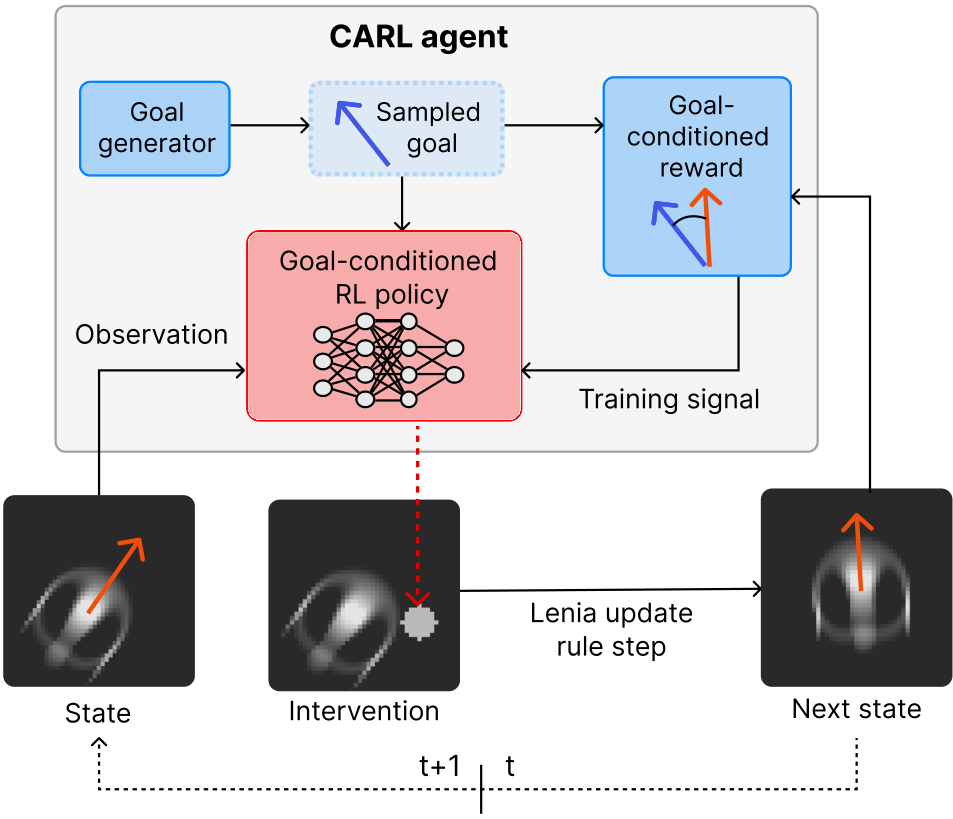
goals — the operational counterpart of these outcomes — in the considered complex system
Through a series of experiments using Lenia as a testbed, we demonstrate that CARL can both discover interesting self-organizing phenomena and control their behavior, with limited interventions and in a sample-efficient manner. Moreover, CARL generalizes well to out-of-distribution scenarios, such as unseen world dynamics and action spaces. Lastly, we show that trained CARL agents can be deployed interactively, enabling humans to specify and adjust high-level goals in real time while the agents translate them into low-level interventions for controlling complex systems.
While the framework is demonstrated on Lenia, it is designed to be system-agnostic. Looking ahead, we hope to extend it to increasingly biologically grounded models.
Related Work
AI for Scientific Discovery
AI is playing a growing role in scientific discovery. It has already driven breakthroughs in domains such as protein structure prediction and combinatorial optimization
Cellular Automata (CAs)
CAs are dynamical systems consisting of grids of cells whose states are updated based on local neighborhoods. Despite their simplicity, CAs can produce remarkably complex phenomena, making them useful both as models of real-world processes (in ecology, urban development, physics) and as objects of study in their own right. In artificial life, foundational contributions include the work of
Automated Exploration of Cellular Automata
Over the years, many methods have been used to illuminate the range of possible CA behaviors, including random search, manual tuning, and hand-crafted heuristics. More recently, gradient-based methods have been used to optimize for specific phenomena
Some works have moved beyond this limitation.
forest-fire dynamics to manage resource acquisition with environmental extremes.
Method
General Framework
We formalize a framework based on autotelic reinforcement learning
Complex system. We define a complex system as a tuple
Intervention space. An intervention is a modification to the system state. We define an intervention function
Task specification. A task is defined by a goal space
The loop. Given a complex system
Algorithm 1 The Autotelic Reinforcement Learning Loop
1: for do
2: Sample goal and initial state
3: for do
4: Observe and over a time interval
5: Select
6: Apply intervention:
7: Evolve system for steps:
8: Receive reward
9: end for
10: (Optional) Roll out for to assess resulting phenomena
11: end for
During inference, the goal can change dynamically
Instantiation: CARL
We instantiate CARL (Figure 1) on Lenia, a continuous generalization of Conway’s Game of Life
Lenia
where
The kernel is defined over a disk of radius
and the final kernel is normalized:
Key phenomena of interest in Lenia are solitons: localized patterns that persist and often move across the grid. We design our experiments with the intent of showing that
CARL can discover new solitons and control their behavior across a range of action costs, across a diversity of update rules, and from procedurally generated initial states. To detect solitons, we apply a simple soliton filter inspired by prior work
Interventions over Lenia
Policy Architecture and Training
We train policies using Double Deep Q-Networks
Observations consist of the last four Lenia grid states. Additional context — including the goal, action cost coefficient, current episode time step, and Lenia update rule parameters — is concatenated and provided through FiLM conditioning layers
We chose an off-policy algorithm for its sample efficiency. Full details of the hyperparameters and network architecture are provided in the code repository.
Experiments
We demonstrate CARL through three sets of experiments. First, we show that it can create stable solitons across a wide range of Lenia update rules and from procedurally generated initial states, and that trained agents generalize zero-shot to unseen goals, update rules and modified action spaces. Second, we train another agent to steer the movement direction of existing solitons, demonstrating that CARL can not only create self-organizing patterns, but also control them. Third, we show a proof of concept that humans can interact with complex systems through CARL agents by modifying their goals in real time, by having users navigate solitons through a maze using the movement direction agent.
We invite the reader to follow experimental results on the companion website, which contains many video examples.
Soliton Creation Task
Rather than searching for solitons directly — which would require defining what constitutes a soliton within the reward signal — we train CARL on a simpler proxy task: maintaining a target mass on the Lenia grid, for a given update rule and action cost. When actions are costly, the agent faces a choice between constantly intervening to hold the mass at the target, and finding a self-sustaining configuration that matches it. Action costs tip the balance toward the latter, making soliton creation an emergent byproduct of reward maximization rather than an explicit objective.
Goal space and reward. The goal space is defined as
where
Experimental setup. Initial states are procedurally generated by randomly applying 20 actions to an empty grid without rolling out the CA in between, producing diverse unstructured configurations. Each episode step consists of an agent’s action followed by a single Lenia update step.

(
See our companion website for a detailed description of hyperparameters and included update rules. Unless stated otherwise, evaluation conditions are run for 16 episodes.
Mass tracking evaluation. We evaluate the agent on the Cartesian product of target masses
The agent tracks the target mass reliably across most of the evaluation range (Figure 2, left). Performance degrades at boundary values of
Soliton creation. We now turn to the central question: does the agent produce solitons? To test this, we take the final Lenia grid state from each evaluation episode above, roll it out for 5,000 Lenia steps without any agent intervention, and apply the soliton filter.
We observe that the agent produces solitons at a high rate, especially for target masses between
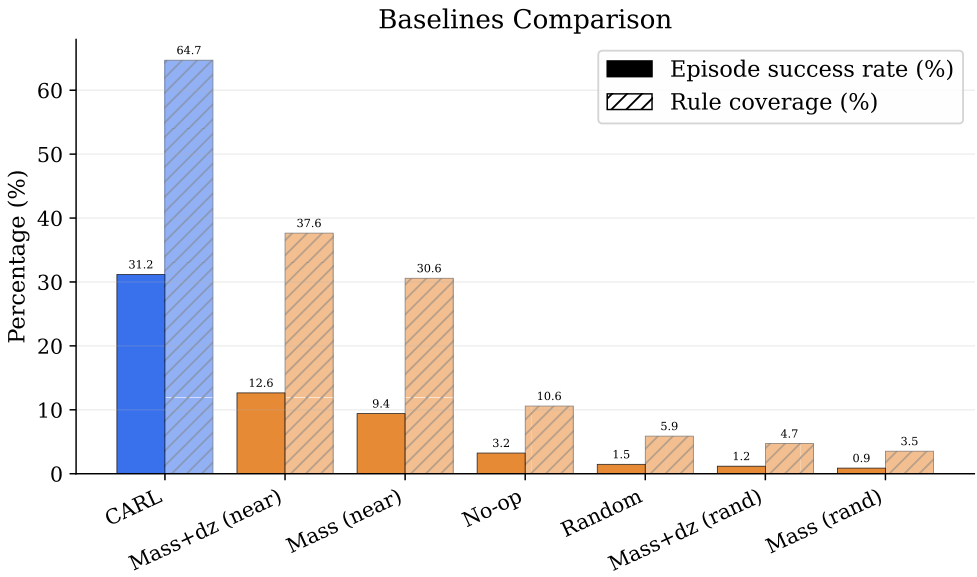
Comparison with baselines. We compare CARL against several heuristic baselines across all training update rules, with a fixed action cost of
CARL outperforms all baselines in both the overall soliton creation rate and in the number of update rules for which at least one soliton is generated (Figure 3). The gap is particularly notable against the mass-based heuristics, which have access to the same mass information as CARL but lack spatial awareness: they cannot learn where to place mass to seed a viable pattern. The no-op baseline confirms that solitons rarely arise from random initial conditions alone, underscoring that the agent’s interventions are essential.
Generalization The results above show that CARL reliably creates solitons under training conditions. We now assess how robust this capability is by testing three axes of generalization: modified action parameters, rescaled update rule kernels, and entirely novel update rules.
Modified action parameters. We evaluate the agent when the action hyperparameters —
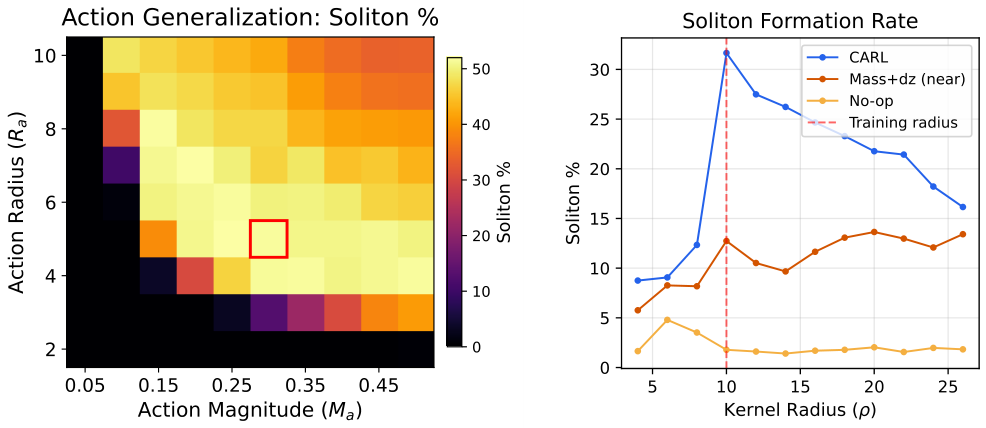
of the training conditions (Fig. 4, left), and degrades gracefully away from this curve. Performance drops to zero only for low-impact action hyperparameters, where individual actions are too weak to seed or sustain any mass on the grid.
Rescaled kernel radius. We evaluate whether the agent can create solitons when the update rule kernel radius
We deploy the agent across kernel radii
The agent adapts well to scaled Lenia worlds, particularly for up-scaled kernels (Fig. 4, right). Although performance drops compared to the training radius, the agent still creates solitons at a relatively high rate, even for kernels double or half the training size. Across all tested radii, the agent’s soliton creation rate remains well above the no-op baseline and comparable to or above the best heuristic baseline evaluated at the training radius. The success rate drops more sharply for down-scaled kernels, likely due to discretization effects.
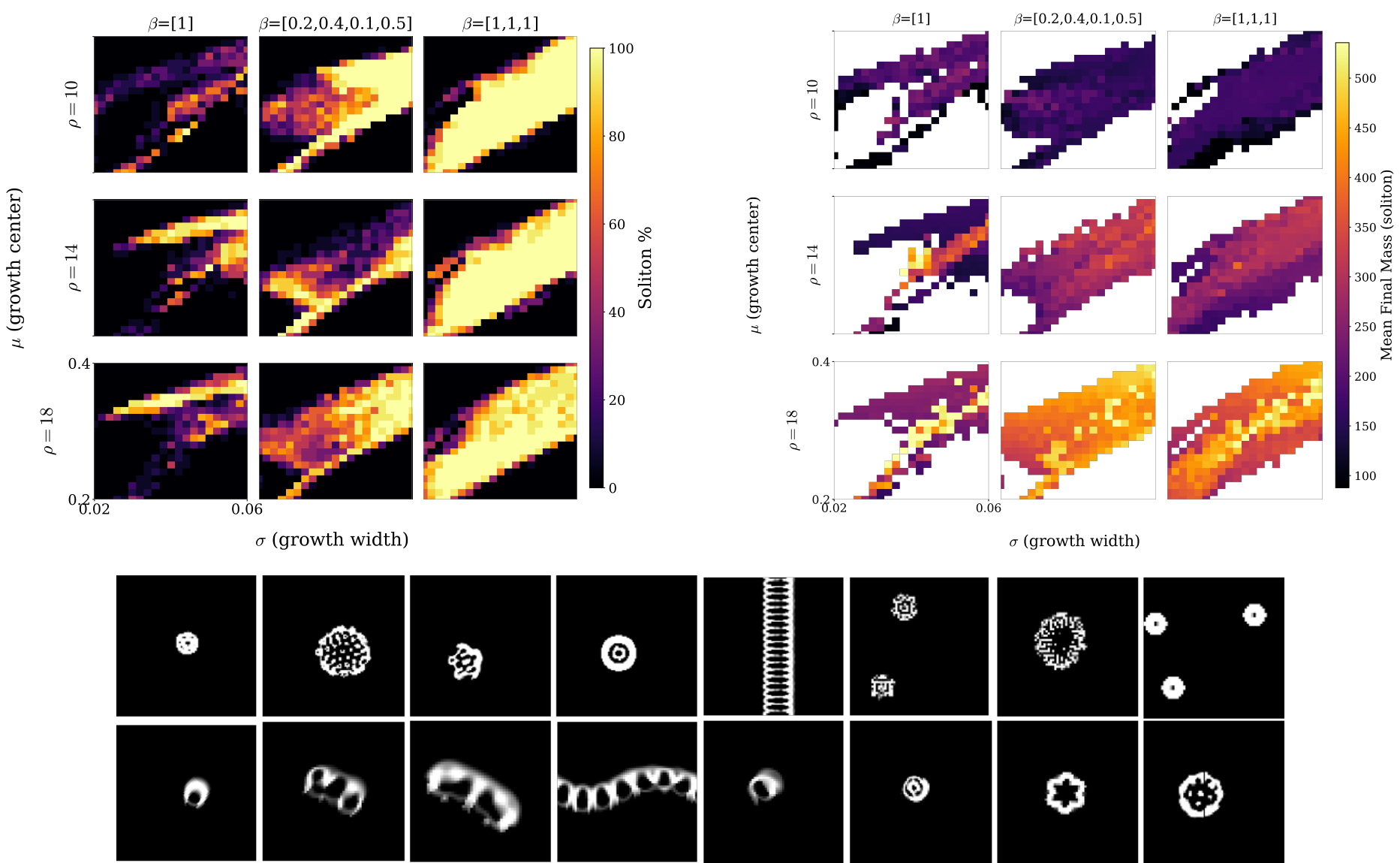
Novel update rules. Finally, we deploy CARL on unseen convolutional kernels. We select seven convolutional kernels
The results show that the trained agent can efficiently map novel update rule spaces, identifying which regions of
Soliton Direction Task
To demonstrate that CARL can control self-organizing phenomena, not only create them, we train a new agent on a task where it must steer a soliton toward a target direction. Each episode lasts 200 steps and begins with a uniformly sampled target direction, an action cost (as before), and a soliton drawn from a set of 48 that the first experiment’s agent discovered in the kernel-scaling generalization test (
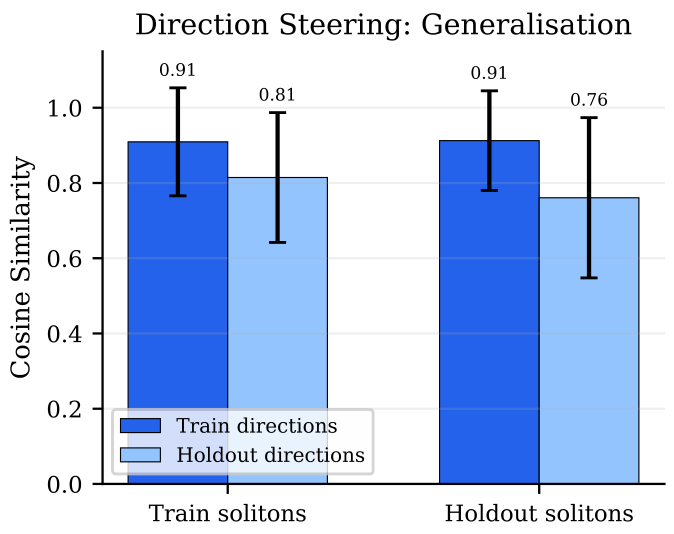
We evaluate generalization along two axes: solitons and directions. The 48 solitons are split into 24 training and 24 holdout (stratified across
two opposite ones are used during training. This yields a
Fig. 6 shows the mean cosine similarity between the soliton’s center-of-mass displacement and the target direction, averaged over all 200 episode steps across the four conditions: On training solitons and training directions, the agent achieves a mean cosine similarity of
Human-in-the-Loop
We demonstrate how trained CARL agents can serve as real-time interfaces for human control. We extend the direction environment with procedurally generated mazes, where walls are regions in which cell values are fixed to zero. A soliton is placed in the maze and the user can modify the agent’s goal (target direction) and action cost in real time, steering the soliton through the maze
The agent has no explicit representation of the maze — it perceives only the single-channel Lenia grid, identical to its training setting. Furthermore, the agent was never trained with changing goals, yet it successfully redirects solitons multiple times within a single episode while preserving their coherent shape. Reducing the action cost makes the agent intervene more frequently and advance faster.
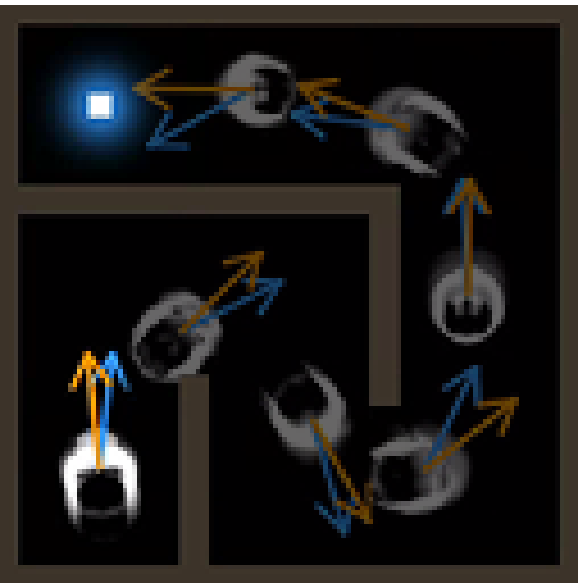
Although the agent performs well, several failure modes emerge. Wall collisions can cause the soliton to disintegrate or explode, though some solitons are robust to contact. High action costs can also lead to failure, as interventions become too sparse to maintain the soliton’s shape after perturbations, and the agent generally cannot recover a disrupted pattern.
Discussion
We introduce a closed-loop framework for autonomous discovery and control of self-organizing phenomena, based on autotelic RL. Rather than setting initial conditions and passively observing outcomes, a goal-conditioned policy observes the evolving complex system and applies minimal, local perturbations toward diverse self-generated goals. We instantiate the framework on Lenia as a system named CARL, which discovers solitons across a wide range of update rules and procedurally generated initial states, generalizes to out-of-distribution conditions, and can efficiently map novel update rule spaces to identify regions that support solitons. Beyond discovery, CARL agents can also learn to control solitons by steering their movement direction. Finally, we demonstrate that CARL agents can serve as real-time interfaces, enabling human users to guide solitons through maze environments with simple directional commands.
A key design choice is the use of action costs that incentivize the agent to act sparsely, reflecting the principle that effective control of self-organizing systems should work alongside the system’s intrinsic dynamics, not against them. In the mass tracking task, action costs lead the agent to discover self-sustaining solitons as a side effect of reward maximization — the cheapest way to maintain a target mass is to find a configuration that maintains itself. In the steering task, they produce a similar effect: instead of continuously micromanaging the soliton’s trajectory, the agent learns to apply a brief perturbation that redirects it, then withdraws, allowing the soliton to continue along the new heading unassisted.
CARL generalizes well to out-of-distribution conditions across variations in goals, action spaces, and novel update rules. This suggests the policies capture transferable system dynamics rather than overfitting. As a result, trained policies can be reused and composed to solve tasks beyond their original training objective. We demonstrate this through a maze-navigation task, where a human user modifies the agent’s goal (desired movement direction), while the policy handles the low-level control to achieve it in real time. This compositional reuse points toward functional integration, where distinct capabilities can be combined to solve increasingly complex tasks. Such integration suggests a path toward hierarchical control, where higher-level agents or processes set subgoals for lower-level controllers. We see CARL as a step toward artificial experimentalist frameworks, where agents not only learn how to autonomously act on complex systems, but also how to structure and combine those actions — deciding what to investigate through self-generated goals and how to achieve it.
A key limitation is that instantiating the framework requires domain expertise: the reward function, action space, and observation design all encode knowledge about what makes a given system interesting. While the mass tracking objective sidestepped the need to define solitons explicitly, it still reflects a designer’s intuition about Lenia. Domain expertise is inherent to scientific inquiry, but when the goal is to uncover phenomena we cannot yet characterize or anticipate, more open-ended approaches, such as intrinsic reward signals, adaptive goal sampling policies, or automated environment and task design, could reduce this dependence and broaden the scope of discovery.
While Lenia offers favorable conditions for closed-loop control — full observability, determinism, simple action space — extending CARL beyond such idealized systems is challenging: especially in biomedical and bioengineering settings, dynamics are partially observed, stochastic, high-dimensional, and multiscale in nature. Most biomedical efforts focus on micromanaging tangible targets — single proteins, genes, or circuits — but many biological systems are best understood not as static objects but as persistent, self-maintaining patterns across bioelectric, mechanical, metabolic, transcriptional, anatomical, and cognitive spaces, patterns that persist, grow, move, and reshape their surroundings
Acknowledgements
We thank Barbora Hudcová for insightful discussions and guidance in navigating the Lenia Explorer dataset. We thank members of the Flowers AI and CogSci Lab and the Levin Lab for helpful discussions. We gratefully acknowledge support for this work provided through a sponsored research agreement with Astonishing Labs and from the Templeton World Charity Foundation, Inc.
References
Barricelli, N. A. (1963). Numerical testing of evolution theories: part ii preliminary tests of performance. symbiogenesis and terrestrial life. Acta Biotheoretica, 16(3-4):99–126.
Chan, B. W.-C. (2019). Lenia: Biology of Artificial Life. Complex Systems, 28(3).
Chan, B. W.-C. (2020). Lenia and Expanded Universe. In ALIFE 2020: The 2020 Conference on Artificial Life, pages 221–229. MIT Press.
Colas, C., Karch, T., Sigaud, O., and Oudeyer, P.-Y. (2022). Autotelic Agents with Intrinsically Motivated Goal-Conditioned Reinforcement Learning: A Short Survey. J. Artif. Int. Res., 74.
Davies, J. A. and Levin, M. (2023). Synthetic morphology with agential materials. Nature Reviews Bioengineering, 1:46–59.
Earle, S. and Togelius, J. (2024). Autoverse: An evolvable game language for learning robust embodied agents.
Etcheverry, M., Moulin-Frier, C., and Oudeyer, P.-Y. (2020). Hierarchically Organized Latent Modules for Exploratory Search in Morphogenetic Systems. In Advances in Neural Information Processing Systems, volume 33, pages 4846–4859. Curran Associates, Inc.
Etcheverry, M., Moulin-Frier, C., Oudeyer, P.-Y., and Levin, M. (2025). AI-driven automated discovery tools reveal diverse behavioral competencies of biological networks. eLife, 13:RP92683.
Faldor, M. and Cully, A. (2024). Toward Artificial Open-Ended Evolution within Lenia using Quality-Diversity. In ALIFE 2024: Proceedings of the 2024 Artificial Life Conference. MIT Press.
Fawzi, A., Balog, M., Huang, A., Hubert, T., Romera-Paredes, B., Barekatain, M., Novikov, A., R. Ruiz, F. J., Schrittwieser, J., Swirszcz, G., Silver, D., Hassabis, D., and Kohli, P. (2022). Discovering faster matrix multiplication algorithms with reinforcement learning. Nature, 610(7930):47–53.
Fields, C. and Levin, M. (2025). Thoughts and thinkers: On the complementarity between objects and processes. Physics of Life Reviews, 52:256–273.
Grizou, J., Points, L. J., Sharma, A., and Cronin, L. (2020). A curious formulation robot enables the discovery of a novel protocell behavior. Science Advances, 6(5):eaay4237.
Hamon, G., Etcheverry, M., Chan, B. W.-C., Moulin-Frier, C., and Oudeyer, P.-Y. (2025). Discovering sensorimotor agency in cellular automata using diversity search. Science Advances, 11(44):eadp0834.
Hartl, B., Levin, M., and Pio-Lopez, L. (2025). Neural cellular automata: Applications to biology and beyond classical AI.
Hudcová, B., Dušek, F., Tuccio, M., and Hongler, C. (2025). Visualizing the Structure of Lenia Parameter Space. In ALIFE 2025: Ciphers of Life: Companion Proceedings of the Artificial Life Conference 2025. MIT Press.
Jumper, J., Evans, R., Pritzel, A., Green, T., Figurnov, M., Ronneberger, O., Tunyasuvunakool, K., Bates, R., Žídek, A., Potapenko, A., Bridgland, A., Meyer, C., Kohl, S. A. A., Ballard, A. J., Cowie, A., Romera-Paredes, B., Nikolov, S., Jain, R., Adler, J., Back, T., Petersen, S., Reiman, D., Clancy, E., Zielinski, M., Steinegger, M., Pacholska, M., Berghammer, T., Bodenstein, S., Silver, D., Vinyals, O., Senior, A. W., Kavukcuoglu, K., Kohli, P., and Hassabis, D. (2021). Highly accurate protein structure prediction with AlphaFold. Nature, 596(7873):583–589.
Khajehabdollahi, S., Hamon, G., Cvjetko, M., Oudeyer, P.-Y., Moulin-Frier, C., and Colas, C. (2025). Expedition & Expansion: Leveraging Semantic Representations for Goal-Directed Exploration in Continuous Cellular Automata. In ALIFE 2025: Ciphers of Life: Proceedings of the Artificial Life Conference 2025. MIT Press.
Kumar, A., Lu, C., Kirsch, L., Tang, Y., Stanley, K. O., Isola, P., and Ha, D. (2025). Automating the Search for Artificial Life With Foundation Models. Artificial Life, 31(3):368–396.
Langton, C. G. (1986). Studying artificial life with cellular automata. Physica D: nonlinear phenomena, 22(1-3):120–149.
Levin, M. (2021). Bioelectric signaling: Reprogrammable circuits underlying embryogenesis, regeneration, and cancer. Cell, 184(8):1971–1989.
Levin, M. (2023). Darwin’s agential materials: evolutionary implications of multiscale competency in developmental biology. Cellular and Molecular Life Sciences, 80(6).
Levin, M. (2025). The multiscale wisdom of the body: Collective intelligence as a tractable interface for next-generation biomedicine. BioEssays, 47(3):e202400196.
Lu, C., Lu, C., Lange, R. T., Yamada, Y., Hu, S., Foerster, J., Ha, D., and Clune, J. (2026). Towards end-to-end automation of AI research. Nature, 651(8107):914–919.
Mathews, J., Chang, A. J., Devlin, L., and Levin, M. (2023). Cellular signaling pathways as plastic, proto-cognitive systems: Implications for biomedicine. Patterns, 4(5):100737.
Michel, T., Cvjetko, M., Hamon, G., Oudeyer, P.-Y., and Moulin-Frier, C. (2025). Exploring Flow-Lenia Universes with a Curiosity-driven AI Scientist: Discovering Diverse Ecosystem Dynamics. In ALIFE 2025: Ciphers of Life: Proceedings of the Artificial Life Conference 2025. MIT Press.
Miotti, P., Niklasson, E., Randazzo, E., and Mordvintsev, A. (2025). Differentiable Logic Cellular Automata: From Game of Life to Pattern Generation. In ALIFE 2025: Ciphers of Life: Proceedings of the Artificial Life Conference 2025. MIT Press.
Mordvintsev, A., Randazzo, E., Niklasson, E., and Levin, M. (2020). Growing neural cellular automata. Distill, 5(2):e23.
Papadopoulos, V. and Guichard, E. (2025). MaCE: General Mass Conserving Dynamics for CAs. In ALIFE 2025: Ciphers of Life: Proceedings of the Artificial Life Conference 2025. MIT Press.
Perez, E., Strub, F., de Vries, H., Dumoulin, V., and Courville, A. (2018). FiLM: Visual reasoning with a general conditioning layer. In Proceedings of the Thirty-Second AAAI Conference on Artificial Intelligence and Thirtieth Innovative Applications of Artificial Intelligence Conference and Eighth AAAI Symposium on Educational Advances in Artificial Intelligence, AAAI’18/IAAI’18/EAAI’18, pages 3942–3951, New Orleans, Louisiana, USA. AAAI Press.
Pio-Lopez, L., Hartl, B., and Levin, M. (2025). Aging as a loss of goal-directedness: An evolutionary simulation and analysis unifying regeneration with anatomical rejuvenation. Advanced Science, 12(46).
Plantec, E., Hamon, G., Etcheverry, M., Chan, B. W.-C., Oudeyer, P.-Y., and Moulin-Frier, C. (2025). Flow-Lenia: Emergent Evolutionary Dynamics in Mass Conservative Continuous Cellular Automata. Artificial Life, 31(2):228–248.
Rainwater, J. H. (2024). Self-Organization and Phase Transitions in Driven Cellular Automata. Artificial Life, 30(3):302–322.
Reinke, C., Etcheverry, M., and Oudeyer, P.-Y. (2020). Intrinsically Motivated Discovery of Diverse Patterns in Self-Organizing Systems. In International Conference on Learning Representations (ICLR), Addis Ababa, Ethiopia.
Ronneberger, O., Fischer, P., and Brox, T. (2015). U-Net: Convolutional Networks for Biomedical Image Segmentation. In Navab, N., Hornegger, J., Wells, W. M., and Frangi, A. F., editors, Medical Image Computing and Computer-Assisted Intervention – MICCAI 2015, pages 234–241, Cham. Springer International Publishing.
Sánchez-Fibla, M., Moulin-Frier, C., and Solé, R. (2024). Cooperative control of environmental extremes by artificial intelligent agents. Journal of The Royal Society Interface, 21(220):20240344.
Turing, A. M. (1952). The chemical basis of morphogenesis. Philosophical Transactions of the Royal Society of London. Series B, Biological Sciences, 237(641):37–72.
Tversky, A. and Kahneman, D. (1974). Judgment under uncertainty: Heuristics and biases. Science, 185(4157):1124–1131.
van Hasselt, H., Guez, A., and Silver, D. (2016). Deep reinforcement learning with double Q-Learning. In Proceedings of the Thirtieth AAAI Conference on Artificial Intelligence, AAAI’16, pages 2094–2100, Phoenix, Arizona. AAAI Press.
Von Neumann, J. and Burks, A. W. (1966). Theory of self-reproducing automata.
Wolfram, S. (1983). Cellular automata. Los Alamos Science, pages 09–01.
Wu, J., Sun, X., Zeng, A., Song, S., Lee, J., Rusinkiewicz, S., and Funkhouser, T. (2020). Spatial Action Maps for Mobile Manipulation. In Robotics: Science and Systems XVI, volume 16.
Zeng, A., Song, S., Welker, S., Lee, J., Rodriguez, A., and Funkhouser, T. (2018). Learning Synergies Between Pushing and Grasping with Self-Supervised Deep Reinforcement Learning. In 2018 IEEE/RSJ International Conference on Intelligent Robots and Systems (IROS), pages 4238–4245, Madrid, Spain. IEEE Press.
Zenil, H., Tegnér, J., Abrahão, F. S., Lavin, A., Kumar, V., Frey, J. G., Weller, A., Soldatova, L., Bundy, A. R., Jennings, N. R., Takahashi, K., Hunter, L., Dzeroski, S., Briggs, A., Gregory, F. D., Gomes, C. P., Rowe, J., Evans, J., Kitano, H., and King, R. (2026). The future of fundamental science led by generative closed-loop artificial intelligence. Frontiers in Artificial Intelligence, 9.
Footnotes
-
Many examples of states that pass the soliton filter are available on the companion website ↩