The Pretense of Knowledge: On the insidious presumptions of Artificial Intelligence
JORDAN OTT
Web: sites.google.com/view/jordan-ott
In 1974
1. INTRODUCTION
The Pretense of Knowledge was a specific application of more general ideas presented previously by
In this article, we examine the field under the lens of spontaneous orders and complexity. This realization yields that, above all, Artificial Intelligence has engaged in an almost century-long misclassification. What the field purports to solve—intelligence—is in fact impossible given current and historical methods. It is this assumption that we seek to expose in Sections 2 and 3 while providing an alternative direction in Section 4.
2. HISTORY
The history of Artificial Intelligence is rife with presumptions of knowledge and top-down style solutions. An analysis of methodologies employed throughout the field—past and present—will shed light on this problem. The ambition of early pioneers is well captured in the words of Herbert Simon, “Machines will be capable, within 20 years, of doing any work a man can do.”
It was 1965 when he made that claim. Shortly thereafter, in 1966, Seymour Papert and others at MIT proposed they would solve vision during that summer
These presumptuous claims resulted directly from a pretense of knowledge. The audacious claims of the best and brightest researchers are not the issue. Instead, it is the notion that discretizing high-level, visible, characteristics of complex systems and implementing them via centrally planned rules, heuristics, and cost functions will be synonymous with the system as a whole. This is the τάξης
Starting in 1956, Allen Newell and Herbert Simon invented a “Logical Theorist,” which leveraged symbolic reasoning to solve geometric proofs
Papert’s confidence for his Summer Vision Project was so high, undergraduates were assigned to the task. The work conducted that summer, and long after, focused on template schemes and hierarchical models
Following this trend, there was a rise in symbolic logic, often termed Classical AI. In programs like CYC
From the geometric puzzle solver, ANALOGY
3. PERPETUATED METHODOLOGY
Assumptions made in the past can appear comical in hindsight. Unfortunately, we are in tomorrow’s past, and this methodology continues to perpetuate the field. Deep learning, the current method in vogue, is lauded because we no longer assume programmatic declarations of human knowledge. The claim is that because we learn directly from data, we sidestep the aforementioned faux pas. This line of thought is a grave red herring. Deep learning is just as vulnerable as the CYCs or Logical Theorists of the past. Though we no longer rely on rule-based systems, the declarations are still explicit, and the systems centrally planned. This methodological shortcoming is hidden, once again, behind a thick veil—the pretense of knowledge.
The ImageNet challenge contains millions of images and thousands of categories
Those that recognize these deficiencies often turn to reinforcement learning as a solution. This methodology offers convincing results in which agents can solve various problems from autonomous vehicles, navigation, and cooperative games. While reinforcement learning is a step in the right direction, its ail-
ments are nonetheless similar
It seems to me that this failure of the economists to guide policy more successfully is closely connected with their propensity to imitate as closely as possible the procedures of the brilliantly successful physical sciences—an attempt which in our field may lead to outright error. It is an approach which has come to be described as the “scientistic” attitude—an attitude which, as I defined it some thirty years ago, “is decidedly unscientific in the true sense of the word, since it involves a mechanical and uncritical application of habits of thought to fields different from those in which they have been formed”
(Hayek 1974) .
Much like Hayek’s critique of economics, the same is true for Artificial Intelligence. The field relies on methods derived from statistics and numerical optimization, which is decidedly unscientific in its application to intelligence research.
“Scientism” as Hayek calls it, is the desire to abstract a system and precisely quantify aspects of it. Following this approach is understandable from the AI researcher’s perspective, given our position in the scientific community as we are surrounded by fields—biology, chemistry, and physics—that make system-level abstractions and give precise predictions about outcomes. Consequently, cost functions are a natural solution, as they provide an exact quantification of the degree to which the system has learned. However, through system abstraction and quantification, we are likely to lose critical information so as to be no longer relevant to the original system. This process’s technical underpinnings are captured in the discretize and conquer approach, which we detail in the following subsection.
3.1 DISCRETIZE AND CONQUER
Neurons in the brain form the cortical substrate from which intelligent behavior is an emergent property. Mathematically, one can regard the brain as a function and intelligence as an output of that function. Such that the manifold of intelligence is described by the function,
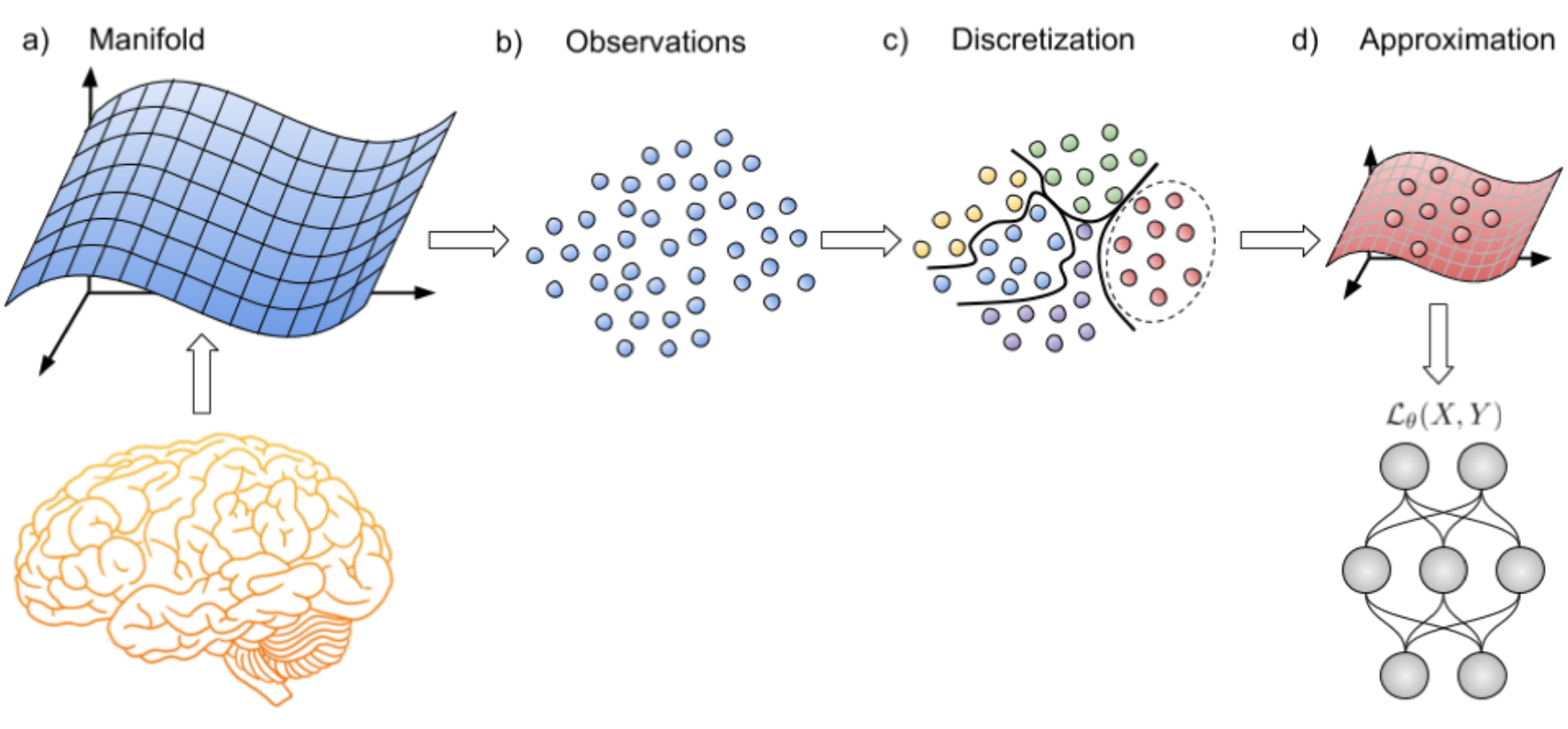
Figure 1a conveys this pictorially, with the brain producing some manifold over possible brain states,
As a result, we must rely on incomplete observations from the manifold. These observations are high-level attributes or behaviors that are emergent products of the underlying system. Figure 1b depicts this by showing single points that represent observations realized from the full manifold. For example, intelligent systems can perceive through vision, communicate through language, reason through abstractions, and act through planning. These are all visible observations from the manifold. What is not visible is the processes, interactions, and dynamics that produce these high-level attributes. Thus the characteristics we ascribe to intelligent beings are only the byproducts of the system from which intelligence can emerge, they are not indicative or defining features of intelligence but merely the result of it.
With a large collection of observations, it becomes natural to cluster and group them according to kind. This is the discretization stage. For example, one may observe that intelligent agents classify objects, identify their location in space, and label them semantically, all from visual stimuli. Grouping these observations together forms the basis of a vision system. Figure 1c shows boundaries placed discretizing all observations—the green dots may refer to language abilities, red to vision, purple to search, blue to planning, and yellow to speech.
Once the attributes of intelligent agents have been placed in identifiable groups, one seeks to solve each disparate task. This is the conquer stage. A new manifold now describes the red dots clustered together in the discretization stage (Figure 1c). One that a deep learning system attempts to approximate through the use of a cost function and gradient descent. In Figure 1d the vision manifold is approximated by a deep neural network trained with a cost function.
The discretize and conquer (DAC) methodology has been fruitful for narrow, domain-specific, engineered applications—top-down planning,
Artificial intelligence is into its eighth decade as a scientific field. Over this period, the field has seen the invention of a great diversity of algorithms, accomplishing tremendous feats in their time. These algorithms have followed a consistent underlying methodology of discretization. The ubiquity of this approach has produced algorithms that are technically diverse but methodologically homogeneous.
4. A COMPLEX SOLUTION
Intelligence—much like economies—is a result of the interactions within large complex systems. Often we cannot measure the system in a broad sense. The definitions for intelligence are inadequate, and the metrics used to assess it are even worse. As a consequence, the field results to the DAC approach. Abstractions come in the form of direct cost functions that our models optimize. Intelligent behaviors are enumerated, and corresponding cost functions are designed for each one. Vision, speech, audition, navigation, and planning all follow this paradigm. The discretization approach yields models with the appearance of intelligence but without understanding. We must consider what is fundamentally different about the economy of neural circuits in which intelligence can emerge.
Much like the macro level, shortcomings are evident in the micro-level as well. Neuroscience generates enormous amounts of detailed observational data. Where regions are discretized and studied in isolation. Unfortunately, the whole cannot be understood by observing the individual. This principle is true of the economy, of ant colonies, and as well as of brains. We will not be able to understand intelligence by observing single actors. Neurons are individual agents in a local-decentralized system. They compete for resources with their neighbors while cooperating in order to achieve beneficial results for the whole. This concept is perfectly summarized in the words of Friedrich Engels, “For what each individual wills is obstructed by everyone else, and what emerges is something that no one willed.” Engels said this in reference to an economy, however, the application to neuroscience and the emergence of intelligence are equally satisfying.
Just as markets coordinate large groups of actions without any one individual being in control, neuronal-markets do the same. No one neuron, or group of neurons, is in charge of all the others.
In his closing remarks, Hayek states:
… he cannot acquire the full knowledge which would make mastery of the events possible. He will, therefore, have to use what knowledge he can achieve, not to shape the results as the craftsman shapes his handiwork, but rather to cultivate a growth by providing the appropriate environment, in the manner in which the gardener does this for his plants.
(Hayek 1974) .
What Hayek’s words translate to is a change in how we think about building intelligent systems. In no way can we achieve the human brain’s complex behavior by top-down control—whether from hard-coded heuristics of the past or explicit cost functions of the present. Instead, we must cultivate an environment comprised of decentralized local actors
At the current moment in history, it is clear we are capable of designing solutions to particular problems—vision, speech, audition. Given sufficient training data, a deep network or statistical model performs
remarkably well. What remains unclear is the path toward human-level intelligence, that offers a breadth of diversity across all aspects of life. As intelligence is the result of a complex system, it is unlikely for the field to make real advancements while those writing the programs grasp ever tighter for control.
REFERENCES
[references omitted]