UNIVERSAL TRANSFORMERS
Mostafa Dehghani, Stephan Gouws, Oriol Vinyals
University of Amsterdam, Google Brain, DeepMind
dehghani@uva.nl, sgouws@google.com, vinyals@google.com
Jakob Uszkoreit, Łukasz Kaiser
Google Brain
usz@google.com, lukaszkaiser@google.com
ABSTRACT
Recurrent neural networks (RNNs) sequentially process data by updating their state with each new data point, and have long been the de facto choice for sequence modeling tasks. However, their inherently sequential computation makes them slow to train. Feed-forward and convolutional architectures have recently been shown to achieve superior results on some sequence modeling tasks such as machine translation, with the added advantage that they concurrently process all inputs in the sequence, leading to easy parallelization and faster training times. Despite these successes, however, popular feed-forward sequence models like the Transformer fail to generalize in many simple tasks that recurrent models handle with ease, e.g. copying strings or even simple logical inference when the string or formula lengths exceed those observed at training time. We propose the Universal Transformer (UT), a parallel-in-time self-attentive recurrent sequence model which can be cast as a generalization of the Transformer model and which addresses these issues. UTs combine the parallelizability and global receptive field of feed-forward sequence models like the Transformer with the recurrent inductive bias of RNNs. We also add a dynamic per-position halting mechanism and find that it improves accuracy on several tasks. In contrast to the standard Transformer, under certain assumptions UTs can be shown to be Turing-complete. Our experiments show that UTs outperform standard Transformers on a wide range of algorithmic and language understanding tasks, including the challenging LAMBADA language modeling task where UTs achieve a new state of the art, and machine translation where UTs achieve a 0.9 BLEU improvement over Transformers on the WMT14 En-De dataset.
1 INTRODUCTION
Convolutional and fully-attentional feed-forward architectures like the Transformer have recently emerged as viable alternatives to recurrent neural networks (RNNs) for a range of sequence modeling tasks, notably machine translation
Notably, however, the Transformer with its fixed stack of distinct layers foregoes RNNs’ inductive bias towards learning iterative or recursive transformations. Our experiments indicate that this inductive
bias may be crucial for several algorithmic and language understanding tasks of varying complexity: in contrast to models such as the Neural Turing Machine
In this paper, we introduce the Universal Transformer (UT), a parallel-in-time recurrent self-attentive sequence model which can be cast as a generalization of the Transformer model, yielding increased theoretical capabilities and improved results on a wide range of challenging sequence-to-sequence tasks. UTs combine the parallelizability and global receptive field of feed-forward sequence models like the Transformer with the recurrent inductive bias of RNNs, which seems to be better suited to a range of algorithmic and natural language understanding sequence-to-sequence problems. As the name implies, and in contrast to the standard Transformer, under certain assumptions UTs can be shown to be Turing-complete (or “computationally universal”, as shown in Section 4).
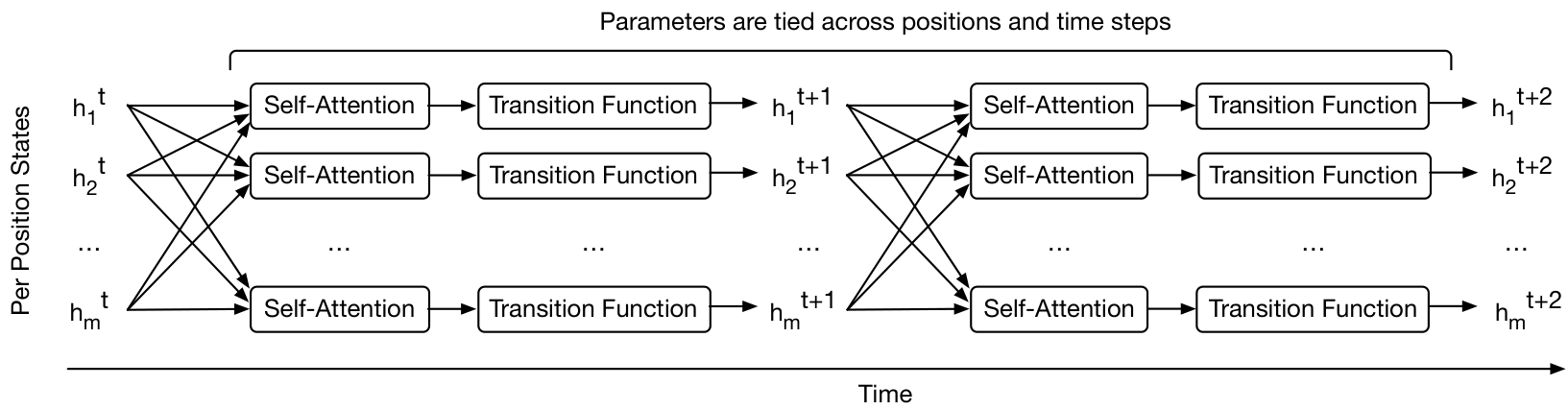
In each recurrent step, the Universal Transformer iteratively refines its representations for all symbols in the sequence in parallel using a self-attention mechanism
Our strong experimental results show that UTs outperform Transformers and LSTMs across a wide range of tasks. The added recurrence yields improved results in machine translation where UTs outperform the standard Transformer. In experiments on several algorithmic tasks and the bAbI language understanding task, UTs also consistently and significantly improve over LSTMs and the standard Transformer. Furthermore, on the challenging LAMBADA text understanding data set UTs with dynamic halting achieve a new state of the art.
2 Model Description
2.1 The Universal Transformer
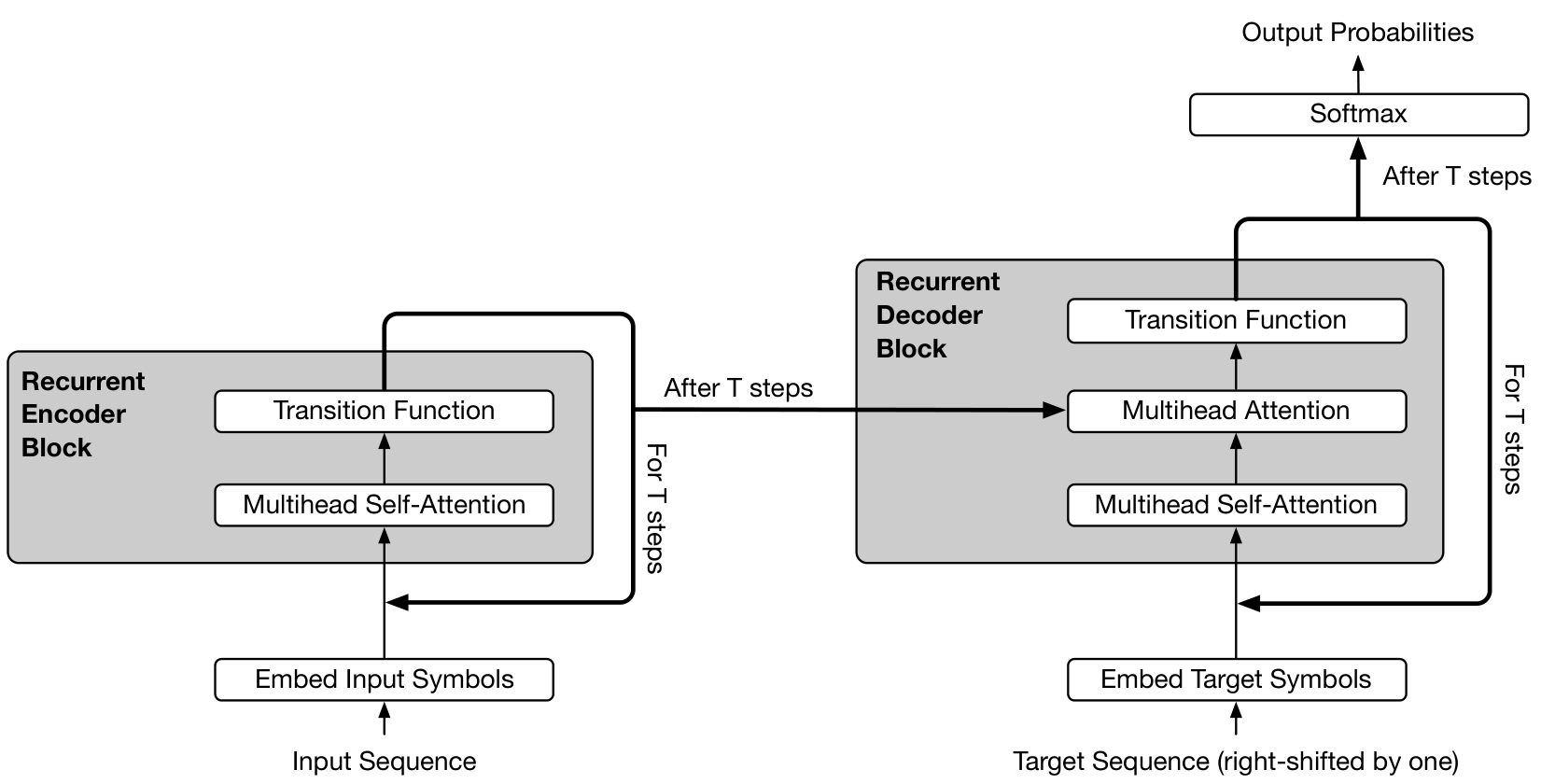
The Universal Transformer (UT; see Fig. 2) is based on the popular encoder-decoder architecture commonly used in most neural sequence-to-sequence models
In each recurrent time-step, the representation of every position is concurrently (in parallel) revised in two sub-steps: first, using a self-attention mechanism to exchange information across all positions in the sequence, thereby generating a vector representation for each position that is informed by the representations of all other positions at the previous time-step. Then, by applying a transition function (shared across position and time) to the outputs of the self-attention mechanism, independently at each position. As the recurrent transition function can be applied any number of times, this implies that UTs can have variable depth (number of per-symbol processing steps). Crucially, this is in contrast to most popular neural sequence models, including the Transformer
ENCODER: Given an input sequence of length
More specifically, we use the scaled dot-product attention which combines queries , keys and values
where
and we map the state
At step
where is defined in
Depending on the task, we use one of two different transition functions: either a separable convolution
After
DECODER: The decoder shares the same basic recurrent structure of the encoder. However, after the self-attention function, the decoder additionally also attends to the final encoder representation
Like the Transformer model, the UT is autoregressive
To generate from the model, the encoder is run once for the conditioning input sequence. Then the decoder is run repeatedly, consuming all already-generated symbols, while generating one additional distribution over the vocabulary for the symbol at the next output position per iteration. We then typically sample or select the highest probability symbol as the next symbol.
2.2 DYNAMIC HALTING
In sequence processing systems, certain symbols (e.g. some words or phonemes) are usually more ambiguous than others. It is therefore reasonable to allocate more processing resources to these more ambiguous symbols. Adaptive Computation Time (ACT)
| Model | 10K examples | 1K examples | ||
|---|---|---|---|---|
| train single | train joint | train single | train joint | |
| Previous best results: | ||||
| QRNet | 0.3 (0/20) | - | - | - |
| Sparse DNC | - | 2.9 (1/20) | - | - |
| GA+MAGE | - | - | 8.7 (5/20) | - |
| MemN2N | - | - | - | 12.4 (11/20) |
| Our Results: | ||||
| Transformer | 15.2 (10/20) | 22.1 (12/20) | 21.8 (5/20) | 26.8 (14/20) |
| Universal Transformer (this work) | 0.23 (0/20) | 0.47 (0/20) | 5.31 (5/20) | 8.50 (8/20) |
| UT w/ dynamic halting (this work) | 0.21 (0/20) | 0.29 (0/20) | 4.55 (3/20) | 7.78 (5/20) |
Table 1: Average error and number of failed tasks (> 5% error) out of 20 (in parentheses; lower is better in both cases) on the bAbI dataset under the different training/evaluation setups. We indicate state-of-the-art where available for each, or ‘-’ otherwise.
(called the “ponder time”) in standard recurrent neural networks based on a scalar halting probability predicted by the model at each step.
Inspired by the interpretation of Universal Transformers as applying self-attentive RNNs in parallel to all positions in the sequence, we also add a dynamic ACT halting mechanism to each position (i.e. to each per-symbol self-attentive RNN; see Appendix C for more details). Once the per-symbol recurrent block halts, its state is simply copied to the next step until all blocks halt, or we reach a maximum number of steps. The final output of the encoder is then the final layer of representations produced in this way.
3 EXPERIMENTS AND ANALYSIS
We evaluated the Universal Transformer on a range of algorithmic and language understanding tasks, as well as on machine translation. We describe these tasks and datasets in more detail in Appendix D.
3.1 BABI QUESTION-ANSWERING
The bAbI question answering dataset
To encode the input, similar to
As originally proposed, models can either be trained on each task separately (“train single”) or jointly on all tasks (“train joint”). Table 1 summarizes our results. We conducted 10 runs with different initializations and picked the best model based on performance on the validation set, similar to previous work. Both the UT and UT with dynamic halting achieve state-of-the-art results on all tasks in terms of average error and number of failed tasks2, in both the 10K and 1K training regime (see Appendix E for breakdown by task).
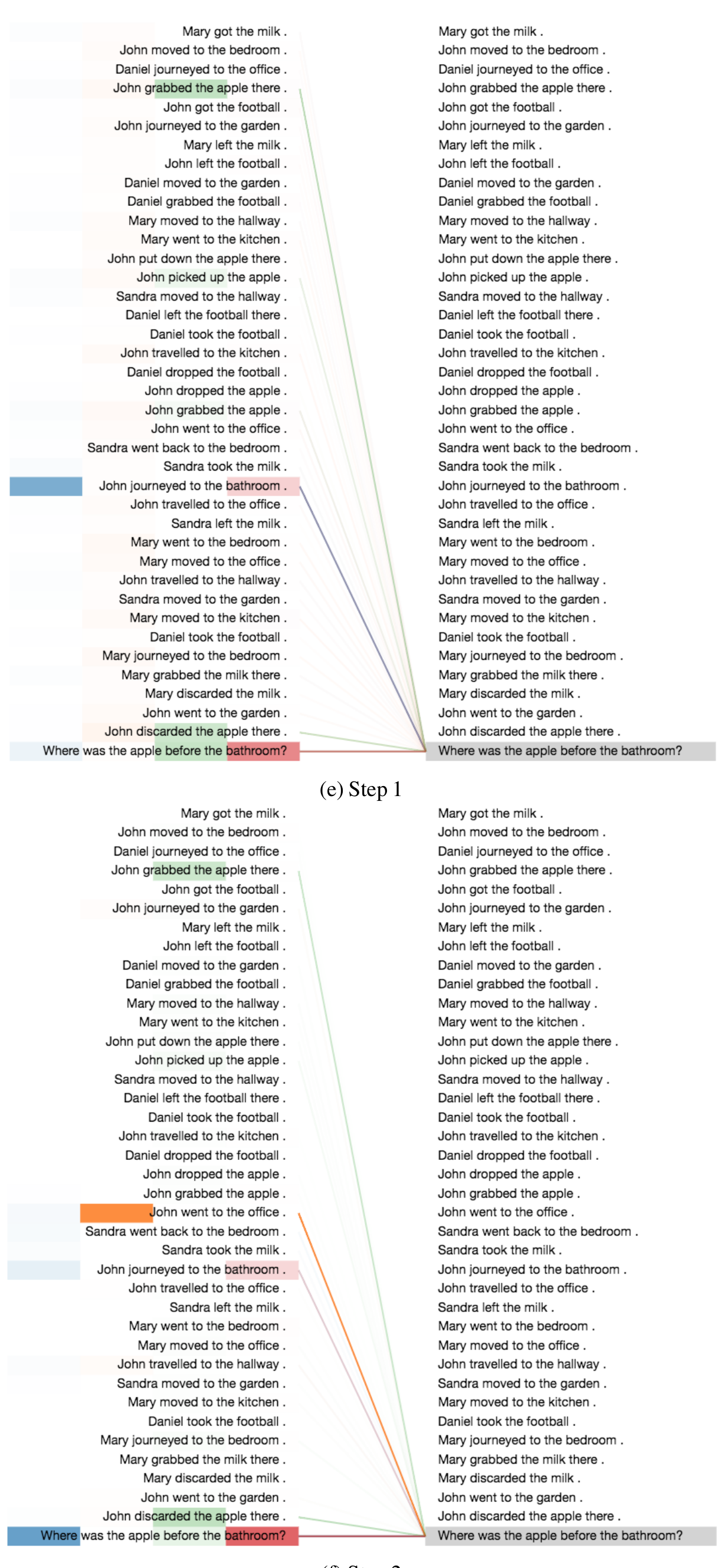
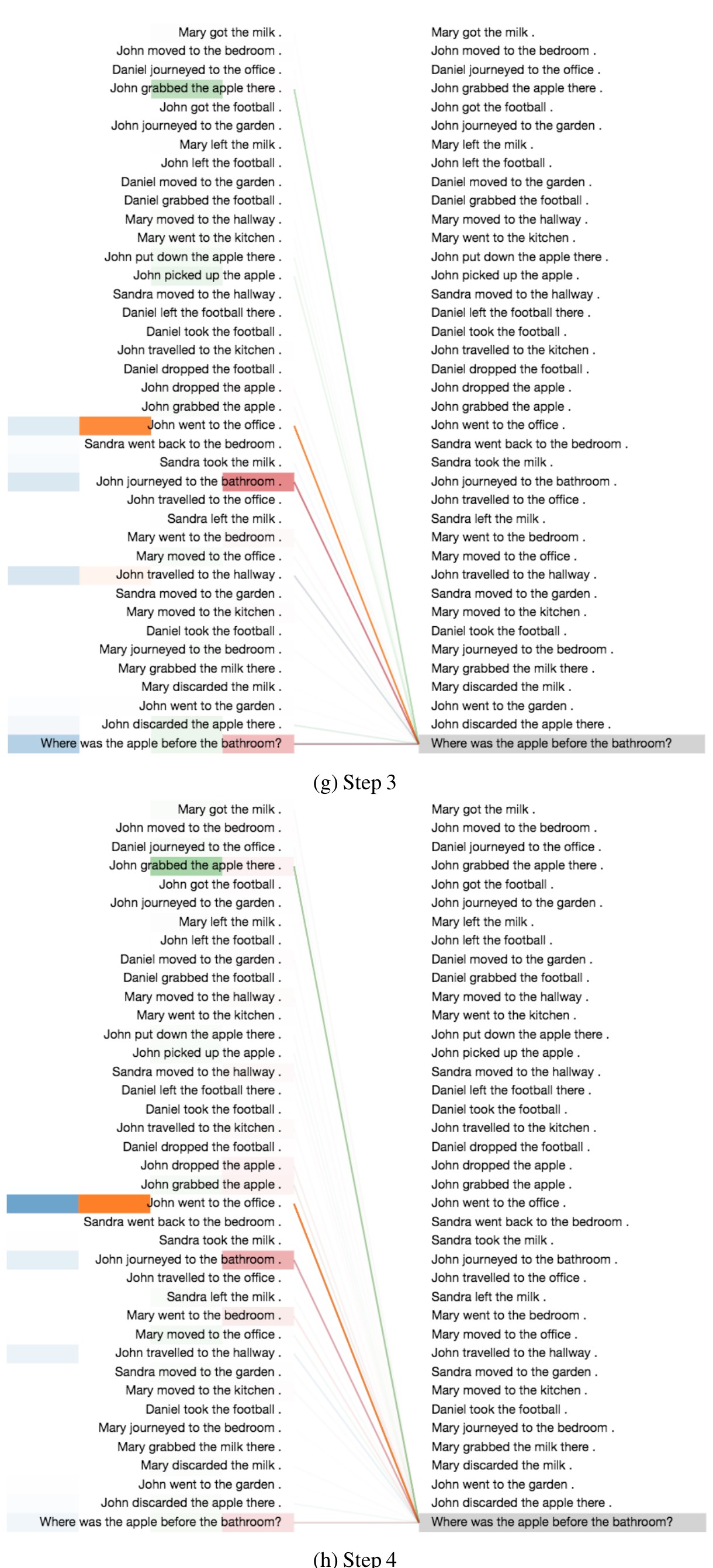
To understand the working of the model better, we analyzed both the attention distributions and the average ACT ponder times for this task (see Appendix F for details). First, we observe that the attention distributions start out very uniform, but get progressively sharper in later steps around the correct supporting facts that are required to answer each question, which is indeed very similar to how humans would solve the task. Second, with dynamic halting we observe that the average ponder time (i.e. depth
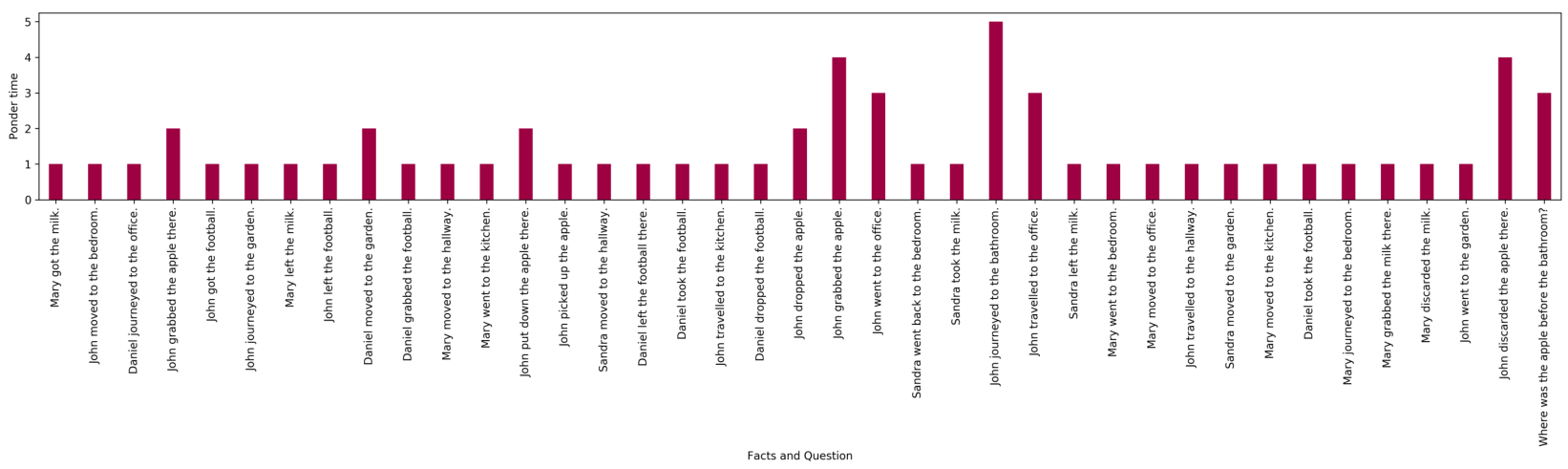
of the per-symbol recurrent processing chain) over all positions in all samples in the test data for tasks requiring three supporting facts is higher
Similar to dynamic memory networks
3.2 Subject-Verb Agreement
Next, we consider the task of predicting number-agreement between subjects and verbs in English sentences
Our results are summarized in Table 2. The best LSTM with attention from the literature achieves 99.18% on this task
3.3 Lambada Language Modeling
The LAMBADA task
| Model | 0 | 1 | 2 | 3 | 4 | 5 | Total |
|---|---|---|---|---|---|---|---|
| Previous best results | |||||||
| Best Stack-RNN | 0.994 | 0.979 | 0.965 | 0.935 | 0.916 | 0.880 | 0.992 |
| Best LSTM | 0.993 | 0.972 | 0.950 | 0.922 | 0.900 | 0.842 | 0.991 |
| Best Attention | 0.994 | 0.977 | 0.959 | 0.929 | 0.907 | 0.842 | 0.992 |
| Our results: | |||||||
| Transformer | 0.973 | 0.941 | 0.932 | 0.917 | 0.901 | 0.883 | 0.962 |
| Universal Transformer | 0.993 | 0.971 | 0.969 | 0.940 | 0.921 | 0.892 | 0.992 |
| UT w/ ACT | 0.994 | 0.969 | 0.967 | 0.944 | 0.932 | 0.907 | 0.992 |
| (UT w/ ACT - Best) | 0 | -0.008 | 0.002 | 0.009 | 0.016 | 0.027 | - |
Table 2: Accuracy on the subject-verb agreement number prediction task (higher is better).
| Model | LM Perplexity & (Accuracy) | RC Accuracy | ||||
|---|---|---|---|---|---|---|
| control | dev | test | control | dev | test | |
| Neural Cache | 129 | 139 | - | - | - | - |
| Dhingra et al. | - | - | - | - | - | 0.5569 |
| Transformer | 142 (0.19) | 5122 (0.0) | 7321 (0.0) | 0.4102 | 0.4401 | 0.3988 |
| LSTM | 138 (0.23) | 4966 (0.0) | 5174 (0.0) | 0.1103 | 0.2316 | 0.2007 |
| UT base, 6 steps (fixed) | 131 (0.32) | 279 (0.18) | 319 (0.17) | 0.4801 | 0.5422 | 0.5216 |
| UT w/ dynamic halting | 130 (0.32) | 134 (0.22) | 142 (0.19) | 0.4603 | 0.5831 | 0.5625 |
| UT base, 8 steps (fixed) | 129(0.32) | 192 (0.21) | 202 (0.18) | - | - | - |
| UT base, 9 steps (fixed) | 129(0.33) | 214 (0.21) | 239 (0.17) | - | - | - |
Table 3: LAMBADA language modeling (LM) perplexity (lower better) with accuracy in parentheses (higher better), and Reading Comprehension (RC) accuracy results (higher better). ‘-’ indicates no reported results in that setting.
modeling, and tests the ability of a model to incorporate broader discourse and longer term context when predicting the target word.
The task is evaluated in two settings: as language modeling (the standard setup) and as reading comprehension. In the former (more challenging) case, a model is simply trained for next-word prediction on the training data, and evaluated on the target words at test time (i.e. the model is trained to predict all words, not specifically challenging target words). In the latter setting, introduced by
The results are shown in Table 3. Universal Transformer achieves state-of-the-art results in both the language modeling and reading comprehension setup, outperforming both LSTMs and vanilla Transformers. Note that the control set was constructed similar to the LAMBADA development and test sets, but without filtering them in any way, so achieving good results on this set shows a model’s strength in standard language modeling.
Our best fixed UT results used 6 steps. However, the average number of steps that the best UT with dynamic halting took on the test data over all positions and examples was
3.4 ALGORITHMIC TASKS
We trained UTs on three algorithmic tasks, namely Copy, Reverse, and (integer) Addition, all on strings composed of decimal symbols (‘0’-‘9’). In all the experiments, we train the models on sequences of length 40 and evaluated on sequences of length 400
| Model | Copy: char-acc | Copy: seq-acc | Reverse: char-acc | Reverse: seq-acc | Addition: char-acc | Addition: seq-acc |
|---|---|---|---|---|---|---|
| LSTM | 0.45 | 0.09 | 0.66 | 0.11 | 0.08 | 0.0 |
| Transformer | 0.53 | 0.03 | 0.13 | 0.06 | 0.07 | 0.0 |
| Universal Transformer | 0.91 | 0.35 | 0.96 | 0.46 | 0.34 | 0.02 |
| Neural GPU* | 1.0 | 1.0 | 1.0 | 1.0 | 1.0 | 1.0 |
*Table 4: Accuracy (higher better) on the algorithmic tasks. Note that the Neural GPU was trained with a special curriculum to obtain the perfect result, while other models are trained without any curriculum.
| Model | Copy: char-acc | Copy: seq-acc | Double: char-acc | Double: seq-acc | Reverse: char-acc | Reverse: seq-acc |
|---|---|---|---|---|---|---|
| LSTM | 0.78 | 0.11 | 0.51 | 0.047 | 0.91 | 0.32 |
| Transformer | 0.98 | 0.63 | 0.94 | 0.55 | 0.81 | 0.26 |
| Universal Transformer | 1.0 | 1.0 | 1.0 | 1.0 | 1.0 | 1.0 |
Table 5: Character-level (char-acc) and sequence-level accuracy (seq-acc) results on the Memorization LTE tasks, with maximum length of 55.
| Model | Program: char-acc | Program: seq-acc | Control: char-acc | Control: seq-acc | Addition: char-acc | Addition: seq-acc |
|---|---|---|---|---|---|---|
| LSTM | 0.53 | 0.12 | 0.68 | 0.21 | 0.83 | 0.11 |
| Transformer | 0.71 | 0.29 | 0.93 | 0.66 | 1.0 | 1.0 |
| Universal Transformer | 0.89 | 0.63 | 1.0 | 1.0 | 1.0 | 1.0 |
Table 6: Character-level (char-acc) and sequence-level accuracy (seq-acc) results on the Program Evaluation LTE tasks with maximum nesting of 2 and length of 5.
train UTs using positions starting with randomized offsets to further encourage the model to learn position-relative transformations. Results are shown in Table 4. The UT outperforms both LSTM and vanilla Transformer by a wide margin on all three tasks. The Neural GPU reports perfect results on this task
3.5 LEARNING TO EXECUTE (LTE)
As another class of sequence-to-sequence learning problems, we also evaluate UTs on tasks indicating the ability of a model to learn to execute computer programs, as proposed in
We use the mix-strategy discussed in
3.6 MACHINE TRANSLATION
We trained a UT on the WMT 2014 English-German translation task using the same setup as reported in
| Model | BLEU |
|---|---|
| Universal Transformer small | 26.8 |
| Transformer base | 28.0 |
| Weighted Transformer base | 28.4 |
| Universal Transformer base | 28.9 |
4 DISCUSSION
When running for a fixed number of steps, the Universal Transformer is equivalent to a multi-layer Transformer with tied parameters across all its layers. This is partly similar to the Recursive Transformer, which ties the weights of its self-attention layers across depth
The connection between the Universal Transformer and other sequence models is apparent from the architecture: if we limited the recurrent steps to one, it would be a Transformer. But it is more interesting to consider the relationship between the Universal Transformer and RNNs and other networks where recurrence happens over the time dimension. Superficially these models may seem closely related since they are recurrent as well. But there is a crucial difference: time-recurrent models like RNNs cannot access memory in the recurrent steps. This makes them computationally more similar to automata, since the only memory available in the recurrent part is a fixed-size state vector. UTs on the other hand can attend to the whole previous layer, allowing it to access memory in the recurrent step.
Given sufficient memory the Universal Transformer is computationally universal – i.e. it belongs to the class of models that can be used to simulate any Turing machine, thereby addressing a shortcoming of the standard Transformer model 5. In addition to being theoretically appealing, our results show that this added expressivity also leads to improved accuracy on several challenging sequence modeling tasks. This closes the gap between practical sequence models competitive on large-scale tasks such as machine translation, and computationally universal models such as the Neural Turing Machine or the Neural GPU
To show this, we can reduce a Neural GPU to a Universal Transformer. Ignoring the decoder and parameterizing the self-attention module, i.e. self-attention with the residual connection, to be the identity function, we assume the transition function to be a convolution. If we now set the total number of recurrent steps
Another related model architecture is that of end-to-end Memory Networks
5 CONCLUSION
This paper introduces the Universal Transformer, a generalization of the Transformer model that extends its theoretical capabilities and produces state-of-the-art results on a wide range of challenging sequence modeling tasks, such as language understanding but also a variety of algorithmic tasks, thereby addressing a key shortcoming of the standard Transformer. The Universal Transformer combines the following key properties into one model:
Weight sharing: Following intuitions behind weight sharing found in CNNs and RNNs, we extend the Transformer with a simple form of weight sharing that strikes an effective balance between inductive bias and model expressivity, which we show extensively on both small and large-scale experiments.
Conditional computation: In our goal to build a computationally universal machine, we equipped the Universal Transformer with the ability to halt or continue computation through a recently introduced mechanism, which shows stronger results compared to the fixed-depth Universal Transformer.
We are enthusiastic about the recent developments on parallel-in-time sequence models. By adding computational capacity and recurrence in processing depth, we hope that further improvements beyond the basic Universal Transformer presented here will help us build learning algorithms that are both more powerful, data efficient, and generalize beyond the current state-of-the-art.
The code used to train and evaluate Universal Transformers is available at GitHub
Acknowledgements We are grateful to Ashish Vaswani, Douglas Eck, and David Dohan for their fruitful comments and inspiration.
REFERENCES
Jimmy Lei Ba, Jamie Ryan Kiros, and Geoffrey E Hinton. Layer normalization. arXiv preprint arXiv:1607.06450, 2016. URL arXiv.
Dzmitry Bahdanau, Kyunghyun Cho, and Yoshua Bengio. Neural machine translation by jointly learning to align and translate. CoRR, abs/1409.0473, 2014. URL arXiv.
Kyunghyun Cho, Bart van Merrienboer, Caglar Gulcehre, Fethi Bougares, Holger Schwenk, and Yoshua Bengio. Learning phrase representations using RNN encoder-decoder for statistical machine translation. CoRR, abs/1406.1078, 2014. URL arXiv.
Francois Chollet. Xception: Deep learning with depthwise separable convolutions. arXiv preprint arXiv:1610.02357, 2016.
Zewei Chu, Hai Wang, Kevin Gimpel, and David McAllester. Broad context language modeling as reading comprehension. In Proceedings of the 15th Conference of the European Chapter of the Association for Computational Linguistics: Volume 2, Short Papers, volume 2, pp. 52–57, 2017.
Bhuwan Dhingra, Zhilin Yang, William W Cohen, and Ruslan Salakhutdinov. Linguistic knowledge as memory for recurrent neural networks. arXiv preprint arXiv:1703.02620, 2017.
Bhuwan Dhingra, Qiao Jin, Zhilin Yang, William W Cohen, and Ruslan Salakhutdinov. Neural models for reasoning over multiple mentions using coreference. arXiv preprint arXiv:1804.05922, 2018.
Jonas Gehring, Michael Auli, David Grangier, Denis Yarats, and Yann N. Dauphin. Convolutional sequence to sequence learning. CoRR, abs/1705.03122, 2017. URL arXiv.
Edouard Grave, Armand Joulin, and Nicolas Usunier. Improving neural language models with a continuous cache. arXiv preprint arXiv:1612.04426, 2016.
Alex Graves. Generating sequences with recurrent neural networks. CoRR, abs/1308.0850, 2013. URL arXiv.
Alex Graves. Adaptive computation time for recurrent neural networks. arXiv preprint arXiv:1603.08983, 2016.
Alex Graves, Greg Wayne, and Ivo Danihelka. Neural turing machines. CoRR, abs/1410.5401, 2014. URL arXiv.
Caglar Gulcehre, Misha Denil, Mateusz Malinowski, Ali Razavi, Razvan Pascanu, Karl Moritz Hermann, Peter Battaglia, Victor Bapst, David Raposo, Adam Santoro, et al. Hyperbolic attention networks. arXiv preprint arXiv:1805.09786, 2018.
Mikael Henaff, Jason Weston, Arthur Szlam, Antoine Bordes, and Yann LeCun. Tracking the world state with recurrent entity networks. arXiv preprint arXiv:1612.03969, 2016.
Sepp Hochreiter, Yoshua Bengio, Paolo Frasconi, and Jürgen Schmidhuber. Gradient flow in recurrent nets: the difficulty of learning long-term dependencies. A Field Guide to Dynamical Recurrent Neural Networks, 2003.
A. Joulin and T. Mikolov. Inferring algorithmic patterns with stack-augmented recurrent nets. In Advances in Neural Information Processing Systems, (NIPS), 2015.
Łukasz Kaiser and Ilya Sutskever. Neural GPUs learn algorithms. In International Conference on Learning Representations (ICLR), 2016. URL arXiv.
Łukasz Kaiser, Aidan N. Gomez, and Francois Chollet. Depthwise separable convolutions for neural machine translation. CoRR, abs/1706.03059, 2017. URL arXiv.
Ankit Kumar, Ozan Irsoy, Peter Ondruska, Mohit Iyyer, James Bradbury, Ishaan Gulrajani, Victor Zhong, Romain Paulus, and Richard Socher. Ask me anything: Dynamic memory networks for natural language processing. In International Conference on Machine Learning, pp. 1378–1387, 2016.
Zhouhan Lin, Minwei Feng, Cicero Nogueira dos Santos, Mo Yu, Bing Xiang, Bowen Zhou, and Yoshua Bengio. A structured self-attentive sentence embedding. arXiv preprint arXiv:1703.03130, 2017.
Tal Linzen, Emmanuel Dupoux, and Yoav Goldberg. Assessing the ability of lstms to learn syntax-sensitive dependencies. Transactions of the Association of Computational Linguistics, 4(1):521–535, 2016.
Denis Paperno, Germán Kruszewski, Angeliki Lazaridou, Ngoc Quan Pham, Raffaella Bernardi, Sandro Pezzelle, Marco Baroni, Gemma Boleda, and Raquel Fernandez. The lambada dataset: Word prediction requiring a broad discourse context. In Proceedings of the 54th Annual Meeting of the Association for Computational Linguistics (Volume 1: Long Papers), volume 1, pp. 1525–1534, 2016.
Ankur Parikh, Oscar Täckström, Dipanjan Das, and Jakob Uszkoreit. A decomposable attention model. In Empirical Methods in Natural Language Processing, 2016. URL arXiv.
Jack Rae, Jonathan J Hunt, Ivo Danihelka, Timothy Harley, Andrew W Senior, Gregory Wayne, Alex Graves, and Tim Lillicrap. Scaling memory-augmented neural networks with sparse reads and writes. In Advances in Neural Information Processing Systems, pp. 3621–3629, 2016.
Minjoon Seo, Sewon Min, Ali Farhadi, and Hannaneh Hajishirzi. Query-reduction networks for question answering. arXiv preprint arXiv:1606.04582, 2016.
Nitish Srivastava, Geoffrey E Hinton, Alex Krizhevsky, Ilya Sutskever, and Ruslan Salakhutdinov. Dropout: a simple way to prevent neural networks from overfitting. Journal of Machine Learning Research, 15(1): 1929–1958, 2014.
Sainbayar Sukhbaatar, arthur szlam, Jason Weston, and Rob Fergus. End-to-end memory networks. In C. Cortes, N. D. Lawrence, D. D. Lee, M. Sugiyama, and R. Garnett (eds.), Advances in Neural Information Processing Systems 28, pp. 2440–2448. Curran Associates, Inc., 2015. URL NIPS.
Ilya Sutskever, Oriol Vinyals, and Quoc V. Le. Sequence to sequence learning with neural networks. In Advances in Neural Information Processing Systems, pp. 3104–3112, 2014. URL arXiv.
Ke Tran, Arianna Bisazza, and Christof Monz. The importance of being recurrent for modeling hierarchical structure. In Proceedings of NAACL’18, 2018.
Ashish Vaswani, Noam Shazeer, Niki Parmar, Jakob Uszkoreit, Llion Jones, Aidan N. Gomez, Lukasz Kaiser, and Illia Polosukhin. Attention is all you need. CoRR, 2017. URL arXiv.
Ashish Vaswani, Samy Bengio, Eugene Brevdo, Francois Chollet, Aidan N. Gomez, Stephan Gouws, Llion Jones, Łukasz Kaiser, Nal Kalchbrenner, Niki Parmar, Ryan Sepassi, Noam Shazeer, and Jakob Uszkoreit. Tensor2tensor for neural machine translation. CoRR, abs/1803.07416, 2018.
Jason Weston, Antoine Bordes, Sumit Chopra, Alexander M Rush, Bart van Merriënboer, Armand Joulin, and Tomas Mikolov. Towards ai-complete question answering: A set of prerequisite toy tasks. arXiv, 2015.
Dani Yogatama, Yishu Miao, Gabor Melis, Wang Ling, Adhiguna Kuncoro, Chris Dyer, and Phil Blunsom. Memory architectures in recurrent neural network language models. In International Conference on Learning Representations, 2018. URL https://openreview.net/forum?id=SkFqf0lAZ.
Wojciech Zaremba and Ilya Sutskever. Learning to execute. CoRR, abs/1410.4615, 2015. URL http://arxiv.org/abs/1410.4615.
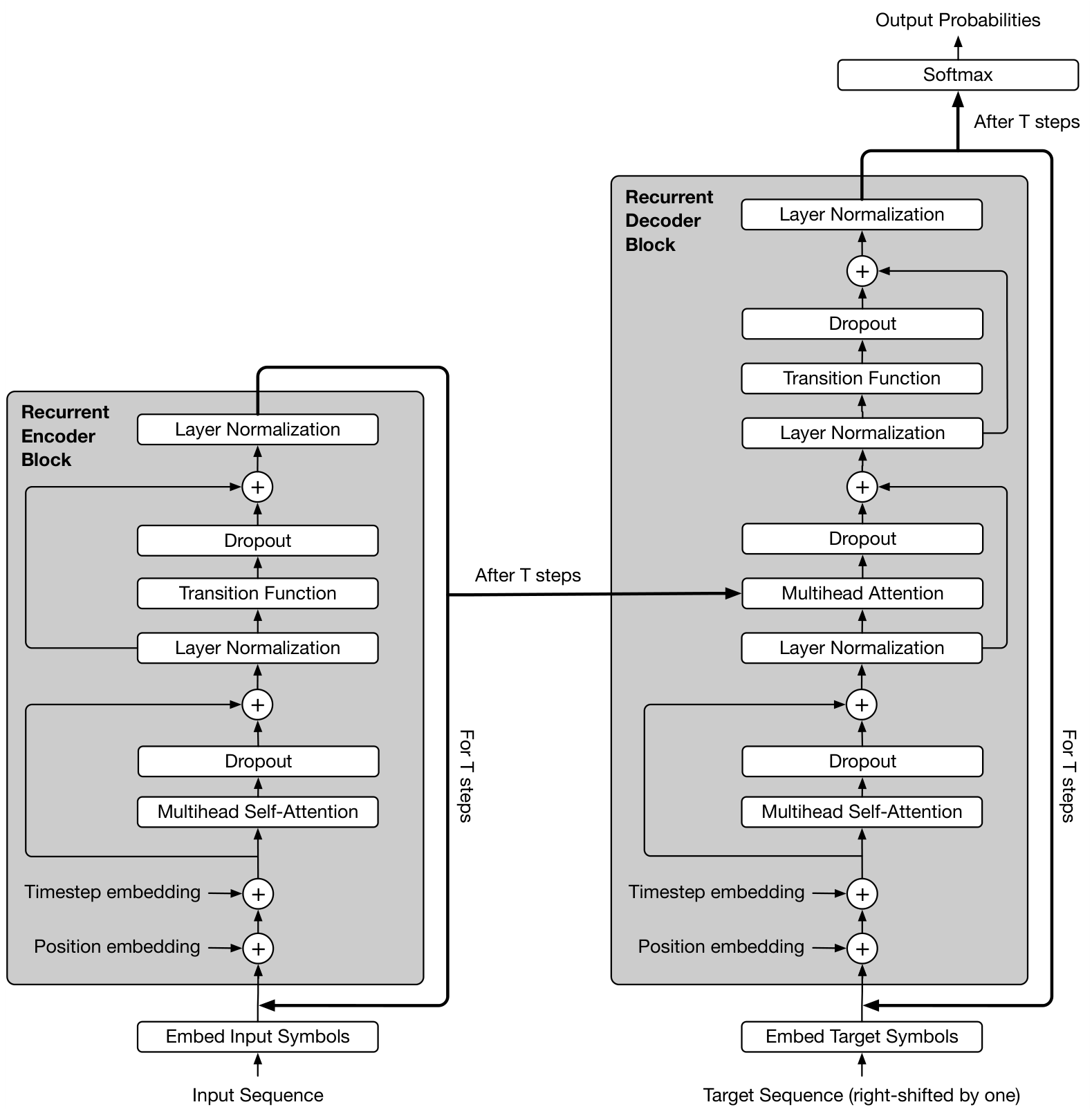
Appendix A Detailed Schema of the Universal Transformer
Appendix B On the Computational Power of UT vs Transformer
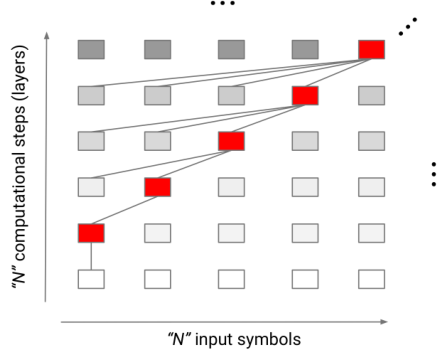
With respect to their computational power, the key difference between the Transformer and the Universal Transformer lies in the number of sequential steps of computation (i.e. in depth). While a standard Transformer executes a total number of operations that scales with the input size, the number of sequential operations is constant, independent of the input size and determined solely by the number of layers. Assuming finite precision, this property implies that the standard Transformer cannot be computationally universal. When choosing a number of steps as a function of the input length, however, the Universal Transformer does not suffer from this limitation. Note that this holds independently of whether or not adaptive computation time is employed but does assume a non-constant, even if possibly deterministic, number of steps. Varying the number of steps dynamically after training is enabled by sharing weights across sequential computation steps in the Universal Transformer.
An intuitive example are functions whose execution requires the sequential processing of each input element. In this case, for any given choice of depth
APPENDIX C UT WITH DYNAMIC HALTING
We implement the dynamic halting based on
# While-loop stops when this predicate is FALSE
# i.e. all ((probability < threshold) & (counter < max_steps)) are false
def should_continue(u0, u1, halting_probability, u2, n_updates, u3):
	return tf.reduce_any(
		tf.logical_and(
			tf.less(halting_probability, threshold),
			tf.less(n_updates, max_steps)))
# Do while loop iterations until predicate above is false
(_, _, _, remainder, n_updates, new_state) = tf.while_loop(
	should_continue, ut_with_dynamic_halting, (state,
	step, halting_probability, remainders, n_updates, previous_state))
Listing 1: UT with dynamic halting.
The following shows the computations in each step:
def ut_with_dynamic_halting(state, step, halting_probability,
							remainders, n_updates, previous_state):
	# Calculate the probabilities based on the state
	p = common_layers.dense(state, 1, activation=tf.nn.sigmoid,
		use_bias=True)
	# Mask for inputs which have not halted yet
	still_running = tf.cast(
		tf.less(halting_probability, 1.0), tf.float32)
	# Mask of inputs which halted at this step
	new_halted = tf.cast(
		tf.greater(halting_probability + p * still_running, threshold),
		tf.float32) * still_running
	# Mask of inputs which haven't halted, and didn't halt this step
	still_running = tf.cast(
		tf.less_equal(halting_probability + p * still_running,
		threshold), tf.float32) * still_running
	# Add the halting probability for this step to the halting
	# probabilities for those inputs which haven't halted yet
	halting_probability += p * still_running
	# Compute remainders for the inputs which halted at this step
	remainders += new_halted * (1 - halting_probability)
	# Add the remainders to those inputs which halted at this step
	halting_probability += new_halted * remainders
	# Increment n_updates for all inputs which are still running
	n_updates += still_running + new_halted
	# Compute the weight to be applied to the new state and output:
	#   0 when the input has already halted,
	#   p when the input hasn't halted yet,
	#   the remainders when it halted this step.
	update_weights = tf.expand_dims(p * still_running +
		new_halted * remainders, -1)

	# Apply transformation to the state
	transformed_state = transition_function(self_attention(state))
	# Interpolate transformed and previous states for non-halted inputs
	new_state = ((transformed_state * update_weights) +
				 (previous_state * (1 - update_weights)))
	step += 1
	return (transformed_state, step, halting_probability,
			remainders, n_updates, new_state)
Listing 2: Computations in each step of the UT with dynamic halting.
APPENDIX D DESCRIPTION OF SOME OF THE TASKS/DATASETS
Here, we provide some additional details on the bAbI, subject-verb agreement, LAMBADA language modeling, and learning to execute (LTE) tasks.
D.1 BABI QUESTION-ANSWERING
The bAbi question answering dataset
There are two versions of the dataset, one with 1k training examples and the other with 10k examples. It is important for a model to be data-efficient to achieve good results using only the 1k training examples. Moreover, the original idea is that a single model should be evaluated across all the tasks (not tuning per task), which is the train joint setup in Table 1, and the tables presented in Appendix E.
D.2 SUBJECT-VERB AGREEMENT
Subject-verb agreement is the task of predicting number agreement between subject and verb in English sentences. Succeeding in this task is a strong indicator that a model can learn to approximate syntactic structure and therefore it was proposed by
Two experimental setups were proposed by
In this task, in order to have different levels of difficulty, “agreement attractors” are used, i.e. one or more intervening nouns with the opposite number from the subject with the goal of confusing the model. In this case, the model needs to correctly identify the head of the syntactic subject that corresponds to a given verb and ignore the intervening attractors in order to predict the correct form of that verb. Here are some examples for this task in which subjects and the corresponding verbs are in boldface and agreement attractors are underlined:
No attractor: The boy smiles.
One attractor: The number of men is not clear.
Two attractors: The ratio of men to women is not clear.
Three attractors: The ratio of men to women and children is not clear.
D.3 LAMBADA LANGUAGE MODELING
The LAMBADA task
Context:
“Yes, I thought I was going to lose the baby.”
“I was scared too,” he stated, sincerity flooding his eyes.
“You were?” “Yes, of course. Why do you even ask?”
“This baby wasn’t exactly planned for.”
Target sentence:
“Do you honestly think that I would want you to have a ________?”
Target word:
miscarriage
The LAMBADA task consists in predicting the target word given the whole passage (i.e., the context plus the target sentence). A “control set” is also provided which was constructed by randomly sampling passages of the same shape and size as the ones used to build LAMBADA, but without filtering them in any way. The control
set is used to evaluate the models at standard language modeling before testing on the LAMBADA task, and therefore to ensure that low performance on the latter cannot be attributed simply to poor language modeling.
The task is evaluated in two settings: as language modeling (the standard setup) and as reading comprehension. In the former (more challenging) case, a model is simply trained for the next word prediction on the training data, and evaluated on the target words at test time (i.e. the model is trained to predict all words, not specifically challenging target words). In this paper, we report the results of the Universal Transformer in both setups.
D.4 LEARNING TO EXECUTE (LTE)
LTE is a set of tasks indicating the ability of a model to learn to execute computer programs and was proposed by
The difficulty of the program evaluation tasks is parameterized by their length and nesting. The length parameter is the number of digits in the integers that appear in the programs (so the integers are chosen uniformly from
Input:
j=8584
for x in range(8):
	j+=920
b=(1500+j)
print((b+7567))
Target:
25011
Appendix E bAbI Detailed Results
| Best seed run for each task (out of 10 runs) | ||||
|---|---|---|---|---|
| Task id | 10K | 1K | ||
| train single | train joint | train single | train joint | |
| 1 | 0.0 | 0.0 | 0.0 | 0.0 |
| 2 | 0.0 | 0.0 | 0.0 | 0.5 |
| 3 | 0.4 | 1.2 | 3.7 | 5.4 |
| 4 | 0.0 | 0.0 | 0.0 | 0.0 |
| 5 | 0.0 | 0.0 | 0.0 | 0.5 |
| 6 | 0.0 | 0.0 | 0.0 | 0.5 |
| 7 | 0.0 | 0.0 | 0.0 | 3.2 |
| 8 | 0.0 | 0.0 | 0.0 | 1.6 |
| 9 | 0.0 | 0.0 | 0.0 | 0.2 |
| 10 | 0.0 | 0.0 | 0.0 | 0.4 |
| 11 | 0.0 | 0.0 | 0.0 | 0.1 |
| 12 | 0.0 | 0.0 | 0.0 | 0.0 |
| 13 | 0.0 | 0.0 | 0.0 | 0.6 |
| 14 | 0.0 | 0.0 | 0.0 | 3.8 |
| 15 | 0.0 | 0.0 | 0.0 | 5.9 |
| 16 | 0.4 | 1.2 | 5.8 | 15.4 |
| 17 | 0.6 | 0.2 | 32.0 | 42.9 |
| 18 | 0.0 | 0.0 | 0.0 | 4.1 |
| 19 | 2.8 | 3.1 | 47.1 | 68.2 |
| 20 | 0.0 | 0.0 | 2.4 | 2.4 |
| avg err | 0.21 | 0.29 | 4.55 | 7.78 |
| failed | 0 | 0 | 3 | 5 |
| Average (var) over all seeds (for 10 runs) | ||||
|---|---|---|---|---|
| Task id | 10K | 1K | ||
| train single | train joint | train single | train joint | |
| 1 | ||||
| 2 | ||||
| 3 | ||||
| 4 | ||||
| 5 | ||||
| 6 | ||||
| 7 | ||||
| 8 | ||||
| 9 | ||||
| 10 | ||||
| 11 | ||||
| 12 | ||||
| 13 | ||||
| 14 | ||||
| 15 | ||||
| 16 | ||||
| 17 | ||||
| 18 | ||||
| 19 | ||||
| 20 | ||||
| avg |
APPENDIX F BABI ATTENTION VISUALIZATION
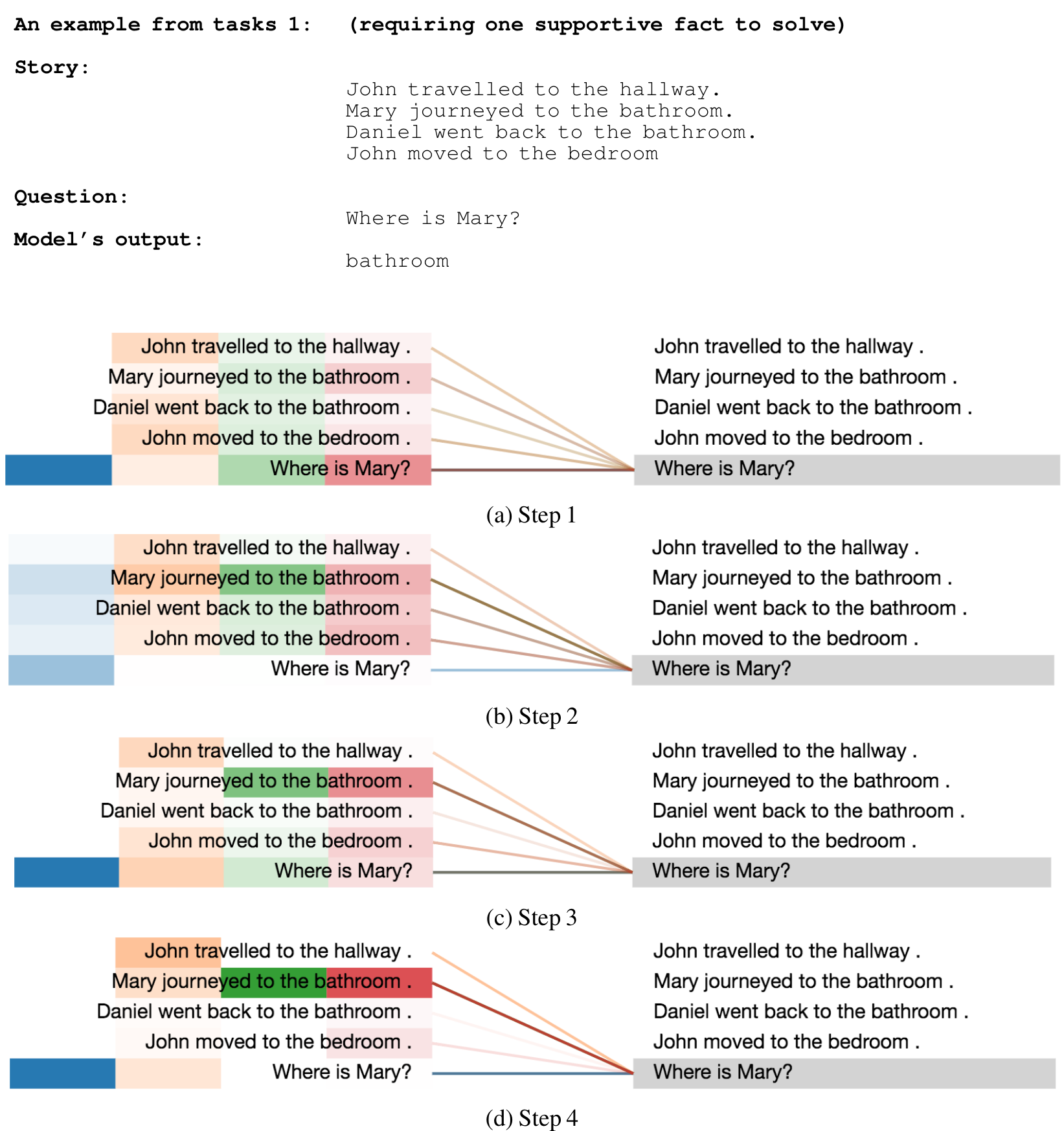
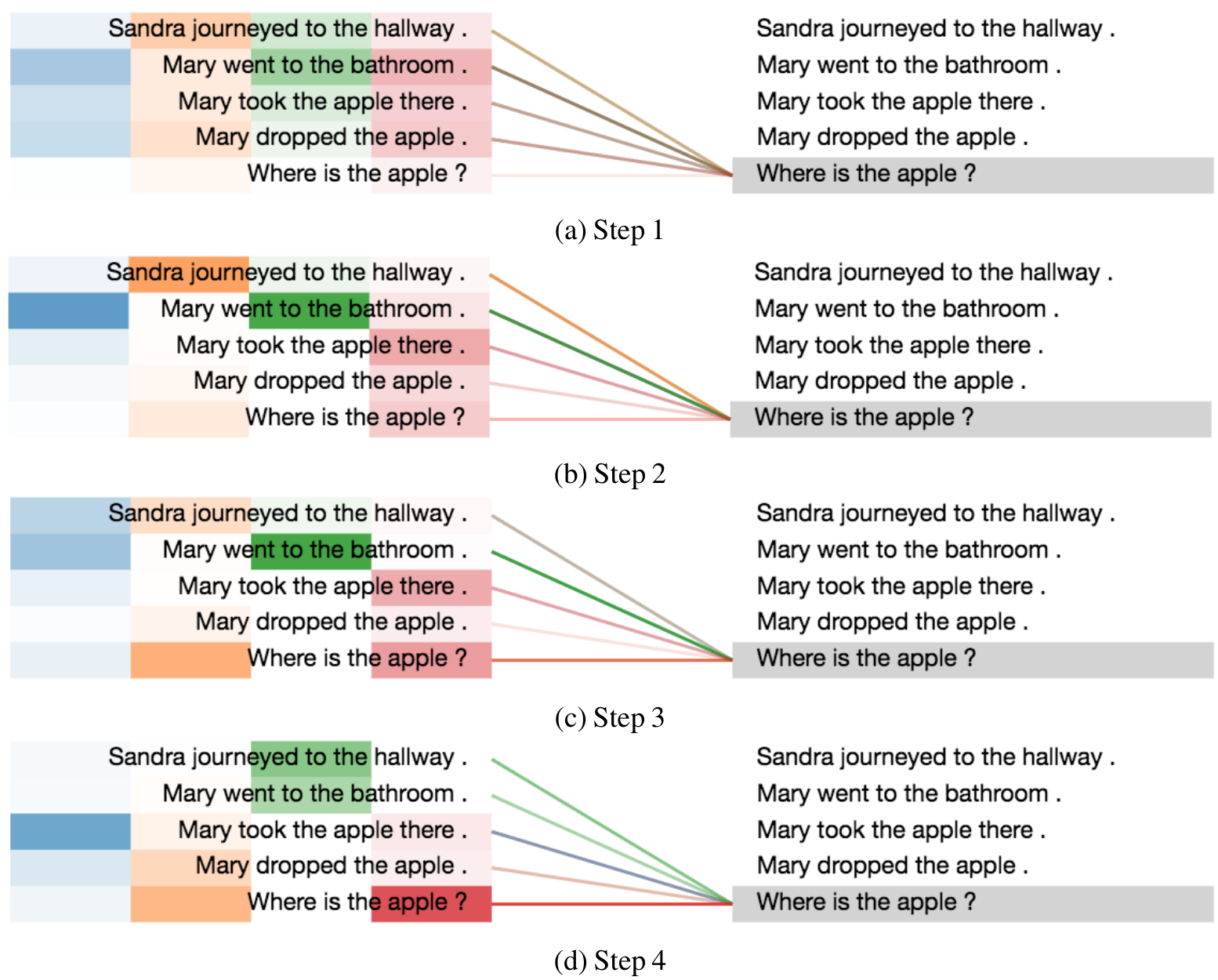
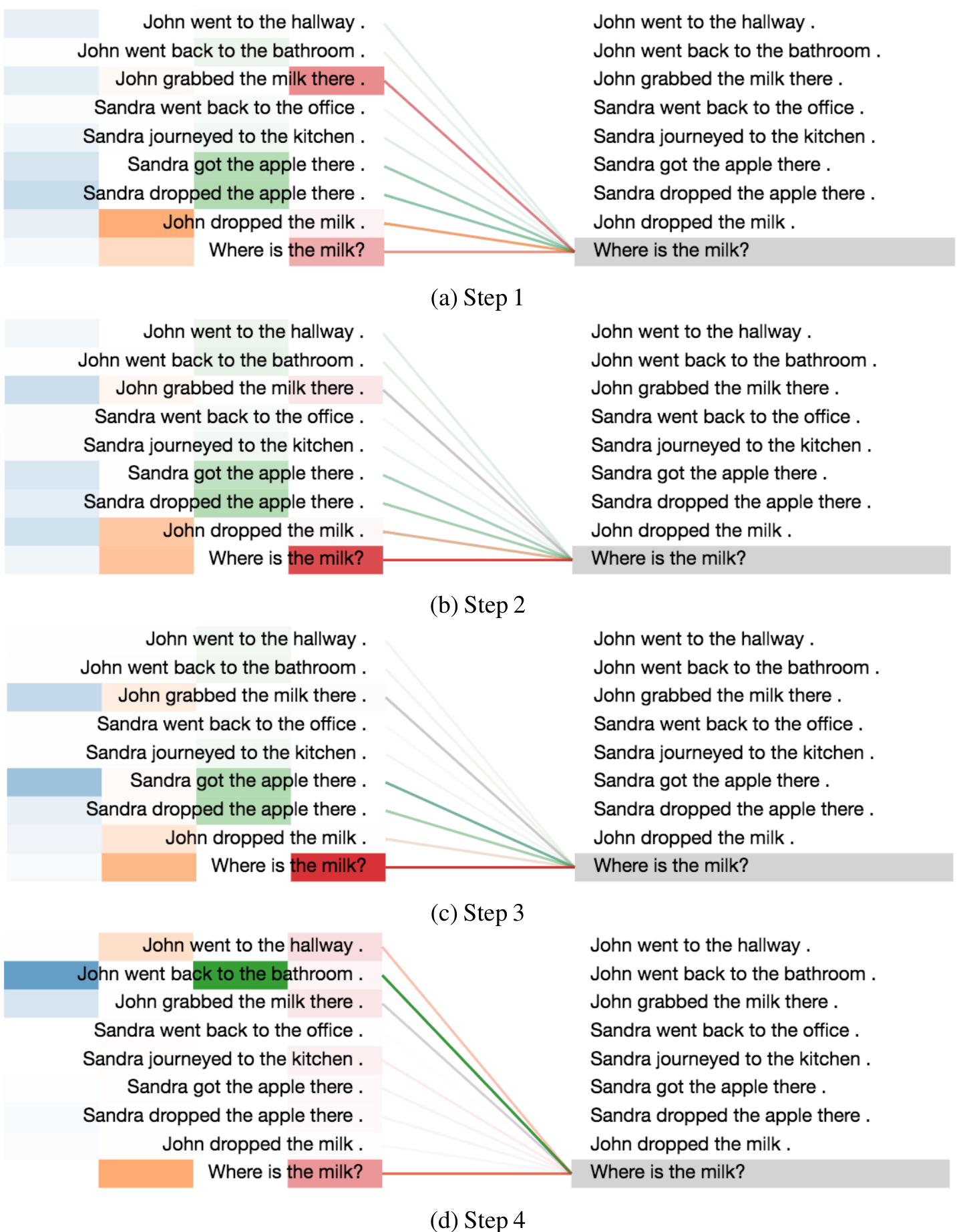
We present a visualization of the attention distributions on bAbI tasks for a couple of examples. The visualization of attention weights is over different time steps based on different heads over all the facts in the story and a question. Different color bars on the left side indicate attention weights based on different heads (4 heads in total).
An example from tasks 1: (requiring one supportive fact to solve)
Story:
John travelled to the hallway.
Mary journeyed to the bathroom.
Daniel went back to the bathroom.
John moved to the bedroom
Question:
Where is Mary?
Model’s output:
bathroom
An example from tasks 2: (requiring two supportive facts to solve)
Story:
Sandra journeyed to the hallway.
Mary went to the bathroom.
Mary took the apple there.
Mary dropped the apple.
Question:
Where is the apple?
Model’s output:
bathroom
An example from tasks 2: (requiring two supportive facts to solve)
Story:
John went to the hallway.
John went back to the bathroom.
John grabbed the milk there.
Sandra went back to the office.
Sandra journeyed to the kitchen.
Sandra got the apple there.
Sandra dropped the apple there.
John dropped the milk.
Question:
Where is the milk?
Model’s output:
bathroom
An example from tasks 3: (requiring three supportive facts to solve)
Story:
Mary got the milk.
John moved to the bedroom.
Daniel journeyed to the office.
John grabbed the apple there.
John got the football.
John journeyed to the garden.
Mary left the milk.
John left the football.
Daniel moved to the garden.
Daniel grabbed the football.
Mary moved to the hallway.
Mary went to the kitchen.
John put down the apple there.
John picked up the apple.
Sandra moved to the hallway.
Daniel left the football there.
Daniel took the football.
John travelled to the kitchen.
Daniel dropped the football.
John dropped the apple.
John grabbed the apple.
John went to the office.
Sandra went back to the bedroom.
Sandra took the milk.
John journeyed to the bathroom.
John travelled to the office.
Sandra left the milk.
Mary went to the bedroom.
Mary moved to the office.
John travelled to the hallway.
Sandra moved to the garden.
Mary moved to the kitchen.
Daniel took the football.
Mary journeyed to the bedroom.
Mary grabbed the milk there.
Mary discarded the milk.
John went to the garden.
John discarded the apple there.
Question:
Where was the apple before the bathroom?
Model’s output:
office
Footnotes
-
We experimented with different hyper-parameters and different network sizes, but it always overfits. ↩
-
Defined as > 5% error. ↩
-
Cabinet (singular) is an agreement attractor in this case. ↩
-
Note that in UT both the self-attention and transition weights are tied across layers. ↩
-
Appendix B illustrates how UT is computationally more powerful than the standard Transformer. ↩