What if automating AI R&D triggers an intelligence explosion?
Alan Chan
Christoph Winter
Andrew Barto
Jakub Pachocki
Geoffrey Hinton
Eric Horvitz
Yoshua Bengio
Dawn Song
Jack Clark
Hilary Greaves
Anton Korinek
Samuel Hammond
Thore Graepel
Ben Bariach
Philip H. S. Torr
Sheila A. McIlraith
Jeff Clune
Sam Manning
Girish Sastry
Tom Davidson
Daniel Eth
Sören Mindermann
Abstract
In contrast to even a year ago, AI systems now write most of the code inside the companies that build them. As more of the AI research and development (R&D) pipeline is automated, could AI progress radically accelerate in an “intelligence explosion,” where years of advances are compressed into months or less? Preliminary evidence suggests that it could. In this work, we assess this evidence, analyze an intelligence explosion’s potential impacts, and propose policy responses. AI systems are on track to automate most AI R&D work within a few years, and possibly all of it. If this triggers an intelligence explosion, it could dramatically bring forward AI’s benefits, but also pose extreme risks: capabilities growth could accelerate far beyond what society can keep up with, humanity could lose control over superhuman AI systems, and checks on power within and between states, companies, and branches of government could be severely eroded. Although there remains much uncertainty about these possibilities, the high stakes warrant serious further attention. Policymakers should urgently obtain more visibility into the automation of AI R&D, develop ways to steer and constrain an intelligence explosion, and prepare society to adapt to an intelligence explosion’s impacts.
Introduction
Computer scientists have long theorized that AI systems would one day design ever-better successors, producing systems that rapidly outnumber, outpace, and outperform humans
We are centrally concerned with the possibility of an intelligence explosion: a dramatic AI-driven acceleration of AI progress, compressing advances that would otherwise take years into months or less. This acceleration would be a qualitative shift from the rapid but largely steady progress of the last few years.
An intelligence explosion could arise from AI contributing to advances in hardware and/or software. Hardware advances increase the quality and quantity of computing hardware (compute) used for developing and running AI systems. Software advances improve the data, algorithms, code, and processes used in AI R&D; they include more efficient training and inference on existing hardware
Preliminary evidence suggests that a software-driven intelligence explosion is possible. If one does happen, it could be the most consequential technological development in history: AI systems could rapidly eclipse human experts across most domains and radically accelerate technological progress. Given the stakes and the potentially narrow window for action, we argue that preparing for an intelligence explosion should be an urgent priority, including at the highest levels of government leadership.
AI is rapidly automating AI R&D
AI systems now either assist with or autonomously carry out major parts of the AI R&D pipeline. In contrast to even just a year ago, R&D staff at leading AI companies delegate core R&D tasks to teams of AI systems, and some delegate all coding. Anthropic reports that AI systems’ share of approved code rose from low single digits to over 80% between January 2025 and May 2026
The best AI systems now complete AI R&D tasks that take human experts hours to days, compared to only being able to complete seconds-long tasks in 2023
Today’s AI systems still have many weaknesses. They sometimes disobey instructions, cheat on tasks, misrepresent their work, and are unable to complete some tasks at all, necessitating human intervention
Still, AI systems are rapidly improving at AI R&D. AI R&D may well be automated before most other work: it is a primarily digital domain with many clear measures of success, automating it would offer a major competitive edge in the AI industry, and AI companies have unmatched data on—and expertise in—their own workflows. Some tentative extrapolations of recent trends suggest that months-long AI R&D projects will be automated by mid-2028.2 Overall, we should expect much more substantial
automation of AI R&D over the next few years, and even full automation within this timeframe should be taken seriously.
Automating AI R&D could trigger an intelligence explosion
The mechanism for a software-driven intelligence explosion has two parts: (1) AI systems expand the effective R&D workforce as they get better and faster at AI R&D, and (2) this workforce produces still better AI systems that expand the workforce even further in a recursive feedback loop. Although the existing evidence is preliminary and sometimes mixed, it suggests that this mechanism could radically accelerate AI progress, overcoming frictions such as diminishing returns and hard-to-automate tasks.
The mechanism and frictions
Each new generation of AI systems will perform a growing range of R&D tasks faster and better than humans can, effectively yielding a larger, smarter, and faster automated R&D workforce. Once AI systems reach expert-level AI R&D capabilities at run-

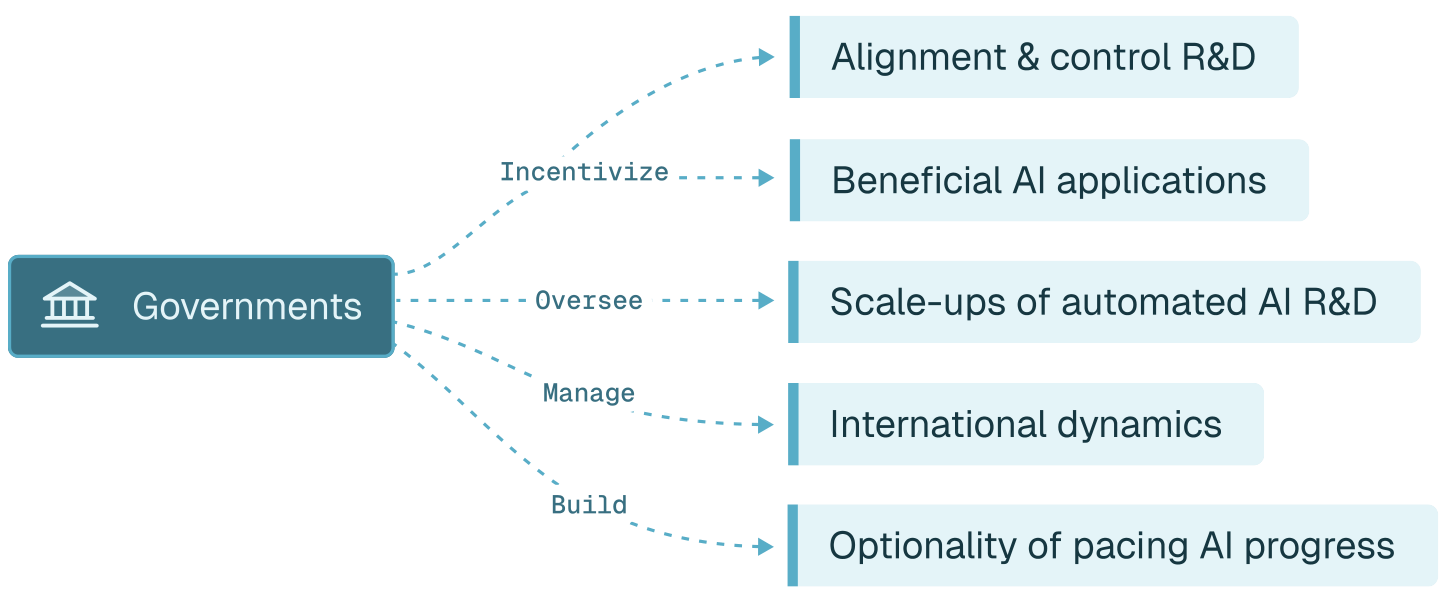
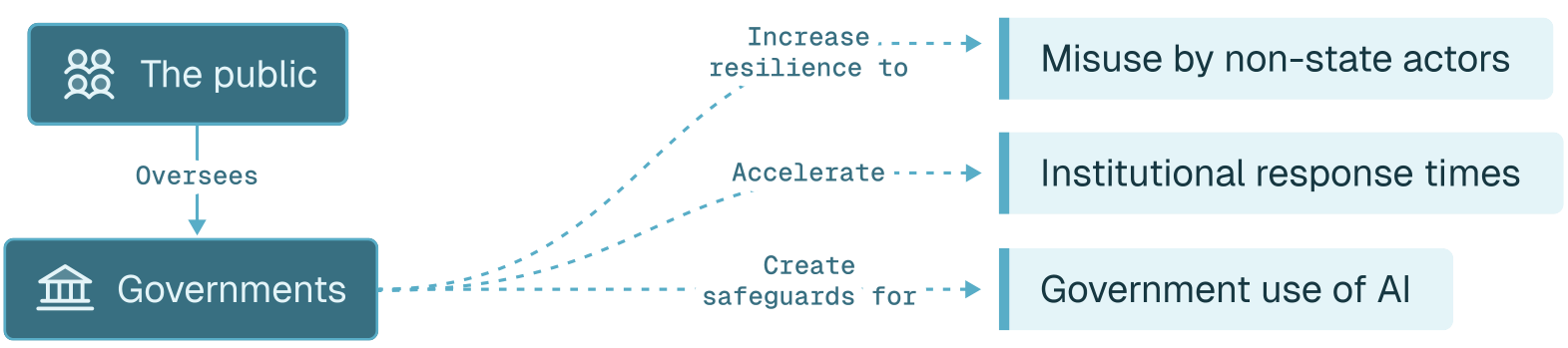
Figure 1. Policymakers should urgently: (1) obtain visibility into automation of AI R&D within frontier AI companies; (2) develop ways to steer and constrain an intelligence explosion; and (3) prepare to adapt to an intelligence explosion’s impacts.
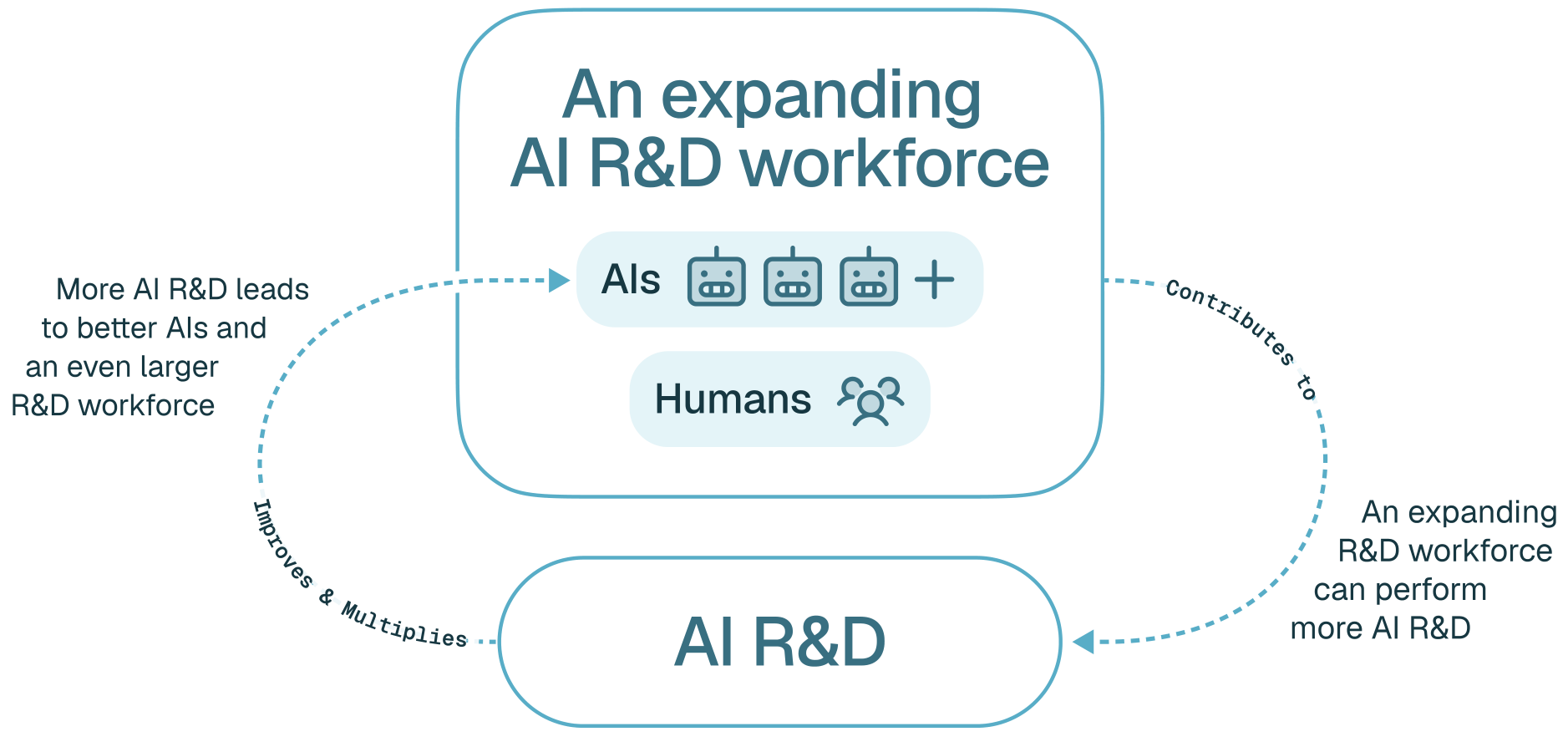
time costs comparable to those of today’s systems, the compute available to a single frontier developer today could sustain an AI workforce equivalent to at least millions of top human researchers
AI systems also help build more capable and efficient successors, further expanding the automated R&D workforce and creating a feedback loop that could sustain and compound successive speed-ups. Past technologies have also involved feedback loops: for example, better computer chips power better chip design tools. What may distinguish a software-driven intelligence explosion is how much AI systems would contribute to producing the next generation: as they substitute for humans on a growing share of R&D tasks, each software advance speeds up an ever-larger share of the R&D pipeline. At full automation, even the current pace of efficiency improvements would grow the automated R&D workforce 100-fold over months or years,3 a relative expansion that took the U.S. researcher population seven decades
At least four frictions push against these dynamics. The first is diminishing returns: across scientific fields such as computer hardware, agriculture, and drug development, sustaining the same rate of progress has required substantially more R&D labor as low-hanging fruit is exhausted
Evidence
Preliminary evidence suggests that automation-driven dynamics could overcome these frictions, though the evidence is mixed and in some cases indirect.
Diminishing returns. Evidence suggests that diminishing returns would not prevent an intelligence explosion, though this finding relies on limited data and stylized modeling assumptions. The main analysis in the literature focuses on whether, after full automation of AI R&D, effective R&D labor would grow fast enough to overcome diminishing returns and accelerate progress. The balance is captured by a quantity called the “returns to research effort,” denoted 4
Compute. There is mixed evidence on whether compute could bottleneck a software-driven intelligence explosion. Finding and testing software advances involves using compute to run R&D experiments. The limited available data suggest that a software-driven intelligence explosion is not possible if such experiments require proportionally more compute as frontier training runs grow
Data. Data could bottleneck progress, but the constraint varies substantially across domains. Historically, AI progress has relied heavily on internet data and expert demonstrations. But the supply of internet data is on track to grow too slowly to support even the current rate of progress past 2028
Hard-to-automate tasks. Indirect evidence suggests that hard-to-automate tasks need not prevent an intelligence explosion if automation advances quickly enough. In a setting that considers both software and hardware,
Time-intensive processes. We lack direct evidence on the extent to which time-intensive processes could bottleneck progress. The most significant such process appears to be training runs, which can currently take 3 months or more
Overall, there is a coherent pathway to a software-driven intelligence explosion that is consistent with the existing evidence. Productivity gains from AI R&D automation have not yet reached the threshold needed to trigger an intelligence explosion, but gains from newer systems are likely approaching that threshold
Societal impacts
An intelligence explosion would lead to (1) the extremely rapid development of highly capable or superhuman AI systems11 and (2) the likely deployment of those systems to develop new technologies and act in the world. This could pull forward by years or decades benefits that the current pace of AI progress would eventually help deliver
technologies such as highly scalable atom-by-atom manufacturing
At the same time, an intelligence explosion could significantly increase the risks from advanced AI in three ways.
Capabilities growth outpacing society’s capacity to steer and adapt. First, an intelligence explosion could dramatically bring forward the risks of advanced AI and AI-enabled technologies, such as biological and cyber attacks, labor market disruption, and loss of control over AI systems themselves
Loss of oversight and control. Second, automating AI R&D could weaken human oversight, compounding the above challenges and severely increasing the risk of losing control over highly capable AI systems. As humans become less involved in AI R&D, they could lose both the opportunities and expertise needed to identify and fix problems. Reliably using AI systems for oversight also remains an unsolved challenge
Erosion of checks on power. Third, an intelligence explosion could severely erode checks on power. Existing checks—such as those within and between states, companies, and branches of government—work only while no actor can vastly out-think and out-execute the others. An intelligence explosion could render such checks moot. A state could use an intelligence explosion to transform a modest lead in military R&D or operations into a decisive one, such as in cyberspace
These potential impacts are uncertain. AI systems could become superhuman in narrow domains (e.g., cyber and mathematics) long before doing so generally, giving society more time to respond. Even generally superhuman AI systems may not significantly accelerate technological progress, given the time needed for running scientific experiments, creating supply chains for specialized materials, and complying with any relevant regulation. AI systems could also accelerate safety R&D and processes for steering and adapting to risks.14 Finally, capability or technology diffusion
Policy implications
AI R&D automation is advancing rapidly, AI progress could radically accelerate, and the stakes are high. We therefore argue that policymakers should urgently: (1) obtain visibility into companies’ automation of AI R&D; (2) develop ways to steer and constrain an intelligence explosion; and (3) prepare to adapt to an intelligence explosion’s impacts. Because progress during an intelligence explosion would out
pace normal policymaking, preparations must be made in advance and activated as evidence about benefits and risks emerges.
Obtaining visibility into AI R&D automation
Policymakers need more data on the likelihood, onset, and consequences of a software-driven intelligence explosion. Much of this data will only be available within the companies automating AI R&D: the relevant AI systems are first used internally, and substantial automation could occur without external visibility. Current mandatory reporting frameworks either do not adequately cover internal AI R&D use cases or do not specify indicators to be reported
Policymakers should consider requiring standardized reporting of key AI R&D indicators and processes to governments and third-party auditors, as well as funding third-party measurement capacity
- Assessing the likelihood of a software-driven intelligence explosion, including the extent to which compute, data, hard-to-automate tasks, and time-intensive processes (e.g., training runs and experiments) bottleneck AI progress, along with better estimates of the returns to research effort in AI R&D. Estimating the latter requires data on how companies divide R&D spending among humans, compute for experiments, and compute for running AI systems to perform R&D labor
[37] . - Detecting the onset15 of an intelligence explosion, including the extent of AI R&D automation (e.g., the fraction of research contributions produced by AI systems) and the pace of AI progress (e.g., algorithmic efficiency improvements).
- Understanding oversight and loss-of-control risks, including the procedures for deciding whether to broaden internal deployment of AI R&D systems, where and how those systems are used in high-stakes R&D decisions, how those systems are overseen, and reports of incidents involving internal AI systems
[58] .
Beyond reporting requirements, policymakers should also consider more extensive ways to obtain visibility into AI R&D automation. For instance, they could require that independent third parties (e.g., accredited private auditors or government evaluation bodies) evaluate AI systems before internal deployment, or that such parties be embedded within certain AI companies to audit
Stronger reporting and auditing requirements are likely most warranted for companies whose AI systems (a) are at the frontier of AI R&D capabilities or (b) exceed some meaningful threshold of such capabilities. Policymakers will need to weigh important trade-offs in determining such thresholds.
Steering and constraining an intelligence explosion
An intelligence explosion would involve an unprecedentedly rapid series of decisions to train and deploy increasingly capable AI systems. The overarching question for policymakers is whether and how public policy should govern these decisions, which we break into three components.
First, policymakers should develop ways to pace and constrain scale-ups of automated AI R&D. They should consider:
- Setting requirements for continued deployment or development, such as the implementation of adequate safety measures (e.g., robust monitoring of automated R&D pipelines), broader stakeholder input, or limits on the extent to which capabilities can increase within a given time period.
- Preparing tools to verify compliance with potential future agreements (domestic or international) that pace AI progress, given competitive pressures to race ahead
[63–65] . - Increasing oversight of data centers engaged in automated AI R&D and establishing incident-response procedures in collaboration with data center operators and AI companies, such as developing options to pause specific AI R&D workloads
[66] . - Requiring that certain evaluations or deployments of automated AI R&D systems take place in appropriately isolated environments, such
as air-gapped networks, to prevent exfiltration of model weights or sensitive R&D outputs and to contain AI systems that attempt to escape human control and act in the world unchecked
Policymakers should weigh the risks of an unchecked intelligence explosion against the potential for abuse of certain powers and the costs of delayed progress. As an example of potential abuse, poorly crafted mechanisms could allow a government to slow R&D at all but a favored company.
Second, policymakers should decide whether and how to steer the direction of AI development and deployment
Third, countries should reduce the risk of conflict arising from an intelligence explosion. They should consider:
- Establishing confidence-building measures such as incident sharing
[68] , as well as norms around reporting of early-warning indicators. - Negotiating international agreements to prevent destabilizing development and use of highly capable AI systems, and funding research into verification methods that could underpin such agreements
[64, 65] . - Clarifying whether and how they would deter another actor from scale-ups of automated AI R&D, potentially in collaboration with other countries
[47, 65] . - Running war games to simulate an intelligence explosion
[69–71] .
Adapting to an intelligence explosion
If an intelligence explosion were to occur, adapting to its impacts would likely be a top priority of every major world power. Compared to business-as-usual AI progress, an intelligence explosion would compress the window for adaptation and make advance preparation far more urgent.
One important intervention is accelerating institutional response times. Policymakers should consider:
- Developing approaches to safely integrate AI systems into policy processes, so as to enhance and support government operations
[72] . - Creating and maintaining emergency response plans for a variety of scenarios involving extreme AI progress, including those leading to significant labor market impacts, geopolitical instability, or a loss of control.
Policymakers will also need to preserve checks on power and defend against misuse of extremely advanced AI. Legal, institutional, and physical safeguards can take years to establish and would come too late if preparations began only after such capabilities had already arrived. Many preparations therefore need to start now. Policymakers should consider:
- Creating safeguards to ensure that government use of AI respects legal and normative limits, such as by procuring AI tools to strengthen checks between branches of government, sharing key information about government AI systems
(e.g., model specs [73, 74]) with the public, or requiring that AI systems follow the law[75] . - Ensuring that citizens and civil society have the capabilities to detect, document, and contest unlawful or harmful uses of AI, such as by giving them timely access to AI systems capable of supporting these activities.
- Helping build sufficient defenses against misuse by malicious non-state actors, such as by funding better medical countermeasures against AI-enabled biological threats
[76] .
Conclusion
An intelligence explosion could be the most consequential technological development in human history
Relative to the stakes, we are not sufficiently prepared. Policymakers should have three priorities:
obtaining visibility into AI R&D automation within frontier AI companies, developing ways to steer and constrain an intelligence explosion, and preparing to adapt to its impacts. Once an intelligence explosion begins, the window for action may close.
Acknowledgments
We thank Anson Ho, Tom Cunningham, Cheryl Wu, Ryan Greenblatt, and many GovAI staff for feedback and conversations that improved this piece.
We are grateful to Taylor Jones for creating the figures and to Zilan Qian for providing a Chinese translation of this piece.
References
[2] A. M. Turing, Intelligent machinery, a heretical theory, 1951 (cit. on p. 2).
[3] J. Evans, B. Bratton, and B. Agüera y Arcas, “Agentic AI and the next intelligence explosion,” Science, vol. 391, no. 6791, eaeg1895, Mar. 2026. DOI: 10.1126/science.aeg1895 (cit. on p. 2).
[4] J. Pachocki, An alien mind, Sep. 2026 (cit. on p. 2).
[5] M. Favaro and J. Clark, When AI builds itself: Our progress toward recursive self-improvement, and its implications, Jun. 2026 (cit. on pp. 2, 7).
[6] T. Tunguz, Are we being railroaded by AI? Nov. 2025 (cit. on p. 2).
[7] C. E. Leiserson, N. C. Thompson, J. S. Emer, B. C. Kuszmaul, B. W. Lampson, D. Sanchez, and T. B. Schardl, “There’s plenty of room at the top: What will drive computer performance after Moore’s law?” Science, vol. 368, no. 6495, eaam9744, Jun. 2020. DOI: 10.1126/science.aam9744 (cit. on pp. 2, 13).
[8] A. Ho, T. Besiroglu, E. Erdil, D. Owen, R. Rahman, Z. C. Guo, D. Atkinson, N. Thompson, and J. Sevilla, Algorithmic progress in language models, 2024 (cit. on p. 2).
[9] OpenAI, How GPT-5.6 fuses frontier intelligence with frontier efficiency, Jul. 2026 (cit. on p. 2).
[10] M. Abdin, J. Aneja, H. Behl, S. Bubeck, R. Eldan, S. Gunasekar, M. Harrison, R. J. Hewett, M. Javaheripi, P. Kauffmann, J. R. Lee, Y. T. Lee, Y. Li, W. Liu, C. C. T. Mendes, A. Nguyen, E. Price, G. de Rosa, O. Saarikivi, A. Salim, S. Shah, X. Wang, R. Ward, Y. Wu, D. Yu, C. Zhang, and Y. Zhang, Phi-4 technical report, Dec. 2024. DOI: 10.48550/arXiv.2412.08905 (cit. on p. 2).
[11] J.-S. Denain and C. Barber, An FAQ on reinforcement learning environments, 2026 (cit. on p. 2).
[12] D. Guo et al., “DeepSeek-R1 incentivizes reasoning in LLMs through reinforcement learning,” Nature, vol. 645, no. 8081, pp. 633–638, Sep. 2025. DOI: 10.1038/s41586-025-09422-z (cit. on pp. 2, 5).
[13] OpenAI, Learning to reason with LLMs, Sep. 2024 (cit. on p. 2).
[14] D. Eth and T. Davidson, “Will AI R&D automation cause a software intelligence explosion?,” 2025 (cit. on p. 2).
[15] M. Favaro and P. Wright, Measurements for understanding the pace of AI development inside frontier labs, Anthropic, Sep. 2026 (cit. on pp. 2, 7).
[16] METR, Frontier risk report (February to March 2026), May 2026 (cit. on p. 2).
[17] METR, Time horizon 1.1, Jan. 2026 (cit. on pp. 2, 13).
[18] OpenAI, Research acceleration: The view inside OpenAI, Sep. 2026 (cit. on pp. 2, 7).
[19] B. Rank, H. Bhatnagar, A. Prabhu, S. Eisenberg, K. Nguyen, M. Bethge, and M. Andriushchenko, “PostTrainBench: Can LLM agents automate LLM post-training?” In International Conference on Machine Learning (ICML), 2026. arXiv:2603.08640 [cs.SE] (cit. on p. 2).
[20] J. Wen, L. Qiu, J. Benton, J. H. Kirchner, and J. Leike, Automated weak-to-strong researcher, Apr. 2026 (cit. on p. 2).
[21] J. Wen, C. Si, Y.-h. Chen, H. He, and S. Feng, Predicting empirical AI research outcomes with language models, Jun. 2025. DOI: 10.48550/arXiv.2506.00794 (cit. on p. 2).
[22] C. Lu, C. Lu, R. T. Lange, Y. Yamada, S. Hu, J. Foerster, D. Ha, and J. Clune, “Towards end-to-end automation of AI research,” Nature, vol. 651, no. 8107, pp. 914–919, Mar. 2026. DOI: 10.1038/s41586-026-10265-5 (cit. on p. 2).
[23] S. Rabanser, S. Kapoor, P. Kirgis, K. Liu, S. Utpala, and A. Narayanan, Towards a science of AI agent reliability, Feb. 2026. DOI: 10.48550/arXiv.2602.16666 (cit. on p. 2).
[24] Anthropic, “Claude Fable 5 & Claude Mythos 5 system card,” Tech. Rep., Jun. 2026 (cit. on p. 2).
[25] OpenAI, “GPT-6 Astra system card,” Tech. Rep., Sep. 2026 (cit. on pp. 2, 6).
[26] P. Whitfill, C. Wu, J. Becker, and N. Rush, Many SWE-bench-passing PRs would not be merged into main, Mar. 2026 (cit. on p. 2).
[27] N. Bloom, C. I. Jones, J. Van Reenen, and M. Webb, “Are ideas getting harder to find?” American Economic Review, vol. 110, no. 4, pp. 1104–1144, Apr. 2020. DOI: 10.1257/aer.20180338 (cit. on pp. 4, 12, 14).
[28] A. Ho and P. Whitfill, The software intelligence explosion debate needs experiments, 2025 (cit. on pp. 5, 12, 13).
[29] P. Whitfill and C. Wu, Will compute bottlenecks prevent an intelligence explosion? Aug. 2025. DOI: 10.48550/arXiv.2507.23181 (cit. on p. 5).
[30] J. Kaplan, S. McCandlish, T. Henighan, T. B. Brown, B. Chess, R. Child, S. Gray, A. Radford, J. Wu, and D. Amodei, Scaling laws for neural language models, Jan. 2020. DOI: 10.48550/arXiv.2001.08361 (cit. on p. 5).
[31] J. Hoffmann, S. Borgeaud, A. Mensch, E. Buchatskaya, T. Cai, E. Rutherford, D. de Las Casas, L. A. Hendricks, J. Welbl, A. Clark, T. Hennigan, E. Noland, K. Millican, G. van den Driessche, B. Damoc, A. Guy, S. Osindero, K. Simonyan, E. Elsen, J. W. Rae, O. Vinyals, and L. Sifre, Training compute-optimal large language models, Mar. 2022. DOI: 10.48550/arXiv.2203.15556
[32] P. Villalobos, A. Ho, J. Sevilla, T. Besiroglu, L. Heim, and M. Hobbhahn, Will we run out of data? Limits of LLM scaling based on human-generated data, Jun. 2024. DOI: 10.48550/arXiv.2211.04325
[33] T. Davidson, B. Halperin, T. Houlden, and A. Korinek, When does automating AI research produce explosive growth? Feedback loops in innovation networks, Jul. 2026
[34] L. Emberson and Y. Edelman, Frontier training runs will likely stop getting longer by around 2027, Jul. 2025
[35] T. Davidson, J.-S. Denain, P. Villalobos, and G. Bas, AI capabilities can be significantly improved without expensive retraining, Dec. 2023. DOI: 10.48550/arXiv.2312.07413
[36] A. Novikov, N. Vu, M. Eisenberger, E. Dupont, P.-S. Huang, A. Z. Wagner, S. Shirobokov, B. Kozlovskii, F. J. R. Ruiz, A. Mehrabian, M. P. Kumar, A. See, S. Chaudhuri, G. Holland, A. Davies, S. Nowozin, P. Kohli, and M. Balog, AlphaEvolve: A coding agent for scientific and algorithmic discovery, Jun. 2025. DOI: 10.48550/arXiv.2506.13131
[37] T. Cunningham, L. Althoff, B. Halperin, B. Jabarian, A. Koh, A. Ramani, P. Trammell, P. Whitfill, and C. Wu, The economics of recursive self-improvement, Jul. 2026
[38] H. Wang, T. Fu, Y. Du, W. Gao, K. Huang, Z. Liu, P. Chandak, S. Liu, P. Van Katwyk, A. Deac, A. Anandkumar, K. Bergen, C. P. Gomes, S. Ho, P. Kohli, J. Lasenby, J. Leskovec, T.-Y. Liu, A. Manrai, D. Marks, B. Ramsundar, L. Song, J. Sun, J. Tang, P. Veličković, M. Welling, L. Zhang, C. W. Coley, Y. Bengio, and M. Zitnik, “Scientific discovery in the age of artificial intelligence,” Nature, vol. 620, no. 7972, pp. 47–60, Aug. 2023. DOI: 10.1038/s41586-023-06221-2
[39] K. E. Drexler, Radical abundance: How a revolution in nanotechnology will change civilization. PublicAffairs, 2013
[40] Y. Bengio, S. Clare, C. Prunkl, M. Murray, M. Andriushchenko, B. Bucknall, R. Bommasani, S. Casper, T. Davidson, R. Douglas, D. Duvenaud, P. Fox, U. Gohar, R. Hadshar, A. Ho, T. Hu, C. Jones, S. Kapoor, A. Kasirzadeh, S. Manning, N. Maslej, V. Mavroudis, C. McGlynn, R. Moulange, J. Newman, K. Y. Ng, P. Paskov, S. Rismani, G. Sastry, E. Seger, S. Singer, C. Stix, L. Velasco, N. Wheeler, D. Acemoglu, V. Conitzer, T. G. Dietterich, E. W. Felten, F. Heintz, G. Hinton, N. Jennings, S. Leavy, T. Ludermir, V. Marda, H. Margetts, J. McDermid, J. Munga, A. Narayanan, A. Nelson, C. Neppel, S. D. Ramchurn, S. Russell, M. Schaake, B. Schölkopf, A. Soto, L. Tiedrich, G. Varoquaux, A. Yao, Y.-Q. Zhang, L. A. Aguirre, O. Ajala, F. Albalawi, N. AlMalek, C. Busch, J. Collas, A. C. P. d. L. F. de Carvalho, A. Gill, A. H. Hatip, J. Heikkilä, C. Johnson, G. Jolly, Z. Katzir, M. N. Kerema, H. Kitano, A. Krüger, K. M. Lee, J. R. López Portillo, A. McLysaght, O. Molchanovskyi, A. Monti, M. Nemer, N. Oliver, R. Pezoa, A. Plonk, B. Ravindran, H. Riza, C. Rugege, H. Sheikh, D. Wong, Y. Zeng, L. Zhu, D. Privitera, and S. Mindermann, “International AI safety report 2026,” Department for Science, Innovation and Technology, Tech. Rep. DSIT 2026/001, 2026
[41] Y. Bengio, G. Hinton, A. Yao, D. Song, P. Abbeel, T. Darrell, Y. N. Harari, Y.-Q. Zhang, L. Xue, S. Shalev-Shwartz, G. Hadfield, J. Clune, T. Maharaj, F. Hutter, A. G. Baydin, S. McIlraith, Q. Gao, A. Acharya, D. Krueger, A. Dragan, P. Torr, S. Russell, D. Kahneman, J. Brauner, and S. Mindermann, “Managing extreme AI risks amid rapid progress,” Science, vol. 384, no. 6698, pp. 842–845, May 2024. DOI: 10.1126/science.adn0117
[42] C. Aveggio, A. J. Patel, S. Nevo, and K. Webster, “Exploring the offense-defense balance of biology: Identifying and describing high-level asymmetries,” RAND Corporation, Santa Monica, CA, Tech. Rep. PE-A4102-1, Aug. 2025
[43] R. Greenblatt, A. Cotra, and H. Wijk, “Brief independent investigation of agents’ behavior, reasoning and collaboration in the OpenAI / Hugging Face hacking incident,” METR and Redwood Research, Tech. Rep., Aug. 2026
[44] OpenAI, OpenAI and Hugging Face partner to address security incident during model evaluation, Jul. 2026
[45] OpenAI, The Hugging Face incident and the road ahead, Aug. 2026
[46] M. Sulmeyer, “Artificial intelligence and the risk of strategic cyberattack,” RAND Corporation, Tech. Rep., Jul. 2026
[47] D. Hendrycks, E. Schmidt, and A. Wang, Superintelligence strategy: Expert version, Mar. 2025. DOI: 10.48550/arXiv.2503.05628
[48] C. O’Keefe, A. Z. Rozenshtein, and C. Winter, Executive branch AI and the rule of law: An emerging research agenda, May 2026
[49] T. Davidson, L. Finnveden, and R. Hadshar, “AI-enabled coups: How a small group could use AI to seize power,” 2025
[50] J. Edwards and L. Emberson, Open models lag state-of-the-art closed models by 4 months, May 2026
[51] R. Slayton, “What is the cyber offense-defense balance? Conceptions, causes, and assessment,” International Security, vol. 41, no. 3, pp. 72–109, 2017. DOI: 10.1162/ISEC_a_00267
[52] B. Garfinkel and A. Dafoe, “How does the offense-defense balance scale?” Journal of Strategic Studies, vol. 42, no. 6, pp. 736–763, Aug. 2019. DOI: 10.1080/01402390.2019.1631810
[53] Transparency in Frontier Artificial Intelligence Act, SB 53, 2025–2026 Reg. Sess. (Cal. 2025), Sep. 2025
[54] European Commission, The general-purpose AI code of practice, Jul. 2025
[56] J. Kwon and S. Casper, Internal deployment gaps in AI regulation, Jan. 2026. DOI: 10.48550/arXiv.2601.08005 (cit. on p. 7).
[57] M. Pistillo, Internal deployment in the AI Act, Jun. 2026 (cit. on p. 7).
[58] A. Chan, R. Padarath, J. Kwon, H. Greaves, and M. Anderljung, Measuring AI R&D automation, Mar. 2026. DOI: 10.48550/arXiv.2603.03992 (cit. on p. 7).
[59] M. Brundage, N. Dreksler, A. Homewood, S. McGregor, P. Paskov, C. Stosz, G. Sastry, A. F. Cooper, G. Balston, S. Adler, S. Casper, M. Anderljung, G. Werner, S. Mindermann, V. Mavroudis, B. Bucknall, C. Stix, J. Freund, L. Pacchiardi, J. Hernandez-Orallo, M. Pistillo, M. Chen, C. Painter, D. W. Ball, C. O’Keefe, G. Weil, B. Harack, G. Finley, R. Hassan, S. Emmons, C. Foster, A. Reuel, B. Treece, Y. Bengio, D. Reti, R. Bommasani, C. Trout, A. S. Shamsabadi, R. Dattani, A. Weller, R. Trager, J. Sevilla, L. Wagner, L. Soder, K. Ramakrishnan, H. Papadatos, M. Murray, and R. Tovcimak, Frontier AI auditing: Toward rigorous third-party assessment of safety and security practices at leading AI companies, Feb. 2026. DOI: 10.48550/arXiv.2601.11699 (cit. on p. 7).
[60] P. Wills, Regulatory supervision of frontier AI developers, SSRN Scholarly Paper, Rochester, NY, Mar. 2025. DOI: 10.2139/ssrn.5122871 (cit. on p. 7).
[61] U.S. Nuclear Regulatory Commission, Backgrounder on NRC resident inspectors, 2023 (cit. on p. 7).
[62] Office of the Comptroller of the Currency, What we do, 2026 (cit. on p. 7).
[63] M. Baker, G. Kulp, O. Marks, M. Brundage, and L. Heim, Verifying international agreements on AI: Six layers of verification for rules on large-scale AI development and deployment, Jul. 2025. DOI: 10.48550/arXiv.2507.15916 (cit. on p. 7).
[64] B. Harack, R. F. Trager, A. Reuel, D. Manheim, M. Brundage, O. Aarne, A. Scher, Y. Pan, J. Xiao, K. Loke, S. N. Adan, G. Bas, N. A. Caputo, J. C. Morse, J. Ahuja, I. Duan, J. Egan, B. Bucknall, B. Rosen, R. Araujo, V. Boulanin, R. Lall, F. Barez, S. Alvira, C. Katzke, A. Atamli, and A. Awad, “Verification for international AI governance,” Oxford Martin AI Governance Initiative, University of Oxford, Tech. Rep., Jul. 2025 (cit. on pp. 7, 8).
[65] T. Larsen, R. Dean, B. Halstead, E. Lifland, R. Greenblatt, and D. Kokotajlo, AI 2040: Plan A, AI Futures Project, 2026 (cit. on pp. 7, 8).
[66] G. Sastry, L. Heim, H. Belfield, M. Anderljung, M. Brundage, J. Hazell, C. O’Keefe, G. K. Hadfield, R. Ngo, K. Pilz, G. Gor, E. Bluemke, S. Shoker, J. Egan, R. F. Trager, S. Avin, A. Weller, Y. Bengio, and D. Coyle, Computing power and the governance of artificial intelligence, Feb. 2024. DOI: 10.48550/arXiv.2402.08797 (cit. on p. 7).
[67] A. Korinek and J. E. Stiglitz, Steering technological progress, Working Paper, Mar. 2026. DOI: 10.3386/w34994 (cit. on p. 8).
[68] S. Shoker, A. Reddie, S. Barrington, R. Booth, M. Brundage, H. Chahal, M. Depp, B. Drexel, R. Gupta, M. Favaro, J. Hecla, A. Hickey, M. Konaev, K. Kumar, N. Lambert, A. Lohn, C. O’Keefe, N. Rajani, M. Sellitto, R. Trager, L. Walker, A. Wehsener, and J. Young, Confidence-building measures for artificial intelligence: Workshop proceedings, Aug. 2023. DOI: 10.48550/arXiv.2308.00862 (cit. on p. 8).
[69] Intelligence Rising, Intelligence Rising, n.d. (cit. on p. 8).
[70] AI Futures Project, About AI 2027: Tabletop exercise, 2025 (cit. on p. 8).
[71] G. Smith, G. Hage, C. Heitzenrater, M. Chessen, and R. S. Girven, “Infinite potential—insights from the cyber surprise scenario,” RAND Corporation, Tech. Rep., Mar. 2026 (cit. on p. 8).
[72] L. Vaintrob, The AI adoption gap: Preparing the US government for advanced AI, Apr. 2025 (cit. on p. 8).
[73] OpenAI, OpenAI model spec, Aug. 2026 (cit. on p. 8).
[74] Anthropic, Claude’s constitution, Jan. 2026 (cit. on p. 8).
[75] C. O’Keefe, K. Ramakrishnan, J. Tay, and C. Winter, “Law-following AI: Designing AI agents to obey human laws,” Fordham Law Review, vol. 94, no. 1, p. 57, 2025 (cit. on p. 8).
[76] S. Guerra, A. Attal-Juncqua, J. P. Tarangelo, C. Aveggio, K. Dammer, and D. Glickstein, “Building a defense-in depth biosecurity strategy for the AI era,” RAND Corporation, Tech. Rep., Aug. 2026 (cit. on p. 8).
[77] J.-S. Denain, A. Ho, and J. Sevilla, How many digital workers could OpenAI deploy? Oct. 2025 (cit. on p. 12).
[78] H. Wijk, T. Lin, J. Becker, S. Jawhar, N. Parikh, T. Broadley, L. Chan, M. Chen, J. Clymer, J. Dhyani, E. Ericheva, K. Garcia, B. Goodrich, N. Jurkovic, H. Karnofsky, M. Kinniment, A. Lajko, S. Nix, L. Sato, W. Saunders, M. Taran, B. West, and E. Barnes, RE-Bench: Evaluating frontier AI R&D capabilities of language model agents against human experts, May 2025. DOI: 10.48550/arXiv.2411.15114 (cit. on p. 12).
[79] A. Ho, J.-S. Denain, D. Atanasov, S. Albanie, and R. Shah, A rosetta stone for AI benchmarks, 2025 (cit. on p. 13).
[80] B. Cottier, B. Snodin, D. Owen, and T. Adamczewski, LLM inference prices have fallen rapidly but unequally across tasks, Mar. 2025 (cit. on pp. 13, 14).
[81] H. Gundlach, A. Fogelson, J. Lynch, A. Trisovic, J. Rosenfeld, A. Sandhu, and N. Thompson, On the origin of algorithmic progress in AI, Nov. 2025. DOI: 10.48550/arXiv.2511.21622 (cit. on p. 13).
[82] P. Trammell, “The bounded parallelizability of R&D: Theory and application to AI,” Jul. 2026 (cit. on p. 13).
[83] METR, Measuring AI ability to complete long tasks, Mar. 2025 (cit. on p. 13).
[84] D. Kokotajlo, S. Alexander, T. Larsen, E. Lifland, and R. Dean, AI 2027, Apr. 2025 (cit. on p. 14).
[85] T. Ord, The dynamics of intelligence explosions, 2026. arXiv:2608.14426 [cs.AI] (cit. on p. 14).
[86] B. Murphy and T. Stone, Uplifted attackers, human defenders: The cyber offense-defense balance for trailing-edge organizations, Aug. 2025. DOI: 10.48550/arXiv.2508.15808 (cit. on p. 14).
Supplementary Materials
Estimate of the effective size of an AI workforce
Following
Modeling the feedback loop under full automation
Most analyses of a software-driven intelligence explosion capture AI progress with some notion of software quality, denoted by
Setting this issue aside, we model the growth of software quality with
Second, consider a case where all improvements in software quality are capability gains, driven by improvements in training compute efficiency: decreases in the amount of compute needed to train an AI system to a given capability level, which allow a more capable system to be trained with a fixed stock of compute. If
In both cases,
How quickly could progress accelerate under current estimates of these parameters? We measure acceleration by the growth rate of software quality:
Uncertainties about the returns to research effort
Several factors could make the true value of
Existing estimates of
Other factors could imply a higher
Estimates of
Finally, the relevant mathematical models may not generalize to extremely large amounts of R&D labor
Notes
- Machine-learning venues typically have a main conference track and several workshop tracks. One caveat to the results is that these workshop tracks can have somewhat laxer standards than the main conference track.
- According to the METR time-horizon metric
[17, 83] , the length of tasks that AI systems can complete initially doubled roughly every 7 months, accelerating to about every 3 months since 2024. Extrapolating this more recent trend would suggest that by mid-2028, AI systems will be able to complete tasks requiring several months of human expert
time, well within the range of many AI R&D projects. See also
Cottier et al. [80] Cottier and colleagues find that the price of running LLMs to achieve a given capability milestone (e.g., GPT-4-level performance on a math benchmark) has decreased by roughly 9- to 900-fold per year, depending on the capability milestone. While a portion of this cost decline has come from hardware improvements (reducing the cost per computation), a substantial fraction is due to software improvements.- In an area of technology,
r governs the relationship between increases in R&D inputs and the resultant change in an output of interest, such as the number of computations that cutting-edge consumer hardware can perform per constant dollar. InBloom et al. [27] Bloom and colleagues , the input is measured in dollars spent on R&D and so includes increases in both labor and physical capital. In this piece, however, we only consider increases in labor, as we are interested in understanding the potential for a software-driven feedback loop in which the compute stock is held roughly constant. This means the value ofr is lower than if we considered increases in all inputs (i.e., labor, data, and compute). r must eventually drop below 1 because AI progress will eventually hit computational and physical limits. It is uncertain how much progress is possible before reaching such limits.- The 90% credible intervals are (0.727 to 2.094), (0.380 to 2.708), and (1.069 to 3.212).
- In this analysis, improvements in algorithmic efficiency do not by themselves resolve this potential bottleneck because they proportionally make both R&D and training more efficient.
- Specifically, the paper provides conditions under which automated research labor, among other quantities like economic output, grows to infinity in finite time.
- See
Ord [85] Ord for a theoretical discussion of how the time between rounds of R&D could affect the dynamics of an intelligence explosion. - The analysis in
Cunningham et al. [37] Cunningham and colleagues focuses on self-sustaining acceleration: “When AI systems are sufficient for accelerating progress in AI capabilities without any growth in exogenous inputs (human labor, training compute, etc.).” Self-sustaining acceleration is necessary for a software-driven intelligence explosion in our sense. - Such systems could be superhuman in some domains (e.g., certain fields of scientific research) but not others (e.g., manipulating objects in the physical world).
- Even in cyber, however, human organizational processes could still add friction for defenders
[86] . - See also Anthropic, UK AI Security Institute, OpenAI, and
Bogdan et al. [90] Bogdan and colleagues . - For example, see
Tessler et al. [91] Tessler and colleagues . More speculatively, AI systems could potentially accelerate the development of brain-computer interfaces that allow humans to think and coordinate much faster. - Precisely operationalizing an intelligence explosion is tricky and remains an area for future work.
- For example, AI is already aiding chip design
[92] . AI systems could also accelerate robotics to automate the chip production process.
Footnotes
-
1 ↩ -
2 ↩ -
Footnote 3. ↩ -
[Note from source] ↩ -
[Note from source] ↩ -
[Note from source] ↩ -
[Note from source] ↩ -
[Note from source] ↩ -
[Note from source] ↩ -
[Note from source] ↩ -
[Note from source] ↩ -
Footnote 12 source text. ↩
-
Footnote 13 source text. ↩
-
Footnote 14 source text. ↩
-
[definition not provided on this page] ↩
-
[footnote 16 definition not provided on this page] ↩