ORIGINAL ARTICLE
What Lives? A Meta-Analysis of Diverse Opinions on the Definition of Life
Reed Bender, Karina Kofman, Blaise Agüera y Arcas, Michael Levin
Abstract
The question of “what is life?” has challenged scientists and philosophers for centuries, producing an array of definitions that reflect both the mystery of its emergence and the diversity of disciplinary perspectives brought to bear on the question. Despite significant progress in our understanding of biological systems, psychology, computation, and information theory, no single definition for life has yet achieved universal acceptance. This challenge becomes increasingly urgent as advances in synthetic biology, artificial intelligence, and astrobiology challenge our traditional conceptions of what it means to be alive. We undertook a methodological approach that leverages large language models (LLMs) to analyze a set of definitions of life provided by a curated set of cross-disciplinary experts. We used a novel pairwise correlation analysis to map the definitions into distinct feature vectors, followed by agglomerative clustering, intra-cluster semantic analysis, and t-SNE (t-distributed Stochastic Neighbor Embedding) projection to reveal underlying conceptual archetypes. This methodology revealed a continuous landscape of the themes relating to the definition of life, suggesting that what has historically been approached as a binary taxonomic problem should be instead conceived as differentiated perspectives within a unified conceptual latent space. We offer a new methodological bridge between reductionist and holistic approaches to fundamental questions in science and philosophy, demonstrating how computational semantic analysis can reveal conceptual patterns across disciplinary boundaries, and opening similar pathways for addressing other contested definitional territories across the sciences.
Keywords Agency · Artificial intelligence · Biology · Computation · Cybernetics · Evolution · Information · Intelligence · Life · Thermodynamics
Attune Intelligence, LLC, Dallas, TX, USA
Faculty of Dentistry, University of Toronto, Toronto, Canada
Paradigms of Intelligence Team, Google, Seattle, WA, USA
Allen Discovery Center at, Tufts University, 200 Boston Ave, Suite 4600, Medford, MA 02155, USA
Wyss Institute for Biologically Inspired Engineering at, Harvard University, Boston, MA, USA
Published online: 02 July 2026
Introduction
The challenge of defining life extends beyond semantics; it reveals fundamental epistemological differences in how experts across disciplines conceptualize and investigate the boundaries between living and nonliving systems. Biologists often emphasize metabolic processes, reproduction, and cellular organization
These divergent perspectives, shaped by distinct methodological approaches and theoretical frameworks, have historically been difficult to reconcile. This definitional challenge becomes increasingly urgent as advances in synthetic biology
Some have advocated for definitional pluralism—the acceptance of multiple, contextually appropriate definitions rather than pursuing a single universal concept
Others have rejected binary categorizations entirely, criticizing attempts to draw arbitrary lines between the living and nonliving. These perspectives reframe the conversation around characterizing life as existing along multiple continuous dimensions rather than as a categorical distinction
We surveyed a set of hand-picked contemporary scholars for their very brief definitions of life and then used both manual and computational semantic analysis to examine the resulting dataset. Our choice of scientists for this survey was not meant to be a statistically-representative consensus or comprehensive overview of the field, but rather an example and investigation of how modern machine learning methods could be used to analyze semantic data on a difficult problem, to establish software and protocols that could later be extended to much larger surveys of diverse backgrounds and communities. Here, we specifically chose a set of modern scholars whose thoughts on the question of “life” had not been previously published, focusing on a sample of those whose interdisciplinary work we deemed most interesting in its dependence (or not) on how one defines life.
Our research addressed the definitional ambiguity through a methodological approach that leverages large language models (LLMs) to systematically analyze 68 expert-provided answers to the question of “what is life?”. We implemented an LLM-derived pairwise correlation analysis to quantitatively map the collective set of responses into an inferred correlation matrix, followed by agglomerative clustering and dimensionality reduction to project those encoded and clustered respondent feature vectors onto a 2-D plane. To further interpret this visualized semantic space, we leveraged LLMs to compare intra-cluster definitions of life and to generate a consensus definition of life that is representative of each cluster.
By systematically mapping how select experts’ perspectives vary across perceptual frames, we aim to provide a multidimensional framework for understanding “aliveness” that transcends traditional categorical distinctions to guide ethical and conceptual decisions in our rapidly evolving technological landscape.
Background
Historical Conceptions of Life
Long before the emergence of modern scientific frameworks, ancient civilizations sought to characterize the animating force that gives rise to life. Rather than providing naturalistic explanations, these ancient cultures relied on supernatural abstractions such as Prana, Qi, Ka, Pneuma, and Ruach in the Vedic, Chinese, Egyptian, Greek, and Hebrew traditions, respectively. These concepts, while diverse in their cultural origins, shared a common attempt to articulate an invisible principle that separated animate from inanimate matter within metaphorical abstractions.
Greek philosophy transformed these symbolic conceptions into the first systematic definitional frameworks of the soul and its relation to life. Plato’s (428–348 BCE) cosmology in the Timaeus characterizes the cosmos itself as a living and intelligent being, with its motions governed by cognition rather than mechanical causation, thereby unifying the soul as both the principle of cognition and the principle of life for the first time
…the permanent value of the Timaeus rests in its successful presentation of a cosmological basis for a theoretical and practical ethics for mankind. Its theme is life, the generating principle of life—not merely the life of one man or even of humanity, but the genesis τοῦ παντός,1 a fit subject for any philosopher.
(Whitaker 1941, p.104)
Aristotle (384–322 BCE) then advanced this framework through his teleological approach in De Anima, further characterizing life by its manifested functional properties. His biological framework presents a nested hierarchy of capacities, in which the vegetative soul (nutrition and reproduction) is present in all living things, the sensitive soul (perception and movement) in animals, and the rational soul is uniquely present in humans
ontologically robust definition of life as a self-actualizing system, where the most natural act of living things is “the production of another like itself, an animal producing an animal, a plant a plant, in order that, as far as nature allows, it may partake in the eternal and divine”
The transition from Greek thought to our modern materialistic conceptions of life was mediated by medieval and Renaissance thinkers who preserved teleological frameworks while introducing increasingly material explanations.
During the Enlightenment,
GRAY
Thus, I say, when you reflect on how these functions follow completely naturally in this machine solely from the disposition of the organs, no more nor less than those of a clock or other automaton from its counterweights and wheels, then it is not necessary to conceive on this account any other vegetative soul, nor sensitive one, nor any other principle of motion and life, than its blood and animal spirits, agitated by the heat of the continually burning fire in the heart, and which is of the same nature as those fires found in inanimate bodies.
(Descartes [1664] 1909, p. 202; translated by the authors)
While Descartes described life as a duality of immaterial mind and its mechanistic body, his contemporaries developed thoroughly materialistic philosophies from the seed of his work.
GRAY
For seeing life is but a motion of Limbs, the beginning whereof is in some principal part within; why may we not say, that all Automata (Engines that move themselves by springs and wheels as doth a watch) have an artificial life? For what is the Heart, but a Spring; and the Nerves, but so many Strings; and the Joints, but so many Wheeles, giving motion to the whole Body, such as was intended by the Artificer?
(Hobbes 1909, p.8)
Throughout the Enlightenment, this mechanistic naturalization of life continued to evolve through philosophers such as
Modern Conceptions of Life
The transition into modern scientific conceptions of life was catalyzed by a series of pivotal 19th-century developments: cell theory identified the fundamental organizational unit of life
These advances set the stage for Erwin Schrödinger’s seminal 1944 lectures, “What is Life?”, which framed organisms as thermodynamic systems that create and maintain order by generating entropy in their environment
energetic characterization capture the qualitative difference between living and nonliving?
The molecular revolution of the mid-twentieth century promised resolution.
Contemporary definitional approaches have proliferated across disciplines, diversifying the available perspectives from which one might define life. Thermodynamic frameworks emphasize energy flux and entropy production
Despite the complexification of life’s definitional landscape, tension between perspectives persists. Thermodynamic approaches may capture energy dynamics while underspecifying organizational complexity. Information-theoretic models illuminate genetic coding but struggle with the semantics of biological meaning. Operational definitions encounter borderline cases: viruses, prions, and computational life forms that exhibit some but not all traditional life characteristics.
The emergence of artificial life, synthetic biology, and complex computational systems has further complicated definitional boundaries.
Systems biology has attempted synthesis through hierarchical frameworks that integrate multiple organizational levels, from molecular networks to ecosystems
The proliferation of definitional frameworks reflects both scientific progress and persistent conceptual challenges in our understanding of life. As our empirical science deepens, the boundaries of life’s definition paradoxically become less distinct. We conceptualize these ontological tensions as a semantic topology that individual disciplinary approaches have mapped only partially, awaiting the tools of computational systematic analysis to reveal the underlying continuities present within this latent space.
To begin to explore this space and develop methods for parsing the conceptual landscape of scientists’ opinions in difficult, interdisciplinary domains, we undertook an AI-guided analysis of a set of modern scientists’ definitions of “life”. Hand-picked thinkers in a range of disciplines were asked to define “life” (or argue against the possibility of doing so) in three sentences or fewer. Our goal was to map the structure and main drivers of the highly diverse set of responses and to evaluate the utility of LLMs for this task.
A Priori Computational Text Clustering Methods
Our approach builds upon recent advances in AI-augmented clustering, consensus formation, and pairwise constraint modeling, applying these techniques to analyze conceptual patterns in the semantic space of our respondents’ definitions of life.
LLMs have been previously demonstrated to achieve comparable or superior performance to state-of-the-art text embedding and clustering methods by asking the model to generate potential labels for a given dataset and then subsequently categorizing each sample with an appropriate label
Recent innovations have further enhanced these capabilities through interpretable k-means clustering and instruction-tuned feedback mechanisms. The k-LLMmeans algorithm utilizes LLMs to generate textual summaries as cluster centroids, capturing semantic nuances often lost when relying
on the purely mathematical properties of k-means clustering <does A better correspond to B than C>, where
These LLM capabilities directly address the methodological challenges inherent in analyzing diverse definitions of life. Traditional approaches have struggled to systematically compare and integrate definitions across disciplinary boundaries. Our approach treats expert definitions as data points within a quantifiable semantic space, enabling computational analysis of patterns that resist conventional categorical frameworks. By applying these techniques to the 68 expert responses, we can map the conceptual relationships between different definitional approaches while maintaining the nuance and complexity of each perspective. This methodology transforms the question “what is life?” from a philosophical debate into a structured exploration of semantic patterns within expert discourse.
Methods
We developed a software architecture to analyze and cluster diverse definitions of life using large language models (LLMs) and unsupervised learning techniques. Our approach encompasses five key methodological components:
- Expert curation and definition collection
- Quantitative pairwise correlation analysis between definitions
- Agglomerative clustering of the resulting correlation matrix
- Thematic analysis of intra- and inter-cluster semantic patterns
- t-SNE dimensionality reduction of correlation feature vectors to 2-D space
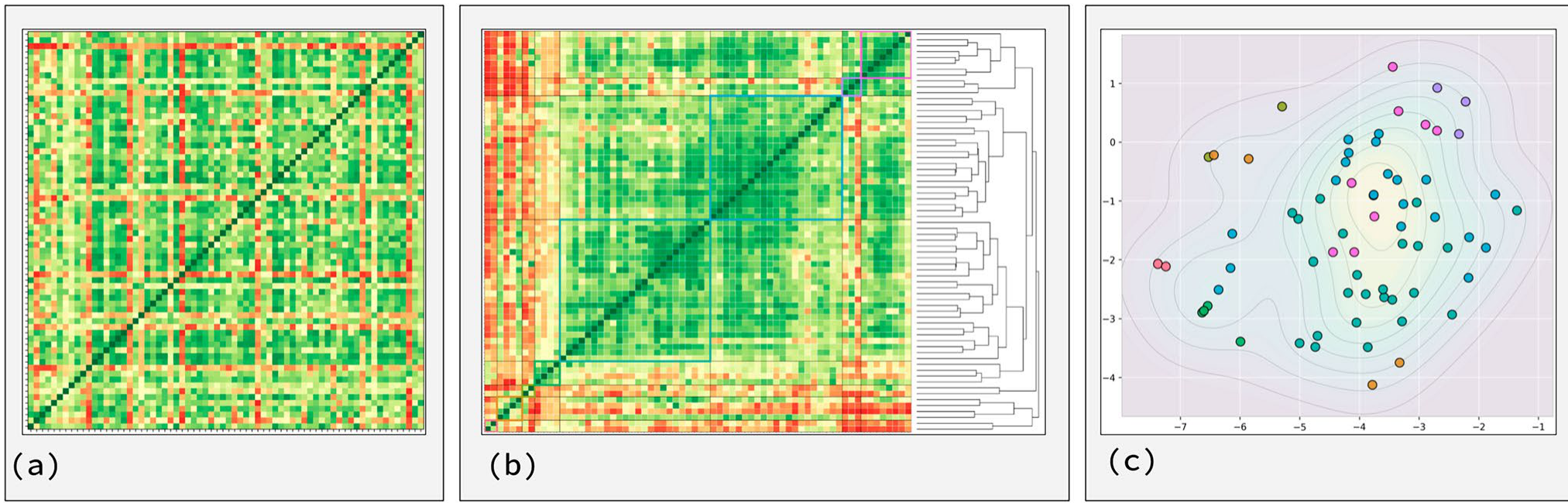
Figure 1 shows the key computational steps taken to go from the raw pairwise correlation matrix to a sorted and clustered matrix to ultimately a 2-D t-SNE projection of the definitional space.
To validate the robustness of our semantic analysis and mitigate potential model-specific biases, we independently replicated all analytical processes across three state-of-the-art LLMs: Claude 3.7 Sonnet, GPT-4o, and Llama-3.3 70B Instruct. These three matrices were then averaged together to produce the final correlation matrix, accounting for cross-model biases and integrating the nuanced perspective of each model in the final feature set. This methodology was implemented using Python, with all code available as an open-source GitHub repository in the Supplemental Code.
Collection of Expert Definitions and Manual Classification
Here, we were specifically focused on modern researchers’ definitions of life (not classic historical figures’ definitions). Individuals were selected based on their peer-reviewed papers in the literature that impacted (or required an opinion on) the question of life.
Sixty-eight total definitions were included in the final analysis. Fourteen distinct countries were represented by the current affiliations of respondents, with the United States (41) and the United Kingdom (9) being the most prevalent.
The method for expert selection was non-random purposive expert sampling
Respondents spanned several disciplines, including biology, philosophy, computer science, physics, AI, and systems theory. There was a strong representation of scientists working in theoretical and interdisciplinary biology. The majority (around 50 of the 68) were primarily trained as academic researchers, around 14 hold hybrid roles (e.g., a blend of any of the following: academic researcher, clinician, philosopher, computer scientist, or organizational leader), and one respondent was primarily involved in science education and public scholarship. No respondents were recruited solely as clinicians, consultants/policy experts, legal scholars, ethicists, humanities-based researchers (philosophers, sociologists, musicians/fine arts, etc.), or industry representatives. In addition, we did not contact any researchers from the fields of death, dying, and grief. We recognize the lack of inclusion of experts from these disciplines as a limitation and an area for future work, because experts from these diverse fields would have shaped the analysis and contributed to the discussion of life in a relevant and useful way.
As the selection was guided by the PI’s professional network, we acknowledge that this may privilege certain perspectives and underrepresent others. Underrepresentation of voices and scholars from other communities, geographies, and schools of thought beyond our sample is acknowledged. A purposive sample may inevitably, though unintentionally, leave behind a vast number of voices whom we specifically invite in future work to enrich the discussion. We emphasize that the computational method we set out to present here can theoretically accommodate an indefinite number of definitions, and the open-source code appended is welcome to be applied to any alternate set of well-balanced, multidisciplinary definitions from experts besides the ones selected in our purposive sample here. More information on the limitations of expert selection as it pertained to the computational analysis can be found in the section below (section “Discussion—Methodological Innovations and Limitations”).
Following selection, the expert authors were contacted through the interview method of email-based correspondence to the interviewee’s institutional email, with balanced representation from the fields and disciplines, including branches of biology, computer science, physics, and engineering.
The respondents were not aware of each other’s responses or thought processes, were not given any specific guidance or criteria for inclusion/exclusion, and were independently responsible for submitting their own definition. Respondents did not have any set time limit to formulate and structure their responses and were permitted to consult external references, and no policy prohibiting contact with colleagues on the matter was set forth. Respondents were instructed to aim for no more than three sentences and told that they should think about life as broadly as they wished, not restricted, for example, to terrestrial life. They were not given any guidelines about word count, and they were made aware that their responses were going to be analyzed in a manuscript for publication.
Two of the provided definitions came from the authors of this analysis. Like all the other respondents, the two authors who provided definitions did not see any of the other life definitions submitted prior to formulating their own. No additional weight was given to these two responses in the downstream analysis.
For editorial purposes, a small proportion of responses were shortened without interfering with the key takeaways of the authors’ definitions. This was done to maintain standardized length for all definitions. Finally, experts were given a chance to proofread their definitions for correct attribution but were strongly discouraged from making any changes at this point, as they had already seen some of the other definitions.
Once all definitions had been received, a manual review and categorization were conducted to ground the results in human understanding before proceeding to the AI-driven analysis. It was possible for an author’s definition to be grouped into more than one category. The row “Other” was introduced when a definition did not neatly fit into one of the preexisting categories. The resulting categorical distinctions are presented in Table 1. All 68 provided definitions of life are presented in Supplemental Table 1.
The overlapping nature of these categories, with many definitions spanning multiple classes and requiring an “Other” category, demonstrates precisely why a continuous semantic space analysis is necessary. Rather than treating these overlaps as classification failures, we view them as evidence that expert thinking about life exists along multiple non-orthogonal dimensions that make discrete categorization challenging. This observation motivates our computational approach, which maps respondent relationships in high-dimensional space without forcing artificial boundaries.
Quantitative Pairwise Correlation Analysis
To quantify semantic relationships between definitions, we developed a pairwise correlation analysis framework using LLM-based inference. For each pair of definitions in our dataset, we computed a correlation score ranging from -1.0 (complete disagreement) to 1.0 (complete agreement) using the following prompt structure:
Analyze the following two definitions of life, where:
-1.0 = Fundamentally opposing or incompatible primary frameworks;
-0.5 to -0.9 = Significantly different emphasis with some contradiction;
0.0 = Independent or orthogonal frameworks;
0.1 to 0.4 = Slight overlap in secondary elements;
0.5 to 0.9 = Significant overlap with some differences;
1.0 = Aligned core frameworks and secondary elements.

Definition 1: {{definition_1}}
Definition 2: {{definition_2}}

What is the correlation metric between -1.0 and 1.0 for these two definitions?
Respond with ONLY a single number!
To enhance reliability and account for potential variability in LLM outputs, we performed multiple replicate inferences (
It is critical to note here that while we inferred correlation across respondents by generating similarity scores in a pairwise manner with redundancy across three unique LLMs, the resulting matrices do not represent correlation as is normally defined by robust statistical analyses such as Pearson or Spearman. Rather, we use the term correlation matrices to define the similarity as ranked by redundant inferred pairwise comparisons.
The pairwise correlation analysis generated two
Table 1 Categorizing definitions of life
| Criteria: Life is defined by specific: | Researchers whose definitions involve those criteria |
|---|---|
| Thermodynamics/energetics | Ball, Davies, Dussutour, Froese, Georgiev, Gilbert, Huang, Ingber, Lane, Mitchell, Newman, Picard, Solms, Soto, Szathmáry, Tuszynski, Vallverdú, Nunn |
| Information/pattern | Ackley, Adami, Bongard, Caves, Das, Dodig-Crnkovic, Georgiev, Ingber, Levin, Miller, Mitchell, Gentili, Nunn, Pavlic, Reber, Solé, Witkowski |
| Complexity | Georgiev, Jackson, Sloman, Nunn |
| Computation | Agüera y Arcas, Stepney, Ackley, Witkowski, Dodig-Crnkovic |
| Dynamics (including self-organization) | Agüera y Arcas, Bongard, Brash, Caves, Das, Dodig-Crnkovic, Dussutour, Friston, Froese, Georgiev, Gilbert, Heylighen, Huang, Kauffman, Mitchell, Pizzi, Rechavi, Solé, Szathmáry, Stepney, Witkowski |
| Autonomy/agency/goal-directedness | Ball, Dussutour, Ellis, Jablonka, Calvo, Heylighen, Krakauer, Lander, Lyon, Mitchell, Noble, Shapiro, Solms, Soto, Tuszynski, Vallverdú, Caves |
| Cognition/intelligence | Dussutour, Fontana, Gentili, Krakauer, Levin, Marshall, Miller, Nunn, Picard, Reber, Lyon, Dodig-Crnkovic |
| Structure/architecture | Baluška, Georgiev, Newman, Caves |
| Functionality/behavior | Albantakis, Ball, Caves, Dussutour, Das, Lyon, Sonnenschein, Sultan |
| Replication/reproduction/ evolution/heredity | Ackley, Adamatzky, Adami, Davies, Ingber, Jablonka, Jackson, Lander, Gentili, Nunn, Ratcliff, Shapiro, Sloman, Szathmáry |
| Material composition | Baluška, Das, Kauffman, Lane, Newman, Pizzi, Ratcliff, Sloman |
| Against strong definition | Albantakis, Ball, Frank, Gunawardena, McShea, Stanley, Wong, McShea |
| Other | Ciaunica, Fields, Hoffman, Marshall, Witkowski, Watson |
Both matrices were symmetrized by averaging with their transpose
This analysis was repeated with Claude 3.7 Sonnet, Llama 3.3 70B, and GPT-4o, with the final correlation matrix being derived from the average of each analysis’s result. Each provided similarity metric (henceforth referred to as correlation) is then the result of 18 averaged LLM-generated correlation metrics, six from each tested model.
This LLM-based correlation methodology raises questions about whether similarity scores reflect genuine conceptual alignment or surface linguistic features such as shared vocabulary, stylistic patterns, or common references from the models’ training data. Several factors suggest these scores capture deeper semantic structure:
- A high cross-model correlation (
r greater than zero point seven ) despite different training data and architectures indicates convergence on stable patterns beyond individual model biases. - Definitions with high correlation scores often employ dissimilar vocabulary while definitions with low correlation sometimes share terminology, suggesting the models detect conceptual frameworks rather than mere word overlap, which is a persistent challenge with traditional text-embedding methodologies.
- The interpretability of resulting clusters in terms of established philosophical frameworks provides external validation.
Nevertheless, we acknowledge that these scores inherently blend conceptual similarity with model-specific training effects, a methodological limitation that parallels how scientific communities construct shared meaning through both individual reasoning and collective zeitgeist.
Agglomerative Clustering of Correlation Matrix
To identify natural groupings within the definition space, we applied hierarchical agglomerative clustering to the symmetrized correlation matrix. This bottom-up clustering approach begins with each definition as its own cluster and iteratively merges the most similar clusters until all definitions belong to a single cluster, creating a hierarchical structure that reveals multi-scale relationships between definitions.
The correlation matrix was first transformed into a distance matrix using the relationship
We employed complete linkage (maximum distance between any two elements from different clusters, also known as farthest-neighbor linkage) as our agglomerative method. Complete linkage was selected for its ability to produce compact, clearly separated clusters that emphasize conceptual boundaries between semantic groupings, making it particularly suitable for analyzing definitional relationships where clear delineations are desirable.
The dendrogram construction process mimics how one might organize ideas into increasingly broad conceptual categories. At the beginning, each definition stands alone as a unique perspective; each leaf is embedded within a tree with one node. The algorithm then identifies the two most similar definitions and joins them at a height proportional to their similarity. Closely aligned definitions join near the bottom of the dendrogram, while more distant conceptual relatives join higher up. This process continues iteratively, with either individual definitions joining existing groups or groups merging with other groups, always connecting the most similar entities at each step. The resulting tree structure then captures which definitions belong together as related conceptual definitions, as well as the relative semantic distance between them.
To then perform unsupervised clustering on this dendrogram, we analyzed the pattern of merge distances to identify the inflection points where further cluster merges would suddenly bring together substantively different conceptual frameworks. This “elbow” in the derived linkage matrix reveals the natural number of clusters present in the data as the point where merging clusters would begin to obscure important conceptual distinctions. This clustering solution partitions definitions into groups that share fundamental conceptual frameworks while maintaining meaningful separation between distinct philosophical or scientific approaches to defining life. When superimposed on top of the sorted correlation matrix of respondent definitions, this multi-scale perspective allows us to examine both fine-grained distinctions within conceptual frameworks and broader patterns across the entire definitional space.
LLM Cluster Semantic Analysis
For each cluster identified through hierarchical agglomerative clustering, we employed LLMs to perform two
complementary analytical processes: (1) intra-cluster thematic analysis to characterize conceptual frameworks and (2) consensus definition generation to distill essential shared elements. Claude 3.7 Sonnet was used to generate the semantic analysis for the multi-model clustered correlation matrix.
The intra-cluster thematic analysis was conducted using a structured prompt designed to systematically extract patterns from definition clusters. This protocol instructed the LLM to analyze definitions through three progressive lenses:
1. WHAT Are The Core Ideas?
 - List every key concept mentioned
 - Count how often each appears
 - Group similar concepts together
 - Note which concepts appear most
 - Mark which are always present
2. HOW Do Ideas Connect?
 - Find concepts that link to others
 - Map which ideas depend on others
 - Note concept hierarchies
 - Identify central hub concepts
 - Track idea flow patterns
3. WHY This Structure?
 - Identify shared a priori frameworks
 - Find similar starting points
 - Track reasoning patterns
 - Mark scope boundaries
 - Note definitional strategies
All prompts are available in their complete form in the Supplemental Code. This thematic analysis was then used to inform our meta-review of various definitions for “what is life?” from a quantitative, statistically grounded, computational point of view. Complementing the thematic analysis, we further employed LLMs to synthesize a single representative definition for each cluster. This protocol explicitly constrained the LLM to adhere to the requirements defined in the following prompt structure:
You are tasked with synthesizing a consensus definition of life from a group of experts
who have similar perspectives. Below are their definitions:
{{definitions}}

In addition to these provided cluster definitions, you have also conducted a prior
thematic review which contains a meta-analysis of the key concepts being discussed
by this group of respondents:
{{cluster_analysis}}

- Start: "Life is..."
- Content: Only majority-shared concepts (>50% frequency)
- Language: Technical terms from source definitions
- Structure: Logical flow of connected concepts
- Style: Match source complexity and tone
- Length: Within ±20% of median definition length
- Exclude: Unique views, novel terms, explanations
This algorithmic approach to consensus formation ensured that the resulting definitions genuinely represented the central tendencies within each cluster rather than introducing new concepts or arbitrary interpretations. By limiting content to majority-shared concepts and using only terminology present in the source definitions, we maintained fidelity to the original expert perspectives while distilling their shared conceptual core.
The resulting thematic analyses and consensus definitions provide complementary perspectives on each cluster: the thematic analysis characterizes the conceptual landscape and intellectual approach shared by definitions within a cluster, while the consensus definition distills these shared elements into a single coherent statement that represents the cluster’s central perspective on what constitutes life. Together, these analyses reveal both the distinctive conceptual frameworks that characterize different approaches to defining life and the core elements that unify definitions within each framework.
Finally, a third inference call was executed to generate a title name for each cluster. Provided with the consensus definition and the thematic analysis in the prompt context, the LLM was asked to generate a brief cluster title according to the following prompt:
Based on the consensus definition and thematic analysis provided, generate a SINGLE
WORD
or VERY SHORT PHRASE (2-4 words maximum) that captures the DISTINCTIVE ESSENCE
of this specific cluster.

The title should be:
1. HIGHLY SPECIFIC to the philosophical, scientific, or conceptual framework unique to
this cluster
2. DISTINCTIVE enough that it wouldn't apply equally well to other clusters of life
definitions
3. TECHNICALLY PRECISE, using domain-specific terminology where appropriate
4. CONCEPTUALLY FOCUSED on the core unifying principle of these definitions

---
Provided below is the analysis of the given cluster:
{{cluster_analysis}}

Provided below is the derived consensus definition for the given cluster:
{{consensus_definition}}
These titles were then mapped to the cluster groups derived by agglomerative clustering and used to define the clusters subsequently plotted by the described 2-D projection methodology.
Two-Dimensional Projection of Definitional Landscape
To create an interpretable visualization of the definitional landscape, we applied t-SNE (t-distributed stochastic neighbor embedding) dimensionality reduction to project the high-dimensional correlation features into a 2-D representational space. Unlike principal component analysis (PCA), t-SNE specifically emphasizes the preservation of local neighborhood relationships, making it particularly suitable for visualizing clusters of semantically related definitions. Critically, t-SNE is a visualization tool that preserves local
neighborhood structure rather than a principled dimensional decomposition like PCA, and its global axis orientations are mathematically arbitrary. However, when interpretable gradients emerge consistently across multiple runs with different initializations and across different LLM analyses, the consistency suggests these dimensions capture genuine structure in expert discourse rather than computational artifacts. We interpret these emergent axes philosophically while acknowledging they are algorithmic constructs that reveal, rather than impose, conceptual organization. This was validated by testing against multidimensional scaling (MDS), principal component analysis (PCA), and uniform manifold approximation and projection (UMAP), with t-SNE consistently producing the best spatial projection of the underlying correlation embeddings.
The correlation matrix was first transformed into a distance matrix using the relationship
The final t-SNE projection visualizes the semantic landscape of life definitions, with each point representing an expert’s response colored according to its assigned cluster. Contour lines were added to highlight density variations within the definitional space, revealing regions of conceptual convergence and divergence. The final visualization incorporates cluster assignments derived from agglomerative hierarchical clustering, with each cluster labeled according to its LLM-derived title that characterizes the unifying conceptual framework of that group. This approach reveals the distinct conceptual territories in relation to the broader definitional landscape, providing a comprehensive spatial reflection of how experts conceptualize life across disciplinary boundaries.
Results
Expert Definitions
Supplemental Table 1 shows the definitions provided by the survey participants. Some focused on the impossibility (or futility) of a definition, while others attempted this task from varying conceptual alignments. The 68 definitions collected represent a broad spectrum of disciplinary perspectives, from traditional biological frameworks to computational approaches, from physics-inspired thermodynamic views to cognitive and philosophical stances. Despite the likely impossibility of defining truly orthogonal categories along which to categorize or classify these definitions, we attempted to do so manually (without AI-assistance) using the criteria in Table 1.
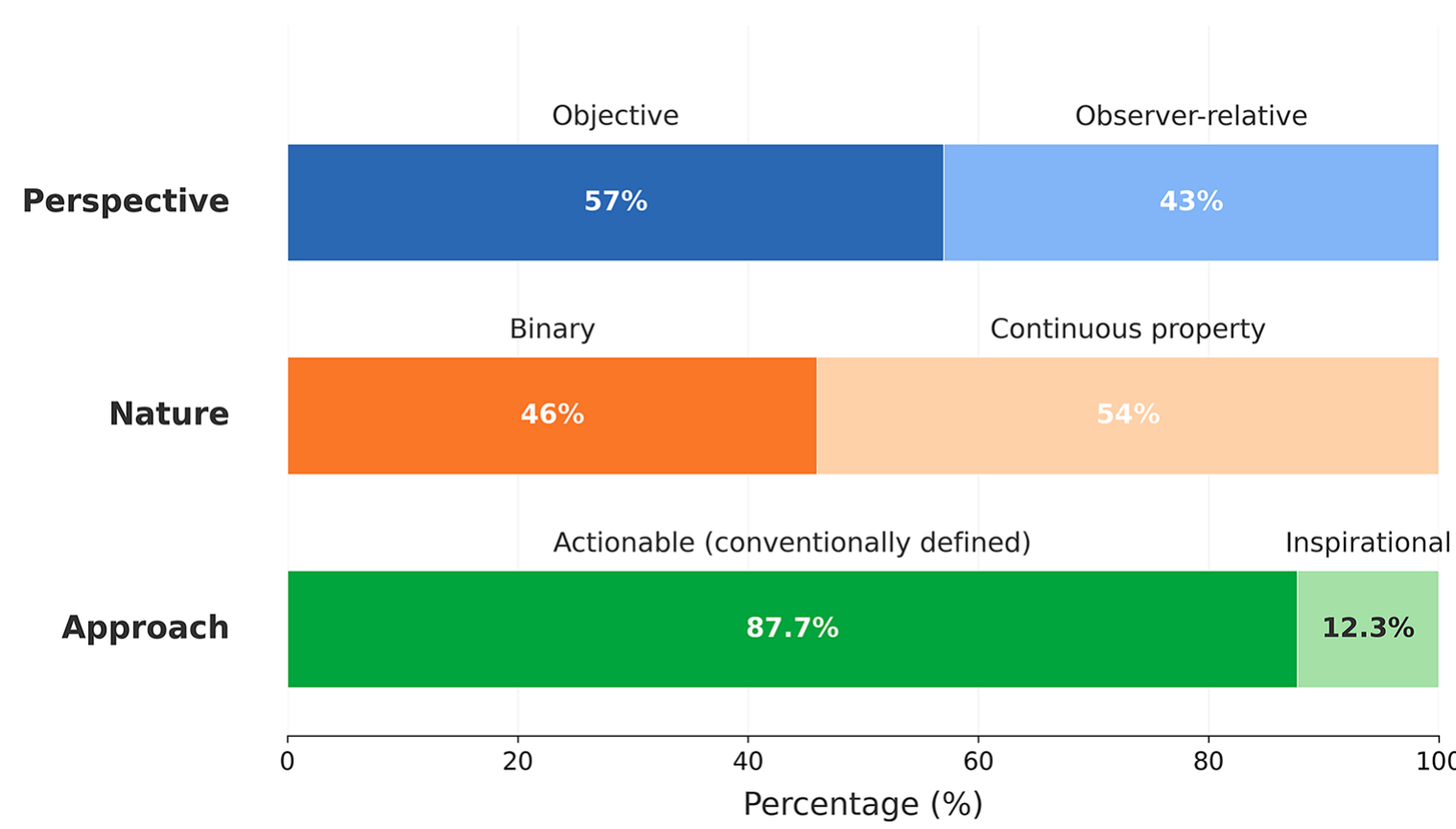
Manual categorization of these definitions revealed several predominant themes, with certain concepts appearing repeatedly across multiple definitional frameworks. Thermodynamics and energetics appeared in 18 out of 68 (26%) of all definitions, while information/pattern-based approaches were found in 25% of definitions. Dynamics (including self-organization) was the most prevalent theme, appearing in 29% of definitions.
We further characterized the most prominent divergent properties commonly discussed
Pairwise Correlation Analysis
To assess the semantic relationships between expert definitions of life, we analyzed how three state-of-the-art LLMs perceived conceptual overlap among the 68 definitions. Each model independently evaluated all possible definition pairs, producing a correlation matrix that quantifies similarity (-1.0 for complete opposition to 1.0 for perfect alignment) between each definition pair.
Claude 3.7 Sonnet, Llama 3.3 70B Instruct, and GPT-4o were independently used to generate three distinct correlation matrices. Claude 3.7 Sonnet demonstrated the most optimistic assessment with the highest average correlation, while Llama 3.3 70B Instruct produced more conservative estimates of correlation and showed greater standard deviation in its responses. Notably, all models displayed negative skewness (-0.76 to -0.97), indicating a systematic tendency to identify more areas of conceptual similarity than opposition. The general correlation matrix statistics for each model are presented in Supplemental Table 2.
Despite the models’ independent analyses, they showed remarkable consistency in their overall assessment of which definitions aligned conceptually and which diverged. The pairwise matrix-to-matrix correlations were notably high:
- Claude 3.7 Sonnet vs. Llama 3.3 70B Instruct:
r equals zero point seven two seven nine
- Claude 3.7 Sonnet vs. GPT-4o:
r equals zero point eight one zero three - Llama 3.3 70B Instruct vs. GPT-4o:
r equals zero point seven nine seven seven
These substantial correlations suggest that while each model brought a distinct analytical perspective to the definitional landscape, they independently converged on similar patterns of conceptual relationships.
These correlation matrices are shared in Supplemental Figs. 1, 2, and 3 for Claude, Llama, and GPT, respectively. The resulting unsorted multi-model averaged correlation matrix is presented as Supplemental Fig. 4. Additionally, the standard deviations (entropy matrix) for all aggregated instances of inference are available at Supplemental Figs. 5, 6, and 7 for Claude, Llama, and GPT, respectively, highlighting the consistency with which the LLMs scored correlation for each respondent across repeated instances of inference.
To mitigate potential biases from any single model and create a more robust assessment of semantic relationships, we computed an element-wise average across the three symmetrized correlation matrices. The multi-model integration succeeded in capturing the central tendencies of all three individual analyses, as evidenced by the high correlations between each model’s matrix and the averaged matrix:
- Claude 3.7 Sonnet vs. Multi-Model-Average:
r equals zero point nine zero one seven - Llama 3.3 70B Instruct vs. Multi-Model-Average:
r equals zero point nine two nine four - GPT-4o vs. Multi-Model-Average:
r equals zero point nine three five eight
The multi-model average matrix successfully captured the nuanced perspectives of each model, ultimately producing a rich encoding of pairwise correlation patterns amongst the provided definitions of life.
Agglomerative Clustering of Correlation Matrices
The three LLMs tested exhibited distinct clustering behaviors, identifying between seven and eleven natural clusters through elbow method analysis. Claude 3.7 Sonnet produced the most integrative solution with seven clusters and the lowest contrast metric (0.258), while Llama 3.3 70B Instruct demonstrated the most discriminative approach with eleven clusters and the highest contrast metric (0.563). The multi-model integration yielded eight clusters with a balanced contrast metric of 0.359, positioning it between the integrative and discriminative extremes. This integrated approach achieved robust intra-cluster correlation (
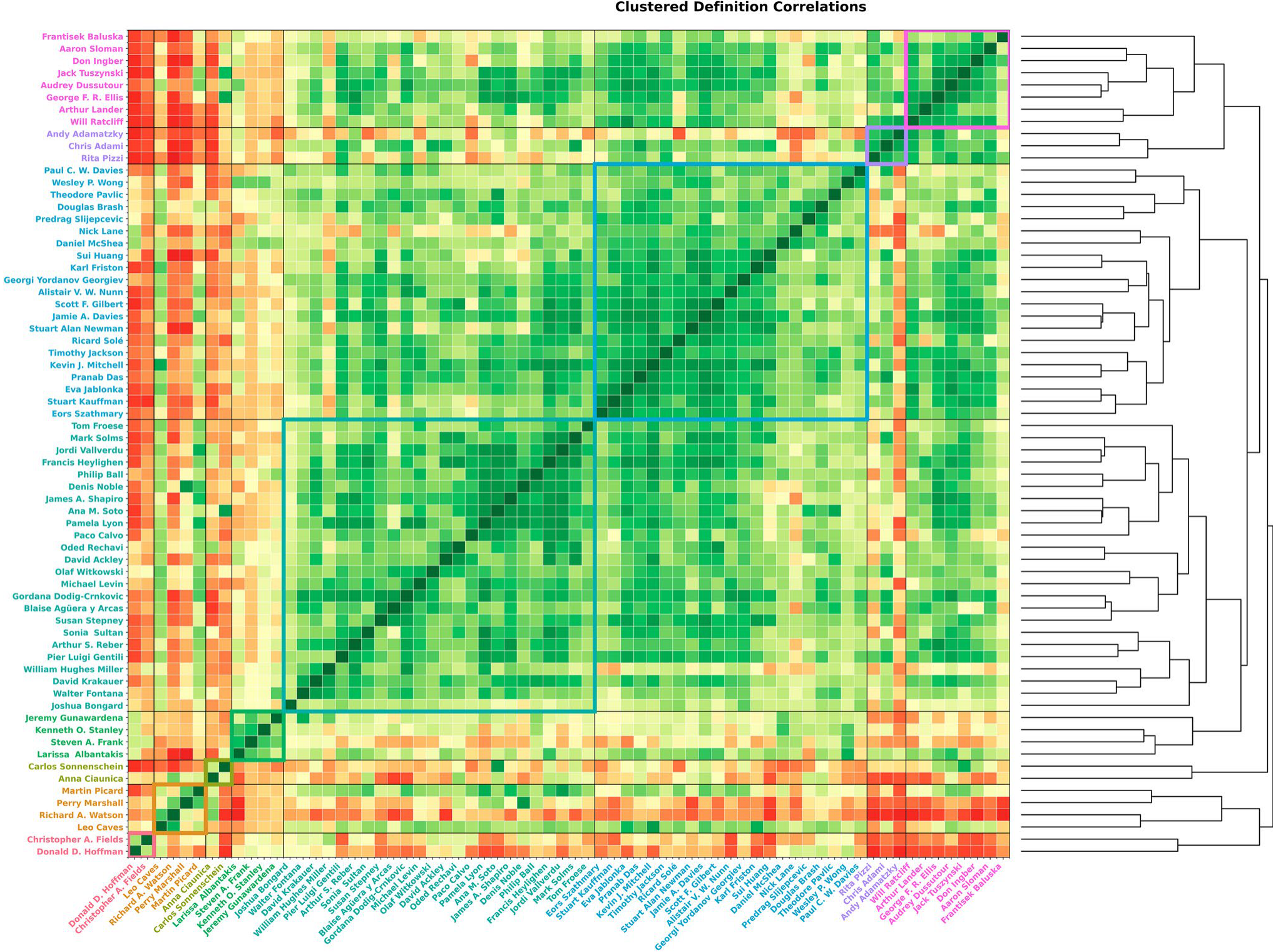
Figure 3 presents the visualization of the multi-model integrated analysis, showing both the clustered correlation matrix (with green indicating high correlation and red indicating negative correlation) and the corresponding dendrogram structure on the right. Additionally, the clustered correlation matrices for Claude, Llama, and GPT’s independent analyses are presented in Supplemental Figs. 8, 9, and 10, respectively, to show how each model uniquely organized the respondents in relation to each other.
This sorted correlation matrix reveals a distinct block-diagonal structure, indicating strong intra-cluster coherence, while also exhibiting meaningful cross-cluster correlations that suggest conceptual continuity across the definitional landscape. To investigate how consistently the various LLMs grouped the respondents into the same cluster relationships, we compared the clustering consistency from
each of the three models’ analyses, plus the multi-model integration.
- Claude 3.7 Sonnet and Llama 3.3 70B Instruct: 71.2% consistency
- Claude 3.7 Sonnet and GPT-4o: 74.8% consistency
- Claude 3.7 Sonnet and Multi-Model-Average: 74.1% consistency
- Llama 3.3 70B Instruct and GPT-4o: 75.7% consistency
- Llama 3.3 70B Instruct and Multi-Model-Average: 72.8% consistency
- GPT-4o and Multi-Model-Average: 79.1% consistency
These high cross-model consistencies (71.2% to 79.1%) indicate substantial agreement on which definitions should be grouped together, despite the different number of clusters identified by each model.
To further assess the robustness of our clustering, we examined how consistently individual definitions were grouped across the three models. The overall grouping stability was 53.7%, indicating that just over half of all definition pairs were consistently grouped together (or consistently separated) across all models. This moderate stability suggests that while the broad structure of the definitional landscape is robust, there remains genuine ambiguity in how some definitions should be categorized at the boundaries between clusters.
Some definitions showed remarkably high grouping consistency across models: those by Christopher Fields, Donald Hoffman (both 100% consistency), Andy Adamatzky, Leo Caves, and Richard Watson (all 95.5% consistency). These definitions appear to occupy clear, distinctive positions in the semantic landscape. In contrast, definitions by Mark Solms (28.4%), Aaron Sloman (26.9%), Paul Davies (23.9%), Tom Froese (23.9%), and Wesley Wong (22.4%) showed the lowest consistency, suggesting these definitions span multiple conceptual frameworks or occupy boundary positions between established clusters. Looking at Fig. 3, we can observe that stable definitions tend to appear within
the most distinctly colored blocks, while unstable ones often appear in transition zones between clusters.
Intra-Cluster Semantic Analysis
From the eight distinct clusters derived by agglomerative clustering of the averaged multi-model pairwise correlation matrix, the thematic content of each cluster was further explored. The consensus definitions in Table 2 represent distillations of the core concepts shared within each cluster, providing insight into how different perspectives approach the question of what constitutes life. These definitions were derived through LLM analysis of the definitions within each cluster, extracting the majority-shared concepts while maintaining the technical language and conceptual frameworks characteristic of each group.
The complete thematic analysis performed for Claude, Llama, GPT, and the resulting multi-model average are shared in Supplemental Files 1, 2, 3, and 4, respectively.
t-SNE Projection of Life’s Definitions
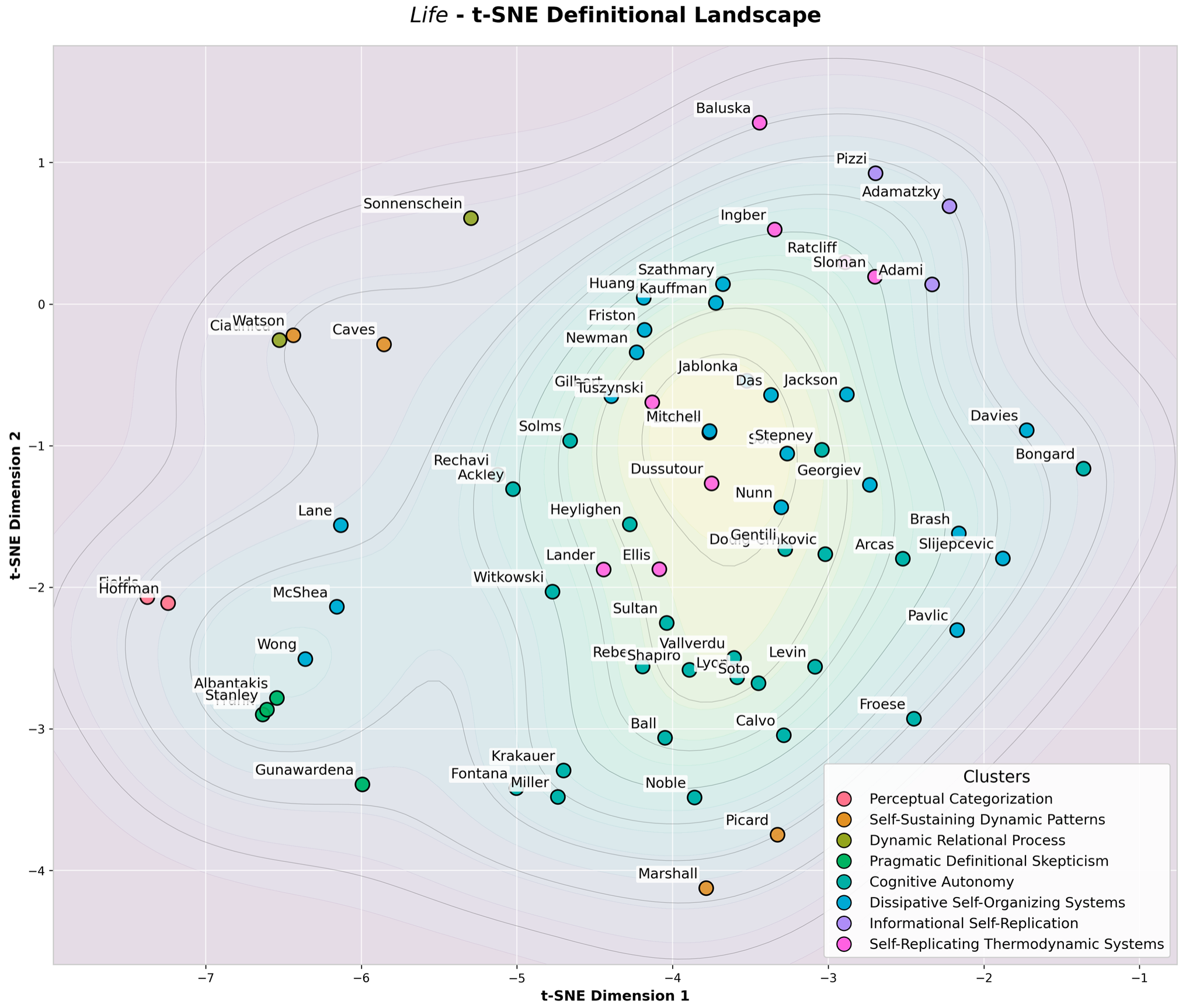
t-SNE dimensionality reduction transformed the high-dimensional correlation data into an interpretable 2-D visualization of the 68 expert definitions (Fig. 4). t-SNE was chosen for its ability to preserve local neighborhood structure while revealing global patterns in high-dimensional data, but the complete panel of clustering results from multidimensional scaling (MDS), uniform manifold approximation
Table 2 Cluster titles and consensus definitions
| Title | Consensus definition |
|---|---|
| Perceptual Categorization | Life is a perceptual category arising from how systems that consider themselves alive recognize and categorize others, rather than an objective distinction with intrinsic properties. The apparent boundary between living and nonliving exists primarily as an artifact of our sensory limitations that introduce artificial distinctions into what may be a more unified reality. |
| Self-Sustaining Dynamic Patterns | Life is a persistent dynamic pattern that sustains itself through recursive processes, creating and maintaining its own conditions for existence. It manifests as a self-aware system capable of transformation, emerging through the resonance and harmonic interaction of its components. This pattern exists in relationship with its environment, expressing consciousness while continuously recreating itself through mutually transformative connections. |
| Dynamic Relational Process | Life is a permanent movement characterized by dynamic exchange between internal and external environments, fundamentally requiring relationship with preexisting others. Life cannot exist in isolation or stasis, as its essential nature involves both movement and proliferation. Rather than being something humans can create, life is received and passed on, existing as an ongoing process of interconnection. |
| Pragmatic Definitional Skepticism | Life is a contextual construct better approached through functional utility than universal definition, where definitional efforts should serve specific research purposes rather than establish absolute boundaries. The concept exists at the intersection of scientific and philosophical domains, requiring recognition of disciplinary limitations and pragmatic focus on what advances understanding rather than what constitutes a “correct” characterization. |
| Cognitive Autonomy | Life is a self-maintaining, goal-directed system that processes information to adapt to environmental changes while preserving its organizational boundaries. It operates as an autonomous agent that actively opposes entropy through energy exchange, making purposeful decisions that ensure its continued existence. Life functions as a cognitive process that senses, interprets, and responds to its surroundings, modifying itself when necessary to maintain stability despite changing conditions. |
| Dissipative Self-Organizing Systems | Life is a dynamic, far-from-equilibrium process characterized by self-organization and self-maintenance through controlled energy dissipation. It maintains semi-permeable boundaries that separate the system from its environment while allowing selective exchange of matter and energy. Living systems process, store, and transmit information through feedback mechanisms that enable adaptation and evolution over time. |
| Informational Self-Replication | Life is a self-replicating system of information encoded in a physical substrate, capable of reproducing itself while maintaining order against natural decay. This information-based process enables the transmission of complex structural and functional data across generations, with the physical components serving primarily as carriers for this essential informational content. |
| Self-Replicating Thermodynamic Systems | Life is a self-sustaining physical and chemical system that reproduces itself while maintaining organization away from thermodynamic equilibrium. It interacts adaptively with its environment, absorbing and transforming resources to support its replication and growth. Living systems exhibit autonomy through self-regulation and response to stimuli, while their reproductive capabilities enable evolutionary processes. |
and projection
The resulting t-SNE projection of Fig. 4 reveals a continuous semantic landscape organized along two conceptually interpretable axes. These dimensional interpretations should be approached with nuance. While t-SNE’s global axis orientations are mathematically arbitrary, the consistency with which these particular philosophical gradients emerge
Dimension 1 (horizontal) maps the transition from observer-dependent, perceptual frameworks (left) to objective, material-structural definitions (right). The leftmost position is occupied by the isolated Perceptual Categorization cluster, exemplified by Fields’ recursive formulation: “to be alive is to be considered alive by systems that consider themselves alive”. This contrasts sharply with the right-side clusters that emphasize concrete mechanisms like replication and thermodynamic properties, captured by Adami’s conception of life as “information that can replicate itself”.
Dimension 2 (vertical) reveals a fundamental ontological tension between entity-based and process-based conceptualizations of life, recapitulating the historical dialectic from Cartesian mechanism to Aristotelian teleology. The topmost positions are occupied by definitions emphasizing material structures, component properties, and tangible mechanisms, such as Baluška’s “Living Cells and All Their Constructs”, Pizzi’s focus on “carbon-based elements with self-organizing and self-replicating properties”, and Sloman’s “components that are able to extend and replicate themselves”. The bottom region contains process-oriented, cognitive-phenomenological frameworks, represented by Marshall’s metaphorical “fire that lights itself”, Picard’s “self-sustaining system capable of healing that uses and organizes energy to achieve expression(s) of consciousness”, and Noble’s “self-creating agency”. This vertical gradient captures the perennial tension between substantialist perspectives that
view life as a collection of specified entities (echoing Cartesian and Hobbesian frameworks) and teleological views that conceptualize life as coherent patterns of organization, information flow, and emergent self-actualization.
The dominant central attractor comprises two partially overlapping clusters: Cognitive Autonomy (teal,
This concentration raises a critical interpretative question: does this central attractor represent genuine conceptual convergence toward an integrated understanding of life, or does it reflect how institutional science and shared disciplinary training constrain the space of professionally expressible positions? The high density may indicate either emerging consensus or the boundaries of what our surveyed respondents find conceptually acceptable, confounded by selection bias amongst the individuals asked to provide their definition. The peripheral clusters, though sparsely populated, may therefore represent not outliers but vanguard positions which challenge the implicit assumptions structuring the central region; these peripheral definitions reflect positions that question fundamental assumptions such as whether life requires objective material properties (Perceptual Categorization) or whether defining life serves scientific progress at all (Pragmatic Definitional Skepticism).
Contour patterns expose varying semantic densities across the landscape. The sparsest regions surround the isolated Perceptual Categorization cluster, while gradient transitions appear between process-oriented clusters (orange and yellow) and the central attractors. The right quadrant displays two distinct poles: Informational Self-Replication (purple,
The continuous nature of this semantic space is further illuminated through definitions that function as conceptual bridges between cluster territories. Watson’s characterization of life as “the pattern and process of love—a deeply vulnerable mutual dance” creates a semantic pathway between perceptual-relational and teleological frameworks. Similarly, Noble’s “Life is self-creating agency” occupies a transitional position between process-oriented approaches and cognitive frameworks, explicitly connecting Aristotelian self-actualization with modern agency-based perspectives. Levin’s “Living beings remember, and anticipate, coarse-graining experience into a continuous actionable dream” bridges cognitive and physical perspectives through concepts that unite information processing with thermodynamic constraints, demonstrating how contemporary definitions continue to negotiate the historical tension between mechanism and teleology.
The emergence of interpretable dimensions from computational semantic analysis validates this approach as a methodological bridge between reductionist and holistic perspectives on fundamental questions in science and philosophy. Rather than imposing preconceived categories, the methodology reveals latent structure within expert discourse, demonstrating how computational tools can expose patterns of conceptual coherence that might otherwise remain obscured by disciplinary fragmentation. The high convergence across different LLMs (correlation coefficients
Cluster Semantic Analysis
The eight conceptual clusters revealed through agglomerative clustering present distinct yet interconnected perspectives within the definitional landscape, each occupying a unique semantic position that illuminates fundamental tensions and convergences in contemporary understandings of life.
The Perceptual Categorization cluster (
Self-Sustaining Dynamic Patterns (
Dynamic Relational Process (
that “Without proliferation and movement, there is no life”, establishing clear boundary conditions. Similarly, Ciaunica’s insistence that life “cannot exist without an other, already being there, already alive” poses significant challenges to origin-of-life theories that assume primordial isolation. This minimal cluster creates bridges between abstract relationality and classical biological requirements, positioning itself as a phase-shift between philosophical and empirical approaches. Its adjacent positioning to Self-Sustaining Dynamic Patterns reflects deep conceptual affinity, while its moderate positive correlations with replication-focused clusters suggest this bridge function operates effectively across multiple scales.
Pragmatic Definitional Skepticism (
Cognitive Autonomy (
Dissipative Self-Organizing Systems (
Informational Self-Replication (
Self-Replicating Thermodynamic Systems (
The correlation patterns between these clusters reveal a semantic topology where conceptual proximity reflects underlying philosophical affinity. The mathematical structure of inter-cluster relationships exposes distinct patterns where central clusters (Cognitive Autonomy, Dissipative Self-Organizing Systems) exhibit broad positive correlations across the landscape, while peripheral clusters display selective affinity patterns that create conceptual archipelagos rather than isolated islands. This field-like structure, with multiple attractors exerting varying degrees of gravitational pull, challenges simple spectral models of definitional space.
Cluster boundaries function as transitional zones rather than hard demarcations, with definitions at peripheries often exhibiting properties of neighboring frameworks (e.g., Noble’s “self-creating agency” which clustered within the Cognitive Autonomy category while remaining in close proximity to the Self-Sustaining Dynamic Patterns cluster). These semantic gradients facilitate conceptual migration and explain why certain definitions show low grouping stability across LLM analyses: they occupy genuine boundary regions where multiple clustering solutions remain mathematically valid. The persistence of these archetypal themes across different LLM architectures (correlation coefficients
as robust features of expert discourse rather than imposed taxonomies.
However, the computational method cannot distinguish whether experts converge due to genuine conceptual agreement, shared disciplinary training, or common theoretical influences present in all models’ training data. This ambiguity is not merely a methodological limitation but a substantive finding about how scientific communities develop and maintain conceptual frameworks through mechanisms that blend individual reasoning with collective discourse in ways that resist clean separation. The moderate overall grouping stability (53.7%) across models, combined with high stability for specific definitions (100% for Fields and Hoffman) and low stability for others (22—28% for Solms, Sloman, Davies), reveals that some positions occupy unambiguous semantic locations while others genuinely span multiple conceptual frameworks.
Discussion
From Ancient Philosophy to Computational Topology
This computational analysis demonstrates that contemporary scientific definitions of life cluster around the same philosophical fault lines that structured ancient Greek thought and have continued to shape scientific discourse about life throughout the centuries. The emergence of two interpretable dimensions in the t-SNE projection, despite the mathematical arbitrariness of t-SNE axes, recapitulates tensions that have organized thinking about life for thousands of years.
Dimension 1 ()
Dimension 2 ()
The central attractor, where Cognitive Autonomy and Dissipative Self-Organizing Systems overlap to contain 66% of all definitions, represents contemporary science’s attempt to transcend these dualisms through integration. Definitions in this region acknowledge both physical constraints (thermodynamics, energy flow) and emergent properties (agency, cognition, autonomy), attempting to bridge the explanatory gap between mechanism and experience that has haunted philosophy since Descartes split mind from matter. Whether this concentration indicates genuine conceptual synthesis or merely reveals the boundaries of professionally acceptable discourse within institutional science remains an open question.
Critically, the computational methodology reveals what philosophical analysis alone could not quantify: these are not discrete positions but continuous gradients. The definitional landscape has no sharp boundaries, only regions of higher and lower density. Definitions occupy positions, but those positions exist within a field structured by historical tensions. Watson’s characterization of life as “the pattern and process of love” functions as a conceptual bridge precisely because it traverses multiple dimensions simultaneously, linking perceptual-relational frameworks with process ontologies while maintaining elements of thermodynamic necessity. Such bridging definitions expose the inadequacy of treating definitional approaches as mutually exclusive categories.
The peripheral clusters deserve particular attention not as marginal positions but as potential conceptual vanguards. The Pragmatic Definitional Skepticism cluster does not merely reject the quest for a universal definition but rather challenges the epistemological assumptions underlying the entire enterprise. This reflexive position, skeptical of definitionalism itself, emerges from contemporary philosophy of science’s recognition that definitions are tools shaped by pragmatic contexts rather than discoveries of natural kinds. Meanwhile, the Perceptual Categorization cluster represents a genuinely radical departure: by positioning life as a
perceptual construct rather than an objective property,
The computational approach also reveals its own limitations in ways that are methodologically instructive. The impossibility of manually assigning definitions to truly orthogonal categories, combined with the algorithmic clustering’s ability to produce interpretable structure, suggests that expert thinking operates in a high-dimensional semantic space that resists projection onto discrete categories but permits mapping as a continuous topology. The t-SNE visualization necessarily reduces this complexity, potentially obscuring nuances that exist in the full 68-dimensional correlation space, yet the consistency with which interpretable gradients emerge across different dimensionality reduction algorithms
What the analysis reveals most clearly is that apparent disagreements about how to define life represent not conceptual incoherence but differentiated perspectives within a unified semantic landscape. The historical progression from Greek teleology through Enlightenment mechanism to contemporary integration has not resolved but rather elaborated the conceptual space. Each new scientific framework, be it thermodynamics, information theory, complexity science, artificial intelligence, or cognitive science, adds dimensions to this space rather than collapsing it toward consensus. The question “what is life?” persists not because science has failed to answer it but because the question itself maps a multidimensional conceptual territory that resists reduction to a single definition. Our computational methodology makes this territory navigable, revealing structure where previous approaches saw only disagreement.
Patterns of Convergence and Divergence
Our computational analysis of 68 expert definitions reveals life as a continuous semantic landscape rather than discrete categorical states. The t-SNE projection (Figure 4) demonstrates this continuity through two interpretable dimensions: Dimension 1
The ancient vitalist-mechanist dichotomy reemerges along Dimension 1, with vitalist-adjacent perspectives clustering toward the perceptual-relational pole on the left and mechanistic frameworks toward the material-structural pole on the right. Similarly, the historical tension between substance-based and process-based ontologies maps directly onto Dimension 2, revealing that these philosophical divides persist in contemporary scientific discourse.
The t-SNE visualization further reveals patterns in how expert perspectives distribute across this conceptual terrain. The highest density region centers on the overlap between Cognitive Autonomy
- Physical principles (far-from-equilibrium thermodynamics, energy dissipation)
- Informational processes (boundary maintenance, information storage, and transmission)
- Functional capacities (self-organization, environmental interaction)
- Agential properties (goal-directedness, adaptive behavior)
This convergence zone bridges traditionally separate disciplinary approaches, from physics and biology to cognitive science and information theory. The integrative nature of high-density definitions, exemplified by
Peripheral regions of the semantic landscape, while less densely populated, may indicate emerging paradigm shifts. These vanguard positions may gain relevance as scientific advancement increasingly encounters borderline cases between living and nonliving systems.
The semantic landscape provides a novel framework for positioning such ambiguous entities. Viruses occupy transitional zones between Informational Self-Replication and Self-Replicating Thermodynamic Systems clusters, while artificial intelligence systems might trace distinctive trajectories through this space as they develop increasingly sophisticated capabilities. Current LLMs might occupy positions between Cognitive Autonomy and Informational Self-Replication clusters, exhibiting information processing and goal-directed behavior while lacking material autonomy and self-maintenance. This positioning reveals how the semantic landscape can accommodate novel entities that challenge traditional categorical boundaries. Future systems incorporating embodied robotics might migrate
toward the Dissipative Self-Organizing Systems region as they develop capacities for environmental interaction and physical self-maintenance.
Methodological Innovations and Limitations
It should be noted that we make no claim about these definitions being a statistically representative survey of any specific field. Instead, we collected the opinions of a hand-picked group of scholars to develop methods for analysis of current thought on this topic and similarly difficult areas. We apologize in advance to any collaborators or external experts who were not asked to share their definition of life for this analysis, but our code and workflow make it possible for future surveys to achieve much greater statistical power to more comprehensively study the thoughts of specific communities. Thus, we call for expanding the discourse to include scholars from diverse backgrounds and communities, including different cultures, ages, and epistemic traditions.
Our application of LLM-driven semantic analysis to the definitional landscape demonstrates a novel approach to consensus formation across disciplinary boundaries. Rather than seeking to identify a single “correct” definition, this approach maps the conceptual territory within which various definitions operate, revealing both their relationships and distinctive contributions. This method offers a model for addressing other contested definitional territories across the sciences.
This approach differs from traditional aggregation methods by preserving the distinctiveness of competing frameworks while revealing their underlying relationships. The methodology’s unique contribution lies in its ability to map conceptual relationships without presupposing which relationships matter. Unlike traditional philosophical analysis that begins with theoretical commitments about relevant dimensions (e.g., mechanism versus vitalism, reductionism versus holism), this LLM-driven pairwise analysis allows structure to emerge from the collective pattern of expert thinking itself. This data-driven approach complements rather than replaces traditional philosophical analysis, offering quantitative scaffolding upon which interpretive work can build.
Furthermore, unlike Delphi methods that drive toward consensus through iterative refinement, the presented computational meta-analysis maintains the integrity of diverse perspectives while providing a quantitative map of their interrelationships. This methodology bridges reductionist approaches that seek necessary and sufficient conditions with pluralist approaches that embrace multiple definitions, thus revealing a unified semantic landscape in place of fragmented definitional domains.
The LLM-based similarity scores warrant particular methodological scrutiny. Do these scores reflect genuine conceptual alignment or surface linguistic features? The philosophical response is that these distinctions may be less separable than they initially appear: if experts consistently use similar conceptual frameworks, overlapping terminologies, and parallel argumentative structures, at what point does “surface linguistic similarity” become “deep conceptual agreement”? Following
Several limitations should be acknowledged. First, the expert definitions analyzed, while diverse, cannot claim to represent all possible perspectives on life. The 68 respondents who were asked to provide definitions were hand-curated by the authors and are intended not to serve as a representative sample of the scientific consensus but rather as a selected set of cross-disciplinary experts. Second, the pairwise correlation methodology, while rigorous, necessarily relies on the semantic capabilities of the LLMs employed, which may introduce subtle biases in how conceptual relationships are evaluated. In addition to the limitations presented by the LLM’s competency, the computational time and cost of generating pairwise correlation matrices scale as the square of the number of samples, making large cohort analyses prohibitively expensive without highly permissive rate limits or self-hosted LLMs. Third, the dimensional reduction required for visualization inevitably sacrifices some nuance in the relationships between definitions.
Despite these limitations, the methodology demonstrates the potential for computational semantic analysis to reveal patterns of conceptual coherence that might otherwise remain obscured by disciplinary fragmentation. This approach suggests that apparent definitional disagreements may, in some cases, reveal deeper patterns of coherence when viewed as gradients in semantic space.
Conclusion
Our computational analysis of 68 expert definitions presents life as a continuous semantic landscape rather than discrete categorical states. LLM-driven semantic analysis identified two emergent dimensions—observer-dependent versus objective frameworks, and process-based versus entity-based ontologies—that recapitulate ancient philosophical tensions while providing quantitative tools for mapping contemporary expert perspectives. This approach transforms apparent conceptual disagreements into complementary positions within a unified definitional space.
The methodology preserves competing perspectives while revealing quantitative relationships between them, bridging reductionist and pluralist paradigms. A concentration of 66% of definitions within overlapping Cognitive Autonomy and Dissipative Self-Organizing Systems clusters indicates emerging consensus on frameworks integrating physical principles, informational processes, and agential properties. This convergence suggests the field is moving beyond historical dichotomies toward hybrid approaches that transcend disciplinary boundaries.
The diversity of life’s definitions reveals not conceptual dissonance but a structured semantic topology with predictable patterns of convergence and divergence. The eight archetypal clusters identified here represent stable conceptual attractors that persist across different computational analyses, suggesting these are robust features of expert thinking rather than analytical artifacts. Critically, the emergence of interpretable dimensions without explicit encoding demonstrates that fundamental philosophical tensions—observer-dependence versus objectivity, process versus substance—continue to structure contemporary scientific discourse in systematic ways.
This methodology scales naturally to larger populations across adjacent fields. While our analysis focused on a curated set of experts, the computational framework enables systematic analysis of thousands of responses across diverse disciplines. Such expansive polling could reveal discipline-specific patterns within the broader semantic landscape, tracking how field-specific vocabularies and methodological commitments shape definitional approaches. This larger-scale mapping might expose previously unrecognized connections between fields or identify emerging conceptual territories at disciplinary boundaries.
Beyond life itself, cognitive processes present the next frontier for this analytical approach. Cognition, like life, resists simple definition and spans multiple levels of analysis from neural mechanisms to subjective experience. Memory, with its complex interplay of molecular, cellular, and systemic processes, exemplifies how fundamental concepts in biology traverse similar definitional challenges. Applying our computational semantic framework to these contested territories could reveal whether certain definitional patterns represent general features of complex biological phenomena or unique characteristics of life’s conceptualization.
The question “what is life?” persists because it maps a multidimensional conceptual space rather than awaiting a singular answer. Our methodology offers immediate applications to other contested definitions across sciences, particularly as synthetic biology and artificial intelligence challenge traditional boundaries. Future progress on fundamental questions may arise not from establishing rigid demarcations but from understanding how perspectives naturally converge and diverge within definitional spaces.
Acknowledgments Chris Fields would like to acknowledge Eric Dietrich as the inspiration for his definition. We thank all of the contributors for their thoughtful definitions and thank all of the scientists who contributed definitions to our survey. We also thank Julia Poirier for assistance with the manuscript.
Author’s Contributions ML—conceptualization, data gathering, and interpretation. RB—computational data analysis, historical background, and making figures. KK—data curation and making figures. BA-A—computational data analysis. All authors contributed to writing and revising the paper.
Funding Michael Levin gratefully acknowledges support from the Elisabeth Giauque Trust, London, and Grant 62212 from the John Templeton Foundation.
Data Availability Code is available as an open-source Github repository at GitHub.
Declarations
Competing Interests None.
References
Aristotle (1931) De Anima, Book II. Smith JA) Clarendon, Oxford
Banerjee S (2021) Emergent rules of computation in the universe lead to life and consciousness: a computational framework for consciousness. Interdiscip Descr Complex Syst 19:31–41
Benner SA (2010) Defining life. Astrobiol 10:1021–1030
Blackiston D, Lederer E, Kriegman S, Garnier S, Bongard J, Levin M (2021) A cellular platform for the development of synthetic living machines. Sci Robot 6. PubMed
Boden MA (2003) Alien life: how would we know? Int J Astrobiol 2:121–129
Boltzmann L (1886) The second law of thermodynamics. Theoretical physics and philosophical problems. In: McGuinness B (ed) Theoretical physics and philosophical problems Vienna Circle Collection. Springer, Dordrecht. DOI
Campbell DR (2021) Self-motion and cognition: Plato’s theory of the soul. South J Philos 59:523–544
Chang KM (2011) Alchemy as studies of life and matter: reconsidering the place of vitalism in early modern chemistry. Isis 102:322–329
Cleland C, Chyba C (2010) Does ‘life’ have a definition? In: Bedau MA, Cleland CE (eds) The nature of life: classical and contemporary perspectives from philosophy and science. Cambridge University Press, Cambridge, pp 326–339
Crick FH (1958) On protein synthesis. Symp Soc Exp Biol 12:138–163
Darwin C (1859) On the origin of species by means of natural selection. John Murray, London
Descartes R, ([1664] (1909) Oeuvres de Descartes: Tome XI Le monde, Description du corps humain, Passions de l’âme. Anatomica, Varia. L. Cerf, Paris
Diaz-Rodriguez J (2025) K-LLMmeans: summaries as centroids for interpretable and scalable LLM-based text clustering, arXiv
England J (2020) Every life is on fire: how thermodynamics explains the origins of living things. Basic Books, New York City
Faggin F (2024) Irreducible: consciousness, life, computers, and human nature. Essentia Books
Galen (1968) On the usefulness of parts of the body. (trans: May MT) Cornell University Press, Ithaca, New York
Gánti T (2003a) Chemoton theory: theory of living systems. Springer, Dordrecht
Gánti T (2003b) The principles of life. Oxford University Press, Oxford
Gayon J, Malaterre C, Morange M, Raulin-Cerceau F, Tirard S (2010) Defining life: conference proceedings. Orig Life Evol Biosph 40:119–120
Gilbert SF (1982) Intellectual traditions in the life sciences: molecular biology and biochemistry. Perspect Biol Med 26:151–162
Gumuskaya G, Srivastava P, Cooper BG, Lesser H, Semegran B, Garnier S, Levin M (2023) Motile living biobots self-construct from adult human somatic progenitor seed cells. Adv Sci (Weinh), p e2303575. PubMed
Gumuskaya G, Davey N, Srivastava P, Bender A, Pio-Lopez L, Hazel D, Levin M (2025) The morphological, behavioral, and transcriptomic life cycle of anthrobots. Adv Sci (Weinh), p e2409330. PubMed
Hobbes T (1909) Hobbes’s Leviathan: reprinted from the edition of 1651. Clarendon Press, Oxford
Holland JH (1975) Adaptation in natural and artificial systems: an introductory analysis with applications to biology, control, and artificial intelligence. University of Michigan Press, Ann Arbor, MI
Huang C, He G (2024) Text clustering as classification with LLMs, arXiv
Hutchison CA 3rd, Chuang RY, Noskov VN, Assad-Garcia N, Deerinck TJ, Ellisman MH, Gill J, Kannan K, Karas BJ, Ma L, Pelletier JF, Qi ZQ, Richter RA, Strychalski EA, Sun L, Suzuki Y, Tsvetanova B, Wise KS, Smith HO, Glass JI, Merryman C, Gibson DG, Venter JC (2016) Design and synthesis of a minimal bacterial genome. Sci 351:aad6253
Idrees S, Manookin MB, Rieke F, Field GD, Zylberberg J (2024) Biophysical neural adaptation mechanisms enable artificial neural networks to capture dynamic retinal computation. Nat Commun 15:5957
Johnson MR (2005) Aristotle on teleology. Oxford University Press, Oxford
Keraghel I, Morbieu S, Nadif M (2024) Beyond words: a comparative analysis of LLM embeddings for effective clustering. In: Miliou I, Piatkowski N, Papapetrou P (eds) Advances in intelligent data analysis XXII. Springer, Cham, pp 205–216
Kobak D, Berens P (2019) The art of using t-SNE for single-cell transcriptomics. Nat Commun 10:5416
La Mettrie JO (1865) L’homme machine. J. Assézat, Paris
Langton CG (1997) Artificial life: an overview. MIT Press, Cambridge
Levin M (2022) Technological approach to mind everywhere: an experimentally-grounded framework for understanding diverse bodies and minds. Front Syst Neurosci 16:768201
Liusie A, Manakul P, Gales MJF (2023) LLM comparative assessment: zero-shot NLG evaluation through pairwise comparisons using large language models. Conference of the European Chapter of the Association for Computational Linguistics
Machery E (2012) Why I stopped worrying about the definition of life… and why you should as well. Synthese 185:145–164
Macklem PT, Seely A (2010) Towards a definition of life. Perspect Biol Med 53:330–340
Malaterre C, Chartier J-F (2021) Beyond categorical definitions of life: a data-driven approach to assessing lifeness. Synthese 198:4543–4572
Margulis L, Sagan D (2000) What is life? University of California Press, Berkeley
Mariscal C, Doolittle WF (2020) Life and life only: a radical alternative to life definitionism. Synthese 197:2975–2989
Mariscal C (2023) Life. In: Zalta, E.N. (ed), The Stanford encyclopedia of philosophy. Metaphysics Research Lab, Stanford University. (Accessed 15 December 2025)
Matthias J (1838) Beiträge zur Phytogenesis. Archiv für Anatomie, Physiologie und wissenschaftliche Medicin. Veit, Berlin
Maturana H, Varela F (1980) Autopoiesis and cognition: the realization of the living. D. Reidel Publishing Company, Dordrecht, Boston, London
Moreno A, Mossio M (2015) Biological autonomy: a philosophical and theoretical enquiry. Springer, Dordrecht
Moreno A, Peretó J (2026) An evolutionary story of agency: how life evolved to act on its own. Springer, Cham
Nicholson DJ (2025) What is life? Cambridge University Press, Cambridge, Revisited
Noble R, Tasaki K, Noble PJ, Noble D (2019) Biological relativity requires circular causality but not symmetry of causation: so, where, what and when are the boundaries? Front Physiol 10:827
Pai V, Pio-Lopez L, Sperry M, Erickson P, Tayyebi P, Levin M (2025) Basal xenobot transcriptomics: analysis of gene expression changes in wild-type cells freed from the influence of the rest of the organism reveals novel control modality. Commun Biol 8:646
Parke E (2021) Characterizing life: four dimensions and their relevance to origin of life research. Preprint. PhilSci-Archive
Parshall KH, Walton MT, Moran BT (2015) Bridging traditions. Penn State University Press, University Park, PA
Popa R (2004) Between necessity and probability: searching for the definition and origin of life. Springer, Berlin Heidelberg
Prigogine I (1980) From being to becoming: time and complexity in the physical sciences. W. H. Freeman, San Francisco
Schrödinger E (1944) What is life? The physical aspect of the living cell. Cambridge University Press, Cambridge
Seoane LF, Sole RV (2018) Information theory, predictability and the emergence of complex life. R Soc Open Sci 5: 172221. PubMed
Sousa T, Domingos T, Kooijman SA (2008) From empirical patterns to theory: a formal metabolic theory of life. Philos Trans R Soc Lond B Biol Sci 363:2453–2464
Spinoza B (2020) Spinoza’s ethics. (trans: Eliot G). In: George Eliot Archiv, edited by Beverley Park Rilett, George Eliot Archive (Accessed 15 December 2025)
Stones GB (1928) The atomic view of matter in the XVth, XVIth, and XVIIth centuries. The University of Chicago Press
Stratton SJ (2024) Purposeful sampling: advantages and pitfalls. Prehosp Disaster Med 39:121–122
Von Neumann J (1966) Theory of self-reproducing automata. University of Illinois Press, Champaign
Wang X, Zhao W, Tang JN, Dai ZB, Feng YN (2025) Evolution algorithm with adaptive genetic operator and dynamic scoring mechanism for large-scale sparse many-objective optimization. Sci Rep 15:9267
Watson JD, Crick FH (1953) Molecular structure of nucleic acids; a structure for deoxyribose nucleic acid. Nat 171:737–738
Whitaker RH (1941) The interpretation of Plato’s Timaeus by a. E. Taylor and f. M. Cornford, Philosophy. Boston University, Boston
Wittgenstein L (1958) Philosophical investigations. (trans: Anscombe G) Macmillan Publishing Co, New York. Internet Archive (Accessed 15 December 2025)
Wolfram S (2002) A new kind of science. Wolfram Data Repository. https://doi.org/10.24097/wolfram.15062.data
Zhang Y, Wang Z, Shang J (2023) ClusterLLM: large language models as a guide for text clustering, p arXiv
Gilbert SF (ed) (1991) A conceptual history of modernembryology. Plenum, New York
Publisher’s Note
Footnotes
-
Greek Tou Pantos, “of the all” or “of the universe/cosmos”, the gestalt of all creation. ↩