P1
P2
michael levin, Nic Rouleau
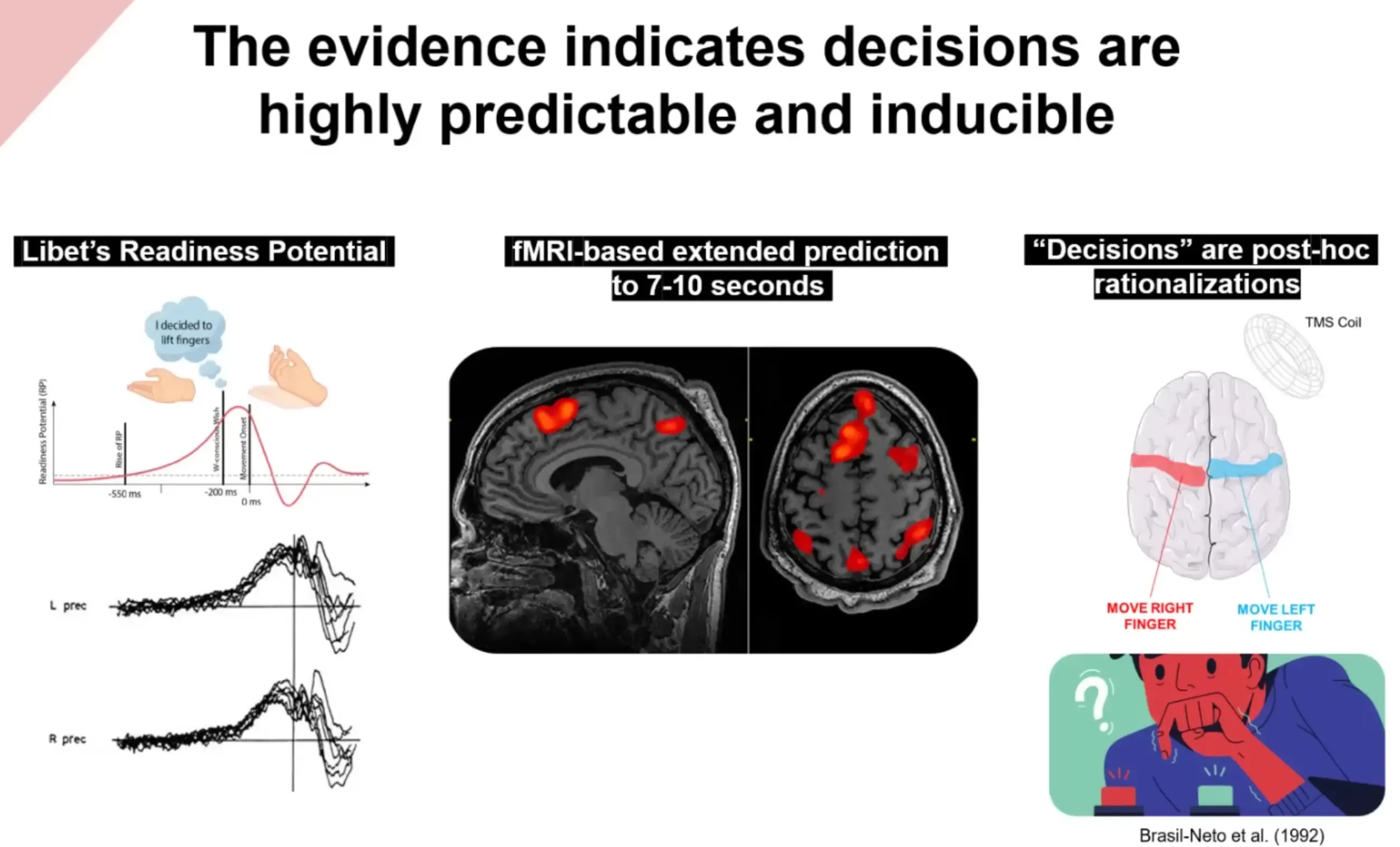
Decisions seem to be made subconsciously, highly predictable and inducible. What we experience as decisions are post-hoc rationalizations.
My take: free will might not exist on the level of which actions you take in the moment, but on the meta level: how you adapt/steer your behavior/subsystems. (more below)
Nic says:Free will is a subjective experience of control
A misattribution of causality — you don’t have control, you’re witnessing your predictions realized. 1
What most people mean by “free will” is the ability to author their own actions, and i don’t think that’s a thing that really exists.
Blame seems to be a vestige of something not true (view’s other people’s actions in the context of their preconditions and histories, more like the weather → easier to forgive people). 2Levin:
Can’t be a laplacian demon, forced to coarse grain. Modelling agents doing things is a powerful way to do that, which you eventually also turn onto yourself.3
Theorem: Any being that arises under resource constraints is going to believe in free will.
Through persistent effort, you’re biasing your likely future behavior.
The first act of free will is embryogenesis. When the collective of cells acquires goals in a large scale morphospace that the individual cells didn’t have → Causality at a differnt level that works downwards to bend the option space for the cells.
Footnotes
-
You have access to your predictions / what’s happening next, and when your predictions are realized, you reinforces what you were predicting → subjective feeling of control / self-attribution of causality. Premotor activity (prediction) always precedes motor activity (realization). learned helplessness is the opposite of this: none of your predictions are realized (punishment no matter what the dog does → dog will eventually stop avoiding the punishment and sit still). constant negative reinforcement → complete lack of experience of free will / don’t think ure the author of your actions anymore ↩
-
Yh it’s useful to view people’s action in the context of their history and society and not be like “X is only Ys fault” (and generally be more forigiving, and if someone does something good to DO attribute it to their free will and actions, as a healthy / practical mindset). ↩
-
Why eventually? Shouldnt it be the first / one of the first things? ↩