Norm
Given a vector space over a subfield of the complex numbers, a norm is a function with the following properties:
norm:
We take the absolute value of because uneven could yield negative values.
The norm tells us the size of a mathematical object in a certain space.
Length usually refers to the 2-norm, but there are other norms as well.
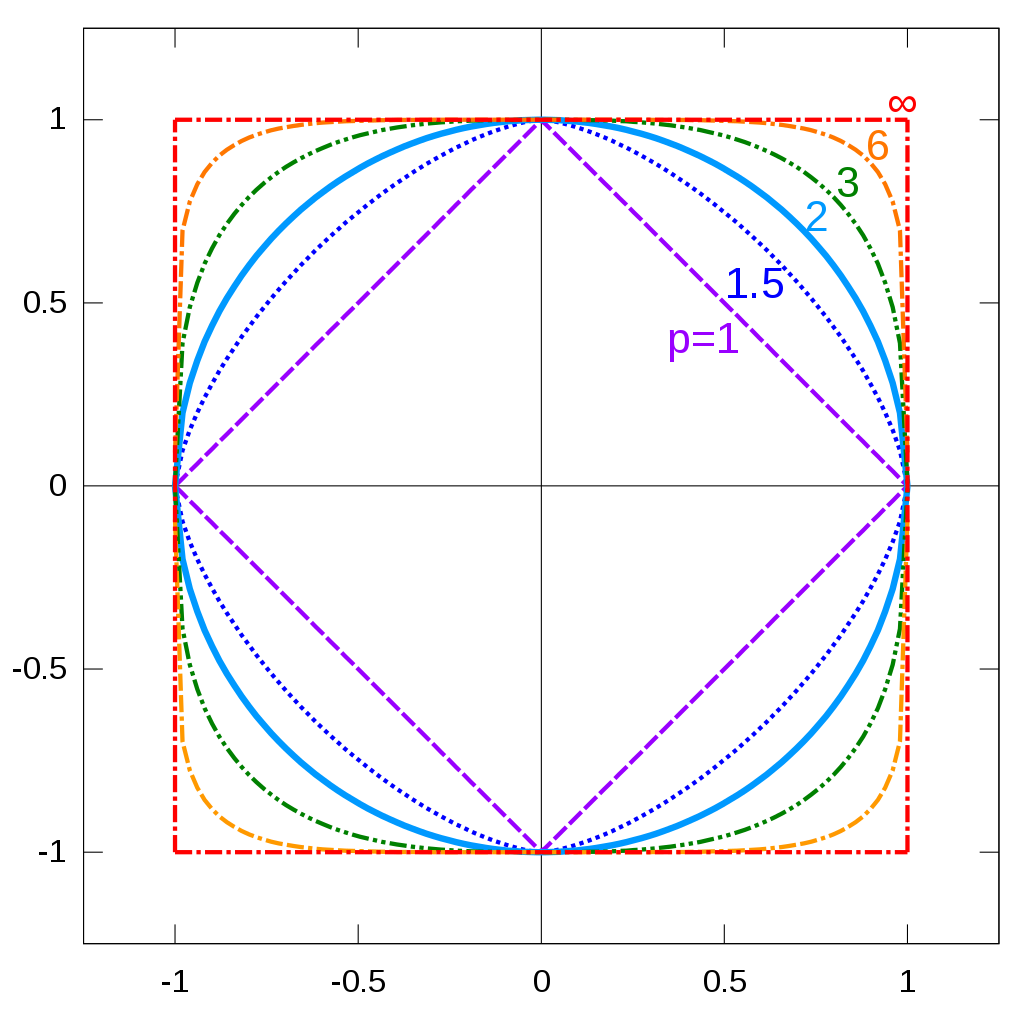
The -norms in 2D look like this (showing the unit circle for each norm, i.e. all points with norm = 1):
is not a norm because it violates the triangle inequality.
is not a norm because it is not positive definite; it is the hamming distance – counting the number of non-zero elements in a vector.
is also reffered to as taxicab norm because with that norm, it is like driving through city blocks (straight lines, no diagonals). You’re adding up the absolute values/distances to zero of each component.
is also known as the euclidean norm. It is the most common norm, measuring the straight-line distance from the origin to the point in space. It’s derived from the pythagorean theorem; it smoothes out the corners of the 1-norm.
is also known as the maximum norm because it only cares about the largest value in the vector.

Info
A norm induces a metric via .
References
Visualizing the circles of p-norms (Medium)