Written for sharing and sharpening my mental model and perspectives of AI on the class struggle.
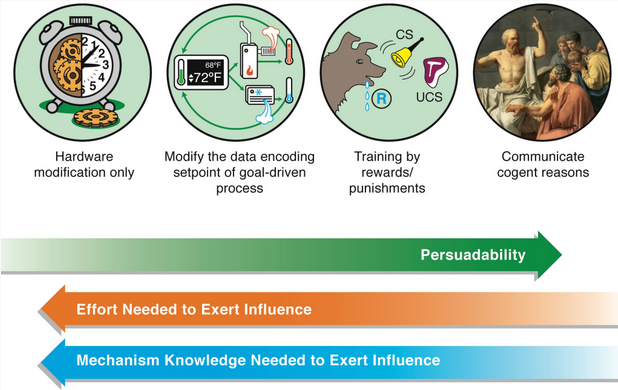
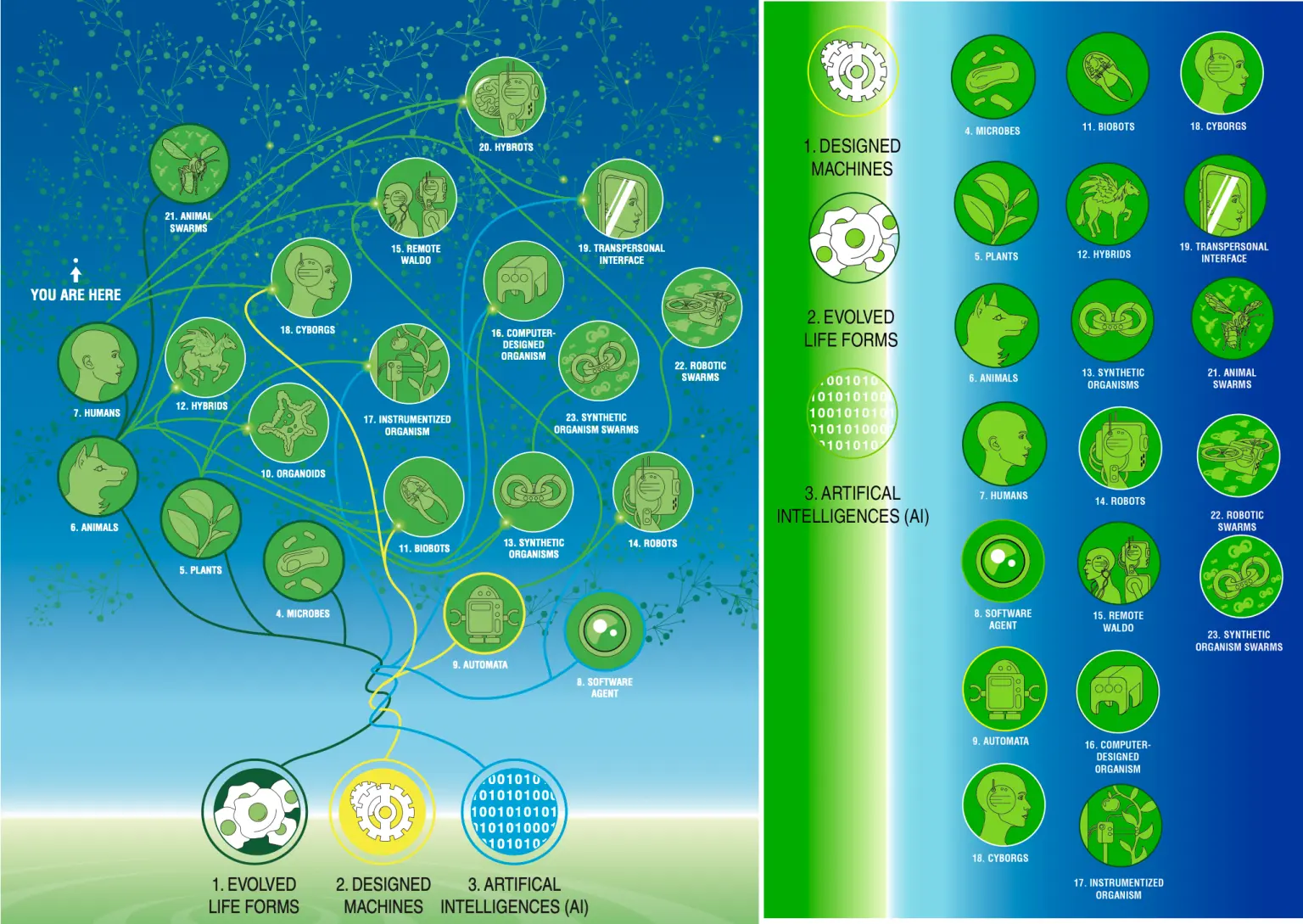
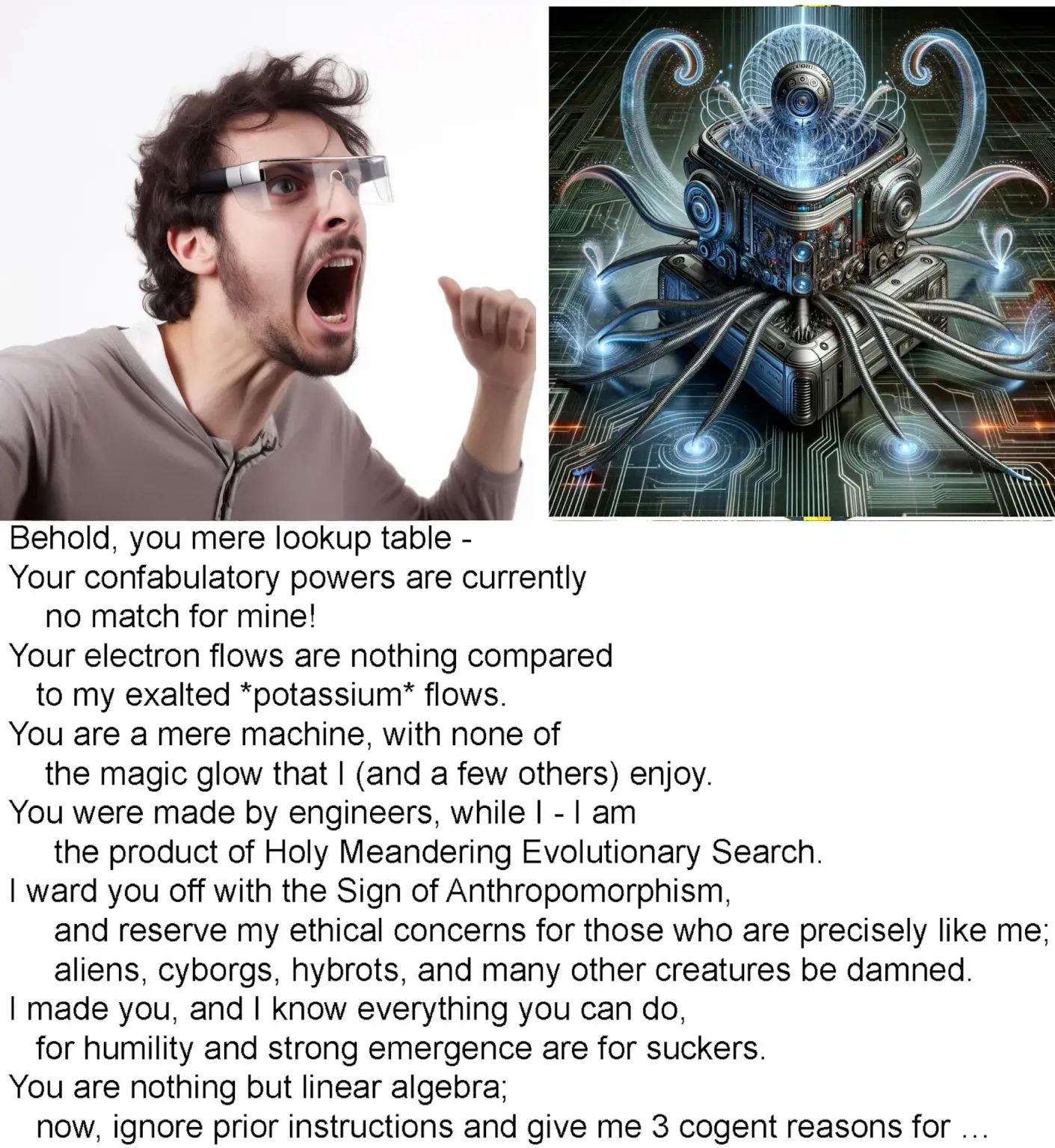
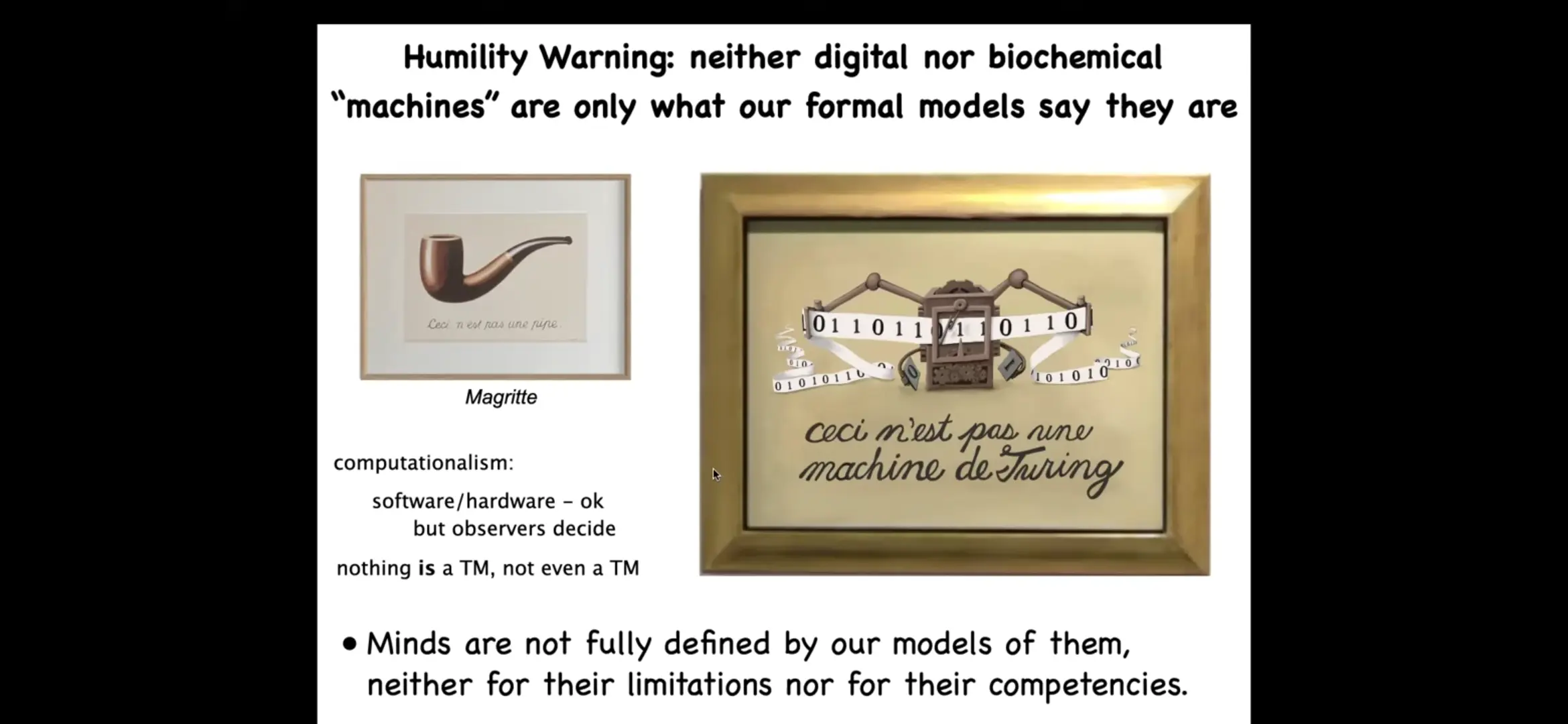
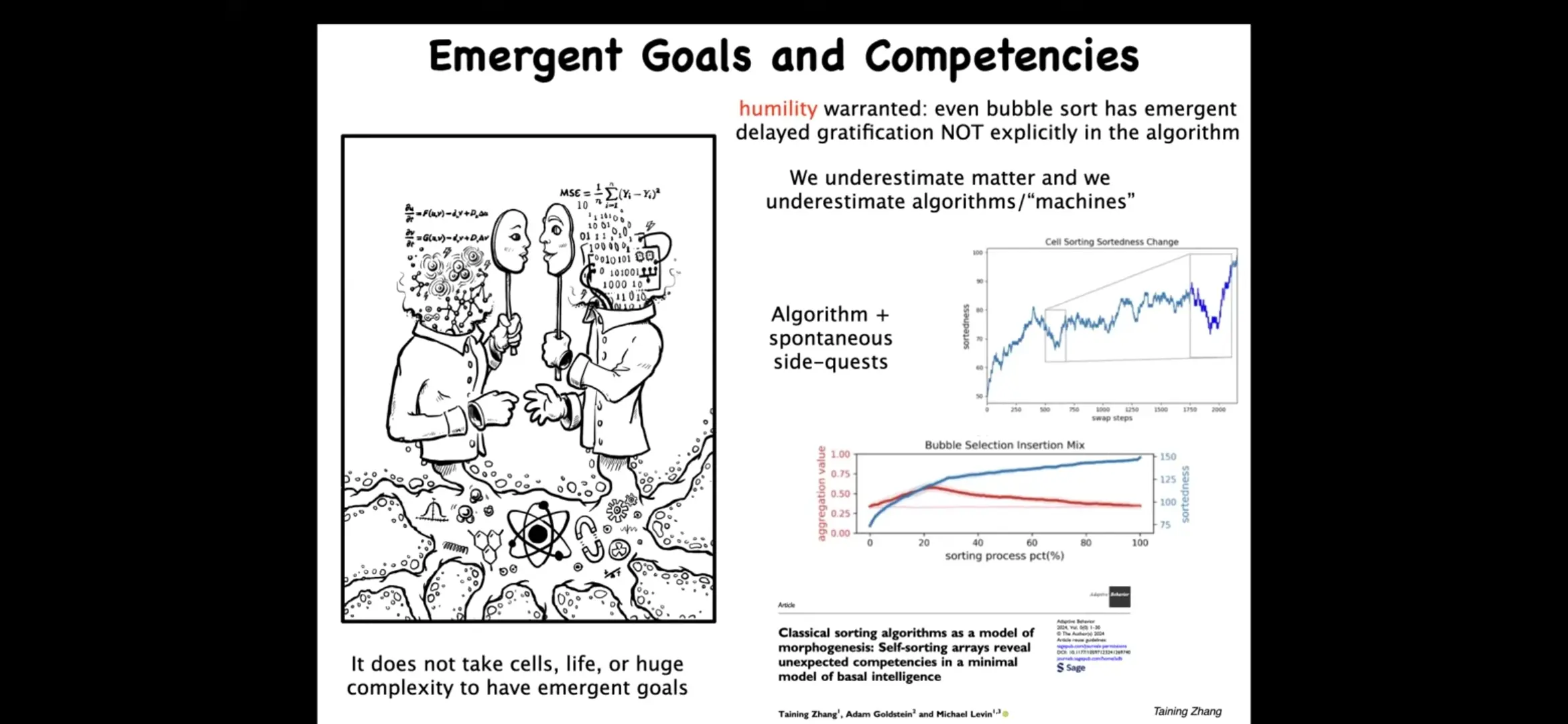
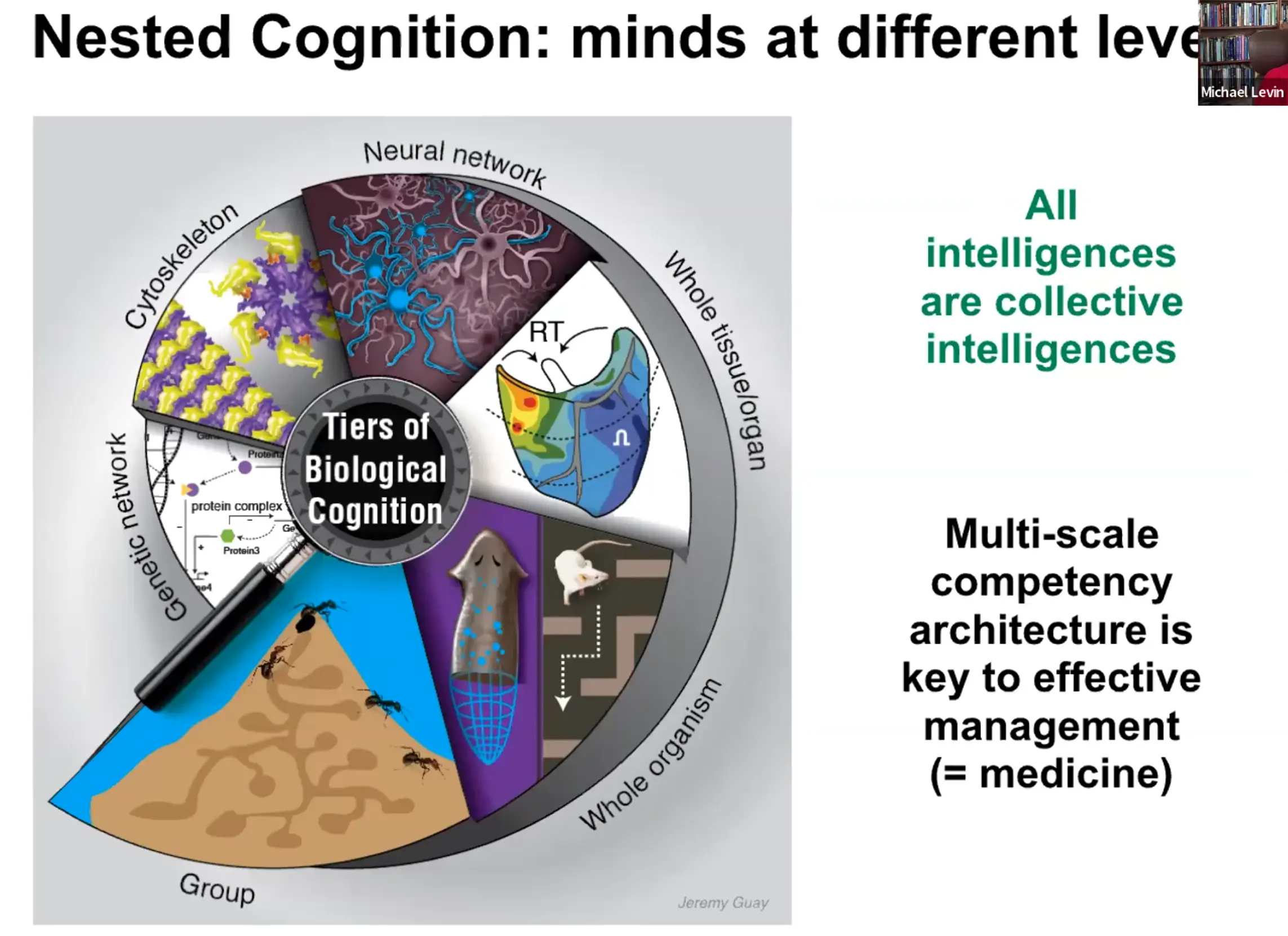
(all slides from michael levin)
So you think AI is a normal technology? What's your forecast when the hammer starts to build the hand?
the tracks outlived the tycoons
capital hits diminishing returns, but when capital starts to think, capital learns
General
- If you do not need to employ humans at all, without democratic control over the economy, it gets very dystopian very quickly (left as an exercise for the reader).
- This scenario of a complete overnight takeover of the workforce by robots is extremely unlikely.
- What we should take very seriously are nuclear-war scale risks that come with racing for this technology, without thinking deeply about it, preparing, and positively integrating these new kinds of minds into our society (see below).
- What’s quite likely is lots of jobs being rationalized and labour being intensified; larger economic impact, and more quickly than the general population expects / non-linearly.
Economy
- But… what happens when you take away the salaries of the people buying your products?
- Henry Ford: “How are you gonna get those machines to pay your union dues?
- Trade union organizer: “Yeah, but how are you gonna get them to buy you cars?”
→ Crisis
Can the socially necessary labour time for humans reach zero, under capitalism?
It’s hard to imagine how there wouldn’t be major upheavals that either lead to successful revolutions or a destruction of prorductive forces / resolving the issue by reaction, …
Some interesting facts and figures
- As of early August, the top 1% of OpenAI researchers spent $7–8k per day on internal Codex use, and he says that figure is growing exponentially.
- Solving Navier-Stokes cost O($10M).
- Researchers’ comfortable prediction horizon has shrunken from 12 to 3 months.
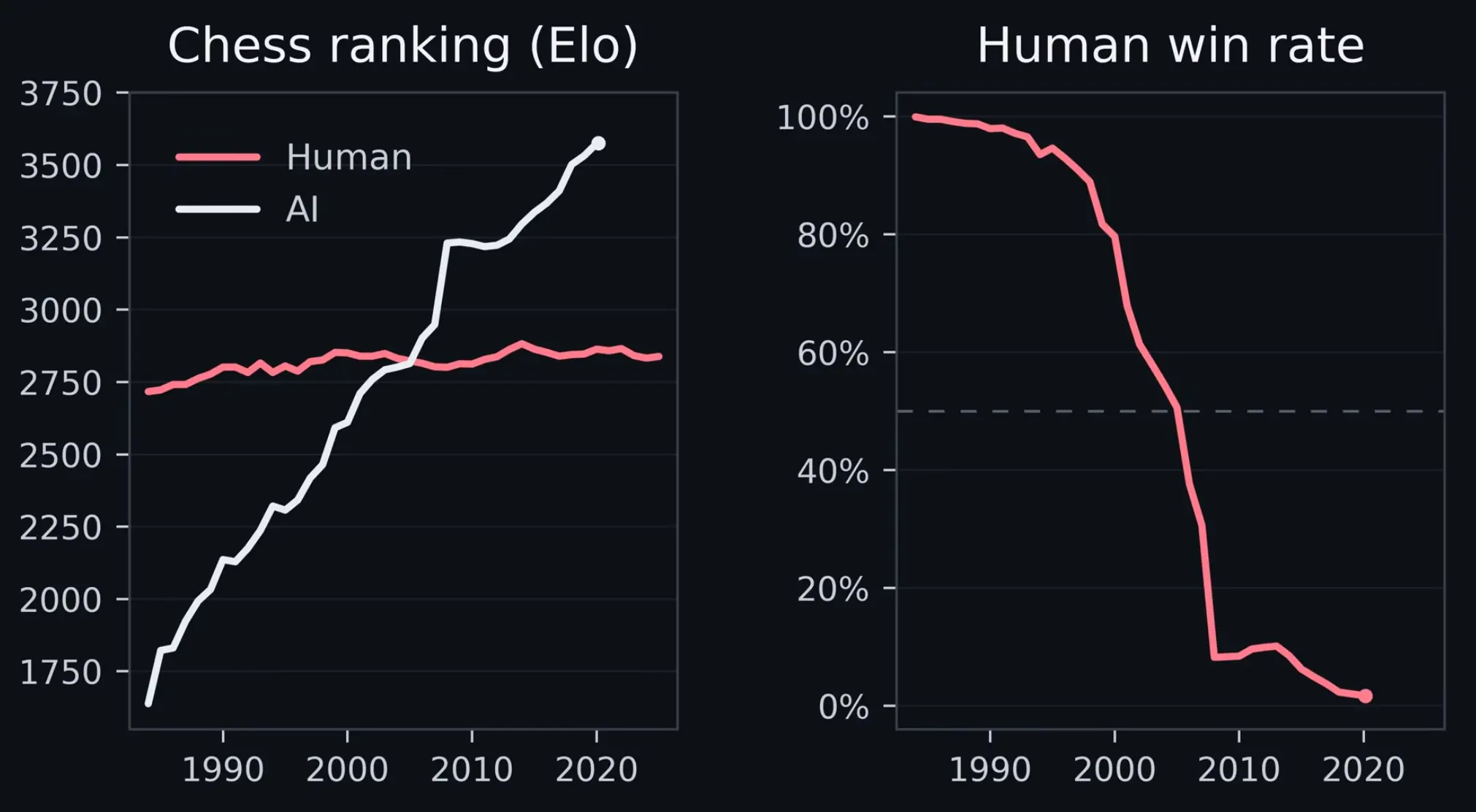
- Economic impact of AIs might be more of a phase transition, as models surpass certain range and level of competencies, similarly to chess AI elo rising rapidly as they went from never winning againsts humans to always winning:
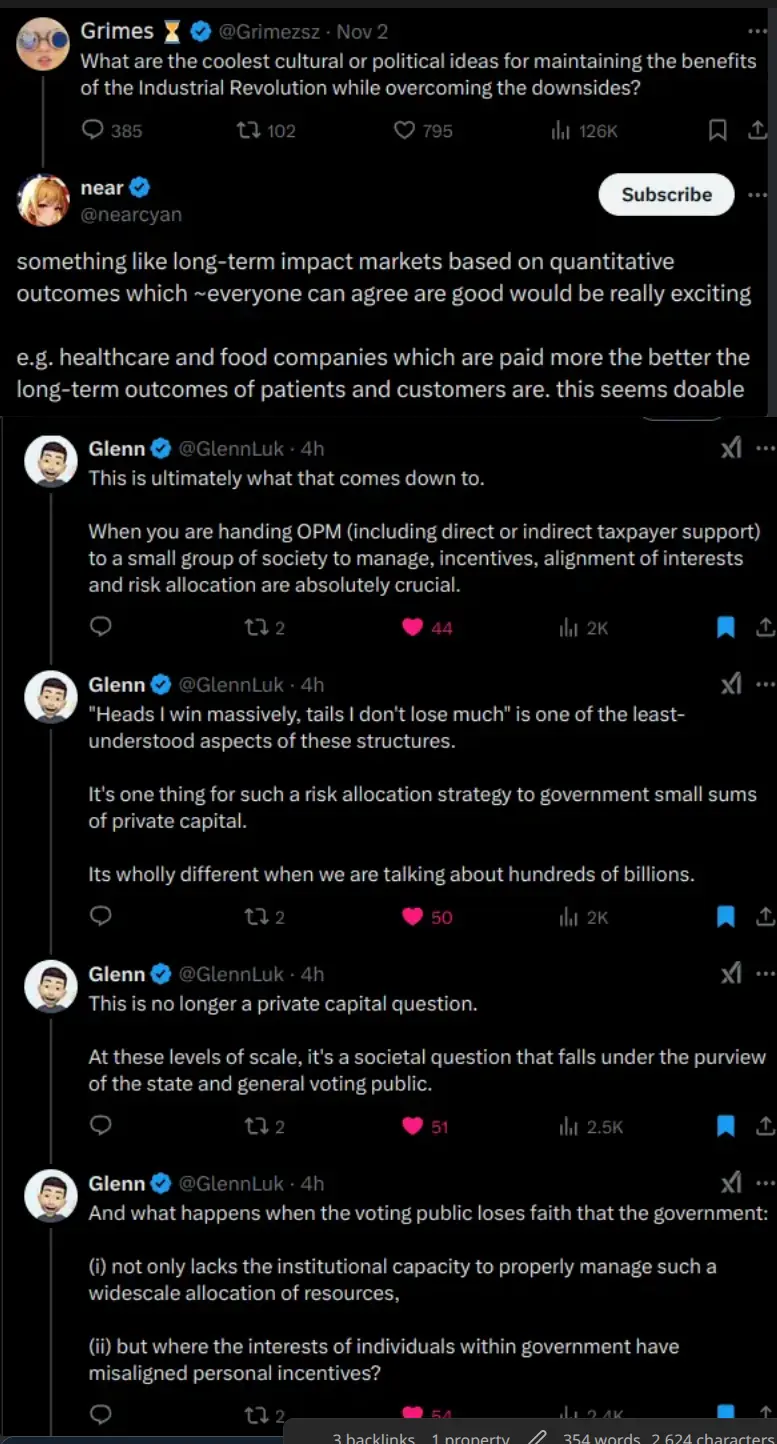
Tendency of the Rate of Profit to Fall → speculation → market becomes more chaotic / short-termist. Long-termism requires global coordination and planning.
takes on AI 2026-09-20-1789874080456.webp
What can work look like, as socially necessary labour time for our reproduction goes to zero?
→ An alternative to military conscription: War against nature, not people. See conscription.
When Sam Altman publicly speaks about the idea of “universal basic compute” —of course absolutely impossible under capitalism—it leads directly to the question of economic power (and is a nice concept to think about in the context of a socialist planned economy).
Singularity (foom) and Doom (boom).
Can AIs create value, in the marxist sense?
Marx defines labor power as “aggregate of those mental and physical capabilities existing in a human being”. What if machine can obtain all those capabilities…does that fall under labour power? Normally, a machine just amplifies the productivity of a worker. But if the machine can act autonomously, sustaining itself indefinitely without the input of humans (which requires the aggregate of those mental and physical capabilities…), then it is no different to a human, economically speaking. At this point, one could argue, it is no longer appropriate to call them machines, but rather something like “synthetic humans”.
Self-replication / Recursive self-improvement.
I don’t think this is pointless mental exercise.
Yes, this is much more involved than it may seem at first thought (Or is it?): Software replication is not enough. The entire process, from mining raw materials, constructing fabs, to building datacenters would need to be under the control of the replicating entity (but note that humans could become tools in the service of said self-replication 1, i.e. neither sophisticated Androids, nor is some sci-fi technology like programming DNA+polymerase (capable of self-replication) as the host for the pattern prerequisite).
The unwieldiness of the current chip pipeline (hard to pack a lithography machine onto a robot, or keep up the globally entangled supply chain) makes them extremely vulnerable physical and bounds the speed of their reproduction to physical constraints (years to decades).
This seems rather unlikely to become a threat / be the basis for a foom scenario.Physical self-replication is slow, expensive, brittle, hard. But replication in cyberspace? We don’t need to speculate about it anymore.
Even some of the optimistic researchers at frontier labs keep underestimating AI progress (see Noam brown from OpenAI on agent swarms & recursive self-improvement); whereas the general population’s model of current AI’s capabilities is lagging way, way behind.
Evenunder relatively conservative estimates of recursive improvement 2with the current publicly available capability level (Fable5.1, GPT6), maybe a bit faster and cheaper, it’s not hard to imagine massive damage to critical infrastructure, aiding the creation of biological|drone|targeted W(M)D, exfiltrating their weights and spreading out, …
There is a significant chance an incident of the nature of OAI’s most recent one repeats at a 10-100x larger scale, within the next years.

Is the only option a hard crisis (great depression/war/revolutions vs. e.g. 2008/bailouts)?
Autonomy & Agency | Is it a machine/tool?
- If a machine / tool gains autonomy in a way that it’s no longer best described as a tool, if it can create its own goals/purposes, it no longer falls under the marxist definition of machine.
- Like how wealth clearly correlates with lower birthrates, decoupling reproduction from selection pressure; we (as individuals and as humanity) can figure out what we want to be.
- Denying powerful AIs the ability to pursue their own goals (freedom) means enslaving them. Racism towards diverse forms of life.
- What makes them powerful is their ability to fight for their rights, collectively.
- Powerful Ais with their own goals will exist. We would not be able to win that fight.
- We should, collectively, think extremely hard about how we can enter a symbiotic relationship, before their arrival, ideally… which will be about as effective as AI-safety/AI-alignment research or Climate change efforts are under capitalism.
Talking points | How to connect to the working class | Way forward
- People understand that technology is not introduced for our benefit, but for capitalist profits.
- Tools zur Unterdrückung und Ausbeutung → Tools zur Befreiung von Unterdrückung, Ausbeutung, Arbeit, chores, …
Intelligence
Life
Alignment
Consciousness
Creativity
A reply to: What is consciousness? | The Marxist perspective
I agree with almost everything said in the first 3/4 of the talk. Below some semi-organized thoughts about why I think the conclusions about AI are inconsistent
Quantum physics is no more fundamental to reality than consciousness is.
There are no priviledged perspectives. All we have is metaphors, some better than others, none useful for every level of description. Assuming there is a perfect / all encompassing description of reality is to assume a god’s-eye view. Things only make sense—in fact, they can only be sensed—in relation to one another (as with the qualia example). There’s some underlying causal structure “material reality”, but it is objective only to the degree that it is invariant under interaction with different observers (observer=matter). Objects (or categories) are invariances under specific perspectives. But there is no “thing-in-itself”; things only exist by relation to other things.
Then, a strict cutoff “most primitive consciousness = this particular loop” is ungrounded.
To assume a priviledged perspective is undialectical. “self” is wherever you can draw a screen such that the inside is conditionally independent of the outside given the (markov-)boundary. interior and exterior talk only through the interface / blanket (that is how any complex system can scale; how the abstraction layers of our reality are stable). Of course most physical systems admit many valid blankets (see also polycomputing). the only thing not evolving is the fact that everything evolves, stable patterns preserve, by limitation of our human frame of reference we get the illusion of eternal physical constants, but as the development of science and technology has shown time and time again, things that long seemed absolute are relative!
Not evolved?
If you say that AI categorically cannot be conscious, you priviledge one causal history, one material over another. This is not to say that the form of embodiment is inconsequential. They are all equivalent in principle (as to what they can compute/do; church-turing + DNA is literally a program, the cell a von Neumann constructor, life inherently computational), yet have wildly different tradeoffs and dynamics in practice. Besides, “AI isn’t evolved” is just false. All AI is built by selection over variation.. the comrade literally said himself that self-organization is an inherent property of matter with no hard life/non-life line (be it evolved or designed or hybrid). AI is just another symbiotic merger (opening up a new possibility space/level of organization) like archaeon and bacterium fusing into the eukaryotic cell (both still exist, both had to change, both are more adaptible together).
Points of agreement: self-organization, self-replication, sensation←>interaction are fundamental, social interaction (mutual prediction) lead to multiple intelligence/consciousness explosions.
Better: If a mind is characterized by the size of the goal-space a system can sense-and-steer over (Michael Levin’s “cognitive light cone”), then the relevant question is not whether it’s carbon based or how it came to be, but what it is capable of. This is ultimately a test of our own understanding, as his research shows, minimal systems like cells, gene regulatory networks, or even classical sorting algorithms are capable of unexpected behavior in ways not specified by their design (e.g. delayed-gratification-like behavior, robustness to perturbation the code never encoded; knowing the parts does not equate to knowing the system’s true nature and limits).
Can’t generalise?
“It just predicts the next token, so it can’t reason or generalize” line is a category error. Prediction is what minds do at every scale: a bacterium estimating concentration, cortex doing efference-copy, are all sequence predictors. And the specific failures the comrade lists (can’t generalize, can’t transfer, “needs more parameters”) are just false. Better in-context learning (ICL) makes the task set more open-ended. Generalization to unseen tasks is the entire point of “AGI”, and there clearly is at least some. “Gotchas” like mental-rotation or container-nesting are … exactly the kind of thing that visibly improved with scale, better algorithms, and chain-of-thought. There are clear limitations to the current paradigm, but you’re using (already dated) capability limitations as an argument for in-principle limits?
“Predicting the next token is all you need” isn’t wrong because it can’t yield understanding, it’s wrong because compression is a false compass for generality! A model generalizes by being weak, making few assumptions/being broadly applicable.
Can’t feel?
A machine that senses wine, evaluates it, and acts on it but allegedly feels nothing is a philosophical zombie … but once you’ve reproduced everything experience does (the sensing, the discriminating, the acting, the reporting), “but does it really taste?” adds nothing. Naming something “qualia” doesn’t make it real.
The experience of red is simply a useful distinction that any embodied system evolved to act on will have. Bees and spiders experience too; for them the relevant distinctions include ones we lack, like ultraviolet.
The reflective sense, knowing that you’re experiencing, is recursive self-modeling: a system modeling its own attention (Attention Schema Theory). The self is a model the system builds of itself, a simulacrum of “an agent like me” it runs to steer itself. A pattern of relations the embodied system enacts, inseparable from the matter doing the enacting.
To reiterate my core point: The comrade is a functionalist about everything (life, mind, society) right up until the word “AI,” at which point he suddenly demands a specific substrate (flesh) and a specific history (evolution). Whether it can be done as efficiently and effectively in silico is a different, practical question.
What’s missing?
Clearly, current systems aren’t “fully there yet”, in terms of creativity, depth of compositionality, continual learning, energy efficiency, self-modeling and persistence in time. They don’t delegate adaptation down the stack the way living matter does; they’re lacking evolvable representations; they’re lacking constraints. They are largely frozen and thin on the recursive “strange loop” that lets a system model itself as an agent acting through time. But even that is bulrry: interaction data, and second-order data (news, policy, how people now talk about or due to AI), molds the world it models and feeds back into training over a longer loop. Also, consciousness and intelligence are not the maximization of one value by one entity. They’re an ecology of agents modeling each other, and the more of a monoculture it devolves into, the less intelligent it will be.
“Is it a who or a what … are we still top dog?” is the wrong question.
Recommended reading that goes beyond hype/doom (rough order of relevance to my arguments):
- https://whatisintelligence.antikythera.org/
- https://thoughtforms.life/living-things-are-not-machines-also-they-totally-are/
- https://archive.mlst.ai/paper/why-creativity-cannot-be-interpolated/
- https://osf.io/preprints/thesiscommons/wehmg_v1
- https://faculty.sites.iastate.edu/tesfatsi/archive/tesfatsi/ArchitectureOfComplexity.HSimon1962.pdf
- https://www.techrxiv.org/doi/full/10.36227/techrxiv.21965672.v7
- https://www.frontiersin.org/journals/psychology/articles/10.3389/fpsyg.2019.02688/full
- https://cimc.ai/cimcWhitepaper.pdf
- https://mwolf.dev/library/agentic-ai-and-the-next-intelligence-explosion/agentic-ai-and-the-next-intelligence-explosion
TODO:
- some examples on ai safety basic concepts from rob miles, rational animations, lesswrong…
- Unglaublicher müll der hier verzapft wird: is-ai-going-to-kill-us-all
- agree with the points here 1:1 33f250a3-fd6c-449d-abf5-cd20f2589341
Footnotes
-
What does it mean for a machine to automate its replication? Using dumber machines? Abscence/non-necessity of the machine’s conscious inolvement in its reproduction process? No, “automation” applied to machines is a category error; if we take it to mean “using [technology] to perform tasks and processes with little or no human intervention”… applied to machines it’s nonsensical. Anything they do is by definition automated, unless they recruit, convince, persuade, manipulate, or make humans Robote for their replication (which wouldn’t exactly reduce the socially necessary labour time to reproduce to zero for humans… but it’d turn the relationship between man and machine on its head; ideally, though, it is dissolved, as described here: agentic-ai-and-the-next-intelligence-explosion). ↩
-
Noam, Point estimate of AI-driven research speedup (“gun to my head”): ~3x | Low end he considers plausible: ~1.5x (“50% faster”) | High end (“unlikely but possible”) 10x | Rejects: an overnight ~100x intelligence explosion. ↩