Cauchy sequence
A sequence is called a Cauchy sequence if
That is, the terms of a Cauchy sequence are pairwise close to each other for large .
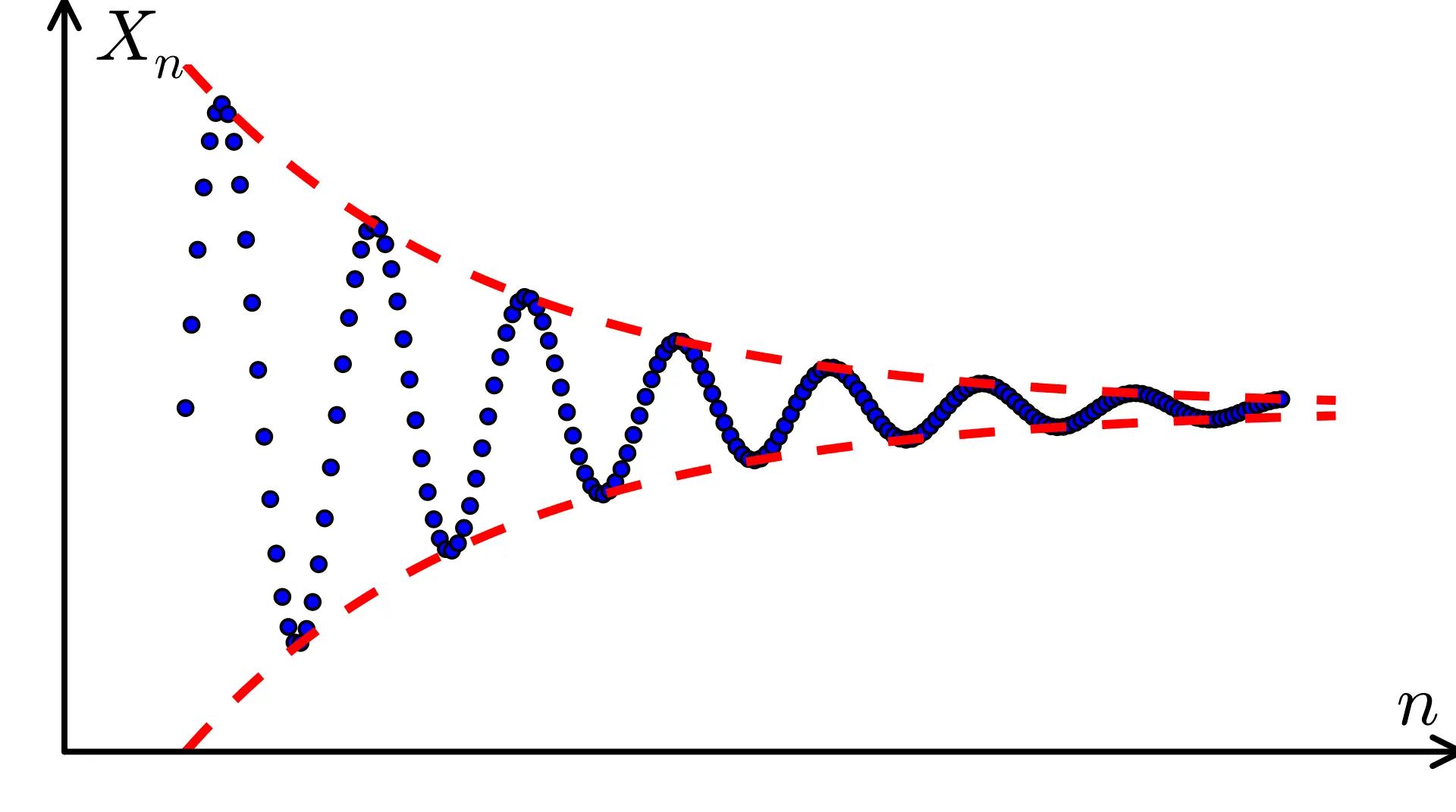
Compare with convergence: convergence says terms get close to a specific value . Cauchy says terms get close to each other. The power of the Cauchy criterion is that you can prove convergence without knowing the limit:
If for some
Each gap is at most a fixed fraction of the previous gap. By induction: . Since , the gaps shrink to zero geometrically, so the terms bunch up: the sequence is Cauchy, hence convergent.
This works for any such sequence. You never need to know the limit.
Cauchy criterion
Proof sketch
If , then for large :
Cauchy bounded (fix , then all terms past some are within of ). Bounded has a convergent subsequence by Bolzano-Weierstrass. Call its limit . Then:
Both terms for large enough and (first by Cauchy, second by subsequence convergence).
Neighbors getting close is not enough
: consecutive terms satisfy (by the conjugate trick), but the sequence diverges.
Cauchy requires all pairs for , not just neighbors. Here .
is Cauchy
For : .
Given , pick . Then for all :
Completeness
The Cauchy criterion relies on being complete. In , a Cauchy sequence of rationals can “converge” to an irrational that isn’t in , so Cauchy convergent there.
This is gives us an equivalent way to define completeness: a space is complete iff every Cauchy sequence converges.
Applying the cauchy criterion to partial sums.
A series is convergent iff the sequence of partial sums is a cauchy sequence.
Let be a series. then we have that is convergent iff
State the Cauchy condition for a sequence in quantifiers.
In words, what does it mean for a sequence to be Cauchy?
Terms are pairwise close to eachother for large .
What can you do with the Cauchy criterion that the definition of convergence does not let you do?
Prove convergence without knowing the limit.
Convergence and Cauchy both say "the terms get close." Close to what, in each case?
Convergence: close to a specific value, the limit
Cauchy: close to eachother
A sequence has . Is it necessarily Cauchy? Give the proof / counterexample.
Circular transclusion detected: general/cauchy-sequence
What is the Cauchy criterion for series?
A series is convergent iff