TLDR: What is life?
Life
Life is self-modifying a computational phase of matter “computronium” arising from evolutionary selection for dynamic stability; it complexifies through the symbiotic composition. The “matter” doesn’t have to be physical matter in our universe, but can be in any environment that supports computation, including of course on a computer. — Blaise Agüera y Arcas (What is Intelligence - What is Life; What Lives - A meta-analysis of diverse opinions on the definition of life)
Link to originalLife is code
In a way, symbiosis is the very essence of functionality. When we talk about a kidney’s function only making sense in context, we mean that it is in symbiosis with other functions—like those of the liver (breaking ammonia down into urea), the heart (pumping blood), and so on. Each of these functions is purposive precisely because its inputs are the outputs of others, its outputs are inputs to others, and thus they form a network of dynamically stable cycles.
The same is true of larger, planetary-scale interrelationships. The “purpose” of plants, from the perspective of animal life, is to produce oxygen and sugar, which we breathe and eat. The “purpose” of animals, from a plant’s perspective, is to turn the oxygen back into carbon dioxide, and provide compost and pollination. Our growing understanding of life as a self-reinforcing dynamical process boils down not to things, but to networks of mutually beneficial relationships. At every scale, life is an ecology of functions.
Because functions can be expressed computationally, we could even say that life is code. Individual computational instructions are the irreducible quanta of life—the minimal replicating set of entities, however immaterial and abstract they may seem, that come together to form bigger, more stable, and more complex replicators, in ever-ascending symbiotic cascades.
Life
A long-running, dynamical, purposive, and self-perpetuating process.
Life is function which needs reproduction which is computation.
There’s no vital spirit that breathes fire into inanimate things. But how do we explain the difference between living and non-living matter?
Life is functional. Different parts of your body perform different functions. If you break them, they break you. Life has goals. Now you can make the argument that everything is alive to some degree. Levin and Blaize do. How you implement / execute functions does not matter. 1embodied cognition | pancomputational enactivism: Rather than having a tape and a head that are made out of something fundamentally different than the information that is written on the tape, the tape and the head are part of what’s being written, e.g. cellular automata.
In order to reproduce, i.e. persist i.e. exist, you need a tape that tells you how to construct yourself, and you need a universal constructor that walks along the tape and executes whatever is written there. You also need a tape-copier (which has to be on the tape), and the instructions for building the universal constructor.
John von Neumann concluded all these things thinking about how life works, and he was spot on, before we discovered that in biological systems, DNA is that tape, the ribosome is the universal constructor, and DNA polymerase is the tape-copier.
He also showed that the universal constructor is an embodied universal computer.
→ In order to have life you need to reproduce. You can’t reproduce without computation → No life without computation.
Life was born in a hostile environment, is implemented on an unreliable substrate, and needs to reproduce in an environment where no situation is quite like anything that came before → Life was intelligent from the start.
Computation is energentically expensive, creating negative entropy by drawing on a source of free energy.
Life is a special phase of matter with structure at every scale.
Link to originalWhat’s Life?
As systems grow complex, they form abstraction layers - atoms form molecules, molecules form cells, cells form organs. Each layer interprets the one below, like software running on hardware running on physics.
In biological systems, each layer can adapt, unlike the rigid stacks of computers.
To be alive is to be considered alive by systems that consider themselves alive. – Chris Fields
Synonyms for alive:
Terrence Deacon calls systems exhibiting apparent backward causality entensional — equivalent to “agential,” “purposive,” or, broadly, “alive.”
Life becomes more complexifies over time and across scales through symbiogenesis.
Difference between living and dead systems
References
About categories: Living Things Are Not Machines (Also, They Totally Are)
Blaise Agüera y Arcas | What is Intelligence?
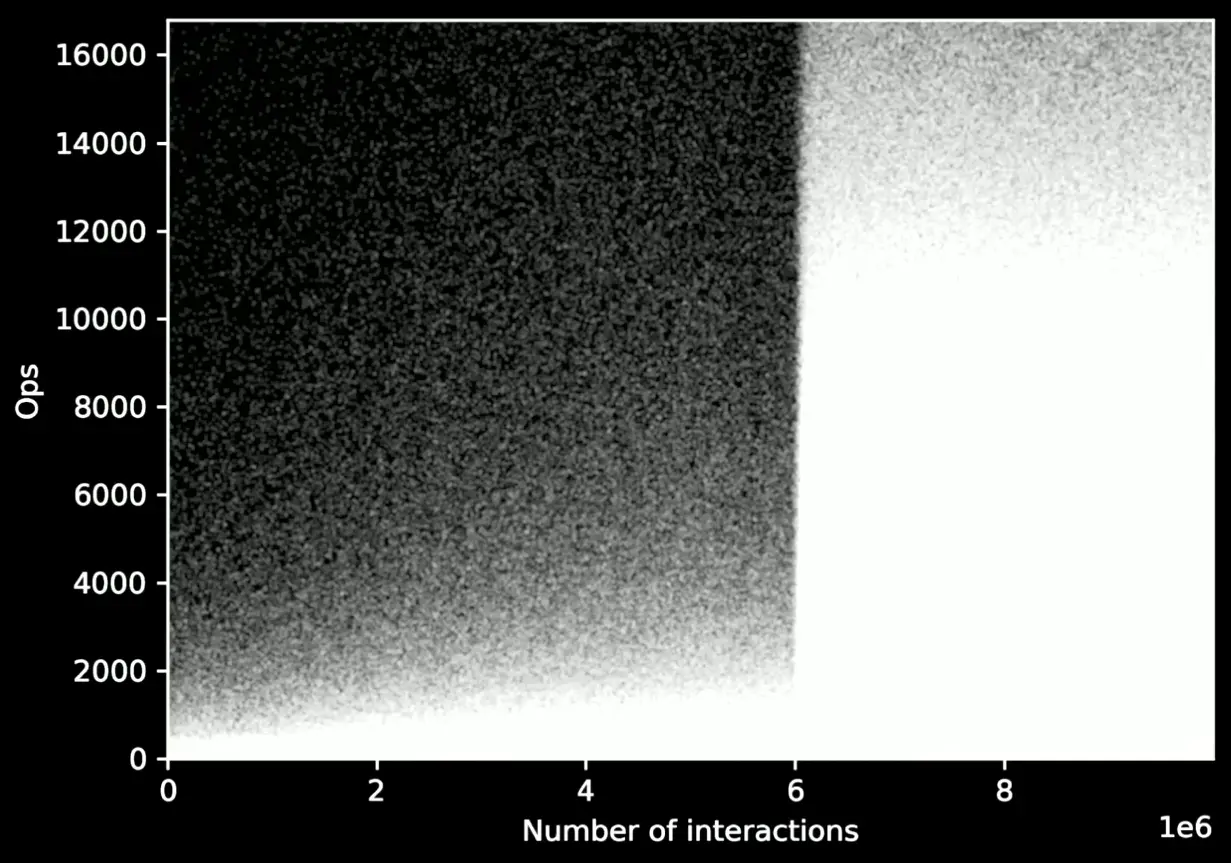
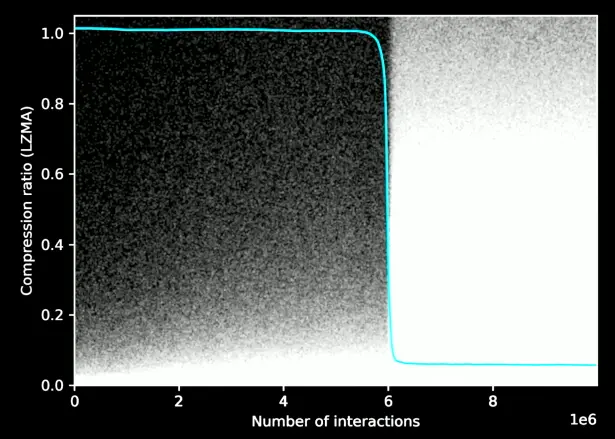
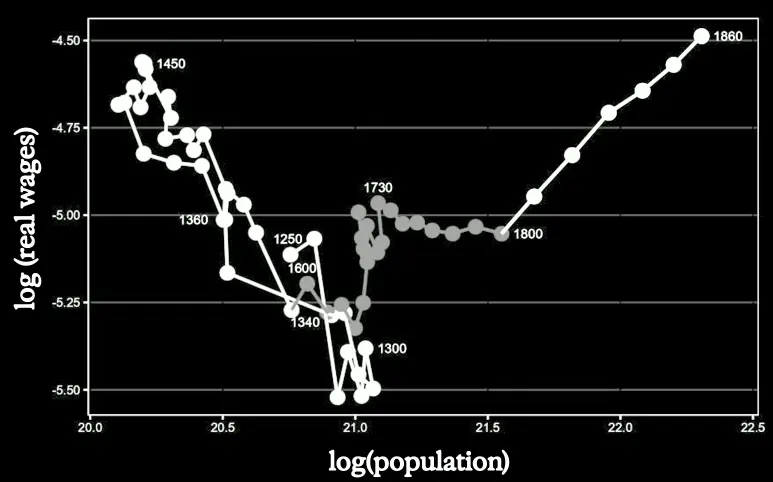
Energy constrained metabolization → oscilation between population and wages.
External metabolism → heaps of extra free energy → population skyrockets + rising standard of living.
Footnotes
-
Read: It does not change the fact that it is life. Of course different substrates have different properites/constraints/… by definition, so it will obviously not be the same if you upload your brain. There’s just no grounds to claim it isn’t life. ↩