results in a new matrix where the row is the dot product of the row of the first matrix with each column of the second matrix.
Example
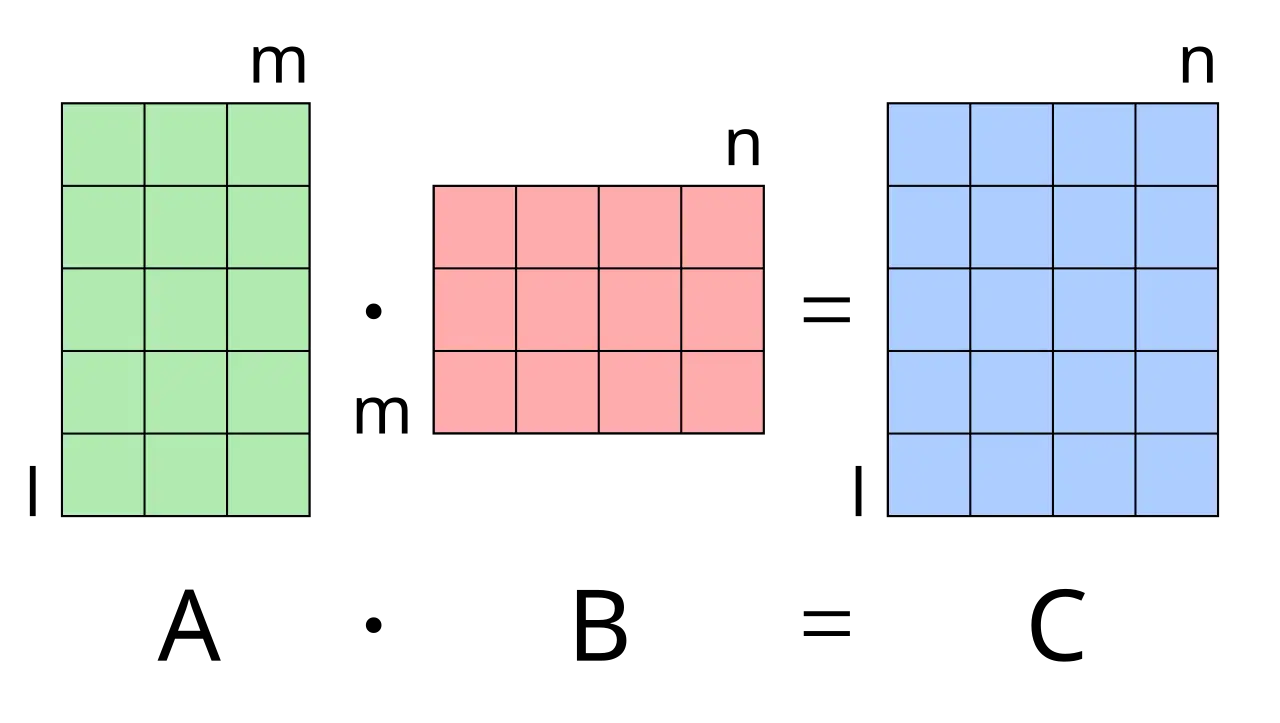
Best visualization: http://matrixmultiplication.xyz/ + by gemini visualizing & explaining matmuls between different matrix patterns (triangular, block diagonal, anti-diagonal, etc.).
… imagine rotating the matrix on the right by 90degress to the left and sliding it over the matrix on the left.
The first row on of the left matrix gets multiplied and summed by each column, each time moving one column to the right in the output, resulting in the first row of the output matrix.
If the result of a matrix multiplication is 0, unlike with real numbers, it does not imply that one of the matrices is 0.
It does not even imply that one of the matrices has a row or column of 0s.
It does imply that the row space of the first matrix is orthogonal to the column space of the second matrix.
Link to original
Let , and . Then,
Note the order of multiplication reverses.
Proof:
Multiplying by a unit vector selects the column of :
 ┌		   ┐   ┌   ┐	 ┌	 ┐
 │ . . c . . │   │ 0 │	 │  c₁ │
 │ . . c . . │   │ 0 │	 │  c₂ │
 │ . . c . . │ × │ 1 │  =  │  c₃ │
 │ . . c . . │   │ 0 │	 │  c₄ │
 │ . . c . . │   │ 0 │	 │  c₅ │
 └		   ┘   └   ┘	 └	 ┘
  	A		  eₖ		 cₖ
  			(k=3)
  	```
  	$e_{k}^{T}A = a_{k}^{T}$ selects the $k^{\text{th}}$ row of $A$:
  	```
  			  ┌		   ┐
  			  │ . . . . . │
  			  │ . . . . . │
  	  [ 0 0 1 0 0 ] × │ a a a a a │  =  [ a₁ a₂ a₃ a₄ a₅ ]
  			  │ . . . . . │
  			  │ . . . . . │
  			  └		   ┘
  	   eᵀₖ			  A				  aₖᵀ
  	```