Independent events
Two events and are independent if knowing gives no extra information about , and vice versa:
Equivalently, using the formula of conditional probability, for independent events, we can say:
So the chain rule of probability simplifies to multiplication for independent events.
EXAMPLE
= deck of 52 cards
= card is spade →
= card is queen →
The probability of getting a spade or queen doesn’t change if we restrict ourselves to the set or :
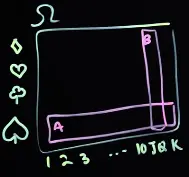
Independence is about proportions, not overlap.
and are independent exactly when takes up the same fraction of as it does of all of , and vice versa.
is a vertical strip of width , a horizontal strip of height , and their lens is the rectangle with area . Inside band , still occupies the same width : knowing happened tells you nothing about .
Disjoint is the opposite of independent
Two disjoint events with positive probability are maximally dependent: if happens, definitely didn’t; .
Independent random variables
Two random variables are independent:
Knowing one variable gives no information about the other.
Mutual independence (more than 2 variables):
What does it mean for two events to be independent?
Neither gives you any information about the other.
and are independent exactly when takes up the same fraction of as it does of all of , and vice versa.