Limit
The limit of a convergent sequence or a function describes the value that the sequence/function approaches as the index/argument grows (or approaches some point).
Limit arithmetic
Proofs
Sum rule: Use the triangle inequality and “epsilon budgeting”:
for large enough. Each term gets half the epsilon budget.
Product rule: Add and subtract :
Since convergent sequences are bounded, for some . Both terms can be made arbitrarily small.
Scalar rule: Follows directly from .
Quotient rule: Show first (using for large ), then apply the product rule.
Arithmetic for definitely divergent sequences
If :
when or
for any
if , and ifIndeterminate forms (no general rule):
Example: and , but diverges, so since , it is indeterminate.
See sequence, null sequence, convergence for some examples.
See also: sandwich rule
Limes superior and limes inferior
Let . Define
These always exist (in ) for any real-valued sequence, even divergent ones.
/ are the smallest / largest accumulation points.
They generalize the ordinary limit: every sequence has a and , but only convergent sequences have a limit. When the limit exists, all three are equal.
Unpacking the definition step by step, for
- Fix an index . Look at all terms from onward:
- Take the supremum of those terms: . This is the largest value the sequence reaches from position onward.
- As increases, we’re taking the sup over a smaller set (we dropped ), so can only decrease or stay: . The sequence is non-increasing.
- A non-increasing sequence always has a limit (by the monotonicity principle: it either converges if bounded below, or ). That limit is .
Same construction flipped for : is non-decreasing (dropping terms can only raise the inf), so its limit always exists too.
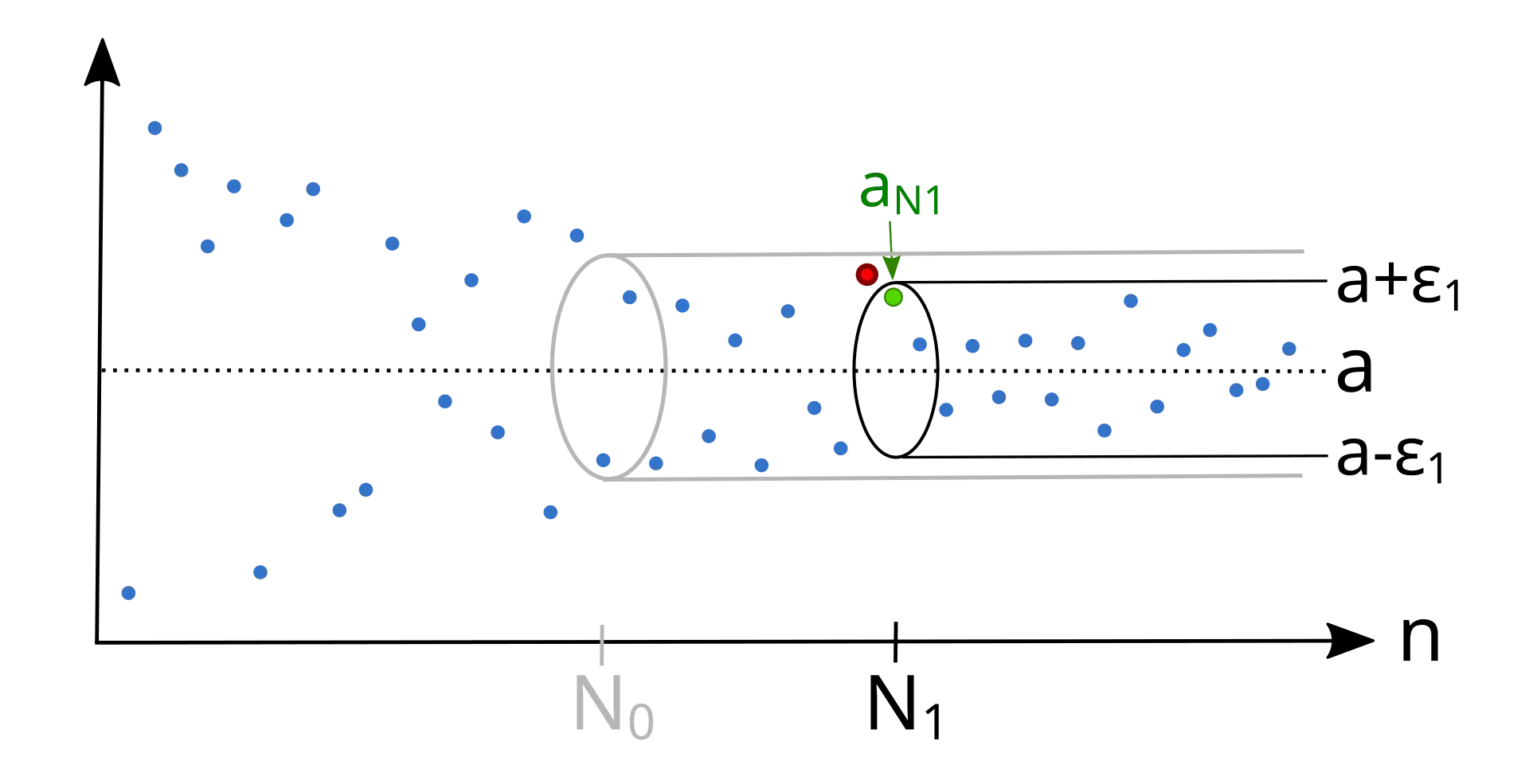
Compare with convergence (figure): Limsup/inf give the eventual bounds of the sequence, whereas convergence, if it exists, is the single value a sequence approaches.
Equivalent formulation
Since is non-increasing, the monotonicity principle gives :
Eventually, all terms are near
For any , eventually:
Individual terms can still lie outside the interval itself: always overshoots slightly. But the overshoot gets arbitrarily small.
Convergence criterion
Equivalently: A bounded sequence converges iff it has exactly one accumulation point.
for all (there’s always an even index ahead), so .
for all (there’s always an odd index ahead), so ., so diverges. The two values are the accumulation points.
Terms:
: the even-indexed terms are largest, and , so . Hence .
: the odd-indexed terms are smallest, and , so . Hence .
What is conceptually?
The largest value a sequence revisits infinitely many times, the smallest asymptotic (eventual) upper bound on the sequence (can be violated finitely many times).
The largest accumulatiion point.
What property do sequences for which and coincide have?
They are convergent.
Explain why we take the sup of the tail of a sequence and then the limit: $$
\limsup_{n \to \infty} a_n := \lim_{n \to \infty} \left(\sup_{k \ge n} a_k\right), \qquad \liminf_{n \to \infty} a_n := \lim_{n \to \infty} \left(\inf_{k \ge n} a_k\right)
$\sup_{k\ge n} a_k$ is the highest the sequence reaches from index $n$ onward. Letting $n\to\infty$ discards ever-larger *finite* prefixes, so only *eventual* behaviour survives.
What question does answer that can't?
asks “does the whole sequence settle on one value?”, which might not have an answer.
asks “what’s the highest value it keeps returning to?”, which always has an answer.
Give the definition of ,
Give an intuitive explanation for why is non-increasing.
Removing an element from a set can not increase its upper bound (nor can it decrease the lower bound).
When are bounded sequences convergent? (3 different characterizations)
and of
, . Note the terms sit outside (each overshoots), yet the overshoot , so the limsup/liminf still land on ; since they differ, diverges, and are its accumulation points.
and of
, .
Reminder: these live in the extended reals , unlike an ordinary limit.