Open-ended systems endlessly produce interesting things.
Open-endedness is inherently observer-dependent—interestingness/novelty/compression.
Trying to define it objectively—that it is a property of the system, measurable from the outside without reference to any observer—, like unbounded novelty, ever-increasing complexity, ongoing adaptive activity, … is silly.
There’s no pre-specified objective that can capture it (see Why Greatness Cannot Be Planned).
But then what is it that drives our sense for interestingness / sense for open-ended systems?
Engineering shortcut: Train on the entire internet, use it as a model of human interestingness, i.e. automated PicBreeder (edit: → the-ai-picbreeder-experiment-in-search-of-automatic-open-endedness)
How far can this shortcut take us? What are the actual principles behind human interestingness?
See also: open-endedness-the-last-grand-challenge-you-ve-never-heard-of, subjective-open-endedness
A different but promising approach / shortcut that operationalizes learnable novelty: Intelligence from Learnable Novelty
Link to originalFrom the perspective of an observer, a system is open-ended if and only if the sequence of artifacts it produces is both novel and learnable.
I.e. you have a system producing artefacts and an observer making statistical models which based on up to , which have a prediction error for arttifacts until .
A system displays novelty if if artifacts become increasingly unpredictable with respect to the observersmodel at any fixed time :
… there is always something more surprising coming in the future.
A system is learnable whenever conditioning on a longer history makes artifacts more predictable:
This can also be defined in terms of compression:
The observer processes an artifact to determine its information content given a history of past ones. posses a history-dependent compression map - the map encodes into a binary string of length .
A system displays novelty if the information content increases, i.e. complexity increrases according to the observer:
A system is learnable if conditioning on a longer history increaes compressibility:
In other words, with a longer history (more data), the observer musst be able to keep extracting additional patterns that help it compress future artifacts.
Lossy compression is also allowed
loss(decompress(compress(X)), X) < epsilon, can also get rid of explicit epsilon and analyse properties of the “rate-distortion” curves.
Link to originalNot open ended
- TV screen with white noise: Figure out it is a normal distribution → never novelty again, as you’ll be able to predict as good as possible: 50/50, with a rate of prediction accuracy change = 0 (also not learnable, as a longer history doesn’t help a bit).
- Presented with random movies (sequencing of unrelated information): Might be arranged in a way to be surprising (novel), but nothing about the current movie tells you anything about the next.
- LLMs appear open-ended to humans in broad domains because we have limited memory. An LLM can learn the daset increasingly well (learnability), but eventually, the observer will capture epistemic uncertainty - we see repeated patterns from the fixed distribution they are sampling from. It’s like a very big noisy TV.
Link to originalTo further advance in levels of AGI towards ASI, we require systems that are open-ended—endowed with the ability to generate novel and learnable artifacts for a human observer.
Link to originalOpen-endedness is observer-dependent
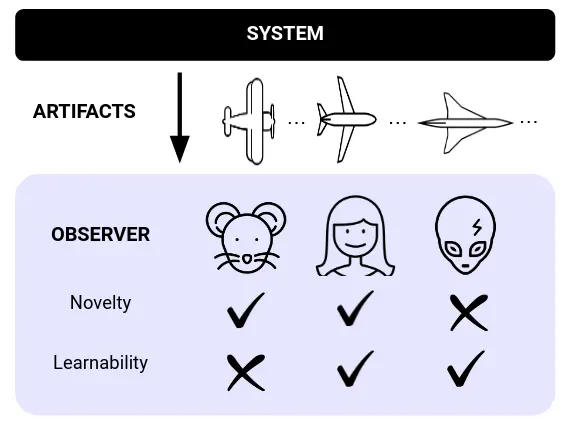
The definition of open-endedness hinges on a system’s ability to continuously generate artifacts that are both novel and learnable to an observer. Consider a system that designs various aircraft: a mouse (left) might find these designs novel but lack the capacity to comprehend the principles behind them; for a human studying aerospace engi- neering (middle), the system offers both novelty and the potential for learning, making it open-ended. However, a superintelligent alien (right) with vast aerospace knowledge might not find the design novel, but would still be able to analyze and understand them. This highlights that open-endedness is observer-dependent and that novelty or learnability alone is not enough.
…
From the perspective of AI research, there is a pre-eminent class of observers, namely humans. In other words, we wish to generate artifacts that are valuable to individual humans and to society. This provides a level of grounding for the open-ended system which narrows the search space considerably.… once human memory capacity is saturated, the human observer will start to forget previous things…
Link to originalOpen-endedness is fundamentally an experiential process
Before proceeding, we must justify our claim that a future foundation model trained passively on some large corpus of human data is unlikely to spontaneously acquire open-endedness. In principle, should we reach ASI, there will be some sum total of data which the model has consumed during its training, possibly via several intermediate stages. Therefore, our claim is not about the impossibility of assembling such a dataset. Rather, we suggest that it is unlikely that this dataset can be pre-collected offline in an efficient way. The reason is that open-endedness is fundamentally an experiential process: producing novelty and learnability in the eyes of an observer requires continual online adaptation on the basis of the artifacts already produced, in the context of that observer’s evolving prior beliefs.
What would it take to collect offline a static dataset from which such an experiential skill could be learned? Such a dataset must contain a treasure trove of artifacts which themselves crisply show novelty and learnability. Yet the process by which culture evolves, ideas develop, inventions arise and technologies proliferate is seldom recorded neatly and comprehensively. The alternative paradigm, in which experience is “built in” to the open-ended system, is well illustrated by the scientific method. Since the Enlightenment, the simple process of making hypotheses on the basis of current knowledge, falsifying them with experiments based on a source of evidence, and codifying the results into new knowledge has yielded unprecedented progress in science and technology (Deutsch, 2011). In our view, the fastest path to ASI will take inspiration from the scientific method, compiling a dataset online by the explicit combination of foundation models and open-ended algorithms
Link to originalOpen-ended exploration
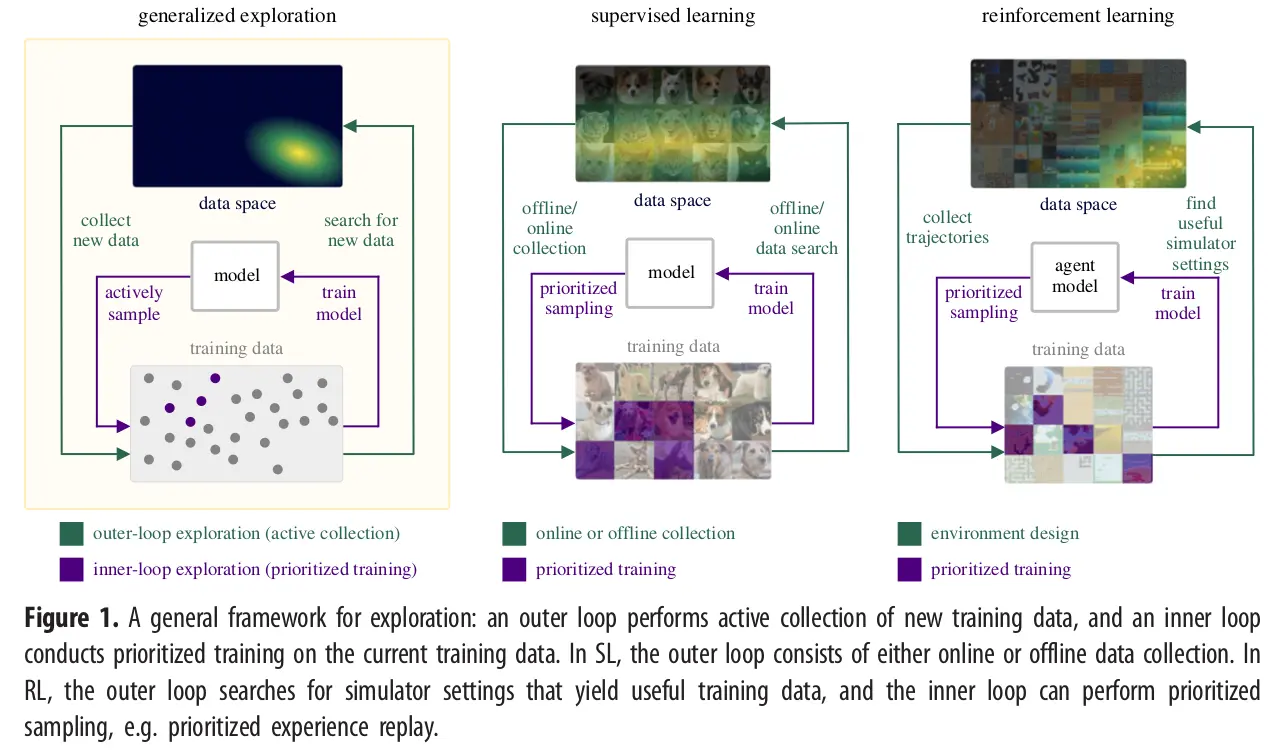
The problem afflicting both classes of learning algorithms reduces to one of insufficient exploration: SL, largely trapped in the offline regime, fails to perform any exploration, while RL, limited to exploring the interior of a static simulation, largely ignores the greater expanse of possibilities that the simulation cannot express.
We require a more general kind of exploration, which searches beyond the confines of a static data generator, such as a finite dataset or static simulator. This generalized form of exploration must deliberately and continually seek out promising data to expand the learning agent’s repertoire of capabilities. Such expansion necessarily entails searching outside of what can be sampled from a static data generator.
This open-ended exploration process, summarized in figure 1, defines a new data-seeking outer-loop that continually expands the data generator used by the inner loop learning process, which itself may use more limited forms of exploration to optimally sample from this data generator. Within each inner loop, the data generator is static, but as a whole, this open-ended exploration process defines a dynamic, adaptive search process that generates the data necessary for training a likewise open-ended learner that, over time, may attain increasingly general capabilities.
Link to originalunboundedness of the universe
A place where anything can be expressed (universal computation) is a place where anything can happen
Computation is a metaphor for expression, but expression happens through a medium. In our universe the medium is physical reality.
Invention: When anything is possible, every end is a beginning.
The easiest way here again is code, inventing tools.
Current RL: immutable environments. Actions are about attached conditional things (mario jumps), but invention changes the outer environment and leaves behind a detached artifact (mario crafts a sword).
→ Endless possibility of detached conditional things (language is one of them).
The API of earth (particles in the ground) sucks.
→ Koding koding koding?