I really like the first few paragraphs of https://near.blog/productivity-tips/
# Stop reading news Stop reading news. Especially politics. _Almost_ none of it is important. If something important politically were to happen, you are almost guaranteed to hear about it from someone regardless. A lot of very large actors and systems want you to be addicted to feeling constantly outraged and/or ‘informed’ about the details of what drama is currently happening, especially in the US. Obviously not all sources of news are equal, and I’m mainly just referencing some of the most popular websites people waste their time on and get upset at things from today; there are plenty of wonderful niche websites and communities that are good uses of your time instead. Learn to say no to more things. Think as carefully as you can about what things in your routine you actually derive enjoyment from, and which you just do because someone was able to instill the habit in you, and you have never analyzed it in-depth enough to realize it’s not worth continuing. # Don’t work against diminishing returns A lot of activities feature diminishing returns that scale with how often you perform them. Checking Twitter or Reddit for the first time in days might provide a lot of value to you, but once you start meticulously checking them over and over, the value decrease until it is near-zero. Consciously analyze when you’re stuck in a loop of something that you are getting less and less value out of, and replace that activity with a fresh one. It’s useful to have some prepared activities that you can spend small arbitrary amounts of time doing, often to fill in gaps between different parts of your day. Social media and other communication like email or instant messengers are commonly used during these periods. One good alternative I like is to use is to review cards in my anki deck, as it’s an activity that I can start and stop instantly, and still provides value even if I only do it for a few minutes. # Schedule intelligently All time is not created equally for most people. Sometimes you are tired, or stressed, or energetic. Analyze the patterns in your mood to best curate your activities to your moods. There’s usually a period halfway through my day when I’m low on energy, so that is my preferred time to relax and consume low-effort content like watching videos. Similarly, I usually have a lot of energy in the first few hours of the day, so that’s the best time for me to perform tasks that take a lot of discipline, like exercising, meditation, making phonecalls, sending emails, and so on. ## Time spent doing nothing is valuable Time off is valuable. Try going for a walk without your phone or setting a thirty minute period every day where you don’t use any electronics. These periods are some of the best times to think and learn about yourself, helping you set your future direction with clarity. It’s interesting how challenging spending 30 minutes alone with no electronics is when you first try it, despite it taking up only 3% of your waking hours that day. # Optimize your sleep Optimizing your sleep can be tricky, but luckily we have a lot of knowledge and tools that can help you if you’re having trouble. You should generally prioritize sleep over additional work in the long-term, as its benefits will outweigh the extra time that it consumes. ... Although difficult, it’s worth taking the time, energy, and money that it may take you to optimize your sleep. Anything I can do to make my sleeping environment quieter, darker, and often slightly cooler, has generally been an absurdly high ROI. Consider ear plugs, noise-canceling earphones such as Airpods Pro, a sleeping mask, various mats that you sleep on that will decrease the temperature of your bed and/or setting the thermostat lower, and devices like a Whoop if you think you may benefit from tracking your sleep in detail. I put a lot of effort into blacking out my bedroom and it’s always worth the time and money. Also worth noting that having more than 1-2 drinks shortly before bed, and eating shortly before bed, are usually not very good for your sleep. Melatonin is worth looking into for many, as well as sometimes some other options.
Figure out the quickest way to falsify hypotheses.
Starting something always has an entry / barrier cost.
And you kinda have to pay that every time you start. So focus on the thing (load it ihto your RAM) and then rlly do that.
Only ever compare yourself to yourself some time ago.
How to learn new things
Do not build them from scratch / go into miniscule details, trying to understand every bit.
→ Take a top down approach.
Use existing tools.
Get familiar with the concepts, write them down.
Talk about it / practice with others.
Get your hands dirty, practice.
How to master things
Build them from scratch.
Explain it to others (at different levels).
Essential learning routines / habits.
Read
Exercise
Write
Produce
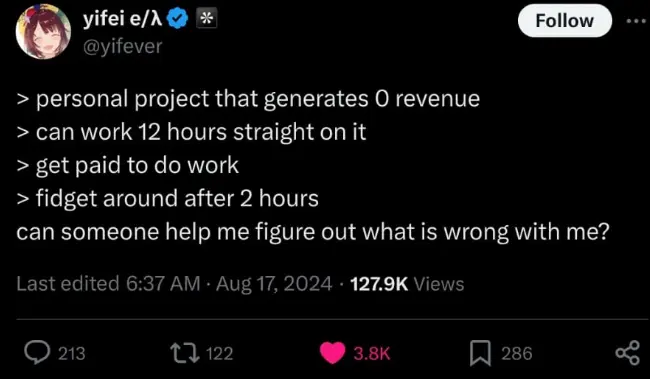
Don’t compete with somone in an area where it is play for them but work for you.
Capitalism’s mis-alignment with humans is a huge productivity loss.
Long story short: Capitalism intrinsically and obviously - for almost every working class person experiencing it every day - does not align our work with our intrinsic motivations.
On a personal note: If I work on something I am uninterested in / I don’t see the immediate purpose of, my productivity is laughably low, it turns into mostly procrastination.
On the contrary, when I just go with the flow of what I feel like doing in the moment, I am unstoppable. This is specific to my circumstances, as what I feel like doing (if I am well rested and fed and temperature is right and - big and - my addictions are supressed) aligns very much with my terminal goals. To an extreme, that if there are multiple things I could be working on that lead to my terminal goals, then if I pick one that I am less in the mood for over another, say for some arbitrary internal constraint I set myself, then it will end up in procrastination all the same.
References
Nice talk by Yannic: https://video.ethz.ch/events/2022/masterfeier_d-infk.html
Key takeaways from How Generalists Win In The Information Age.
The RAM thing comes from karpathy tweets I think.
